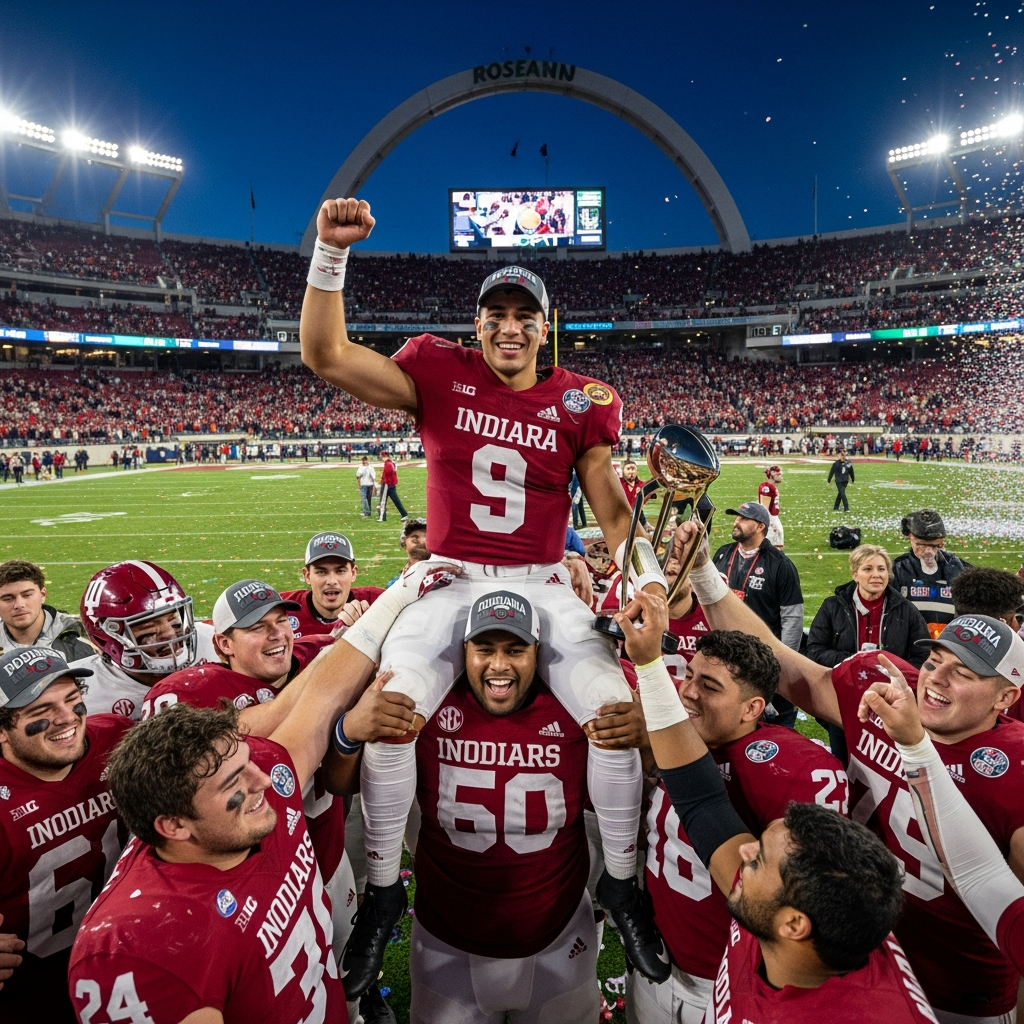
The 2026 Rose Bowl delivered an unforgettable spectacle as the top-seeded Indiana Hoosiers orchestrated a stunning 38-3 demolition of the Alabama Crimson Tide. This wasn’t just a victory; it was a program-defining moment for Indiana, marking their first Rose Bowl win ever and shattering Alabama’s postseason record with the most lopsided defeat in its storied history. Led by Heisman Trophy winner Fernando Mendoza, the Hoosiers powered through a dominant performance, earning their place in the College Football Playoff semifinals and signaling a seismic shift in college football’s elite landscape. This compelling win captivated audiences, proving Indiana’s meteoric rise is no fluke.
A Rose Bowl for the Ages: Indiana’s Historic Triumph
The Indiana Hoosiers arrived in Pasadena as the top seed and an undefeated powerhouse, a stark contrast to their historical reputation. What unfolded on New Year’s Day was nothing short of extraordinary. The Hoosiers dominated ninth-seeded Alabama 38-3 in a College Football Playoff quarterfinal, pushing their remarkable record to 14-0. This historic victory propelled them into the CFP semifinals, where they are set for a highly anticipated rematch against fifth-seeded Oregon in the Peach Bowl on January 9.
This monumental win signified Indiana’s first bowl victory since the 1991 Copper Bowl. It also marked their inaugural Rose Bowl triumph, a testament to Coach Curt Cignetti’s transformative two-season tenure. The Hoosiers remarkably became the first top-four seed to win a game in the newly expanded 12-team CFP. This broke a peculiar trend where previous bye teams, including fourth-seeded Texas Tech earlier the same day, had started 0-6 in the playoff.
Mendoza Magic and Offensive Dominance
Indiana’s Heisman Trophy-winning quarterback, Fernando Mendoza, showcased his elite talent in his first game since receiving college football’s most prestigious individual award. Mendoza was exceptionally efficient, completing 14 of 16 passes for 192 yards and throwing three touchdowns. His precision and composure were instrumental in dictating the game’s pace and outcome. The Hoosiers’ ground game was equally formidable, accumulating an impressive 215 rushing yards. This statistic alone highlighted Indiana’s offensive superiority, as it remarkably exceeded Alabama’s entire offensive output for the game.
Running backs Kaelon Black and Roman Hemby proved to be a dynamic duo. Black rushed for 99 yards, while Hemby added 89 yards, with both scoring crucial touchdowns early in the fourth quarter to cement Indiana’s commanding lead. Charlie Becker, Omar Cooper Jr., and Elijah Sarratt were Mendoza’s primary aerial targets, each hauling in a touchdown pass. This balanced attack kept Alabama’s defense constantly off-balance, contributing to the Hoosiers’ overwhelming 407 total yards compared to the Crimson Tide’s meager 193.
Cignetti’s Unprecedented Two-Season Turnaround
The Indiana program, historically associated with more losses than almost any other in college football, has undergone a breathtaking transformation under Coach Curt Cignetti. His leadership has ignited a “greatest turnaround in college football history,” a sentiment echoed by legendary coach Urban Meyer. After winning 11 games and reaching the CFP last season, the Hoosiers “steamrolled” through their schedule this fall. This included beating defending national champion Ohio State for the Big Ten title and ascending to the No. 1 spot in the AP Top 25 for the first time ever.
Under Cignetti, Indiana boasts an incredible 25-2 record, showcasing a consistent dominance that has surprised the college football world. This Rose Bowl victory isn’t just another win; it’s a profound statement of Indiana’s new identity as a legitimate national championship contender. Their ability to manage the extended layoff from a first-round bye, a challenge that tripped up other top-seeded teams, further underscored their readiness and discipline.
The Crimson Tide’s Unwanted Place in History
For the Alabama Crimson Tide, the 2026 Rose Bowl was a catastrophic conclusion to their season. The 38-3 defeat marked an unprecedented “debacle,” etching an unwanted record in their program’s storied history. This 35-point margin of defeat stands as Alabama’s worst ever in a bowl or postseason game. It significantly surpassed the previous record of a 32-point loss (38-6) to Nebraska in the 1972 Orange Bowl, which was a de facto national championship contest.
Furthermore, this loss represented Alabama’s most decisive defeat in over a quarter-century, a streak maintained through the tenures of Dennis Franchione, Mike Shula, and the legendary Nick Saban. The Crimson Tide had not been beaten by at least 35 points in any game since a 42-6 loss at Arkansas on September 27, 1998. The mere three points scored against Indiana also marked Alabama’s fewest in a bowl game in 66 years, narrowly avoiding their first postseason shutout since 1959. This game also extended a concerning trend, as it was Alabama’s third consecutive season ending with a bowl game loss, a pattern reminiscent of the late 1990s.
A Stifled Offense and Quarterback Struggles
Alabama’s offense was largely ineffective throughout the game, managing only 193 total yards. Quarterback Ty Simpson struggled significantly, completing 12 of 16 passes for a mere 67 yards before being replaced by backup Austin Mack in the third quarter. Simpson’s limited impact was evident, with only two completions exceeding eight yards. While Mack provided a brief spark, throwing for 103 yards on 11 of 16 passes and leading the drive that resulted in Alabama’s only points—a 28-yard field goal from Conor Talty late in the third quarter—it was far too little to contend with Indiana’s relentless attack.
The Crimson Tide’s inability to establish any offensive rhythm, coupled with crucial turnovers, highlighted a significant performance gap. This stagnant offensive showing left many questioning the program’s direction in Kalen DeBoer’s second season, which ended in the same venue as Nick Saban’s final season two years prior. The outcome puts immense pressure on the coaching staff to address fundamental issues before next season.
Key Moments That Defined the Rout
The game began with a rarity: a scoreless first quarter, the first in a Rose Bowl in 26 years. However, the equilibrium didn’t last long. Indiana quickly seized control in the second quarter, demonstrating their strategic prowess and superior execution.
Breaking the Early Stalemate
Indiana’s breakthrough came early in the second quarter. They capped an exhaustive 16-play, 84-yard drive that consumed nearly nine minutes with Nicolas Radicic’s 31-yard field goal, giving them an initial 3-0 lead. A pivotal moment followed when Alabama coach Kalen DeBoer’s aggressive decision to go for it on fourth-and-1 from their own 34-yard line backfired. Germie Barnard was stopped short by Indiana’s Isaiah Jones and Rolijah Hardy, handing the Hoosiers prime field position. Just five plays later, Mendoza capitalized, connecting with Charlie Becker for a 21-yard touchdown, extending Indiana’s lead to 10-0.
Halftime Momentum and Second-Half Surge
Late in the second quarter, Indiana defensive back D’Angelo Ponds delivered a critical hit on Alabama quarterback Ty Simpson, forcing a fumble that was recovered by Jones. Mendoza then led an 11-play, 58-yard touchdown drive, culminating in a 1-yard scoring pass to Omar Cooper with just 17 seconds left in the half. This crucial score sent the Hoosiers into halftime with a commanding 17-0 lead and significant momentum. The second half continued the onslaught, with Mendoza leading another sustained drive that concluded with a 24-yard touchdown pass to Elijah Sarratt, further solidifying Indiana’s dominance and extending the lead to 24-0.
Shifting Sands of the College Football Playoff
The expanded 12-team College Football Playoff format brought with it new dynamics, prominently featuring the struggles of teams coming off a first-round bye. Prior to Indiana’s win, six consecutive bye teams had been eliminated in the quarter-finals, often in lopsided fashion. The Hoosiers’ victory as the top seed became the first instance of a top-four seed successfully navigating this challenge, showcasing their exceptional preparation and focus.
The Expanded Playoff’s Early Drama
The Rose Bowl wasn’t the only CFP quarterfinal making headlines on January 1, 2026. Fifth-seeded Oregon secured a commanding 23-0 shutout victory over No. 4 Texas Tech in the Orange Bowl, further cementing the trend of bye teams struggling. Meanwhile, in a thrilling Sugar Bowl clash, No. 6 Ole Miss edged out No. 3 Georgia 39-34. These results solidified the “Last Four” teams in college football: Indiana, Oregon, Ole Miss, and Miami. Each of these matchups demonstrated the intense competition and unpredictability that the expanded playoff format promises, with Indiana emerging as a clear frontrunner.
Implications and What’s Next
For the Indiana Hoosiers, the path ahead is clear and filled with immense opportunity. They are now just two victories away from securing their first national championship in school history, a prospect that seemed unthinkable just a few seasons ago. Their semifinal rematch against Oregon in the Peach Bowl on January 9 promises another high-stakes battle, as Indiana previously defeated the Ducks 30-20 in Eugene earlier in the season. The Hoosiers’ sustained success under Cignetti has made them a compelling narrative and a true Cinderella story in the making.
Conversely, the Alabama Crimson Tide faces a period of introspection and strategic re-evaluation. Ending the season with an 11-4 record and a historic loss raises significant questions for Coach Kalen DeBoer and his program. The comprehensive nature of the defeat, particularly the offensive struggles and defensive lapses, will require a thorough analysis and potential adjustments. The Crimson Tide, accustomed to being at the pinnacle of college football, now confront the challenge of rebuilding momentum and reasserting their dominance in a rapidly evolving landscape.
Frequently Asked Questions
What historic records did Indiana set or break with their Rose Bowl victory over Alabama?
The Indiana Hoosiers achieved several monumental records with their 38-3 Rose Bowl win. This marked their first-ever Rose Bowl victory and their first bowl game win since the 1991 Copper Bowl. Additionally, Indiana, as the top seed, became the first team with a first-round bye to win a game in the newly expanded 12-team College Football Playoff. This broke a trend where the first six bye teams in the playoff format had been eliminated. This victory also represented a significant milestone in Coach Curt Cignetti’s two-season turnaround, culminating in a 25-2 record and their first AP Top 25 No. 1 ranking.
How does this dominant Rose Bowl win position Indiana for the rest of the College Football Playoff?
Indiana’s commanding 38-3 victory over Alabama propels them directly into the College Football Playoff semifinals. As a top-seeded team, they successfully navigated the challenge of an extended layoff from a first-round bye, a hurdle that tripped up other top teams. Their next challenge is a highly anticipated rematch against fifth-seeded Oregon in the Peach Bowl on January 9. A victory there would put the Hoosiers just one win away from their first-ever national championship, solidifying their status as a legitimate contender in college football’s elite.
What does the 38-3 Rose Bowl loss signify for the Alabama Crimson Tide program’s history?
The 38-3 Rose Bowl defeat against Indiana was an unprecedented “debacle” for the Alabama Crimson Tide. This 35-point margin of loss stands as the worst postseason defeat in the program’s entire history, surpassing a 32-point loss in the 1972 Orange Bowl. It also marked Alabama’s biggest margin of defeat in any game since 1998. Furthermore, the Crimson Tide scored only three points, their fewest in a bowl game in 66 years, narrowly avoiding their first postseason shutout since 1959. This loss also meant Alabama ended their season with a bowl game defeat for the third consecutive year.