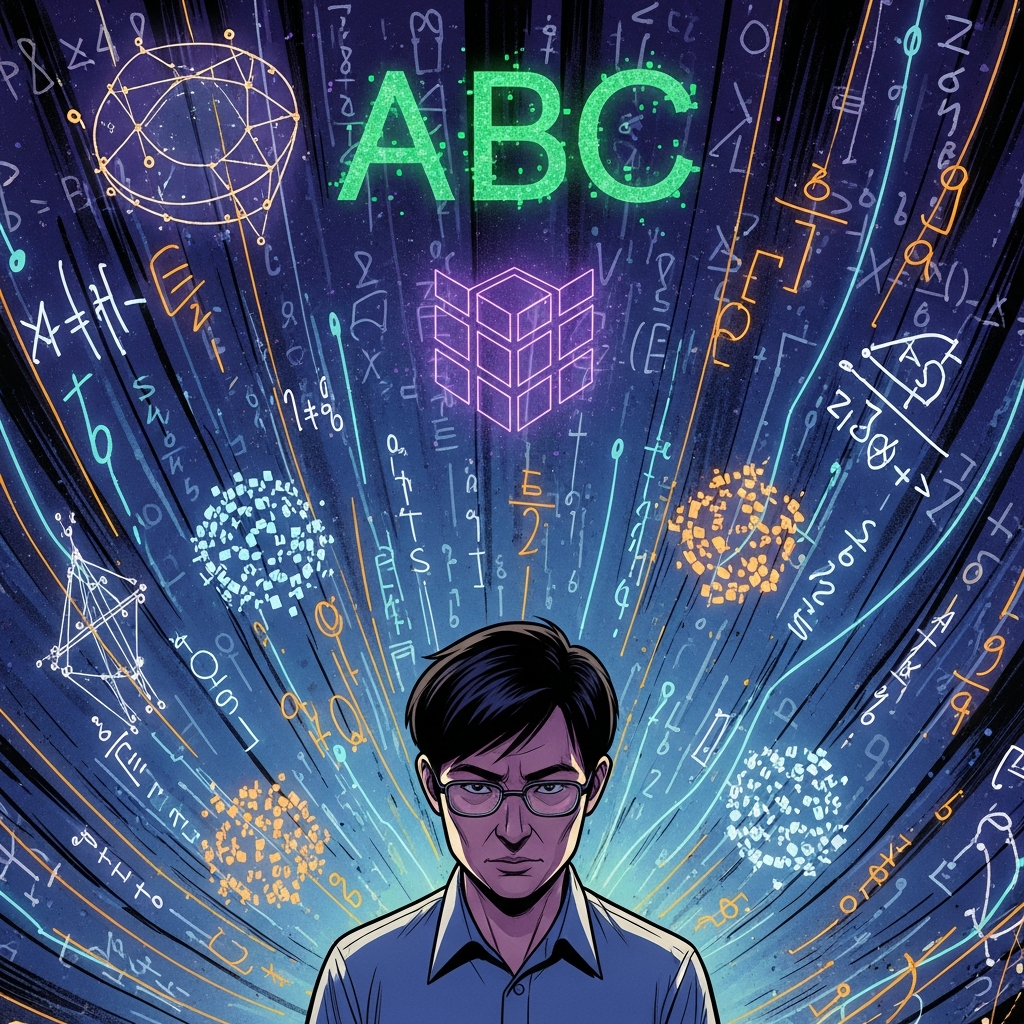
The world of mathematics, often perceived as a realm of absolute certainty, is currently gripped by a decade-long intellectual battle. At its core is the abc conjecture, one of number theory’s most profound unsolved problems, and a groundbreaking, yet fiercely debated, proof put forth by Japanese mathematician Shinichi Mochizuki. Now, a new chapter in this complex saga is unfolding, proposing a digital solution to an intensely human dispute. This article delves into the heart of the abc conjecture controversy, exploring its origins, the pivotal players, and the groundbreaking proposal to use computer verification to finally bring clarity to this mathematical enigma.
Unraveling the ABC Conjecture: A Foundation of Number Theory
For over four decades, the abc conjecture has captivated mathematicians. Proposed as a fundamental relationship between prime numbers, it centers on three positive integers, a, b, and c, linked by the simple equation a + b = c. The conjecture posits that if you take the product of all distinct prime factors of a, b, and c (known as the radical, rad(abc)), this product typically exceeds c.
Consider the example: 12 + 21 = 33. The distinct prime factors are 2 (from 12), 3 (from 12, 21, 33), 7 (from 21), and 11 (from 33). Multiplying these gives 2 3 7 11 = 462. Here, 462 is significantly larger than 33. While there are exceptions, the conjecture suggests this relationship holds true in most cases, particularly for “square-free” numbers.
Why the ABC Conjecture Matters So Much
The significance of the abc conjecture extends far beyond its elegant simplicity. Proving it would unlock solutions to several other long-standing mathematical mysteries. Most notably, it offers a potentially simpler pathway to confirming Fermat’s Last Theorem, a problem that famously eluded mathematicians for centuries before Andrew Wiles delivered a complex proof in the 1990s. The profound implications of the abc conjecture for number theory spurred intense excitement when Shinichi Mochizuki first announced his proof.
Mochizuki’s Grand Vision: Inter-universal Teichmüller Theory
In 2012, Shinichi Mochizuki of Kyoto University ignited the current debate. He claimed to have proven the abc conjecture through a sprawling, 500-page work based on his entirely novel “Inter-universal Teichmüller (IUT) theory.” Mochizuki’s IUT theory is a revolutionary, yet incredibly abstract, framework. It conceptualizes numbers as entities that move across various “mathematical universes,” undergoing alterations and reconstructions to yield fresh insights into their relationships.
The Inaccessibility of IUT
Despite the potential magnitude of Mochizuki’s achievement, his proof remained largely inaccessible. The extreme complexity and highly specialized language of IUT theory meant that only a handful of mathematicians, primarily within Mochizuki’s immediate circle in Kyoto, claimed to fully grasp it. This lack of broad understanding led to widespread international confusion and increasing frustration within the mathematical community. Early attempts to verify the proof stalled, leading Mochizuki to express dismay at what he perceived as insufficient effort from his peers.
The Storm Breaks: Scholze, Stix, and the “Critical Flaw”
The abc conjecture controversy reached a flashpoint in 2018. Two highly respected German mathematicians, Peter Scholze of the University of Bonn and Jakob Stix of Goethe University Frankfurt, traveled to Tokyo. Their mission was to critically review Mochizuki’s proof firsthand. Following their detailed analysis, Scholze and Stix publicly declared they had identified a “critical flaw.” They specifically pointed to “Corollary 3.12” within the proof, arguing it contained an unsupported logical leap.
Mochizuki and his supporters vehemently rejected this critique, maintaining the proof was entirely sound. The mathematical world subsequently fractured into two distinct camps: a majority, largely skeptical of the proof’s validity, and a smaller, staunch group connected to Mochizuki’s institute, who supported it. Adding another layer of contention, Mochizuki’s papers were officially published in 2021 in Publications of the Research Institute for Mathematical Sciences, a journal where he himself holds the position of editor-in-chief, further fueling the dispute.
A Third Voice: Kirti Joshi’s Proposed “Fix”
The academic dispute deepened with the intervention of Kirti Joshi, a mathematician from the University of Arizona. Joshi put forth a nuanced perspective, suggesting that both Mochizuki and Scholze/Stix were partially incorrect. While acknowledging the potential value of Mochizuki’s IUT theory, Joshi argued it was incomplete. He contended that Mochizuki failed to properly define certain critical structures, particularly “arithmetic holomorphic structures.”
Joshi proposed an “improved version” of IUT theory, asserting that his enhancements filled these gaps and thereby “fixed” the disputed Corollary 3.12. In a recent paper titled “Final Report on the Mochizuki-Scholze-Stix Controversy,” Joshi concluded that the critique by Scholze and Stix was “mathematically false” and boldly asserted that the abc conjecture is indeed proven, provided his modifications are accepted. However, Mochizuki did not welcome Joshi’s proposed corrections, dismissing them as “profoundly misguided.” This complex interplay of criticisms and counter-criticisms has created “two competing realities” within mathematics, making reconciliation seem increasingly distant.
The Digital Lifeline: Formalizing IUT in Lean
To break this protracted impasse, Mochizuki has now proposed a radical new solution: computer verification. He plans to translate his intricate proof from human-readable mathematical notation into Lean. Lean is a sophisticated programming language designed specifically for automatic computer verification of mathematical proofs. This process, known as formalization, represents an emerging field with the potential to revolutionize mathematical practice. While formalization of Mochizuki’s work has been suggested previously, this marks his first explicit commitment to the endeavor.
Mochizuki, in a recent report, articulated his strong belief that Lean is uniquely suited to resolve the kind of disagreements that have hindered his proof’s acceptance. He describes Lean as “the best and perhaps the only technology… for achieving meaningful progress with regard to the fundamental goal of liberating mathematical truth from the yoke of social and political dynamics.” His conviction in formalization’s merits deepened after attending a Lean conference in Tokyo, where he witnessed its capability to manage the complex mathematical structures integral to his IUT theory.
Experts in the field view this as a promising development. Kevin Buzzard of Imperial College London believes formalizing the proof in Lean would establish its well-defined nature, directly addressing concerns about the “strange language” used in the original papers. Johan Commelin of Utrecht University emphasizes the urgent need for clarity, stating, “We want to understand the why [of IUT], and we’ve been waiting for that for more than 10 years,” adding that Lean could finally provide those answers.
Herculean Challenges and Lingering Doubts
Despite the optimism, formalizing IUT theory presents immense challenges. Both Buzzard and Commelin describe it as a “mammoth undertaking.” It will require the meticulous translation of vast quantities of existing mathematical equations into Lean code. This project is comparable in scale to the largest formalization efforts ever completed, demanding years of collaborative work from teams of expert mathematicians and Lean programmers. The daunting nature of such a task might deter the limited number of qualified individuals from dedicating their time to a project that could still ultimately fail.
Even if successfully formalized and found free of contradictions by the Lean software, concerns remain. Commelin notes that disagreements could still arise over the interpretation of the code’s meaning, potentially involving Mochizuki himself. Mochizuki acknowledges this limitation, writing that Lean “does not appear at the present time to constitute any of sort of ‘magical cure’ for the complete resolution of social and political issues.” Commelin further stresses that the ultimate resolution hinges on Mochizuki’s unwavering commitment to the formalization process, warning that a withdrawal could simply perpetuate the “social problem” at the heart of the abc conjecture controversy. Nevertheless, Buzzard remains hopeful that successful formalization could, at minimum, advance the protracted debate, particularly if Mochizuki achieves his goal, as “You can’t argue with the software.”
Beyond the Numbers: The Human Element in Mathematics
The abc conjecture controversy profoundly illustrates how mathematics, often considered the purest form of objective reasoning, is deeply human. This bitter dispute, initially an academic pursuit, has morphed into a drama characterized by cultural misunderstandings, entrenched positions, and human factors such as ego and communication failures. It challenges the common perception of mathematics as universally certain and free from conflict, demonstrating that even in the most logical of fields, human emotions can profoundly influence outcomes and create loud disagreements. The quest for truth is rarely straightforward.
Frequently Asked Questions
What is the core concept of the abc conjecture and why is it considered so important in number theory?
The abc conjecture proposes a fundamental relationship between prime numbers involved in the equation a + b = c, where a, b, and c are positive integers. It suggests that the product of their distinct prime factors (the radical, rad(abc)) usually exceeds c*. This conjecture is immensely important because a proven solution would unlock simpler proofs for other major mathematical problems, including Fermat’s Last Theorem, thus advancing our understanding of number theory significantly.
Where did the main controversy surrounding Shinichi Mochizuki’s IUT proof initially gain widespread attention?
The main controversy surrounding Shinichi Mochizuki’s proof of the abc conjecture escalated dramatically in 2018 when prominent German mathematicians Peter Scholze and Jakob Stix traveled to Kyoto University to review it. Following their visit, they publicly identified a “critical flaw,” specifically in “Corollary 3.12.” This critique, and Mochizuki’s subsequent rejection of it, fractured the mathematical community and brought the long-simmering dispute into the global spotlight.
How might the proposed formalization of IUT theory using the Lean programming language impact the future validation of complex mathematical proofs?
The proposed formalization of IUT theory into the Lean programming language could revolutionize the validation of complex mathematical proofs. If successful, it would provide a definitive, machine-checked verification of Mochizuki’s work, removing human bias and potential for interpretive disagreements. This effort, though daunting, could establish a new standard for mathematical rigor, demonstrating the power of computer-assisted proof checking to resolve intractable academic disputes and ensure absolute certainty in foundational mathematical claims for future generations.
The abc conjecture controversy serves as a fascinating case study in the intersection of mathematical rigor, human nature, and technological innovation. As the mathematical community awaits the outcome of Mochizuki’s bold venture into formalization, the hope remains that a definitive, computer-verified resolution could finally emerge. This would not only settle a decade-long debate but also potentially usher in a new era for how fundamental mathematical truths are established and universally accepted. The quest for mathematical certainty continues, perhaps now, with the assistance of algorithms and code.