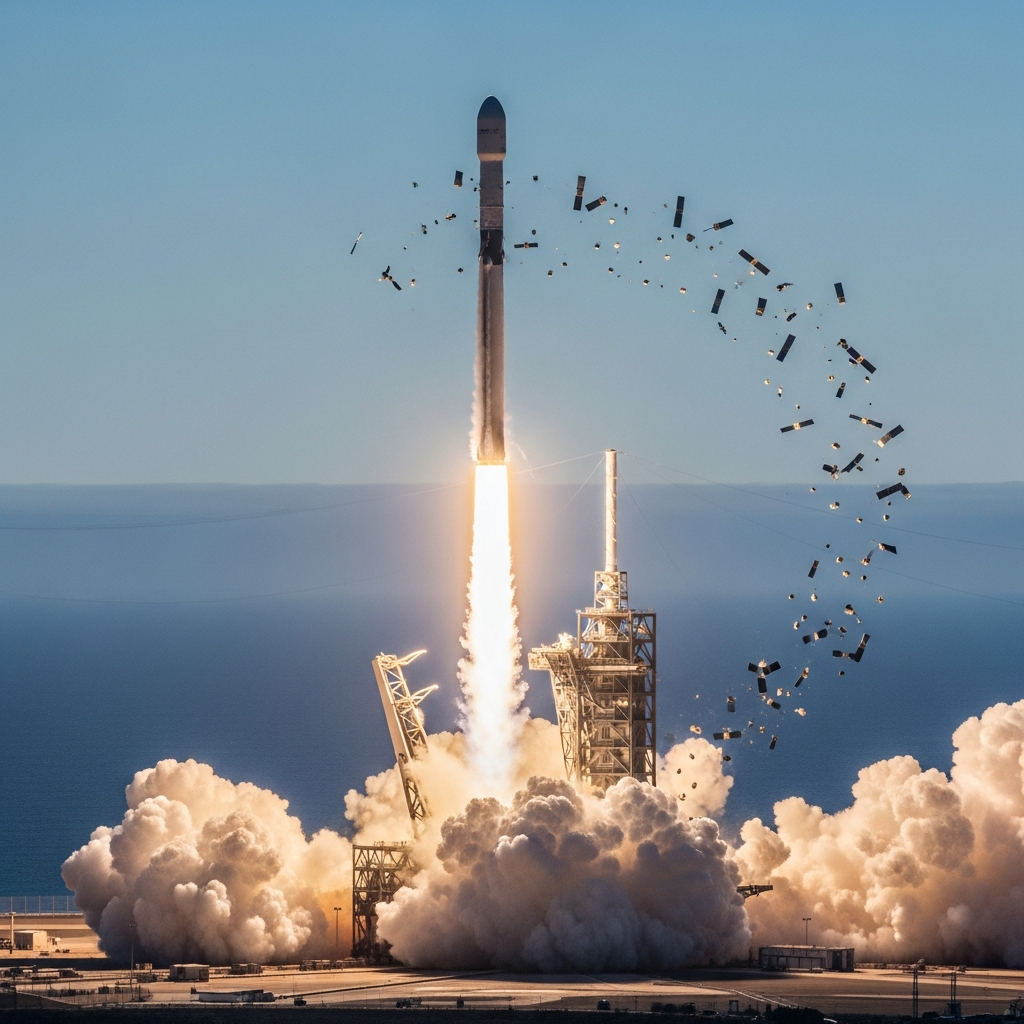
On November 28, 2025, SpaceX achieved another remarkable feat with the successful launch of its Transporter-15 mission. This Falcon 9 rideshare flight delivered an astounding 140 commercial and government payloads into sun-synchronous orbit. The mission also celebrated a major reusability milestone, as Falcon 9 first stage booster B1071 completed its incredible 30th journey to space. This pivotal launch from Vandenberg Space Force Base underscored SpaceX’s commitment to democratizing access to orbit for a diverse array of small satellites.
Mission Overview: A Milestone Launch for Commercial Space
SpaceX’s Transporter-15, the 19th mission in its Smallsat Rideshare program, lifted off successfully at 10:44 a.m. PST (1:44 p.m. EST / 18:44 UTC) from Space Launch Complex 4 East (SLC-4E) at Vandenberg Space Force Base. This achievement followed an earlier scrub two days prior, caused by a “ground systems issue” during liquid oxygen loading. The Falcon 9 rocket soared on a southerly trajectory, carrying its record-setting payload into orbit.
The Journey to Orbit: Precision and Power
The deployment sequence for the 140 satellites was a meticulously planned process. It commenced approximately 54 minutes after liftoff with the release of the Toro2 spacecraft. The Falcon 9’s second stage performed a total of five burns to ensure each payload reached its precise inclination. The entire deployment concluded nearly two hours later, delivering all intended payloads, including NASA’s Realizing Rapid, Reduced-cost high-Risk Research (R5) CubeSat, into their designated orbits.
Falcon 9’s Unprecedented Reusability: Booster B1071’s 30th Flight
A true testament to SpaceX’s engineering prowess was the veteran Falcon 9 first stage booster B1071. This mission marked its astounding 30th flight, making it only the second booster in SpaceX’s history to achieve this significant milestone. Booster B1071 boasts a distinguished service record, having supported 18 Starlink launches, five National Reconnaissance Office missions, four previous rideshare flights, and NASA’s Surface Water and Ocean Topography (SWOT) mission. Approximately 8.5 minutes after launch, B1071 executed a flawless autonomous landing on the droneship ‘Of Course I Still Love You’ (OCISLY) in the Pacific Ocean. This landing was the 165th for OCISLY and SpaceX’s 540th overall booster recovery. The mission also saw the reflight of a payload fairing, further cementing SpaceX’s dedication to reusability.
Democratizing Space: The Power of Rideshare Missions
Transporter missions are invaluable for the burgeoning small satellite industry. They provide a cost-effective pathway to space for a multitude of commercial, academic, and government entities.
Economic Access: Transforming Satellite Deployment
The economic benefits of the Falcon 9 rideshare program are profound. A dedicated Falcon 9 launch costs approximately $69.85 million. In stark contrast, companies can launch payloads weighing up to 50 kg for just $325,000 on a rideshare mission. This dramatic reduction in cost allows startups, universities, and smaller nations to access space, fostering innovation and global participation in space exploration and technology development. SpaceX’s Transporter-15, as the 157th mission of the year, exemplifies the company’s accelerating launch cadence.
Diverse Manifest: A Global Array of Payloads
The 140 payloads on Transporter-15 represented a truly global endeavor. They included a diverse assortment of CubeSats, microsats, and hosted payloads from over 30 commercial and government customers across 16 countries. Beyond the initial 140, orbital transfer vehicles included in the manifest possess the capability to deploy an additional 13 spacecraft at a later stage, extending the mission’s reach even further. This mission highlights the complex logistical coordination required for such large-scale multi-payload deployments.
Key Integrators and Groundbreaking Payloads
Several mission managers played crucial roles in integrating and deploying the numerous spacecraft. Each brought unique technologies and missions to the Transporter-15 flight.
Exolaunch: Leading the Charge with 59 Satellites
German aerospace company Exolaunch managed an impressive 59 payloads, marking its largest single rideshare deployment to date. Exolaunch has been a consistent partner on every SpaceX Transporter mission, having deployed 595 satellites across 39 missions using various launch vehicles.
Eye on Earth: ICEYE SAR and HYDROGNNS-1
Among Exolaunch’s manifest were five ICEYE synthetic aperture radar (SAR) satellites. These advanced Earth observation satellites can penetrate all weather conditions and provide imagery at any time of day, serving vital purposes like environmental monitoring. Also critical was HYDROGNSS-1, a European Space Agency (ESA) payload built by Surrey Satellite Technology Ltd. This twin microsatellite, part of ESA’s first Scout mission, focuses on studying Essential Climate Variables such as soil moisture and above-ground biomass, crucial for understanding Earth’s water cycle.
Taiwan’s Space Ambitions: TASA Cubesats and Formosat-8A
Exolaunch also facilitated the launch of three homegrown 8U CubeSats for the Taiwanese Space Agency (TASA), developed with commercial partners to boost Taiwan’s commercial space industry. These included Black Kite-1 (IoT remote-sensing), Bellbird-1 (testing Ka-band high-speed communications), and TORO-8U-1 (ocean color remote sensing). Additionally, TASA’s own Formosat-8A satellite was the uppermost payload in the stack, designed for high-resolution optical remote sensing as the first of eight planned Earth observation satellites.
Planet Labs: Expanding Earth Imaging Capabilities
San Francisco-based Earth imaging company Planet Labs launched 36 SuperDove satellites (Flock 4H). These 3U, 5kg spacecraft provide medium-resolution imagery at three meters per pixel, ideal for daily global land monitoring. Furthermore, Planet Labs deployed two larger Pelican constellation spacecraft (Pelican 5 and 6), weighing 200 kg each, which offer much higher resolution imagery at 30 cm per pixel for capturing fleeting events.
Impulse Space: Innovating In-Orbit Services with Mira Tug
Impulse Space’s Leo-Express 3 mission utilized an upgraded Mira space tug, featuring enhanced propulsion and deployable solar arrays. The Mira tug hosted Heo Space’s Holmes MK2 NEI Camera for high-resolution imaging of other spacecraft, and Samara Aerospace’s Multifunctional Structures for Attitude Control (MSAC), demonstrating advanced spacecraft orientation and steering.
Varda Space Industries: Pioneering In-Space Manufacturing
Varda Space Industries launched its Winnebago-5 (W-5) reentry capsule. This capsule is designed to process pharmaceuticals in microgravity. Its heat shield, made from NASA-developed C-PICA (a variant, PICA-X, is used on SpaceX’s Crew Dragon), protected it during its Mach 25 (28,000 km/h) reentry.
SEOPS: Tailored Integration for Unique Missions
Launch integrator SEOPS deployed 11 spacecraft on Transporter-15, utilizing its Equalizer Flex, Ghost Trap Deployer, and Keystone Separation System. CEO Chad Brinkley highlighted their ability to tailor integration for unique payloads.
Stargazing and Solar Science: Mauve and 3UCubed-A
Key SEOPS payloads included the 16U Mauve spectrograph from UK startup Blue Skies Space. Mauve will be the first commercial spectrograph in orbit, using a 13 cm telescope to study stars and exoplanet habitability. Also notable was 3UCubed-A, a student-led CubeSat from the University of New Hampshire, Sonoma State University, and Howard University, funded by NASA’s Heliophysics Division to measure solar winds and particle precipitation.
Global Contributions: Hunity and Saudi Satellites
SEOPS also manifested Hunity from Hungary’s BME, which hosts instruments from university and high school students. Two satellites, Sari-1 and Sari-2, from the Saudi Space Agency, will carry imaging and real-time telemetry equipment. Other payloads included Alba Orbital’s Hunity/NMMH-1, ANISCSAT (Azerbaijan), CS3’s WISDOM (collision avoidance), SatRev’s PW-6U (Earth-imaging), and TRYAD-1 and 2 (lightning observation).
Umbra: High-Resolution Radar Imaging
Santa Barbara-based Umbra, known for its advanced radar-imaging systems, deployed its Umbra-11 satellite on Transporter-15. This mission further expands Umbra’s constellation of high-resolution Synthetic Aperture Radar (SAR) satellites.
Supporting the Network: Leaf Space Ground Station Connectivity
Leaf Space, a provider of ground segment services, played a crucial role by supporting approximately 30% of the launch’s total spacecraft. They added 31 of Transporter-15’s payloads to their Leaf Line ground station network, further expanding their infrastructure for tracking and telemetry data.
The Reentry Spectacle: Sonic Booms Along the Coast
Following the successful launch and booster recovery, officials and SpaceX issued warnings to residents along California’s Central Coast. Communities in Santa Barbara, San Luis Obispo, and Ventura counties were advised that they might hear one or more audible sonic booms during the rocket’s ascent. The experience of these sonic events depended on various factors, including prevailing weather conditions.
Frequently Asked Questions
What made the SpaceX Transporter-15 mission particularly significant for the space industry?
The SpaceX Transporter-15 mission was highly significant for several reasons. It successfully deployed a massive 140 payloads, showcasing SpaceX’s capability for large-scale rideshare operations. Crucially, it marked the 30th flight for Falcon 9 booster B1071, an unprecedented reusability milestone. The mission reinforced the Transporter program’s role in providing incredibly cost-effective access to orbit for a diverse range of global customers, democratizing space for startups, governments, and educational institutions alike.
Which key payloads were launched on Transporter-15 and what are their primary objectives?
Transporter-15 carried a wide array of payloads. Notable ones included five ICEYE synthetic aperture radar (SAR) satellites for all-weather Earth observation, and ESA’s HYDROGNNS-1 for studying Earth’s water cycle. Taiwan launched several satellites, including Formosat-8A for optical remote sensing, and CubeSats for IoT communications and ocean health monitoring. Planet Labs deployed 36 SuperDoves for daily land imaging and two high-resolution Pelican satellites. Other payloads featured Varda Space Industries’ capsule for microgravity manufacturing and Blue Skies Space’s Mauve spectrograph for astronomical research.
How does SpaceX’s rideshare program like Transporter-15 benefit small satellite companies?
SpaceX’s rideshare program, exemplified by Transporter-15, dramatically lowers the cost barrier for small satellite companies. A dedicated Falcon 9 launch costs nearly $70 million, but rideshare missions allow companies to send payloads up to 50 kg for a mere $325,000. This affordability makes space access feasible for a much broader range of organizations, fostering innovation, accelerating satellite development, and enabling more frequent missions for Earth observation, communications, and scientific research.
Conclusion: Shaping the Future of Space Access
The Transporter-15 mission stands as a powerful testament to SpaceX’s relentless innovation and its transformative impact on the global space industry. By consistently pushing the boundaries of rocket reusability and offering unparalleled cost-effective access to orbit, SpaceX is not just launching satellites; it is actively shaping the future of space exploration and commercial enterprise. The successful deployment of 140 diverse payloads, coupled with the historic 30th flight of booster B1071, solidifies Transporter-15’s place as a landmark achievement, heralding an era where space is increasingly accessible for all.