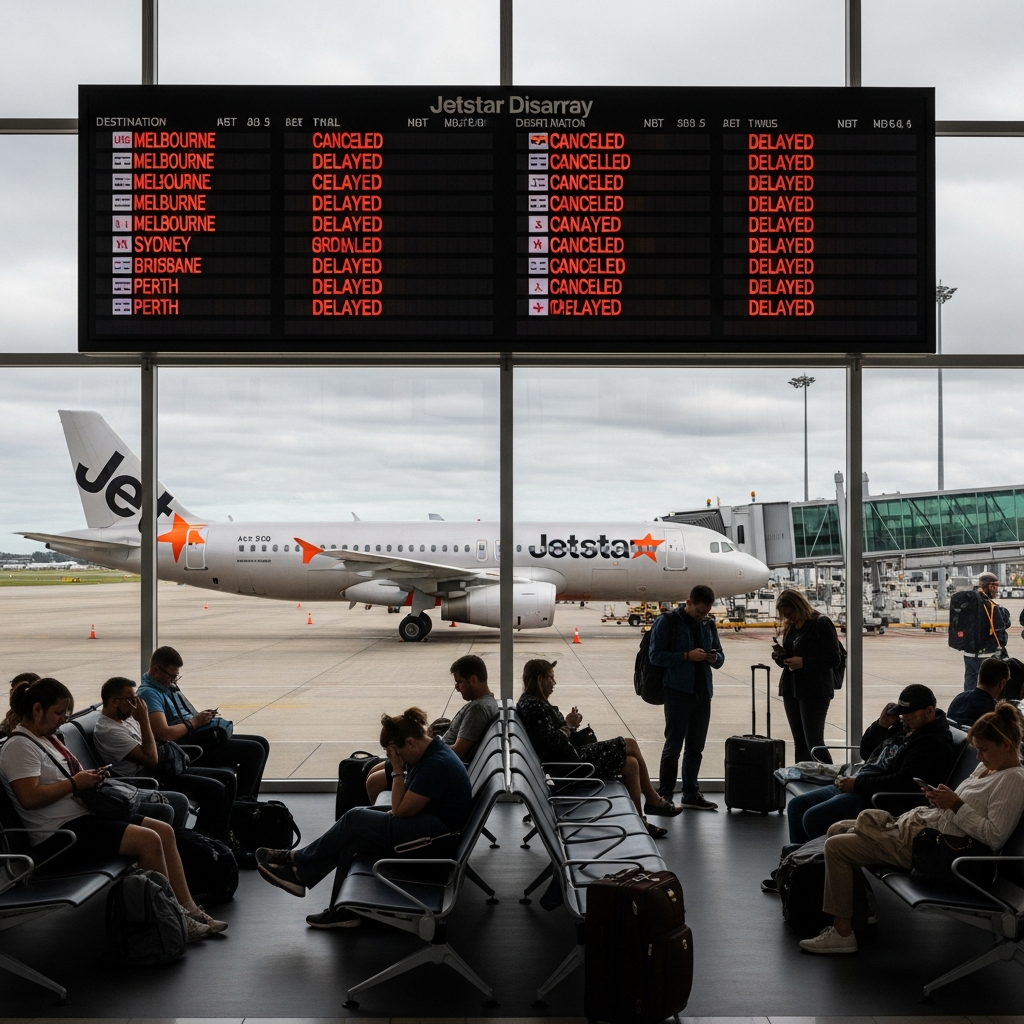
Australia’s domestic air travel faces significant disruption as Jetstar grounds a portion of its fleet following a global recall of Airbus A320 family aircraft. This urgent safety measure, triggered by a critical software vulnerability, has led to widespread flight cancellations and delays across the country. Passengers flying with Jetstar are experiencing the most severe impact, while other airlines like Qantas and Virgin Australia report minimal or no disruption. The issue highlights the complex interplay between advanced aircraft technology and environmental factors, prompting an industry-wide push for immediate software upgrades to ensure continued flight safety.
Jetstar, a key player in Australia’s low-cost domestic market, confirmed it is the airline most heavily affected. The carrier immediately grounded some of its Airbus A320s. This precautionary action has resulted in numerous cancelled flights across major routes. Jetstar emphasized that passenger safety remains its paramount concern. Its teams are actively working to rebook customers and provide direct communication to those impacted. Airports in Sydney, Melbourne, and Adelaide reported scenes of confusion as travelers grappled with unexpected changes to their plans.
The Core Issue: Global Airbus A320 Software Recall
Airbus, the European aerospace giant, issued a global recall for a “significant number” of its popular A320 family aircraft. This order mandates an immediate software change across the affected fleet. The A320 is a narrow-body plane widely used by airlines worldwide, including several in Australia and New Zealand. This unprecedented recall is one of the largest in Airbus’s 55-year history. It impacts approximately 11,300 A320-family jets currently in operation globally.
The October 30 Incident: A Precautionary Trigger
The global recall stems from a serious mid-air incident on October 30. A JetBlue flight, an A320, traveling from Cancún, Mexico, to Newark, New Jersey, experienced a sudden and “uncommanded and limited pitch down event.” This abrupt drop in altitude caused injuries to several passengers and necessitated an emergency landing in Tampa, Florida. The European Union Aviation Safety Agency (EASA), the primary certifying authority for A320 aircraft, described the event in its recall notice. EASA warned that if left uncorrected, such an issue could lead to “uncommanded elevator movement that may result in exceeding the aircraft’s structural capability.” This underscores a critical and potentially catastrophic safety concern.
Solar Radiation: Unmasking a Critical Vulnerability
Investigations revealed the root cause: intense solar radiation. Airbus determined that this radiation could corrupt data critical to the functioning of flight controls. Specifically, the problem was traced to the Elevator and Aileron Computer (ELAC) system. The ELAC transmits commands from the pilot’s side-stick to the elevators, which control the aircraft’s pitch. Airbus acted proactively by collaborating with aviation authorities. They issued an Alert Operators Transmission (AOT). This transmission requested immediate precautionary action from operators. It mandates the implementation of available software and/or hardware protection to ensure the fleet remains safe to fly.
Australian Airlines Face Varied Disruptions
While the recall is global, its impact varies significantly among Australian and New Zealand carriers. Jetstar has undoubtedly borne the brunt of the immediate operational challenges. The airline’s large fleet of 56 A320s means a greater proportion requires the software update. Jetstar reported immediate groundings and cancellations for domestic services. Routes from Sydney to Victoria’s Tullamarine and Avalon airports, Adelaide, Perth, and Hobart were among those affected. The airline confirmed it is directly contacting all affected customers. It also advises passengers to monitor its official channels for the latest flight information and rebooking options.
Qantas and Virgin Australia’s Limited Exposure
Other major Australian airlines appear largely unaffected by the recall. Qantas, despite owning planes in the A320 family, stated that none of its fleet required the urgent software upgrade. This meant all Qantas flights and aircraft continued to operate as scheduled. Similarly, Virgin Australia, which utilizes four A320-class planes for its Western Australian regional service, anticipated minimal disruption. The airline indicated that its existing Boeing 737 fleet capacity could cover any small number of flights typically handled by the A320s. This strategic advantage allowed Virgin Australia to mitigate the recall’s impact effectively.
Air New Zealand’s Cross-Tasman Challenge
Across the Tasman, Air New Zealand also operates A320 aircraft within its domestic and international network. The airline reported cancelling 12 services on a Saturday. It further anticipated “some further disruption today.” However, all its services operating between New Zealand and Australia continued without interruption. Nathan McGraw, Air New Zealand’s chief safety and risk officer, clarified the situation. He stated that this is a “precautionary software update.” He reassured the public that it “does not present an immediate safety risk to our flights.” Customers traveling with Air New Zealand were advised to regularly check the airline’s app or website for real-time updates.
A Global Aviation Industry Challenge
The sheer scale of this Airbus A320 recall underscores a massive operational challenge for the global aviation industry. Globally, approximately 3,000 A320-family jets were actively in the air when Airbus announced the precautionary measure. Major international carriers are also wrestling with the implications. American Airlines, the world’s largest A320 operator, expects to fix about 340 of its 480 A320s. Most of these repairs are anticipated to be completed within a single day. However, some airlines face more prolonged disruptions.
The Repair Process and Lingering Disruptions
The complexity of the repairs varies across the affected fleet. For about two-thirds of the aircraft, a relatively brief software fix is sufficient. This process involves reverting to an earlier, stable software version and takes approximately two hours per plane. However, other aircraft may face longer groundings if hardware changes are deemed necessary alongside the software update. Griffith University professor and former pilot, Sidney Dekker, described the software update as “fairly simple.” Yet, he highlighted potential delays arising from the need for specialized expertise. A global shortage of aviation maintenance engineers could further exacerbate these issues. Dekker predicted the problem would “reverberate for a couple of weeks worldwide” and cause “a lot of disruptions.” This suggests passengers should prepare for potential lingering effects beyond the immediate cancellations.
What This Means for Travelers: Your Next Steps
For passengers planning travel in the coming days, proactive measures are essential. If you are flying with Jetstar or other potentially impacted airlines operating A320 aircraft, you must verify your flight status. Always check directly with your airline via their official website or app before heading to the airport. Affected customers should have received direct contact from their airline regarding rebooking options or compensation. Familiarize yourself with your passenger rights in case of flight cancellations. Maintaining open communication with your carrier is crucial during periods of unforeseen disruption.
Regulatory Oversight and Future Safety
Regulatory bodies are playing a critical role in overseeing the recall and ensuring compliance. Australia’s Civil Aviation Safety Authority (CASA) confirmed its awareness of the issue. CASA stated that all affected aircraft must undergo checks in accordance with directives from Airbus and EASA. Such proactive measures by authorities instill confidence in the swift action taken by major airlines to minimize disruptions while upholding stringent safety standards. This incident reinforces the critical importance of software integrity in modern aviation. The A320, which recently surpassed the Boeing 737 as the most-delivered model, utilizes advanced fly-by-wire computer controls. The recall draws parallels to the lengthy worldwide grounding of the Boeing 737 MAX. That earlier incident was also linked to faulty flight-control software. These events underscore the continuous need for rigorous safety protocols and rapid technological responses to maintain aviation safety amidst complex systems and environmental challenges.
Frequently Asked Questions
What caused the global Airbus A320 software recall and subsequent flight disruptions?
The global Airbus A320 recall was triggered by a mid-air incident on October 30 involving a JetBlue flight that experienced a sudden pitch down. Investigations revealed that intense solar radiation could corrupt data vital to the aircraft’s Elevator and Aileron Computer (ELAC) system, which controls flight pitch. This software glitch posed a critical safety risk, prompting Airbus to order an immediate, precautionary software upgrade across a significant portion of its A320 family fleet to ensure aircraft safety.
Which airlines in Australia and New Zealand are most affected by the A320 grounding, and what should passengers do?
Jetstar is the most significantly affected airline in Australia, experiencing numerous domestic flight cancellations and groundings. Air New Zealand also reported some flight disruptions and cancellations, primarily on domestic routes, though its Australia-New Zealand services remained operational. Qantas and Virgin Australia reported minimal to no impact. Passengers should immediately check their flight status directly with their airline via official websites or apps. Affected Jetstar customers are being contacted directly regarding rebooking options.
How significant is this Airbus A320 recall for the aviation industry, and what are the long-term implications?
This recall is one of the largest in Airbus’s history, impacting thousands of its bestselling A320 family jets globally. It highlights the critical importance of software integrity and responsiveness to environmental factors like solar radiation in modern aviation. While most repairs involve a relatively quick software fix, the incident could lead to extended disruptions due to the scale and potential need for specialized maintenance. It underscores the ongoing challenges in maintaining complex aircraft systems and reinforces the need for rigorous safety protocols, similar to lessons learned from the Boeing 737 MAX groundings.