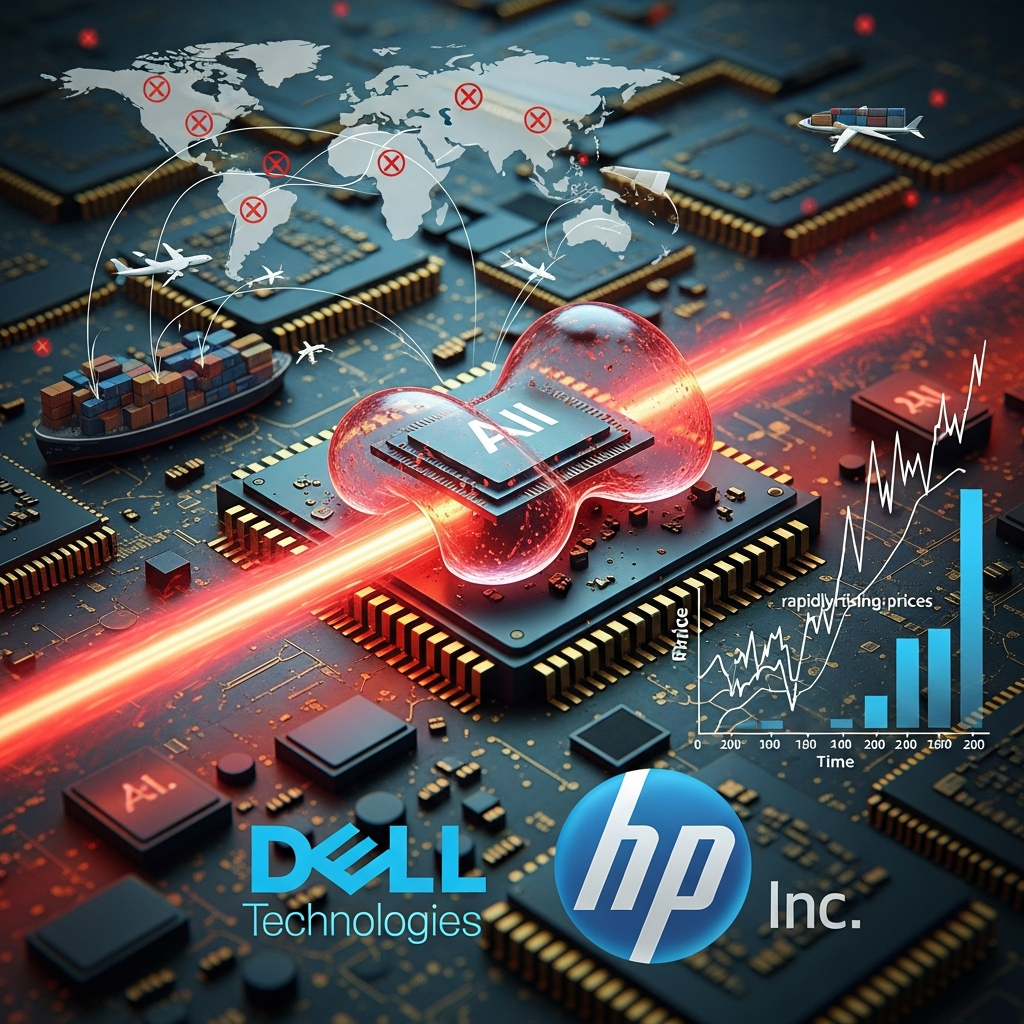
The burgeoning artificial intelligence (AI) revolution, while promising unprecedented technological advancement, is simultaneously creating a critical bottleneck in the global tech supply chain. Major industry players, including Dell Technologies Inc. and HP Inc., are sounding alarms over an impending, severe AI memory chip shortage. This crisis threatens to drive up prices, squeeze margins for hardware manufacturers, and ultimately impact consumers globally. Experts warn of an “unprecedented pricing supercycle” for memory components, with ripple effects expected across all sectors reliant on digital infrastructure.
The Core Problem: AI’s Insatiable Appetite for Advanced Memory
At the heart of the looming crisis is AI’s voracious demand for specialized, high-performance memory chips, particularly High-Bandwidth Memory (HBM). These advanced chips are crucial for the rapid data processing required by sophisticated AI models and large-scale data centers. The escalating need for HBM has prompted semiconductor manufacturers to reallocate significant production capacity. This shift inadvertently creates a scarcity of more common memory types, such as Dynamic Random Access Memory (DRAM) and NAND flash memory, which are fundamental components in virtually all modern electronic devices.
The Dual Nature of Memory: Advanced vs. Conventional
While HBM is tailor-made for AI’s intense computational demands, conventional DRAM and NAND flash are the workhorses of consumer electronics and enterprise IT. They store the operating systems, applications, and user data in everything from smartphones and personal computers to medical equipment and automotive systems. As production lines pivot towards the more complex and profitable HBM, the supply for these everyday memory chips dwindles. This fundamental imbalance between surging demand for AI-specific memory and constrained supply for broader applications is propelling the market into uncharted territory. Counterpoint Research recently projected a staggering 50% price increase for memory modules by the second quarter of the coming year, underscoring the severity of the situation.
Industry Giants Raise the Alarm
Warnings about the impending AI memory chip shortage are emanating from boardrooms across the tech world. Companies heavily reliant on memory components are preparing for significant challenges, with some already implementing proactive measures. The consensus is clear: the current demand environment is unlike anything seen before.
Dell and HP: Facing Unprecedented Cost Hikes
Dell Technologies Inc. and HP Inc., two of the world’s largest PC and server manufacturers, are at the forefront of these concerns. Dell’s Chief Operating Officer, Jeff Clarke, reported “unprecedented cost increases” for memory components, including both HBM and PC-grade DRAM, as well as hard drives and NAND flash. Dell anticipates these rising costs will inevitably be passed on to customers, leading to repricing for some of its devices. Similarly, HP Chief Executive Officer Enrique Lores foresees a particularly challenging latter half of 2026. HP estimates that memory accounts for 15% to 18% of a typical PC’s cost, highlighting the significant impact even a moderate price hike can have on their bottom line. The company is actively pursuing “aggressive actions,” including diversifying its memory suppliers and potentially optimizing the amount of memory in certain products.
Proactive Measures: Stockpiling and Repricing
Beyond Dell and HP, other major players are feeling the squeeze. Consumer electronics giants like Xiaomi Corp. have already raised prices on flagship devices and expect further hikes for mobile products next year. Lenovo Group Ltd. has adopted a strategy of aggressive stockpiling, with inventories roughly 50% higher than usual. Lenovo’s CFO, Winston Cheng, echoed Dell’s sentiment, describing the cost surge as “unprecedented,” yet the company aims to leverage its economies of scale to maintain market share. Taipei-based Asustek Computer Inc. has also ramped up its memory chip stockpiles. These PC makers are planning to hold steady on prices through the current holiday quarter before reevaluating the market in the new year. Conversely, Apple Inc., benefiting from its immense purchasing power and strong leverage as a top customer, has offered a more optimistic outlook, acknowledging only a “slight tailwind” on memory prices.
The Financial Fallout: A “Pricing Supercycle”
The financial implications of this AI memory chip shortage are profound. Morgan Stanley has issued a stark warning about an “unprecedented pricing supercycle” in memory chips, triggering significant stock downgrades for several hardware companies. Since September alone, memory chip costs have reportedly surged by 60%, largely fueled by the relentless demand from the AI boom. Morgan Stanley analysts point out that memory chips constitute a substantial portion—between 10% and 70%—of a product’s bill of materials for global hardware OEM/ODM companies. This makes the escalating prices a major risk to earnings estimates for the coming year.
Investor Unease: Market Downgrades and Stock Plunges
The market has reacted sharply to these warnings. Dell’s shares plunged by 8%, and Hewlett Packard Enterprise (HPE) saw a 7% drop following Morgan Stanley’s analysis. Other hardware companies experienced similar declines of up to 6%. Dell was specifically singled out as vulnerable due to its dual exposure: as a major customer of Nvidia, it builds AI servers, but the rapidly increasing memory costs are eroding its margins faster than it can pass them on. Morgan Stanley issued a rare double-downgrade for Dell, moving it from “overweight” directly to “underweight,” and downgraded HPE from “overweight” to “equal weight.” Other affected companies include HP Inc., Asustek, Pegatron, Gigabyte, and Lenovo. Analysts forecast a period of 12-18 months of sustained “margin pressure” for these hardware entities.
Winners and Losers in the Semiconductor Arena
While hardware OEMs face a significant squeeze, memory chip manufacturers are experiencing a boom. Companies like South Korea’s Samsung Electronics Co. and SK Hynix Inc., alongside Micron Technology Inc., have seen their stock valuations surge. Inventories are dwindling, and supply challenges are becoming more pronounced, giving these manufacturers substantial pricing power. SK Hynix has already announced that its entire memory chip lineup for the upcoming year is sold out, and Micron anticipates tight supply persisting into 2026. Japan’s Kioxia Holdings Corp., a specialist in NAND flash, has also seen a significant stock increase due to the tight market conditions.
The Paradox of AI Infrastructure Buildout
The current situation highlights a critical paradox: demand for data center hardware specifically for AI workloads remains “white-hot.” Yet, the very companies building this essential infrastructure are getting “squeezed from both sides.” They face escalating input costs for crucial components like memory chips, even as their own customers—the hyperscalers and cloud providers—become increasingly price-sensitive regarding their massive AI investments. Morgan Stanley’s analysis concludes that this memory chip crisis exposes the fragility of the AI infrastructure boom, which can quickly transform into a “margin nightmare” for companies caught in the middle of such a commodity supercycle.
Broader Implications Beyond Servers
The impact of the AI memory chip shortage extends far beyond specialized AI servers and personal computers. Given the ubiquity of memory chips, a price surge and scarcity will affect a vast array of electronic devices. From intricate medical diagnostic equipment to the complex control systems in modern automobiles, virtually all data-storing electronics will face increased manufacturing costs.
Ripple Effects Across the Global Supply Chain
China’s Semiconductor Manufacturing International Corp. (SMIC) has warned that the memory shortage could constrain car and electronics production in 2026, partly due to manufacturers prioritizing business with leading AI chip provider Nvidia Corp. This highlights a cascade effect where even suppliers of logic chips, essential for AI systems, may face reduced orders if their customers cannot secure sufficient memory. External factors further exacerbate the crunch, including US sanctions that limit the technological capabilities of new Chinese chip manufacturers, and rising energy costs impacting areas with large data centers. SK Group Chairman Chey Tae-won underscored the severity, describing the current situation as an “era in which supply is facing a bottleneck,” with numerous requests for memory chips posing a significant challenge for suppliers.
Expert Outlook: A Prolonged Challenge
Analysts largely agree that this challenging market environment is not a fleeting issue. Sanjeev Rana, head of research at CLSA Securities Korea, notes that demand for all types of memory, whether advanced or conventional, is “extremely strong,” with supply clearly lagging. He predicts the DRAM and NAND price upturn to last “several quarters.” Morgan Stanley further reinforces this, forecasting 12 to 18 months of sustained margin pressure for hardware companies. The consensus is that investors and businesses must differentiate between companies equipped to weather these rising input costs and those likely to face severe margin compression. The coming year and a half will be a critical period for determining which hardware giants will emerge stronger and which will become casualties of this challenging market.
Frequently Asked Questions
Why are memory chips becoming scarce and more expensive?
The scarcity and rising cost of memory chips are primarily driven by the explosion in demand for artificial intelligence (AI) infrastructure. AI systems require specialized High-Bandwidth Memory (HBM) for rapid data processing. Semiconductor manufacturers are reallocating production capacity to meet this intense HBM demand, leading to a reduced supply of conventional memory types like DRAM and NAND flash. This shift, coupled with overall strong demand, creates a supply-demand imbalance across the memory market.
Which major tech companies are most impacted by the AI memory chip crunch?
Major hardware manufacturers like Dell Technologies Inc. and HP Inc. are significantly impacted, facing “unprecedented cost increases” for memory components. Other companies feeling the squeeze include Xiaomi Corp., Lenovo Group Ltd., and Asustek Computer Inc., which are implementing strategies like stockpiling or price increases. While these OEMs face margin pressure, memory chip producers such as Samsung Electronics Co., SK Hynix Inc., and Micron Technology Inc. are benefiting, seeing surging valuations as demand outstrips supply.
How will the AI-driven memory chip shortage affect consumers and businesses?
Consumers can expect to see higher prices for a wide range of electronic devices, including smartphones, personal computers, and other smart gadgets, as manufacturers pass on their increased component costs. Businesses, particularly those in sectors like automotive, medical equipment, and enterprise IT, may also face higher procurement costs for memory-intensive hardware. Additionally, the shortage could lead to potential delays in product availability and longer lead times for custom hardware builds, forcing strategic planning for technology upgrades and purchases.
Conclusion
The AI memory chip shortage is a defining challenge of the current technological landscape. Fuelled by AI’s explosive growth, the shift in semiconductor manufacturing priorities has created a profound imbalance that will impact businesses and consumers globally. While memory manufacturers stand to benefit from the “pricing supercycle,” hardware OEMs face a daunting period of margin compression and strategic adjustments. As the tech world navigates this bottleneck, proactive measures, diversified supply chains, and a keen understanding of market dynamics will be crucial for weathering the storm and continuing to innovate in an increasingly AI-driven world. The next 12 to 18 months will undoubtedly test the resilience and adaptability of the entire tech ecosystem.