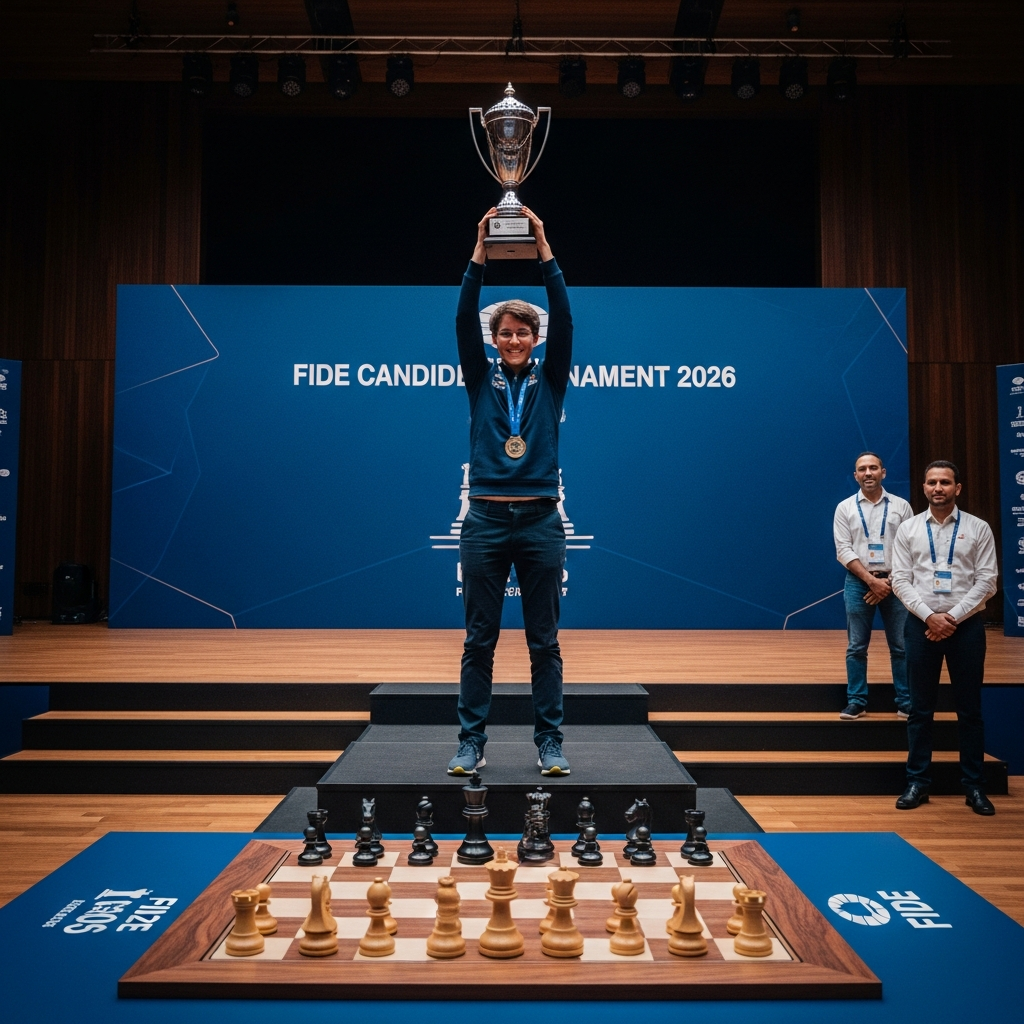
The FIDE World Cup 2025, a thrilling spectacle of strategic brilliance and high-stakes drama, has concluded its main phase in Goa, India. As of November 26, 2025, this biennial chess event has not only crowned a champion but, more importantly, confirmed the majority of the formidable line-up for the prestigious 2026 FIDE Candidates Tournament. Chess enthusiasts worldwide have witnessed a “wild ride” filled with unexpected upsets and heroic performances, cementing the World Cup’s reputation as a crucial stepping stone in the quest for the World Chess Championship title.
The Dramatic Road to the Candidates Tournament 2026
The primary objective of the FIDE World Cup 2025 was to determine three qualifiers for the much-anticipated 2026 FIDE Candidates Tournament. After weeks of intense competition, the chess world now knows the names of the three grandmasters who have secured their spots through this grueling knockout event:
Wei Yi (China)
Javokhir Sindarov (Uzbekistan)
Andrey Esipenko (Russia, playing under the FIDE flag)
These three exceptional talents will join an elite group of players in Pegeia, Cyprus, from March 28th to April 16th, 2026, all vying for the ultimate prize: the right to challenge the reigning World Chess Champion, D Gukesh, for the world crown.
Wei Yi and Sindarov Clash in the FIDE World Cup Final
The final match of the FIDE World Cup 2025 pitted two rising stars against each other: China’s Wei Yi and Uzbekistan’s Javokhir Sindarov. Their journey to the final was a testament to their skill and resilience, automatically qualifying both for the Candidates Tournament even before the World Cup winner was decided.
After two classical games ended in quick draws, the championship title, and a significant portion of the $2 million total prize fund, hinged on a dramatic tiebreak. The winner of this ultimate showdown stood to claim a handsome $120,000, while the runner-up would still secure a substantial $85,000. For Wei Yi, a victory would mark him as the first Chinese player to win the World Cup. Sindarov, on the other hand, had the chance to etch his name in history as the youngest ever World Cup champion. The rapid draw in their second classical game, while criticized by some as not “peak elite sport,” set the stage for a thrilling tiebreak spectacle, promising maximum entertainment for fans globally.
Esipenko’s Breakthrough: Securing the Final Candidates Spot
While the final determined the World Cup champion, the 3rd-place playoff carried perhaps even greater significance: the final qualification spot for the Candidates Tournament. This high-pressure match saw Andrey Esipenko face off against Nodirbek Yakubboev.
Esipenko, a 23-year-old Russian prodigy, displayed remarkable fortitude. Despite a heartbreaking semi-final loss to Wei Yi, he regrouped and delivered a dominant 2-0 victory against Yakubboev in the classical phase of their playoff match. Esipenko’s performance was particularly decisive in the second game, where Yakubboev, playing White, made a critical blunder early in a Catalan-style opening. Esipenko capitalized swiftly, trapping a rook and leading to a resignation that secured his 3rd place finish and the coveted Candidates berth.
An emotional Esipenko, exhausted after playing 30 demanding games, described the moment as “probably the best moment of my chess career.” This win represented a crucial breakthrough for him, overcoming past disappointments where he had narrowly missed out on Candidates qualification. For Nodirbek Yakubboev, it was a moment of heartbreak, missing out on two clear opportunities to qualify. Despite his efforts and personal sacrifices, he concluded his impressive World Cup run with a consolation prize of $50,000.
The FIDE World Cup 2025: A Tournament of Surprises
Held at the luxurious Resort Rio in Goa, India, from November 1st to November 26th, the FIDE World Cup 2025 was a single-elimination knockout tournament involving 206 players. Characterized by its unpredictable nature, the event saw many pre-tournament favorites exit unexpectedly, highlighting the depth of talent in modern chess.
The tournament followed a standard format: two classical games per match. These games featured a time control of 90 minutes for the first 40 moves, followed by an additional 30 minutes to complete the game, with a 30-second increment per move from the start.
Understanding the Intense Tiebreak System
When classical games resulted in a tie, a comprehensive playoff system was implemented on the third day of the round to ensure a decisive outcome. This system underscored the immense pressure faced by players:
Rapid Games: The tiebreak began with two rapid games, each with 15 minutes plus a 10-second increment per move.
Slow Blitz: If still tied, two ‘slow blitz’ games followed, with 10 minutes plus a 10-second increment.
Standard Blitz: Persistent ties led to two standard blitz games (5 minutes plus 3 seconds increment).
Faster Blitz: If necessary, two 3-minute plus 2-second games were played.
Sudden Death Game: If all prior tiebreakers failed, the match culminated in a single sudden death game. White received 4 minutes of starting time with a 2-second increment. Black’s time was determined by a confidential bidding process (max 4 minutes), with the lowest bid winning the right to play as Black with their specified time. Critically, if this game ended in a draw, the player playing Black was declared the winner. This unique rule adds another layer of psychological complexity and strategic decision-making.
Rising Stars: Profiles of the World Cup Finalists
The FIDE World Cup 2025 not only identified Candidates qualifiers but also showcased the extraordinary talent of young grandmasters on the global stage.
Wei Yi (China)
At 26 years old and currently ranked 11th in the world, Wei Yi has long been considered a prodigious talent. He earned his Grandmaster title at an astonishing 13 years, 8 months, and 23 days in 2013, and was the youngest ever to achieve a 2700 rating at just 15. After a period focusing on his education from 2018 to 2024, he marked a significant return by winning the Tata Steel tournament in 2024. His path to the World Cup final included hard-fought victories over several strong opponents, notably winning a rapid game against Andrey Esipenko from a lost position, demonstrating his incredible fighting spirit.
Javokhir Sindarov (Uzbekistan)
Just 19 years old, Javokhir Sindarov is described as “on the rise” and is currently ranked 25th globally. He achieved his Grandmaster title at an even younger age than Wei Yi: 12 years, 10 months, and 8 days in 2018. Sindarov crossed the 2700 rating barrier after his strong performance at the 2023 FIDE Grand Swiss. His journey through the World Cup saw him defeat a series of formidable players, including his compatriot Nodirbek Yakubboev in a tense semifinal. Sindarov often credits the support of his family, who even traveled to Goa with traditional Uzbek food, for his success.
The Full Roster for Candidates Tournament 2026
With the FIDE World Cup 2025 concluded, the field for the 2026 FIDE Candidates Tournament is now largely complete, promising an exhilarating contest. The confirmed and expected participants include:
- Fabiano Caruana (Winner of 2024 FIDE Circuit)
- Anish Giri (Winner of 2025 FIDE Grand Swiss)
- Matthias Bluebaum (Runner-Up of 2025 FIDE Grand Swiss)
- Javokhir Sindarov (2025 World Cup Finalist)
- Wei Yi (2025 World Cup Finalist)
- Andrey Esipenko (2025 World Cup 3rd Place)
- R Praggnanandhaa (2025 FIDE Circuit Winner – pending confirmation)
- Hikaru Nakamura (Highest-rated player not qualified by other means – pending confirmation)
This lineup features a blend of established elite grandmasters and dynamic young talents, setting the stage for one of the most exciting Candidates tournaments in recent memory.
—
Frequently Asked Questions
What are the FIDE World Cup tiebreak rules?
The FIDE World Cup features a multi-stage tiebreak system for matches that end in a draw after two classical games. It begins with two rapid games (15 mins + 10 sec increment). If still tied, two ‘slow blitz’ games follow (10 mins + 10 sec increment). Next are two standard blitz games (5 mins + 3 sec increment), and potentially two faster blitz games (3 mins + 2 sec increment). If a winner still isn’t decided, a sudden death game is played. In this decisive game, White gets 4 minutes, and Black’s time (max 4 mins) is determined by a confidential bid. Critically, if the sudden death game is drawn, the player playing Black is declared the winner.
Who are the confirmed qualifiers for the 2026 FIDE Candidates Tournament from the World Cup?
The FIDE World Cup 2025, held in Goa, India, served as a crucial qualifying event for the 2026 FIDE Candidates Tournament. The three players who successfully secured their berths through the World Cup are Wei Yi of China and Javokhir Sindarov of Uzbekistan, both of whom reached the final, and Andrey Esipenko of Russia (playing under the FIDE flag), who won the 3rd-place playoff. These players will join others like Fabiano Caruana, Anish Giri, and Matthias Bluebaum in the Candidates Tournament, which determines the challenger for the World Chess Championship.
What’s next for the top players after the FIDE World Cup?
For the FIDE World Cup finalists, Wei Yi and Javokhir Sindarov, and 3rd-place finisher Andrey Esipenko, the immediate next step is preparing for the 2026 FIDE Candidates Tournament. Scheduled for March and April 2026 in Pegeia, Cyprus, the Candidates is a double round-robin event where the winner earns the right to challenge the World Chess Champion for the coveted world title. For other top players who participated in the World Cup but didn’t qualify, their focus shifts to other FIDE events, rating tournaments, and circuit events to earn future Candidates qualification opportunities or to improve their world rankings.
—
Conclusion
The FIDE World Cup 2025 in Goa has been an unforgettable journey, celebrating the strategic depth and emotional intensity of elite chess. It has launched three new hopefuls onto the grandest stage of the Candidates Tournament, while simultaneously showcasing the incredible talent of young grandmasters like Wei Yi and Javokhir Sindarov. As the chess world now looks forward to the 2026 Candidates Tournament, the legacy of this World Cup—marked by dramatic tiebreaks, resilient performances, and the crowning of new stars—will undoubtedly continue to inspire and excite fans for years to come. The road to the World Chess Championship is clearer, and the anticipation for the ultimate chess battle only grows.