A spectacular night launch recently illuminated Florida’s night sky, as a SpaceX Falcon 9 rocket successfully propelled another crucial batch of Starlink internet satellites into orbit. This mission, originating from Cape Canaveral, not only expanded SpaceX’s rapidly growing satellite constellation but also underscored the company’s unprecedented operational tempo and commitment to reusable rocket technology in 2025. The event marks another significant milestone in SpaceX’s relentless pursuit of revolutionizing global connectivity and space access.
A Dazzling Ascent from Florida’s Space Coast
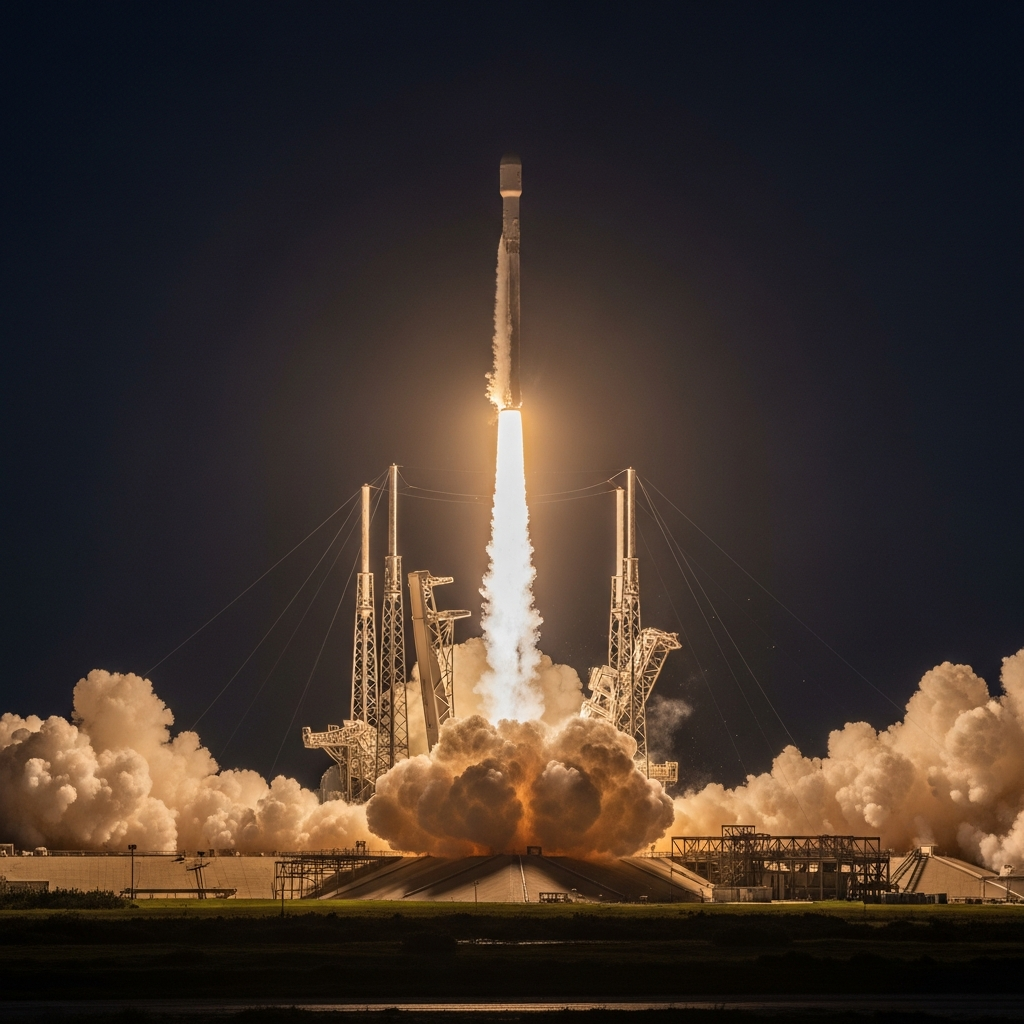
On Tuesday, November 18, 2025, a SpaceX Falcon 9 rocket roared to life, launching 29 Starlink spacecraft. The nighttime liftoff from Cape Canaveral Space Force Station occurred precisely at 7:12 p.m. EST (0012 GMT on November 19). Spectators watched as the powerful Falcon 9 soared, leaving a brilliant trail against the dark Florida sky, a common yet always awe-inspiring sight on the Space Coast.
Just 8.5 minutes after launch, the rocket’s first stage executed a flawless vertical landing. It touched down gently on SpaceX’s autonomous drone ship, aptly named “A Shortfall of Gravitas,” stationed in the Atlantic Ocean. This specific booster, designated 1085, achieved its 12th successful launch and landing. Its proven reliability highlights the remarkable advancements in reusable rocket technology. This particular booster had previously supported several critical missions, including Crew-9, RRT-1, Firefly Blue Ghost Mission 1, Fram2, SXM-10, MTG-S1, and five prior Starlink deployments.
The Growing Starlink Constellation Reaches New Heights
Approximately 65 minutes after the initial launch, the Falcon 9’s upper stage successfully deployed all 29 Starlink satellites into low Earth orbit (LEO). This deployment, confirmed by SpaceX via X (formerly Twitter), represents a significant expansion of the Starlink megaconstellation. These new satellites are designed to boost global internet coverage, particularly in underserved and remote areas.
Prior to this SpaceX Falcon 9 launch, astrophysicist and satellite tracker Jonathan McDowell reported the total count of operational Starlink spacecraft at 8,979. This latest deployment is set to push that number beyond an impressive 9,000. The continuous expansion of Starlink highlights SpaceX’s ambition to provide a global, high-speed, low-latency broadband internet service.
Unprecedented Cadence: SpaceX’s Record-Breaking 2025
The November 18 SpaceX Falcon 9 launch is just one example of the company’s incredibly busy year. As of that date, SpaceX had already conducted 148 Falcon 9 missions in 2025. A staggering 107 of these were specifically dedicated to expanding the Starlink megaconstellation. This relentless pace underscores SpaceX’s dominant role in the commercial space launch market.
Beyond its workhorse Falcon 9, SpaceX also pushed the boundaries with its next-generation Starship rocket. Five suborbital test flights of the giant Starship rocket were successfully performed during 2025. Starship, the largest and most powerful rocket ever constructed, is being developed for full and rapid reusability. Its ultimate goal is to enable human missions to the Moon and Mars.
A Flurry of Florida Liftoffs: New State Records
SpaceX’s activity in 2025 has set numerous new records for the entire space industry. Just prior to the Nov 18 Starlink launch, on November 10, 2025, another SpaceX Falcon 9 launch from Cape Canaveral marked the 94th orbital liftoff from Florida in a single year. This was a new state record at the time, achieved with Booster 1096 on its third flight, landing on the drone ship “Just Read the Instructions.” This mission, carrying 29 Starlink satellites, further demonstrated SpaceX’s high operational tempo. Senior Space Writer Mike Wall highlighted this achievement as evidence of the company’s escalating launch frequency.
The record-breaking didn’t stop there. On November 20, 2025, SpaceX achieved its 100th rocket launch of the year from Florida’s Space Coast. This mission, involving a Falcon 9 with Booster 1080 completing its incredible 23rd flight, further cemented Florida’s position as a global launch hub. By this date, SpaceX had conducted a total of 149 Falcon 9 missions in 2025, surpassing its 2024 record of 132 Falcon 9 launches. Over 90 of these originated from Florida, showcasing the Sunshine State’s integral role in the new era of spaceflight.
Beyond Starlink: Advancing Earth Science with Reusable Rockets
While Starlink launches dominate the headlines, SpaceX’s reusable rocket technology serves a broader purpose. On November 17, 2025, SpaceX achieved another monumental feat: its 500th orbital mission utilizing a flight-proven Falcon 9 booster. This landmark launch from Vandenberg Space Force Base in California carried the Copernicus Sentinel-6B ocean-mapping satellite into orbit.
This mission for Sentinel-6B is critical for global climate monitoring. The satellite is designed to accurately measure global sea surface heights, extending nearly four decades of vital sea-level records from space. As highlighted by NASA spokesman Derrol Nail, this data is crucial for tracking a key consequence of climate change. The European Space Agency (ESA) considers monitoring sea-level rise a high global priority, with Copernicus data showing a nearly 10-centimeter rise over the past 25 years.
The Sentinel-6B satellite is a collaborative effort involving the European Commission, ESA, NASA, Eumetsat, and NOAA. It carries advanced instruments, including an ESA-developed radar altimeter and a NASA-provided microwave radiometer, for unparalleled accuracy. SpaceX President Gwynne Shotwell commended the team for making “the impossible possible with reusable rockets.” She emphasized how this innovation paves the way for a permanent human presence on the Moon and beyond.
The Future of Space: Reusability and the Rise of Starship
SpaceX’s Falcon 9 reusability is a game-changer. By routinely recovering and reflving boosters, SpaceX drastically reduces launch costs and increases launch frequency. This capability has fueled the rapid expansion of the Starlink constellation. It has also enabled more accessible space for various government and commercial payloads, from scientific research satellites like Sentinel-6B to crewed missions.
The continuous success of the Falcon 9 missions, including its record-breaking 2025 cadence, is laying the groundwork for the next giant leap: Starship. Described as the biggest and most powerful rocket ever built, Starship is designed to be fully and rapidly reusable. Its development continues with ambitious test flights from Starbase in South Texas. Starship promises to revolutionize heavy-lift space transportation. It will ultimately enable cost-effective travel to the Moon, Mars, and beyond, fulfilling humanity’s long-held dreams of interplanetary exploration.
Frequently Asked Questions
What is the significance of SpaceX’s record-breaking launch cadence in 2025?
SpaceX’s unprecedented launch cadence in 2025, exceeding 149 Falcon 9 missions, highlights a transformative era in space exploration. This rapid frequency, with over 107 missions dedicated to Starlink, demonstrates the efficiency and reliability of reusable rocket technology. It significantly accelerates the deployment of satellite internet infrastructure globally. The record pace also underscores increasing commercial demand for space access and positions SpaceX as a dominant force in the global space industry, enabling both economic growth and scientific advancement.
How does the Starlink constellation support global internet access?
The Starlink constellation provides global internet access by deploying thousands of satellites into low Earth orbit (LEO). These satellites transmit broadband internet signals directly to user terminals on the ground. By operating in LEO, Starlink significantly reduces latency compared to traditional geostationary satellites. This makes it ideal for high-speed, responsive internet service in remote and underserved areas worldwide, bridging the digital divide and connecting communities that previously had limited or no access to reliable internet.
Why is Falcon 9 reusability so important for the future of space travel?
Falcon 9 reusability is paramount for the future of space travel because it dramatically reduces the cost and increases the frequency of space launches. Traditionally, rockets were single-use, making each mission extremely expensive. By landing and reflving its first stages, SpaceX cuts manufacturing costs per launch, making orbital access more affordable for commercial, scientific, and government entities. This innovation has democratized space access, accelerated satellite deployment, and is crucial for developing larger, fully reusable systems like Starship for future deep-space human exploration.
Conclusion: A New Era of Spaceflight
SpaceX’s recent Starlink launch from Florida is far more than just another mission; it’s a testament to a new era in spaceflight. The company’s record-setting pace in 2025, marked by hundreds of Falcon 9 missions and the ongoing development of Starship, is reshaping our relationship with space. From expanding global internet access with Starlink to monitoring Earth’s climate with Sentinel-6B, SpaceX continues to push the boundaries of what’s possible. As reusable rocket technology evolves, the future promises even more accessible, ambitious, and impactful endeavors in the cosmos. Stay tuned, as the night skies are set to be lit up by many more historic launches.