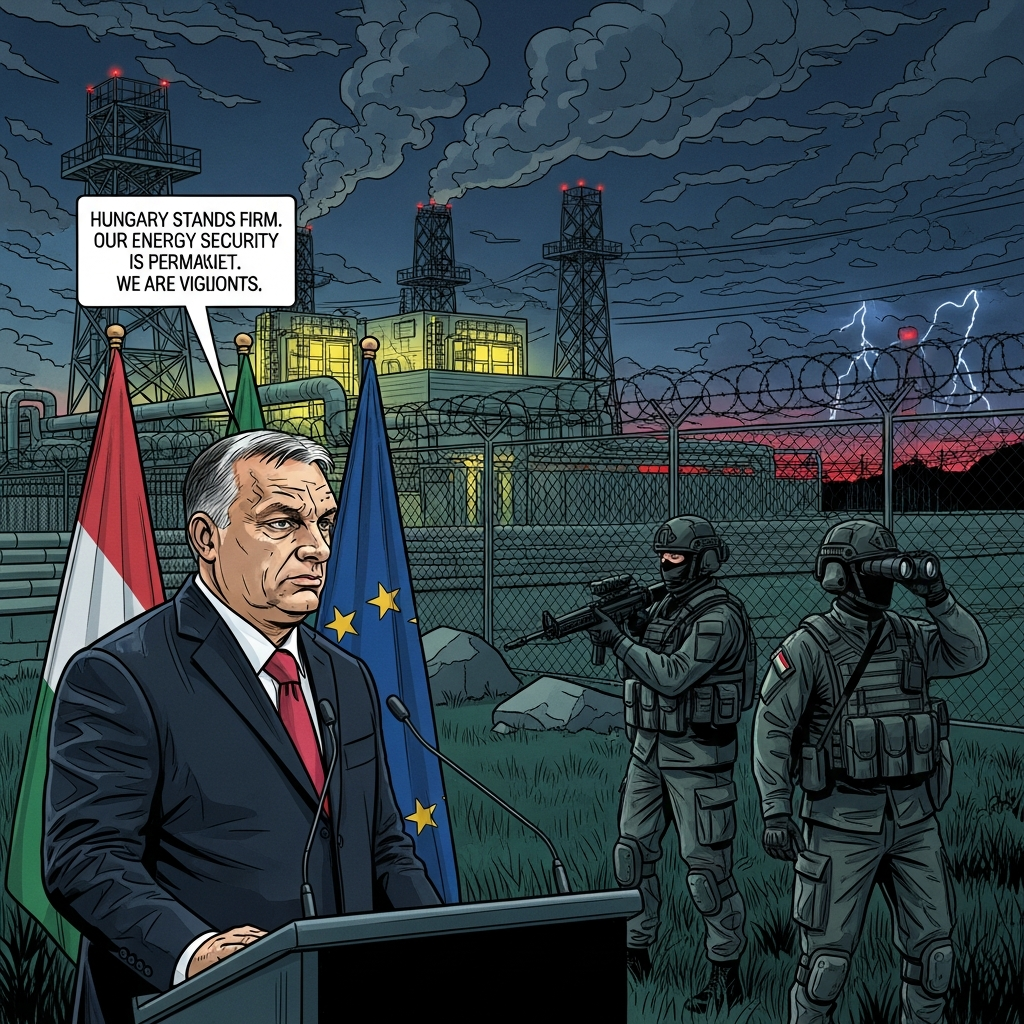
In a dramatic escalation of regional tensions, Hungary has initiated significant security measures, deploying military personnel to critical energy facilities and imposing a drone flight ban in a county bordering Ukraine. Hungarian Prime Minister Viktor Orbán publicly justified these actions, asserting that Ukraine is preparing “further actions to disrupt the functioning of the Hungarian energy system.” This move comes amid a complex geopolitical backdrop, raising serious questions about Hungarian energy security and its relationship with both Kyiv and Brussels.
Since January 27, no Russian oil has reached Hungary via the Druzhba pipeline from Ukraine, a critical supply route. Orbán’s government has repeatedly framed this disruption as “Kyiv’s supposed ‘political blackmail.'” However, a crucial counter-narrative reveals the pipeline’s shutdown stemmed from damage inflicted by a Russian air strike, not Ukrainian inaction. This stark discrepancy underscores the contentious nature of Hungary’s official narrative and its unique stance on the ongoing conflict.
Hungary’s Urgent Energy Security Measures
Prime Minister Viktor Orbán’s directive to deploy soldiers to protect vital energy infrastructure marks a significant shift in Hungary’s domestic security posture. Following a Defence Council meeting and a review of national security intelligence, Orbán declared a firm stance, stating, “We will not give in to blackmail, I have ordered the reinforcement of the protection of critical energy infrastructure.” This bold declaration signals Hungary’s deep anxieties regarding its energy supply amidst the volatile geopolitical climate.
Strategic Military Deployment and Drone Ban
The security measures implemented are comprehensive and highly visible. Soldiers, equipped to repel potential attacks, are now stationed near “priority facilities,” which include designated power plants, distribution stations, and control centres. These military deployments are complemented by intensified police patrols in the surrounding areas, demonstrating a multi-layered approach to safeguarding national energy assets.
Adding another layer of protection, Orbán also ordered a strict ban on drone flights within Szabolcs-Szatmár-Bereg county. This region, strategically located along the Ukrainian border, is a focal point of concern, suggesting a concentrated effort to prevent aerial surveillance or potential aerial threats. These actions highlight Hungary’s proactive, albeit controversial, steps to secure its energy lifelines.
The Druzhba Pipeline: A Point of Contention
Central to Orbán’s justifications is the status of the Druzhba pipeline. He referenced the cessation of Russian oil deliveries from Ukraine since late January. While Orbán and his government attribute this disruption to “Kyiv’s supposed ‘political blackmail’,” the reality, as noted by observers, is far different. The pipeline was rendered inoperable due to severe damage caused by a Russian air strike. This critical detail directly contradicts Orbán’s public statements, painting a picture of deliberate misdirection designed to shift blame towards Ukraine.
The dispute over the Druzhba pipeline illustrates the delicate balance of Hungarian energy security and its dependence on external sources. For Hungary, reliable energy supply is paramount, and any disruption is quickly politicized, often through a lens that challenges mainstream Western narratives.
Orbán’s Broader Political Narrative: “Brussels, Not the East, is the Threat”
Orbán’s recent actions concerning Hungarian energy security are not isolated events but rather integral to his broader political philosophy. In his most recent annual assessment speech, delivered before the 2026 elections, Orbán articulated a contentious worldview, positioning Brussels as the primary threat to freedom, not Russia or the “East.” He prognosticated a “century of humiliation for Europe,” yet expressed optimism for Hungary’s unique path.
Challenging the Western Stance on Russia
The Hungarian Prime Minister introduced the term “Putining,” which he described as the “primitive and frivolous” Western tendency to demonize Russia and its leadership. Instead, Orbán argues that “Brussels is a tangible reality and a direct threat,” urging those who value freedom to “fear Brussels and not the East.” He supported this claim by referencing a US report alleging that the European Commission pressured social media platforms to censor content, including during elections in Romania and Moldova, a practice he appreciates the US for exposing.
This stance significantly diverges from the consensus among European allies, creating friction within the EU and NATO. Orbán’s consistent efforts to reframe geopolitical threats underscore Hungary’s distinct foreign policy, often prioritizing national interests as defined by his government, even at the expense of solidarity with European partners.
Domestic Battle Against “Brussels Agents”
Domestically, Orbán has pledged to intensify his government’s fight against what he terms “Brussels agents” within Hungary. Following the upcoming April elections, he vowed to complete the “half the job” his administration has already started. These alleged agents, according to Orbán, include “disguised civil organisations, bought journalists, judges, politicians, algorithms, bureaucrats, [and] rolling Euro-millions.” This rhetoric fuels an atmosphere of internal mistrust and reinforces his government’s image as a bulwark against perceived external influences.
Furthermore, Orbán has aligned Hungary with former US President Donald Trump’s “revolution against the former liberal elites,” believing this alliance will strategically position Hungary on the “main street of history.” He has also accused Hungarian domestic rivals of being puppets of “global big business,” citing examples like a Tisza Party candidate linked to Shell, alleging the company profited from the war and sought to sever Hungary from cheap Russian oil.
“Last Election Before War”: A Dire Prophecy
A particularly alarming aspect of Orbán’s rhetoric is his warning that “Europe has decided to go to war by 2030.” He declared the upcoming election as the “last election before war,” claiming Brussels is intent on defeating Russia in Ukraine. According to Orbán, the EU is actively preparing for war across the continent, arming itself, instructing populations on wartime protocols, and sending substantial funds to Ukraine on credit. He questioned the feasibility of defeating a nuclear power without deploying nuclear weapons and firmly asserted that Hungary would not send money or weapons to Ukraine, nor would Hungarian youth be conscripted for the conflict. He emphasized that NATO’s charter does not mandate military force in such circumstances.
This “last election before war” narrative serves to heighten stakes for Hungarian voters, presenting his government as the only guarantor of peace and stability in a continent he portrays as veering towards conflict. It also provides a strong foundation for his arguments against deeper engagement in the Ukraine war, directly impacting Hungarian energy security decisions and diplomatic relations.
Unpacking the Energy Security Claims
The narrative around Hungarian energy security is undeniably complex. Orbán’s claims about Ukrainian intent to disrupt energy systems are presented without concrete evidence, especially when contrasted with the confirmed Russian damage to the Druzhba pipeline. This discrepancy highlights a pattern of information control and strategic framing by the Hungarian government. By blaming Ukraine, Orbán can justify increased militarization of infrastructure and reinforce his anti-Kyiv stance, aligning with his broader “Brussels is the threat” agenda.
Hungary’s reliance on Russian oil and gas, despite efforts to diversify, remains a critical vulnerability. The sanctions regime, initially implemented under the Trump administration, has seen Hungary’s national oil company MOL significantly profit from purchasing cheap Russian oil due to specific exemptions. This economic reality underscores a pragmatic, yet controversial, element of Hungary’s energy strategy that sometimes conflicts with broader EU objectives.
Implications for Regional Stability and Hungary’s Future
Orbán’s actions and rhetoric have significant implications for regional stability and Hungary’s future standing within the European Union and NATO. His deployment of troops and public accusations against Ukraine, particularly given the misinformation regarding the Druzhba pipeline, strain diplomatic relations. Such moves could be perceived as further distancing Hungary from its Western allies at a time when unity is paramount.
The emphasis on “special taxes on big business” to fund welfare measures, while politically popular domestically, also invites scrutiny. Critics point to omissions in Orbán’s past speeches, such as unfulfilled promises of significant economic recovery, with Hungary only achieving modest growth in 2025. These economic realities, combined with social issues like the continued celebration of Pride events despite a pledged ban, suggest a gap between the government’s rhetoric and on-the-ground realities. Ultimately, Hungary’s path forward is deeply intertwined with its energy security, its unique political positioning, and the ongoing geopolitical shifts in Eastern Europe.
Frequently Asked Questions
Why did Hungary deploy soldiers to energy facilities?
Hungarian Prime Minister Viktor Orbán stated the deployment of soldiers to critical energy facilities was a response to his belief that “Ukraine is preparing further actions to disrupt the functioning of the Hungarian energy system.” He also linked this to the disruption of Russian oil flow via the Druzhba pipeline, which he characterized as “political blackmail” by Kyiv. However, external reports clarify that the pipeline was damaged by a Russian air strike, not Ukrainian action.
What specific security measures did Hungary implement near the Ukrainian border?
In addition to deploying soldiers and equipment to protect priority power plants, distribution stations, and control centres, Hungary also ordered increased police patrols around these facilities. Critically, Prime Minister Orbán imposed a ban on drone flights specifically in Szabolcs-Szatmár-Bereg county, a region directly bordering Ukraine, indicating heightened concern for potential aerial threats in that area.
How do Orbán’s recent actions impact Hungary’s relations with Ukraine and the EU?
Orbán’s actions and his public narrative, which falsely attributes pipeline damage to Ukraine and portrays Brussels as the primary threat, significantly strain Hungary’s relations with Ukraine and the European Union. These moves deepen mistrust, undermine EU solidarity, and could further isolate Hungary politically. His rhetoric reinforces a perception of Hungary diverging from mainstream Western policy regarding the conflict in Ukraine and broader European security.
Conclusion
The deployment of Hungarian soldiers to safeguard critical energy facilities, coupled with a drone ban near the Ukrainian border, marks a pivotal moment for Hungarian energy security and its international relations. While Prime Minister Viktor Orbán frames these measures as a necessary defense against perceived Ukrainian threats and “political blackmail,” the underlying facts concerning the Druzhba pipeline’s disruption tell a different story, pointing to Russian aggression. This discrepancy is central to understanding Hungary’s complex geopolitical stance, which increasingly positions Brussels as a greater threat than Moscow. As Europe grapples with ongoing conflict, Hungary’s unique and often defiant approach will continue to shape regional dynamics, underscoring the intricate balance between national interest, energy independence, and international solidarity.