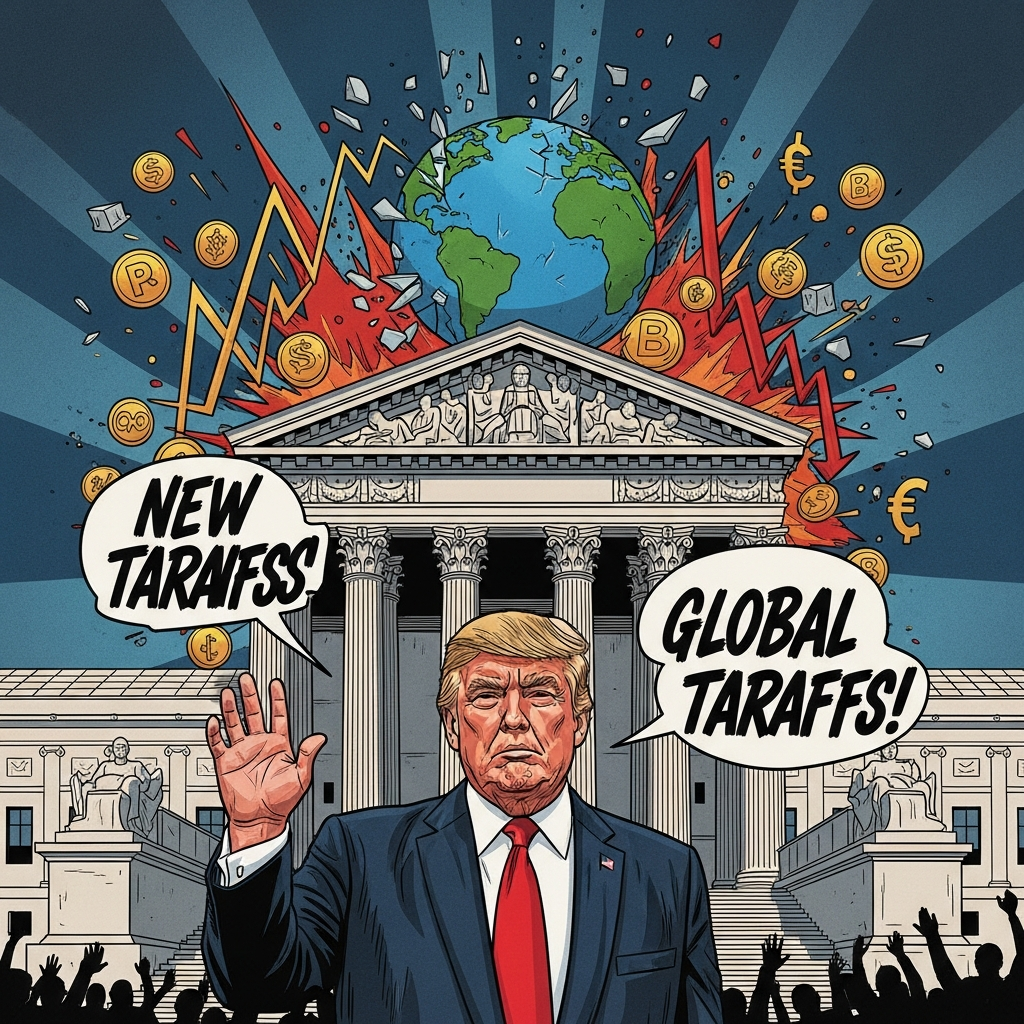
The United States Supreme Court has delivered a landmark decision, striking down President Donald Trump’s expansive emergency tariffs and ushering in a fresh wave of economic and political uncertainty. This pivotal ruling not only invalidates previous import taxes but also sets the stage for a dramatic recalibration of U.S. trade policy. In a move that quickly followed the court’s judgment, President Trump defiantly announced plans for new global tariffs, promising a revised approach to his “America First” agenda. This complex scenario now leaves businesses, economists, and legal experts grappling with profound questions about billions in potential refunds, market stability, and the constitutional limits of presidential power.
The Landmark Supreme Court Decision: A Blow to Presidential Prerogative
In a resounding 6-3 decision, the Supreme Court determined that President Trump had overstepped his authority by imposing sweeping global tariffs under the International Emergency Economic Powers Act (IEEPA). Chief Justice John Roberts, authoring the majority opinion, firmly asserted that IEEPA, a statute designed for national emergencies, does not grant the President unchecked power to levy tariffs of “unlimited amount, duration, and scope.” This ruling emphatically reinforced the constitutional principle that the power to impose taxes, including tariffs, traditionally rests with Congress.
President Trump’s reaction to this judicial setback was immediate and intensely personal. At a White House press conference held hours after the Friday decision, he publicly lambasted the six justices in the majority, calling the ruling “deeply disappointing.” He declared they should be “absolutely ashamed” and lacked the courage to “do the right thing” for the country. His criticism was notably broad, targeting not only liberal justices but also his own appointees, Justices Neil Gorsuch and Amy Coney Barrett, whom he described as an “embarrassment” and “fools and lapdogs.” He even alleged, without providing evidence, that the court had been influenced by “foreign interests.” Conversely, Trump showered praise on Justices Clarence Thomas, Samuel Alito, and Brett Kavanaugh, who dissented, thanking them for their “strength and wisdom.” Trade experts like Colin Grabow from the Cato Institute hailed the ruling as a significant “victory for the rule of law,” emphasizing that the Supreme Court had determined the President “went too far.”
Trump’s Swift Rebuttal: A New Tariff Blueprint Emerges
Despite the judicial defeat, President Trump wasted no time outlining his “Plan B.” He immediately ordered a new 10% tariff on all imports under Section 122 of the 1974 Trade Act, effective almost immediately. This levy was swiftly raised to 15% via a Truth Social post. This new authority permits the president to apply a “temporary import surcharge” for up to 150 days if “large and serious” balance-of-payments deficits threaten a “significant” depreciation of the U.S. dollar. The White House justified this move as an effort to stem dollar outflows and incentivize domestic production, with certain exceptions for agricultural products, critical minerals, pharmaceuticals, some electronics, and passenger vehicles.
Beyond this temporary measure, the administration signaled broader ambitions. U.S. Trade Representative Jamieson Greer announced an “accelerated timeframe” for investigations under Section 301 of the Trade Act of 1974. These investigations will target “most major trading partners” for alleged “unjustifiable, unreasonable, discriminatory, and burdensome acts.” Such findings could lead to new, more targeted tariffs addressing issues like discrimination against U.S. technology companies, digital goods, and pharmaceutical pricing. Treasury Secretary Scott Bessent conveyed confidence that, despite the legal shift, the administration expects “virtually unchanged tariff revenue” in the coming year.
A Calculated Shift, or More Uncertainty?
While the new strategy aims to maintain tariff revenue, its legal footing is not without challenge. Neal Katyal, an attorney involved in the Supreme Court case, quickly questioned the validity of such “sweeping tariffs” under Section 122, suggesting they should still require congressional approval. Gregory Daco, chief economist of EY-Parthenon, aptly summarized the situation: “The ruling represents a de-escalation in U.S. trade policy. However, it does not constitute a full reset. Uncertainty persists around the durability of the relief, the potential reimposition of tariffs under alternative statutory authorities, and the treatment of tariffs already collected.” The transition period itself, involving complex administrative requirements, is expected to take months, prolonging economic confusion.
The Billion-Dollar Question: Will Americans Get Refunds?
One of the most contentious issues arising from the Supreme Court’s decision is the fate of the more than $134 billion collected in tariffs under the now-invalidated IEEPA authority. The Justice Department had previously indicated in court filings that the government would issue refunds if the tariffs were struck down. However, following the ruling, President Trump warned that importers and the government “will end up being in court for the next five years” haggling over the matter, signaling a potential protracted legal battle. Justice Kavanaugh, in his dissent, had even predicted that the ruling would create a “mess” for the government regarding these billions in refunds.
Small-business advocacy groups, including the National Retail Federation and Main Street Alliance, swiftly called for immediate, automatic refunds, emphasizing the severe burden these tariffs placed on American enterprises. Similarly, Democratic governors demanded prompt refund checks for businesses and consumers. Customs brokers anticipate a complex and lengthy refund process. Salvatore Stile II, a New York customs broker, noted that clients are asking “When are we getting the money?” and he must advise them that “it’s a long process.” He also suggests that some importers might sell their refund rights to hedge funds at a discount for immediate cash, a practice seen before the court’s decision. Trade lawyer Ted Murphy described a “ripple effect,” where companies that paid tariffs to the government will seek refunds, and their customers, who absorbed higher prices, will in turn demand their share from the importers. These commercial disputes are set to be significant and complex.
Economic Ripple Effects: Winners, Losers, and Inflationary Pressures
The elimination of the IEEPA tariffs creates a fiscal gap, challenging economic forecasters and potentially presenting opportunities for some financial players. While the immediate end to these tariffs, which previously drained over $100 billion from the economy, could act as a mild economic stimulant, this relief might be short-lived given Trump’s swift implementation of new tariffs. Economist Stephen Brown of Capital Economics suggested that a brief economic spur “could make the Fed[eral Reserve] concerned about the upside risks to inflation further ahead,” especially as inflation recently rose to an annual rate of 3 percent.
The redesign of the nation’s tariff schedule, now for the third time in little more than a year, will undoubtedly produce commercial winners and losers. For example, Brazilian goods, previously facing 50% IEEPA tariffs, will now see the import tax drop to 15% under the new Section 122 arrangement. Vietnamese products, which faced a 20% rate, will also see a cut. While these changes might not trigger companies to relocate production facilities, they could make imported goods temporarily more attractive, potentially widening the U.S. trade deficit. Businesses relying on foreign suppliers might accelerate imports, mirroring past behavior to front-run anticipated higher tariffs. This “material increase in trade policy uncertainty” could also create a “new headwind to capex,” or business spending on capital equipment, according to JPMorgan Chase economist Michael Feroli. Public opinion further underscores the precariousness of the new policy, with a Washington Post-ABC News-Ipsos poll revealing that voters oppose the president’s tariffs by a margin of nearly 2-1 (64% to 34%). Ed Gresser, a former U.S. Trade Representative economic research unit leader, voiced skepticism about the “durability” of these policies, citing their widespread unpopularity.
Political Fallout and Executive Power Redefined
The Supreme Court’s ruling arrives at a crucial juncture for President Trump, with congressional elections less than nine months away and unfavorable early polls. The fiscal implications are also significant, as tariffs serve as a source of revenue for the federal government, currently running crisis-level budget deficits. January saw the Treasury Department collect approximately $28 billion from all import taxes, representing about 5% of that month’s government revenue.
Beyond economics, the decision marks a profound reassertion of judicial power. A Supreme Court, including three justices appointed by Trump, openly rejected his broad interpretation of executive authority. Chief Justice Roberts explicitly dismissed the President’s claim that he could “impose tariffs on imports from any country, of any product, at any rate, for any amount of time.” This judgment forces the president onto more constitutionally defensible ground, relying on powers explicitly delegated by Congress. In a moment of striking candor, President Trump conceded that his new course was “probably the direction I should have gone the first time.”
Reactions from the political spectrum highlighted the ruling’s significance. Former Vice President Mike Pence lauded it as “a Victory for the American People and a Win for the Separation of Powers.” Congressional leaders like Senator John Thune and Senator Mitch McConnell echoed praise for the decision as a victory for separation of powers and U.S. consumers. International trading partners like Canada and the European Union welcomed the ruling as a “positive signal for the rule of law.” Conversely, some Trump allies, including Vice President JD Vance and Senator Bernie Moreno, criticized the decision as a “betrayal” and “lawlessness.” Despite the political upheaval, Wall Street’s reaction was relatively muted, with traders having largely priced in a Supreme Court defeat for the president. Stocks rose slightly, and Treasury yields remained stable, suggesting the markets had already adjusted to the anticipated outcome.
Frequently Asked Questions
What was the Supreme Court’s key ruling on Trump’s tariffs?
The Supreme Court, in a 6-3 decision, ruled that President Trump exceeded his authority by imposing sweeping global tariffs under the International Emergency Economic Powers Act (IEEPA). The Court clarified that IEEPA does not grant the President unlimited power to levy tariffs and reaffirmed that the power to impose taxes, including tariffs, primarily rests with Congress, as outlined in the U.S. Constitution. This decision invalidates all tariffs previously imposed under IEEPA.
How is the Trump administration attempting to reimpose tariffs after the ruling?
Following the Supreme Court’s decision, President Trump immediately announced a new strategy. He ordered a temporary 15% global tariff on all imports under Section 122 of the 1974 Trade Act, which permits such surcharges for up to 150 days to address balance-of-payments deficits. Additionally, the administration plans “accelerated timeframe” investigations under Section 301 of the 1974 Trade Act into alleged unfair trading practices by major partners, which could lead to further, more targeted tariffs.
What are the potential economic impacts and refund implications for businesses?
The ruling creates significant economic uncertainty. Businesses that paid the estimated $134 billion in IEEPA tariffs face a contentious battle for refunds, with President Trump suggesting protracted litigation. This “ripple effect” means importers may seek refunds from the government, while their customers, who absorbed higher prices, will likely demand money back from the importers. Economically, the initial end to emergency tariffs could act as a mild stimulant but might also spark Federal Reserve concerns about inflation. Furthermore, the constant tariff reshuffling is expected to increase trade policy uncertainty, potentially slowing business investment (capex).
Conclusion: Navigating a Shifting Trade Landscape
The Supreme Court’s decisive ruling on President Trump’s emergency tariffs marks a significant moment in U.S. trade policy and constitutional law. By curtailing what it deemed an overreach of executive power, the Court has unequivocally underscored the legislative branch’s authority over commerce. While the President has swiftly moved to establish new tariff regimes under different legal frameworks, the path ahead remains shrouded in uncertainty. Questions surrounding billions in potential refunds, the economic ripple effects on various industries, and the long-term viability of these new policies will dominate discussions. Businesses and consumers alike must brace for a period of continued adjustments and potential legal battles as the U.S. navigates this complex and evolving trade landscape, demonstrating the enduring tension between presidential ambition and constitutional checks and balances.