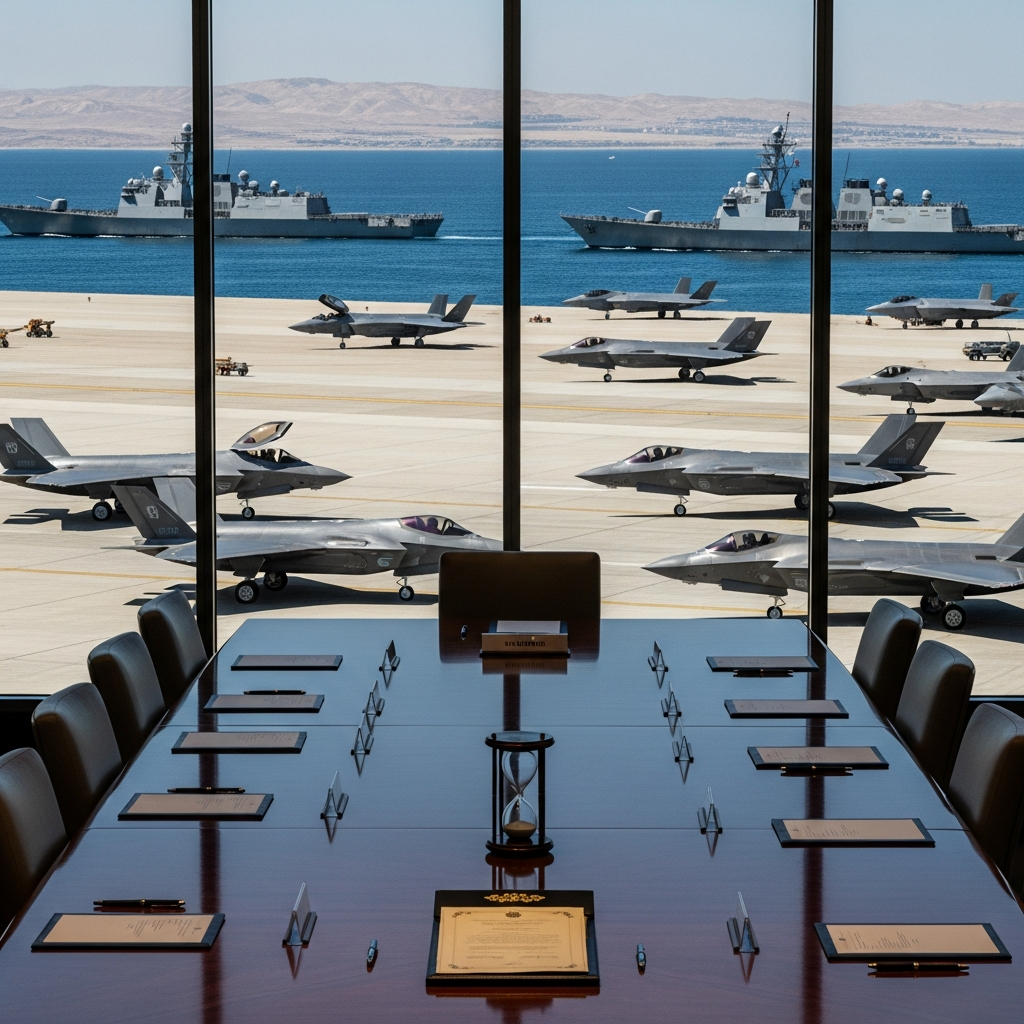
The United States is significantly bolstering its military footprint in the Middle East. This strategic move includes a substantial deployment of advanced weaponry and personnel. This escalation signals potential military action against Iran, even as delicate diplomatic efforts continue to unfold. The complex situation highlights a critical geopolitical standoff, balancing assertive military posturing with ongoing attempts to avert a full-scale conflict. Understanding these dynamics is crucial for grasping the region’s volatile future.
Escalating Tensions: U.S. Military Bolsters Middle East Presence
The Pentagon has confirmed a major dispatch of additional military assets to the Middle East. This includes warships, sophisticated air defense systems, and submarines. These deployments are explicitly framed as preparations for a possible strike on Iran. President Donald Trump retains the ultimate decision on authorizing such an action. This substantial buildup creates a ready force in a highly sensitive region.
Among the notable deployments, the USS Gerald R. Ford, a formidable aircraft carrier, is making its way to the Mediterranean Sea. It travels with an accompanying strike group. A nuclear submarine is already positioned in the Mediterranean. These forces will soon converge with the USS Abraham Lincoln carrier strike group in the Persian Gulf. This brings immense airpower and naval capability to bear.
Further naval presence includes at least three littoral combat ships. A guided missile destroyer patrols the Red Sea. Two other guided missile destroyers are stationed near the vital Strait of Hormuz. This critical waterway handles roughly 20% of the world’s oil supply. Iranian officials have repeatedly threatened to close the Strait if their country is attacked. Recent military drills by Iran’s Islamic Revolutionary Guard Corps temporarily closed parts of the Strait, underscoring these threats.
A key strategic advantage of these aircraft carrier deployments is the ability to launch offensive operations independently. This bypasses the need for facilities in Arab Gulf states. Many allied governments in the region fear Iranian retaliation. Consequently, they have prohibited offensive actions from their territories. This independent operational capability is crucial for U.S. strategic flexibility.
Diplomacy’s Precarious Path: Talks Continue Amidst Disagreement
Despite the significant military buildup, diplomatic channels remain open. Indirect talks between the U.S. and Iran are ongoing. Iranian Foreign Minister Abbas Araghchi reported “good progress” from recent talks in Geneva. These discussions involved Trump’s special envoy, Steve Witkoff, and son-in-law Jared Kushner. White House press secretary Karoline Leavitt also noted “some progress.” However, she acknowledged that “a lot of details” still require discussion.
A major breakthrough appears remote due to fundamental disagreements. The Trump administration insists on Iran accepting restrictions on both its missile program and nuclear activities. Tehran has consistently rejected these demands as non-negotiable. Top national security advisers have convened in the White House Situation Room to discuss Iran. No final decisions on military action have been made. The U.S. awaits a written response from Iran addressing outstanding disagreements. This underscores the delicate balance between military readiness and diplomatic efforts.
Potential Military Options: From Limited Strikes to Regime Change
Should diplomatic efforts fail, President Trump faces a spectrum of military options. These range from targeted strikes to a full-scale assault. One option involves limited strikes designed to prevent Iran from rebuilding its nuclear facilities. It could also target ballistic missile sites. Israeli officials have reportedly advised Trump to strike Iran’s ballistic missile sites specifically.
Another possibility is an all-out attack aimed at “decapitating” the regime. This would involve eliminating Iran’s leadership, including Supreme Leader Ayatollah Ali Khamenei. Covert actions could also be part of a regime change strategy. The U.S. has prior experience with limited strikes against Iran. “Operation Midnight Hammer” in June saw aerial attacks on three nuclear sites. These strikes reportedly lasted less than 30 minutes. A future attack could be more extensive, seeking lasting damage.
Potential targets for military action are diverse. They include Iran’s air defense systems, some of which were damaged in a previous conflict with Israel. Ballistic missile depots and launchers are also on the list. Drone manufacturing plants and bases used by the Islamic Revolutionary Guard Corps (IRGC) and Basij militia could be hit. These groups played significant roles in the brutal crackdown on recent anti-regime protests, which killed thousands. An underground nuclear site known as Kūh-e Kolang Gaz Lā, or “Pickaxe Mountain,” is another potential target. This site, near Natanz, has seen renewed construction since June.
The Force Equation: Are Current Deployments Sufficient for a Major Conflict?
Despite the visible military buildup, questions arise about the sufficiency of current U.S. forces for a major, sustained campaign against Iran. Experts suggest that while limited tactical airpower can inflict damage, a “complete, fully packaged force” is necessary for significant impact and to manage broader contingencies. This raises concerns about the scale of the current deployment.
A key limitation is the scarcity of Tomahawk Land Attack Missiles (TLAMs) in the region. Only a few destroyers and potentially one submarine are present. Even global bomber deployments (B-52s, B-1s, B-2s) would involve low sortie numbers. These factors limit the scope and duration of any sustained offensive. Furthermore, the U.S. military may be underprepared for Iran’s likely retaliation. Iran possesses massive barrages of short-range ballistic missiles, cruise missiles, and drones. These systems remain largely intact. Mounting a major defense, let alone an offensive, would require extensive additional deployments. This includes ground-based air defenses, fighters, and naval assets. Such large-scale movements are not currently observed.
Allies in the region also express caution. Israeli Prime Minister Benjamin Netanyahu reportedly advised against a U.S. strike. He cited Israel’s significant expenditure of air defense munitions during a previous conflict with Iran. This left Israel vulnerable to potential Iranian barrages. Mark Dubowitz, CEO of the Foundation for Defense of Democracies, views the administration’s policy as “maximum weakening,” potentially leading to regime change. However, some retired defense officials question if enough assets, like Patriot air defense systems, are fully in place for a full-scale regime change operation. This suggests a potential gap between current capability and maximal objectives.
Behind the Scenes: The Influence of the Defense Industry
The discourse surrounding potential military action against Iran is not solely driven by geopolitical strategy. The defense industry and its affiliates play a significant, often undisclosed, role. Figures with direct financial ties to defense contractors frequently appear on influential media platforms like Fox News. These individuals often advocate for military intervention or increased tensions. Their financial interests in a “hot war” can be substantial.
For instance, Alex Karp, CEO of Palantir, openly stated that “bad times are very good for Palantir.” Mike Gallagher, a former Republican Representative, now heads defense at Palantir. He has praised Israel’s military campaigns and urged U.S. support. Palantir provides AI-enabled targeting capabilities and has an agreement with the Israeli Ministry of Defense for “war-related missions.” General Jack Keane (ret.), a Fox News contributor, advocated for B-2 bombers and bunker-buster bombs in Iran. He is a former board member of General Dynamics. In 2018, he held over $4 million in General Dynamics stock. The USS Georgia, a General Dynamics Ohio-class submarine, was reportedly used in a U.S. attack on Iran.
David Petraeus, former CIA Director, presented Trump with options on Fox. These included an ultimatum for Iran’s “unconditional surrender” or a strike on the Fordow reactor. Petraeus is a partner at KKR, a private equity firm with investments in defense and cybersecurity companies. Brian Hook, who led Washington’s “maximum pressure” campaign against Iran, is now with Cerberus Capital Management. Cerberus owns a hypersonics company and a private military company. Hook appeared on Fox discussing Israeli bombings of nuclear facilities. These examples highlight potential conflicts of interest. Critics question whose interests are truly served when defense-linked figures shape public and presidential opinion without disclosing their financial stakes. Fox News itself faced criticism from former personalities like Tucker Carlson, who called them “warmongers.” This suggests a selective presentation of views, potentially favoring interventionist stances.
Regional Realignments: Saudi F-35s and Broader Implications
Beyond immediate U.S.-Iran tensions, the broader regional power dynamics are shifting. Saudi Arabia’s pursuit of the F-35 Lightning II stealth fighter is significantly advancing. This follows a new U.S.-Saudi Strategic Defense Agreement (SDA). This move reflects a major shift in Washington’s policy, aiming to expedite foreign military sales. President Trump expressed confidence in a rapid approval of the F-35 sale, calling Saudi Arabia “a great ally.”
The U.S. has formally designated Saudi Arabia as a “major non-NATO ally.” The SDA authorizes the F-35 sale and the purchase of nearly 300 M1 Abrams tanks. This agreement strengthens an 80-year defense partnership. It also fortifies deterrence across the Middle East. Saudi Arabia aims to acquire up to 48 F-35 aircraft. This deal, estimated between $5.3 and $5.7 billion, would be a major modernization effort for the Royal Saudi Air Force (RSAF).
However, this proposed sale faces hurdles. A primary concern is preserving Israel’s Qualitative Military Edge (QME). U.S. law mandates that arms sales must not erode Israel’s technological advantage. Israel has historically opposed F-35 exports to Arab states. The Israeli Air Force has voiced concerns that Saudi acquisition could “erode or significantly degrade” its QME. Trump, however, dismissed these concerns, stating both Saudi Arabia and Israel deserve “top of the line” F-35s.
Another complication involves Saudi Arabia’s use of Chinese military systems. The U.S. worries that foreign systems could compromise sensitive F-35 technologies. This echoes Turkey’s expulsion from the F-35 program after acquiring Russian S-400 air defense systems. The acquisition of F-35s would provide the RSAF with advanced capabilities to counter Iran and its proxies. It would also end Israel’s regional monopoly on low-observable combat aircraft. This strategic realignment could reshape the balance of airpower in the Middle East significantly.
Frequently Asked Questions
What U.S. military assets are currently deployed to the Middle East amidst Iran tensions?
The U.S. military has significantly increased its presence, deploying a wide array of assets. This includes two aircraft carrier strike groups, led by the USS Abraham Lincoln and the USS Gerald R. Ford. Multiple submarines, guided missile destroyers in the Red Sea and Persian Gulf, and littoral combat ships are also in the region. These forces bring substantial air defense, naval power, and strike capabilities, strategically positioned for potential operations.
How do diplomatic efforts factor into the U.S. military buildup near Iran?
Diplomatic efforts are running concurrently with the military buildup, creating a complex dual strategy. Indirect talks involving U.S. and Iranian envoys have reported “some progress.” However, fundamental disagreements persist, particularly regarding Iran’s missile program and nuclear activities. While the White House emphasizes diplomacy as the “first option,” the military presence serves as leverage and preparation should negotiations fail. This simultaneous approach aims to both deter and de-escalate, depending on the outcome of talks.
What are the key concerns regarding the sufficiency of U.S. forces for a major conflict with Iran?
Experts express concerns that the current U.S. military presence might be insufficient for a major, sustained campaign against Iran. Key limitations include a potential scarcity of Tomahawk Land Attack Missiles (TLAMs) and low sortie numbers for global bomber deployments. There are also worries about the ability to effectively counter a massive Iranian retaliation involving ballistic missiles, cruise missiles, and drones. Furthermore, allies like Israel have expressed caution, citing their own limited air defense munitions, suggesting the need for more robust regional defenses for a prolonged conflict.
Conclusion
The situation in the Middle East remains incredibly tense, with the U.S. military’s enhanced presence sending a clear message to Iran. While diplomatic channels are actively being pursued, fundamental disagreements continue to complicate the path to a peaceful resolution. The potential for military action, ranging from limited strikes to broader regime change objectives, looms large. However, experts question the current force’s sufficiency for a protracted, large-scale conflict or to manage the extensive retaliation Iran could mount. Adding to this complexity are the profound influences of the defense industry and shifting regional alliances, such as Saudi Arabia’s pursuit of advanced U.S. fighters. As the U.S. awaits Iran’s response, American credibility and the stability of the entire region hang in the balance.