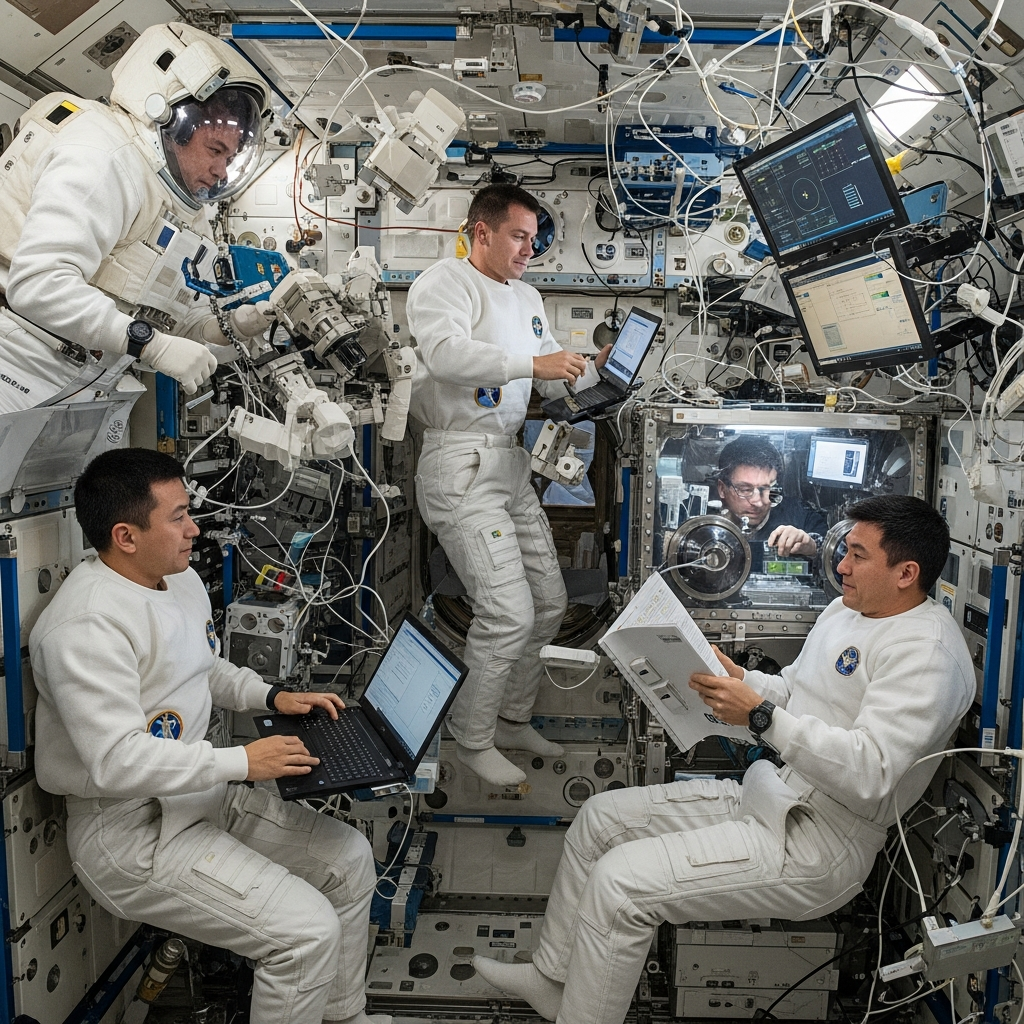
The International Space Station (ISS) is currently operating with a significantly reduced “skeleton crew,” a situation creating operational challenges for the orbital laboratory. A highly anticipated resupply of astronauts, the SpaceX Crew-12 mission, has faced yet another delay, pushing its launch target to Thursday, February 12. This critical mission aims to restore the ISS to its full complement of seven astronauts, easing the burden on the three dedicated spacefarers currently managing the outpost.
The Critical Crew-12 Mission: Bringing Relief to Orbit
NASA and SpaceX are working tirelessly to prepare for the Crew-12 mission. This vital launch will send four fresh astronauts to the International Space Station. The mission includes NASA astronauts Jessica Meir and Jack Hathaway, ESA (European Space Agency) astronaut Sophie Adenot, and cosmonaut Andrey Fedyaev from Roscosmos. Their arrival is paramount to resuming full-scale scientific research and maintenance tasks aboard the orbital outpost.
The launch is set for 5:38 a.m. EDT (1038 GMT) from Space Launch Complex-40 (SLC-40) at Cape Canaveral Space Force Station in Florida. The Crew Dragon capsule “Freedom” sits atop a powerful Falcon 9 rocket, poised to carry its precious cargo into space. However, this critical launch has encountered hurdles, pushing its departure back from an earlier target date.
Why the Delay? Weather and Minor Technical Hurdles
The primary reason for the Crew-12 mission’s most recent delay stems from unpredictable weather patterns. Mission managers, on Monday, February 9, adjusted the target launch date due to a forecast of poor conditions on Wednesday, February 11. Specifically, high winds posed a significant risk. Steve Stich, NASA’s Commercial Crew Program manager, explained that a low-pressure system was driving winds up to 24 to 28 knots (27.6 to 32.2 mph) along the Eastern seaboard. These conditions are particularly hazardous in potential abort staging areas.
Ensuring astronaut safety is the absolute priority for every human spaceflight mission. Even a marginally better forecast for Thursday, February 12, requires reassessment on Tuesday, February 10. This means further adjustments to the launch schedule remain a possibility.
Beyond the weather, teams are diligently addressing a single minor technical issue. There’s been a communication problem detected between the Crew Dragon “Freedom” capsule and launch support team members. Despite this, Stich confirmed that “the vehicles are ready, the crew’s ready, the ground systems are ready.” The launch will proceed only when all conditions are optimally safe.
Life Aboard a Skeleton ISS: Strains and Adaptations
The arrival of the Crew-12 astronauts is more urgent than usual because the ISS has been operating with a “skeleton crew” of just three individuals since mid-January. This followed the unprecedented early departure of the Crew-11 mission due to a medical evacuation. It marked the first time in the ISS’s 25-year history of continuous occupation that a crew member required such an emergency return.
Currently, the station is staffed by NASA astronaut Chris Williams and Roscosmos cosmonauts Sergey Kud-Sverchkov and Sergei Mikayev. While a three-person crew can maintain essential ISS operations, it significantly impacts daily activities and research. Historically, the ISS operated with three crew members for nearly a decade before 2009. However, the nominal crew size was later increased to seven to maximize scientific research and operational efficiency.
With the current reduced staffing, the trio primarily focuses on essential maintenance and core space station operations. This unfortunately necessitates a significant reduction in time dedicated to scientific experiments. Crucially, non-essential spacewalks (Extravehicular Activities or EVAs) are also on hold. EVAs typically require four crew members: two performing tasks outside and two providing critical support from inside. Chris Williams is solely responsible for managing the American segment of the ISS. However, NASA Associate Administrator Amit Kshatriya expressed confidence in Williams’ extensive training and confirmed he receives assistance from ground control teams and his Russian crewmates. The “skeleton crew” is expected to manage the ISS in this reduced capacity for approximately one month until Crew-12 arrives.
A Busy Launchpad: Competing Missions at Cape Canaveral
The complexity of scheduling space launches at Cape Canaveral is immense. Crew-12’s launch window is not the only activity in the bustling spaceport. Several other significant missions and tests are underway, potentially impacting the schedule.
At Kennedy’s Launch Pad 39B, NASA engineers are continuing to troubleshoot a hydrogen leak and other issues identified during a “wet dress rehearsal” (WDR) for the Space Launch System (SLS) rocket. This rocket is a crucial component of the Artemis 2 moon mission. While no immediate conflicts are foreseen for Crew-12 this week, continuous communication between teams is essential.
More directly, United Launch Alliance (ULA) has its own launch planned for Thursday. Their Vulcan rocket is slated for a mission for the Space Force, departing from Space Launch Complex-41 (SLC-41) at Cape Canaveral Space Force Station at 3:20 a.m. EDT (0820 GMT). Stich confirmed that if the abort weather conditions for the Crew Dragon are unfavorable, NASA might concede the February 12 launch window to allow the Vulcan mission to proceed, highlighting the intricate dance of launch schedules.
Ensuring Future Spaceflight Readiness at Historic Pads
In a separate but related development, SpaceX is undertaking significant maintenance at Kennedy’s historic Launch Pad 39A. The crew access arm, which previously supported Falcon 9 human spaceflight missions from this pad, is being removed and lowered to the ground. This maintenance is necessary to access and service unique bearings that attach the arm to the tower.
Bill Gerstenmaier, SpaceX’s vice president for build and flight reliability, explained that these bearings are distinct from those on SLC-40 and require the arm’s physical removal for maintenance. Once the work is completed, the arm will remain on the ground. SpaceX’s long-term strategy is to utilize Launch Pad 39A primarily for its more powerful Falcon Heavy and future Starship flights. This strategic shift means Falcon 9 launches, including crewed missions like Crew-12 (from SLC-40), are increasingly moving to other pads at the Cape. The access arm could be reinstalled if future NASA requirements necessitate a crewed launch from 39A, but it’s not an immediate priority. This foresight ensures the infrastructure is optimized for the next generation of space exploration.
Frequently Asked Questions
Why is the ISS currently operating with a skeleton crew?
The International Space Station is operating with a reduced crew of three astronauts because the four-person Crew-11 mission unexpectedly departed early in mid-January. This was due to the first-ever medical evacuation from the ISS, where one astronaut required advanced diagnostic attention only available on Earth. While a three-person crew can maintain essential operations, it significantly limits scientific research and prohibits critical tasks like spacewalks.
Where will the Crew-12 mission launch from?
The SpaceX Crew-12 mission, featuring the Crew Dragon capsule “Freedom” atop a Falcon 9 rocket, is scheduled to launch from Space Launch Complex-40 (SLC-40) at Cape Canaveral Space Force Station in Florida. This is a critical departure point for many human spaceflight missions, aimed at delivering astronauts to the International Space Station.
What are the risks or limitations of a reduced crew on the ISS?
Operating the ISS with a reduced “skeleton crew” of three astronauts poses several limitations. Scientific research time is significantly cut back, as the remaining crew prioritizes essential maintenance. Critical tasks like spacewalks (EVAs) become impossible, as they require a minimum of four crew members for safety and support. Additionally, a smaller crew makes the station more vulnerable to contingency situations or hardware malfunctions, as there are fewer hands available to respond to emergencies.
Conclusion
The ongoing delays for SpaceX’s Crew-12 mission underscore the immense complexities inherent in human spaceflight. From volatile weather systems to the meticulous maintenance of ground infrastructure, every detail must align perfectly for a safe and successful launch. The strain on the ISS’s dedicated skeleton crew highlights the critical importance of these missions. As the space community awaits the launch, it’s a stark reminder of the challenges and triumphs that define our journey of exploration beyond Earth. The safe arrival of Crew-12 will not only bring much-needed relief to the orbital outpost but also reinvigorate the scientific endeavors and operational capabilities of humanity’s most ambitious off-world laboratory.