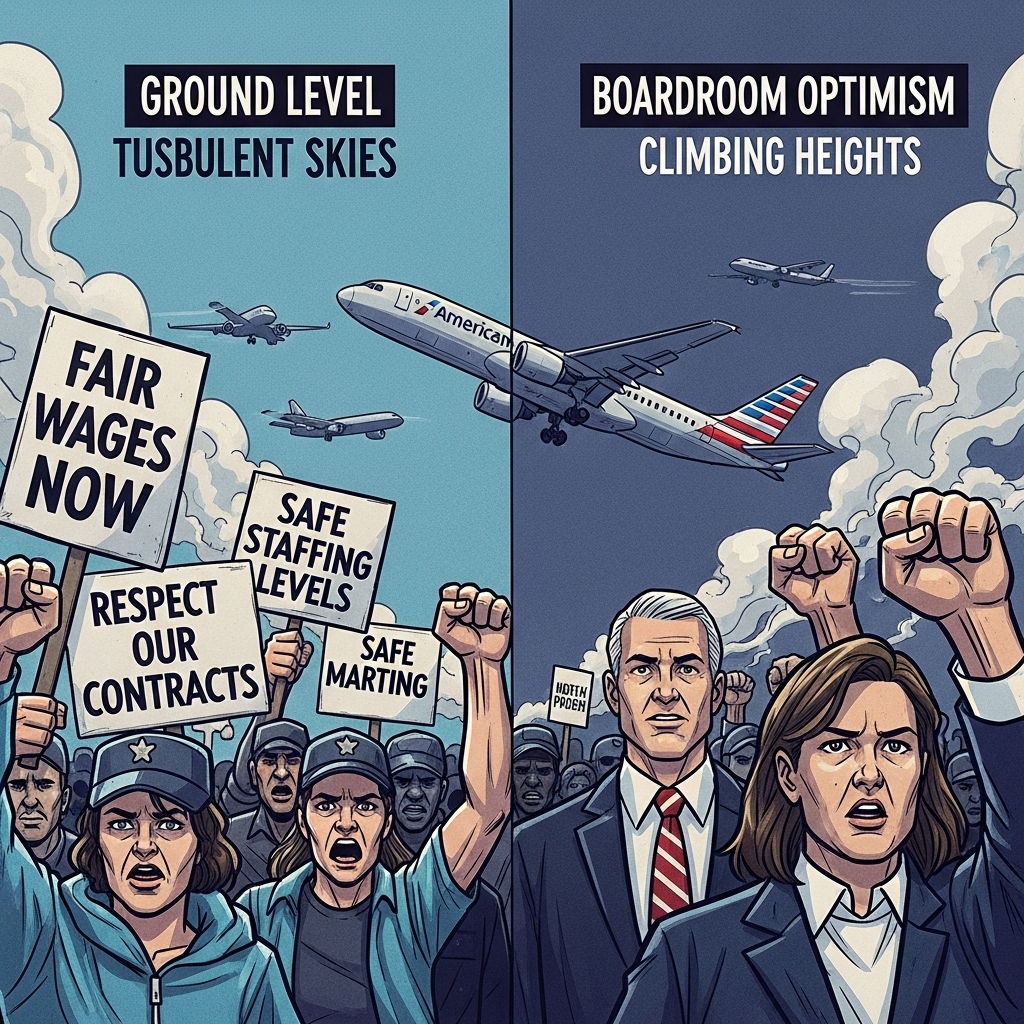
American Airlines CEO Robert Isom finds himself at the center of a significant leadership challenge. The Association of Professional Flight Attendants (APFA), representing over 28,000 flight attendants, recently delivered a historic no-confidence vote against him. This unprecedented action signals deep discontent within a crucial segment of the airline’s workforce. Yet, amidst this escalating labor tension, Isom and financial analysts project a remarkably optimistic outlook for American Airlines’ performance and profitability in 2026. This article delves into the core of these contrasting narratives, exploring the grievances fueling union anger and the financial data underpinning the executive team’s confidence.
The Unprecedented No-Confidence Vote Rocks American Airlines
The no-confidence vote against American Airlines CEO Robert Isom marks a pivotal moment in the airline’s history. It is the first time the APFA has taken such a step against a sitting chief executive. The union’s board of directors unanimously approved the measure, just weeks after publicly calling for new leadership. This collective action highlights profound dissatisfaction among frontline employees, raising questions about corporate governance and employee morale.
Flight Attendants’ Grievances: Operational Failures and Financial Woes
APFA President Julie Hedrick minced no words when articulating the union’s reasons for the vote. She pointed to a “relentless downward spiral” since Isom took the helm in March 2022. Hedrick specifically cited “abysmal profits” and mounting financial losses in the post-COVID era. She also highlighted American Airlines’ operational performance, noting it significantly lags behind major competitors.
The union’s frustrations are deeply rooted in tangible experiences. “Operational failures that have front-line Workers sleeping on floors” were a key point of contention. This directly attributes a severe lack of support for employees to CEO Robert Isom’s leadership. These instances, particularly during challenging periods like recent winter storms, underscore a perceived systemic failure at the executive level. The severe disruptions effectively “hamstrung” operations at major hubs like DFW International Airport and Charlotte Douglas International Airport, directly impacting flight attendants.
Tone-Deaf Leadership and Corporate Strategy Concerns
Beyond operational shortcomings, the APFA criticized Isom’s “tone-deaf leadership.” A notable example arose during a winter storm incident where flight attendants were forced to sleep on airport floors. Isom reportedly dismissed this by stating it was simply “part of our job.” Hedrick characterized this response as demonstrating “a complete disregard for the human element,” arguing it actively harms both the airline and its dedicated employees.
The union further raised concerns about Isom’s support for a “failed corporate sales strategy.” They allege this strategy has alienated crucial business customers. This, in turn, has contributed to a decline in American Airlines’ overall ranking within the industry. Independent evaluations reinforce these claims. American Airlines finished last in J.D. Power’s annual North American Airlines Satisfaction Study. Moreover, it tied for last place in the Wall Street Journal’s ranking of the best airlines for 2025.
Another significant point of contention revolves around compensation disparity. While CEO Isom and other top executives have reportedly seen their salaries increase, flight attendant compensation has stagnated. The union notes members are “missing out on substantial profit sharing” that should accompany their efforts. In October 2025, American Airlines unions called for management to develop a concrete turnaround strategy, a plea that APFA claims went unanswered. Their demands are clear: accountability, improved operational support, and a change in leadership.
Broader Labor Tensions Echo Across the Airline
The APFA’s no-confidence vote is not an isolated incident. Tensions between American Airlines’ management and other employee groups are reportedly escalating. The Allied Pilots Association (APA), which represents the company’s pilots, has also voiced strong criticism of Robert Isom and the broader management team. Following a message from APA advocating for “decisive action,” the pilot’s union sought a meeting with the airline’s board of directors, on which Isom serves.
In response to the pilot’s concerns, Robert Isom sent a letter agreeing to meet with APA President Nick Silva and his leadership team. He stated that the board and he are “aligned…in the desire to make American the strongest airline possible in every respect.” Isom emphasized the appropriateness of him meeting promptly to address their concerns. This indicates that the challenges facing American Airlines extend beyond a single union, affecting multiple critical labor groups.
Robert Isom’s Counter-Narrative: A Vision for 2026 Upside
Despite intense union criticism, American Airlines CEO Robert Isom maintains a confident stance regarding the airline’s future. He asserts that American Airlines Group (NASDAQ: AAL) is “positioned for significant upside in 2026.” This optimistic outlook is not merely speculative; it is reportedly backed by strong financial results and positive analyst sentiment.
Strong Q4 2025 Results and Debt Reduction
The airline released its Q4 2025 results on January 27, demonstrating robust financial performance. American Airlines reported a record fourth-quarter revenue of $14 billion. The full-year revenue also reached a record high of $54.6 billion. These impressive figures were achieved despite an estimated $325 million impact from a government shutdown. Beyond revenue growth, the company also successfully reduced its net debt by $2.1 billion, signaling financial prudence and stability. This financial strength underpins Isom’s forward-looking statements about the company’s trajectory.
Bullish 2026 Projections and Analyst Confidence
Looking ahead, Robert Isom projects significant growth for American Airlines in 2026. He anticipates total revenue growth for the first quarter to be between 7-10%. Earnings Per Share (EPS) for the full year 2026 are expected to range from $1.70 to $2.70 per share. This forecast represents a substantial 10x to 16x increase compared to 2025’s results, indicating a strong rebound in profitability.
These positive developments have resonated with financial analysts, leading to increased confidence in AAL stock. BMO Capital, citing the above-consensus Q4 results, strong management guidance, and debt reduction, raised its target price for AAL from $16.75 to $17.00 on January 28. The firm even suggested that persistent demand momentum could push American Airlines toward the higher end of its 2026 guidance. On the same day, JP Morgan also updated its model post-earnings report, raising its target price for AAL from $20 to $22.
Analyst ratings further illustrate this confidence. CNN data indicates that approximately 54% of analysts covering AAL currently hold a “Buy” rating. Another 43% recommend a “Hold,” with only a small minority suggesting a “Sell.” The median target price among analysts is $17.32, implying a potential upside of 27.30%. The highest analyst estimate of $22.00 implies an even greater upside of 61.65%. Isom’s strategy for maximizing revenue potential focuses on an elevated customer experience, optimizing their network and fleet, building loyalty partnerships, and advancing sales and revenue management. He believes 2026 is when these multi-year efforts “bear fruit.”
Navigating the Crossroads: What Lies Ahead for American Airlines?
The current landscape for American Airlines presents a stark dichotomy. On one side, significant portions of its workforce express deep dissatisfaction with Robert Isom’s leadership, citing operational failures, stagnant compensation, and perceived tone-deafness. These “American Airlines union criticism” issues are not isolated; they represent broader challenges in “airline executive leadership” and “labor relations.” On the other side, the airline’s financial reports paint a picture of strong recovery and promising growth for 2026, bolstering investor confidence.
The challenge for Robert Isom and American Airlines lies in bridging this gap. Rebuilding trust with employees, especially after a historic “APFA no-confidence vote,” is critical for long-term “American Airlines performance.” Happy and supported frontline workers are fundamental to delivering the “consistent, elevated customer experience” that Isom himself identifies as a key strategic pillar. Investors may be optimistic about the financial trajectory, but sustained labor unrest could ultimately impact operational stability and, consequently, future profitability. The coming months will be crucial for observing how American Airlines’ management addresses these complex internal and external pressures.
Frequently Asked Questions
What led to the no-confidence vote against AA CEO Robert Isom?
The Association of Professional Flight Attendants (APFA) passed a historic no-confidence vote against American Airlines CEO Robert Isom due to a “relentless downward spiral” in the airline’s performance since March 2022. Key reasons include “abysmal profits,” operational failures leading to frontline workers sleeping on airport floors, a perceived “tone-deaf” response from Isom regarding these issues, a “failed corporate sales strategy,” and significant disparities in executive versus flight attendant compensation. The union also cited American Airlines’ low rankings in customer satisfaction and overall industry performance.
How does American Airlines’ financial performance compare to competitors despite union criticism?
Despite intense union criticism, American Airlines reported record Q4 2025 revenue of $14 billion and a full-year revenue of $54.6 billion. The airline also reduced its net debt by $2.1 billion. However, these figures trail competitors in terms of net income. For instance, American’s $99 million net income was significantly lower than United Airlines’ $1 billion and Delta Air Lines’ $1.2 billion in the same period. While CEO Robert Isom projects significant revenue growth and a 10x-16x increase in EPS for 2026, the current profitability gap remains a point of contention and comparison within the industry.
What does the no-confidence vote mean for American Airlines’ future?
The no-confidence vote signifies a severe breakdown in trust and communication between American Airlines’ flight attendants and CEO Robert Isom’s leadership. For the airline’s future, it creates pressure for management to address employee grievances, improve operational support, and potentially revisit corporate strategy. While Isom and financial analysts remain optimistic about American Airlines’ financial projections for 2026, ongoing labor disputes and low employee morale could impact customer experience, operational reliability, and the airline’s overall market perception. The resolution of these tensions will be crucial for American Airlines’ long-term stability and growth.
The road ahead for American Airlines is undoubtedly complex. The stark contrast between the union’s calls for accountability and the bullish financial forecasts paints a picture of a company at a critical juncture. For Robert Isom, the challenge lies in unifying a fractured workforce while simultaneously delivering on ambitious financial promises. How American Airlines navigates these internal and external pressures will ultimately determine its trajectory in the competitive airline industry. Industry observers and stakeholders will closely watch how these challenges are addressed, and whether the promised “benefits of our work in 2026” truly materialize for all.