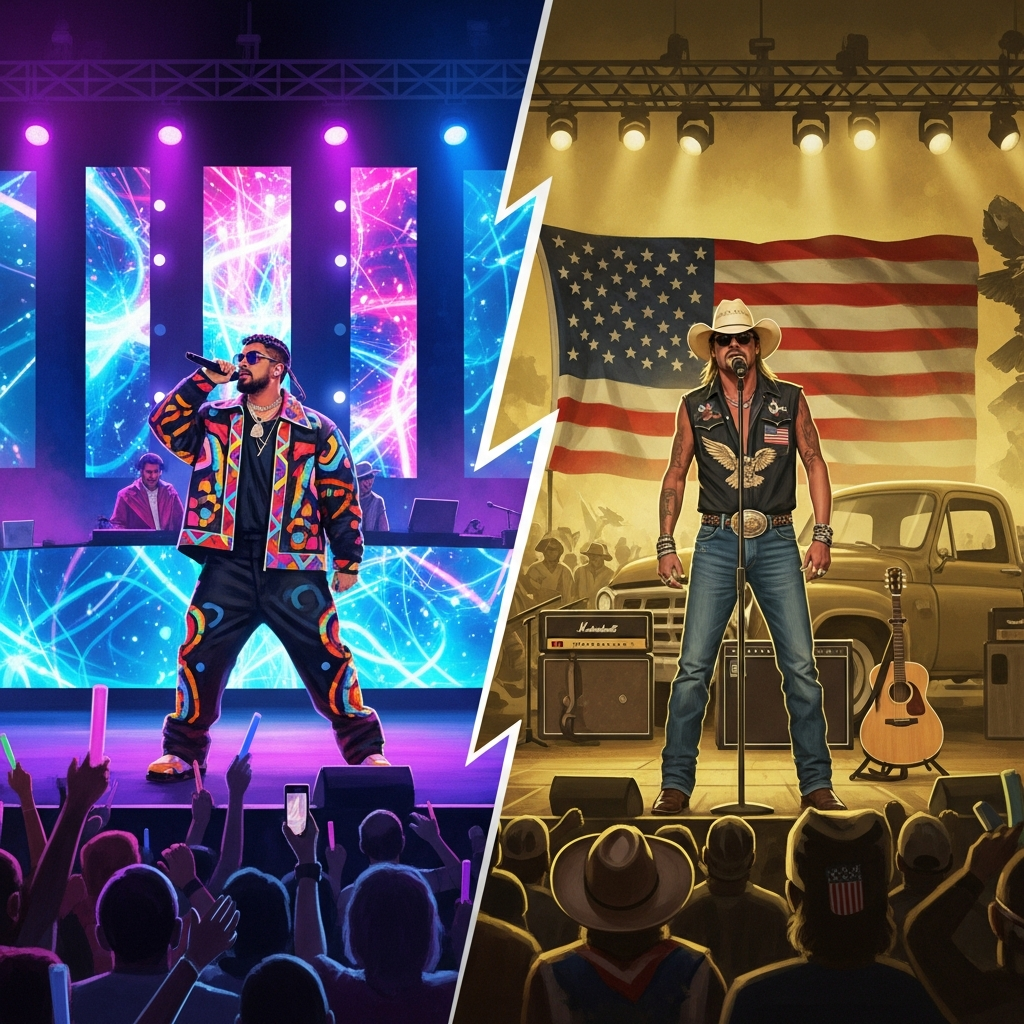
The Super Bowl LX halftime show wasn’t just about football; it became a vivid cultural battleground. While Grammy winner Bad Bunny delivered a vibrant, inclusive performance hailed as a celebration of America’s diverse spirit, a conservative alternative, fronted by Kid Rock, positioned itself as the “All-American” counter-narrative. This created a stark contrast, forcing audiences to question: what truly embodies American patriotism in today’s entertainment landscape? This deep dive explores the two shows, their intentions, and their indelible impact on viewers nationwide.
Bad Bunny’s Halftime Show: A Celebration of Modern America
Bad Bunny’s official Super Bowl LX halftime show was a joyous, star-studded affair. Featuring artists like Lady Gaga, Ricky Martin, Karol G, and Cardi B, the performance radiated messages of unity and pride. Visual storytelling brought to life the “American dream,” depicting diverse workers, elderly folks, female friendships, and unabashed jubilation. Even for those who didn’t speak Spanish, the visual narrative powerfully evoked a nation built on talent and embraced differences.
Music critics and fellow artists widely praised Bad Bunny’s performance. Eight-time Grammy winner Kacey Musgraves declared, “Well. That made me feel more proudly American than anything Kid Rock has ever done.” Country singer Rissi Palmer underscored the depth of Bad Bunny’s message, quoting his Spanish opening: “My name is Benito Antonio Martinez Ocasio. And if today I’m here at the Super Bowl, it’s because I never, never stopped believing in myself.” Palmer emphasized that this journey from grocery store bagger to Super Bowl headliner was “what was needed for this moment,” embodying the American dream itself. The show concluded with a powerful message displayed on a massive screen: “The only thing more powerful than hate is love,” a poignant statement resonating far beyond the stadium.
The Genesis of an “All-American” Counter-Show
In stark contrast, the “All-American Halftime Show,” organized by conservative group Turning Point USA (TPUSA), emerged from a wave of conservative backlash. Outrage from the MAGA faithful over the selection of Bad Bunny, a proud Puerto Rican artist who performs in Spanish, fueled the creation of this alternative event. Critics implicitly weaponized patriotism, with TPUSA covertly surveying fans and offering “Anything in English” as a preferred music choice. This ignored the fact that Bad Bunny, born in Puerto Rico, is a U.S. citizen, incorrectly labeling him a “foreigner.”
Former President Donald Trump publicly joined the chorus of criticism, calling the NFL’s halftime show “absolutely terrible, one of the worst, EVER!” He specifically disparaged Bad Bunny’s performance, stating, “Nobody understands a word this guy is saying, and the dancing is disgusting.” This partisan criticism set the stage for TPUSA’s counter-programming, an event predicated on outrage and a narrow definition of American identity.
Turning Point USA’s “All-American” Lineup and Commercial Undertones
The TPUSA event, held at Levi’s Stadium, featured a lineup of country artists alongside headliner Kid Rock. Brantley Gilbert, Lee Brice, and Gabby Barrett rounded out the roster. From its opening moments, the broadcast revealed a strong commercial undertone. Viewers were greeted with constant merchandising pitches and requests for text sign-ups, signaling a focus on commercial opportunism rather than genuine entertainment. “Wear the mission. Text merch to 71776 for official TPUSA merch,” a chyron blared nonstop, setting a distinctly transactional tone for the evening.
While the alternative show garnered significant online viewership, with its YouTube livestream reaching as high as 5 million viewers according to some reports, its quality and reception were deeply polarized. Many proponents lauded it as a “patriotic alternative,” expressing satisfaction with its nationalistic tone. However, numerous critics quickly emerged, finding the event underwhelming and poorly executed.
A Performance Plagued by Low Energy and Stumbles
From a critical perspective, the “All-American Halftime Show” was described as a “slapdash” and “half-hearted” endeavor. Brantley Gilbert’s guitarist kicked things off with a solo electric guitar rendition of “The Star-Spangled Banner” that critics found uninspired, struggling to elicit more than polite applause. Gilbert’s subsequent set, described as “inoffensive twang,” felt devoid of emotional resonance, with his hip-hop verse in “Dirt Road Anthem” being particularly “ear-demolishing.” His stated motivation for taking the gig — imagining his kids watching him perform — was perceived as disingenuous, likely aimed at carving out a niche MAGA audience and securing appreciative Fox News appearances.
The event, which reportedly struggled with live audience attendance and maintained a subdued atmosphere despite its online reach, continued with performances that failed to impress. Lee Brice’s three-song set was aptly summarized by his closer, “Hard to Love,” while Gabby Barrett’s two-song performance suggested neither artist was yet ready for prime time. Their alignment with the MAGA crowd was seen by some as a career gambit, their only hope for elevating their public profiles.
Kid Rock’s Uneven Headlining Act
The highlight, or perhaps the most unexpected moment, came from headliner Kid Rock. Starting energetically with bright lights, a big flag, and a huge fur coat, he launched into his nearly 30-year-old rap-rock anthem “Bawitdaba.” For a moment, it provided fleeting entertainment. However, critics noted that the self-described “American Bad Ass” eventually “just kinda…stopped” lip-syncing to the backing track, marking the night’s only truly unscripted moment. His later reintroduction, by his government name Robert James Ritchie, for a somber cover of Cody Johnson’s “‘Til You Can’t,” created a jarring tonal shift.
Kid Rock’s presence highlighted his evolving political persona. Prior to 2016, his most significant political affiliation was stumping for Mitt Romney. However, after his singles last hit the Billboard Hot 100, he fully embraced Donald Trump, leveraging “partisan relevancy” for financial gain. This trajectory positioned him as another figure “riding that wave of partisan relevancy,” appearing at various functions and benefiting from the “MAGA thing” with merch stores full of American flag gear.
Echoes of Disappointment: Public and Political Reactions
The “All-American Halftime Show” largely failed to captivate broader audiences or even its intended demographic. Slate.com’s review derided it as “utter lameness,” highlighting a struggle to compete with mainstream pop culture. Zach Bryan, a Billboard 200 chart-topper, publicly mocked the TPUSA show, sharing an Instagram reel depicting someone pointedly avoiding Bad Bunny’s performance to watch Kid Rock. His sardonic caption read, “What Kid Rock actually thinks is happening across America.”
Even former President Trump, despite his harsh condemnation of Bad Bunny, appeared to tune into the mainstream event, slamming it on Truth Social minutes after it ended. His implied hypocrisy further underscored the performative nature of some of the outrage. Influencer Jake Paul, who resides in Puerto Rico, also controversially urged fans to “purposefully turn off the halftime show,” accusing Bad Bunny of being “a fake American citizen performing who publicly hates America.” This revealed a deep cultural and ideological chasm surrounding the event.
Defining American Patriotism: Two Divergent Visions
The contrasting Super Bowl halftime shows ultimately offered two vastly different interpretations of American patriotism. Bad Bunny’s performance celebrated a vibrant, diverse nation, filled with talented people from various backgrounds who embody the American dream through hard work and unity. His show was a declaration of love, inclusion, and the strength found in differences. It subtly yet powerfully communicated that “God Bless America” is a sentiment that can be expressed in myriad ways, across languages and cultures.
In stark contrast, the Turning Point USA show, despite its “All-American” branding, often felt like a commercially driven endeavor. It presented a narrower, more exclusive vision of patriotism, fueled by perceived grievances and implicitly xenophobic undertones. While some viewers found it genuinely patriotic, many others saw it as a financially motivated “grift,” lacking the genuine emotional resonance and universal appeal of the official Super Bowl performance. The two events served as a microcosm of a broader cultural divide, each ending with a dramatically different message: Bad Bunny’s with “The only thing more powerful than hate is love,” and TPUSA’s with “Get involved,” alongside a QR code soliciting donations.
Frequently Asked Questions
What motivated Turning Point USA to host an alternative Super Bowl Halftime Show?
Turning Point USA (TPUSA) organized the “All-American Halftime Show” primarily in response to conservative outrage over the NFL’s selection of Bad Bunny for the official Super Bowl LX halftime show. Many “MAGA faithful” expressed dissatisfaction that a Puerto Rican artist who performs in Spanish was chosen. TPUSA implicitly fueled this sentiment by surveying fans about preferred music choices, with “Anything in English” being an option. The event aimed to offer a “patriotic alternative” to what was perceived as a “woke” or un-American mainstream performance.
Which artists performed at the Turning Point USA “All-American” Halftime Show?
The Turning Point USA “All-American Halftime Show” featured a lineup of country artists alongside its headliner. The performers included Brantley Gilbert, Lee Brice, and Gabby Barrett. The main act of the night was Kid Rock, who performed some of his well-known songs and a cover. The event notably concluded with a tribute to Turning Point USA founder Charlie Kirk, a detail highlighted by coverage from Fox News and NPR.
How did critics and the public react to the Bad Bunny vs. Kid Rock Super Bowl halftime shows?
Reactions were deeply polarized. Bad Bunny’s official Super Bowl performance received widespread critical acclaim and praise from many artists and the public, lauded for its joyous, inclusive, and diverse celebration of the American dream. Artists like Kacey Musgraves and Rissi Palmer praised it as truly American. Conversely, the Turning Point USA show featuring Kid Rock garnered a mixed reception. While millions streamed it online and some proponents called it “patriotic” and “awesome,” critics widely panned it as “underwhelming,” “slapdash,” and lacking quality, with specific criticisms aimed at the performances and its commercial nature.
Conclusion: A Clear Winner in the Battle for American Spirit
The 2026 Super Bowl halftime events became more than just musical performances; they served as a telling barometer of America’s cultural pulse. Bad Bunny’s performance, rich in diversity and unified celebration, resonated as a powerful embodiment of the modern American spirit. It was an authentic, heartfelt display that championed inclusion and the pursuit of dreams. In stark contrast, Turning Point USA’s “All-American” counter-show, despite its patriotic branding, largely fell flat for critics, marred by commercial undertones and uneven performances. Ultimately, while both shows claimed to represent America, Bad Bunny’s vibrant, unifying message proved far more resonant, reflecting a dynamic and evolving definition of what it truly means to be American.