NASA’s Mars Curiosity rover is embarking on a critical new phase in its decadal search for alien life. Fresh from reconnecting with Earth after a solar conjunction, the rover is gearing up for a rare and energy-intensive experiment at the “Nevado Sajama” drill site. This mission, focusing on the detection of organic molecules—the fundamental building blocks of life—promises to unlock deeper secrets about Mars’s past habitability and potentially reshape our understanding of life beyond Earth.
Unveiling Martian Secrets: Curiosity’s Latest Organic Hunt
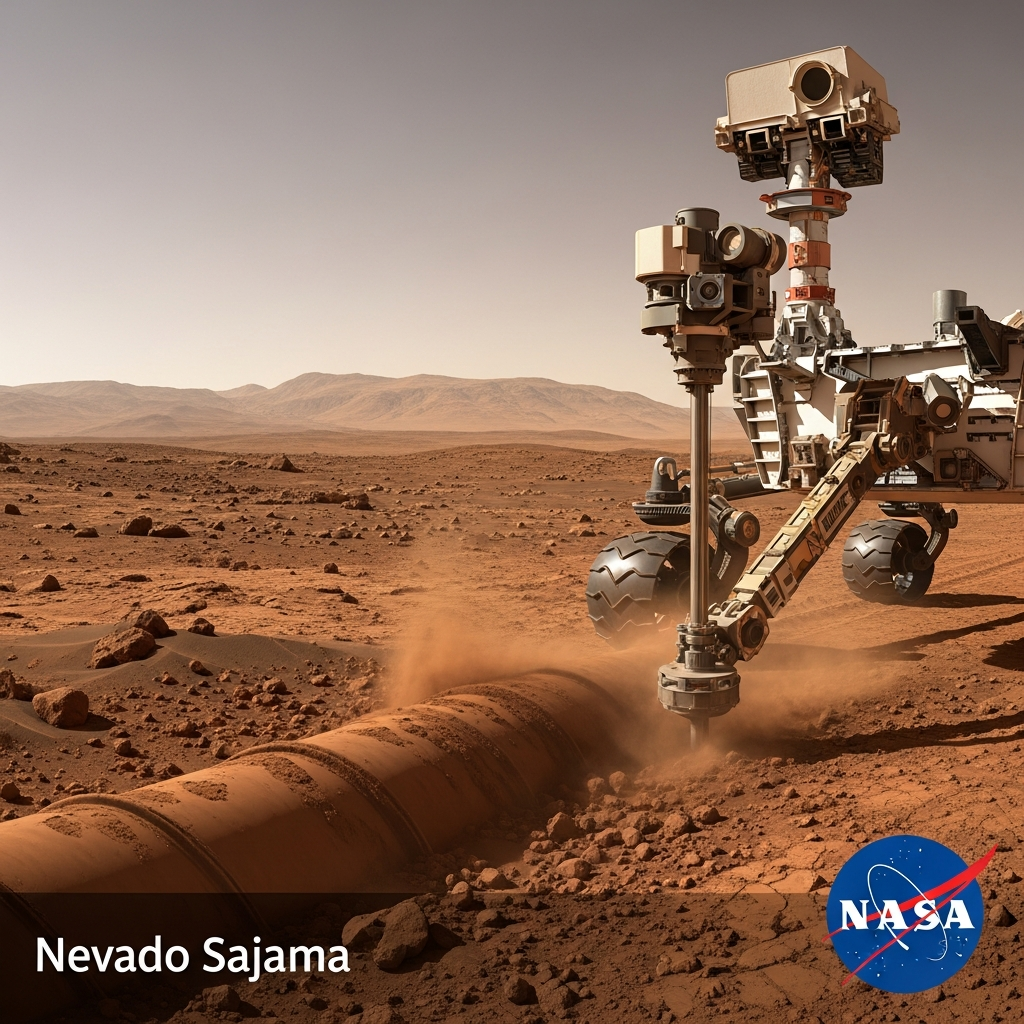
In late January 2026, on its 4,789th Martian day (Sol 4789), the Curiosity rover meticulously prepared for a groundbreaking drill operation. This new site, just centimeters from its previous “Nevado Sajama” drilling location from November, is chosen for a singular, high-stakes purpose. The rover’s Sample Analysis at Mars (SAM) instrument will deploy its last remaining container of tetramethylammonium hydroxide (TMAH). This potent chemical is vital for effectively extracting and identifying organic molecules locked within the Martian rock samples.
The TMAH experiment is not only rare but also incredibly demanding on Curiosity’s power reserves. To ensure success, a rehearsal of the sample handoff to SAM was completed earlier in the week. This intense focus means other scientific activities are limited, a testament to the experiment’s significance. However, the team has capitalized on previous extensive imaging of the area. This ensures a rich dataset of the surroundings, allowing Curiosity to allocate its minimal extra energy to crucial environmental observations. With Mars now deep into its dusty season, monitoring local dust devils and wider atmospheric dust concentrations remains a top priority.
The Science Behind TMAH
Tetramethylammonium hydroxide (TMAH) acts as a chemical “key” to unlock buried organic molecules. When mixed with rock samples, TMAH helps break down the mineral matrix, releasing complex organic compounds that might otherwise remain undetectable. This method is particularly effective for revealing thiophenes and other carbon-sulfur molecules that could be signatures of ancient biological processes or the remnants of primordial chemistry. The successful deployment of this final TMAH container is a make-or-break moment for this specific line of organic investigation for Curiosity.
A Legacy of Discovery: Curiosity’s Past Organic Findings
The current TMAH experiment builds upon a rich history of discoveries by the Curiosity rover since its landing in Gale Crater in 2012. Curiosity has already made significant strides in proving Mars was once capable of supporting microbial life. Early in its mission, the rover provided compelling evidence of ancient rivers and lakes, existing 3 to 3.5 billion years ago, complete with the necessary chemical ingredients for life. These findings revealed Mars to be intrinsically gray beneath its rusty surface, further highlighting hidden geological processes.
A monumental breakthrough came in 2018 when Curiosity’s SAM instrument confirmed the presence of diverse organic molecules, specifically thiophenes, within 3-billion-year-old mudstone samples from Gale Crater. Researchers, including planetary science astrobiologist Jennifer Eigenbrode of NASA’s Goddard Space Flight Center, found these molecules after heating samples to over 500 degrees Celsius. This high-temperature approach was crucial to burn off perchlorate salts, which are known to destroy organic material and had complicated earlier analyses. This discovery addressed Mars’ long-standing “missing carbon” mystery, suggesting well-preserved carbon reservoirs exist beneath the surface.
Unraveling the Methane Mystery
Beyond solid organics, Curiosity has also detected fluctuating levels of methane in the Martian atmosphere above Gale Crater. While a background level of about 0.4 parts per billion persists, methane levels show a distinct seasonal pattern, peaking significantly in Martian summer. On Earth, methane is predominantly produced by microbes, leading to tantalizing hypotheses for Mars:
Geological release: Water interacting with rocks deep underground could produce methane.
Ancient release: Methane trapped in subsurface ice and rock could be released as temperatures rise.
Biological activity: Subsurface Martian microbes, known as methanogens, could periodically produce methane.
While these findings are not definitive proof of life—as methane and simple organic molecules can also form through abiotic geological processes—they are powerful clues guiding the ongoing search.
Beyond Curiosity: Perseverance Joins the Hunt for Life
The quest for Martian organics is not exclusive to Curiosity. NASA’s Perseverance rover, which landed in Jezero Crater in 2021, represents the next generation in this search. Perseverance’s mission, exploring an ancient lakebed and river delta estimated to be 3.7 billion years old, has focused on collecting intact rock samples for eventual return to Earth. This is a key difference from Curiosity’s in-situ analysis.
Perseverance is equipped with the advanced SHERLOC (Scanning Habitable Environments with Raman & Luminescence for Organics & Chemicals) instrument. SHERLOC uses an ultraviolet laser to identify and map diverse organic molecules and minerals on rock surfaces, creating a spectral “fingerprint.” Within its first 400 days, SHERLOC detected a variety of carbon-based compounds in rock targets like “Garde” and “Quartier.” More recently, in July 2024, Perseverance uncovered potential signs of ancient microscopic life, including organic-carbon-bearing mudstones containing specific iron phosphate and sulfide minerals (vivianite and greigite) in the “Sapphire Canyon” area of Jezero. These minerals are considered potential biosignatures, hinting that bacterial processes might have contributed to their formation.
The Mars Sample Return (MSR) Initiative
Both Curiosity’s and Perseverance’s findings underscore the ultimate importance of the Mars Sample Return (MSR) campaign. While rovers can identify organics and potential biosignatures, definitive proof of biological origin often requires sophisticated laboratory equipment far beyond what can be deployed on Mars. Perseverance is actively caching drilled core samples, which will be retrieved by a future “fetch rover” mission, launched into Martian orbit, and eventually returned to Earth for unprecedented detailed analysis. This ambitious international collaboration between NASA and ESA is considered the “holy grail” of Mars science, holding the key to truly answering whether life once existed on the Red Planet.
The Quest for Life: What Martian Organics Really Mean
Finding organic molecules on Mars is a significant step, but it’s crucial to understand what it implies. Organics are the chemical building blocks of life, but their presence alone doesn’t prove life exists or ever existed. They can also form through non-biological (abiotic) geological processes, such as reactions between water and rock, or arrive on Mars via meteorites. The challenge lies in distinguishing between biogenic (formed by life) and abiogenic origins.
Scientists use a “Confidence of Life Detection” (CoLD) scale to rigorously interpret observations, stressing a cautious approach. While the evidence from Curiosity and Perseverance is compelling, firm conclusions regarding ancient Martian life await advanced analysis in terrestrial laboratories. If future analysis confirms ancient life, it would be a monumental achievement, demonstrating life’s ability to arise in diverse chemical environments or suggesting a common evolutionary pathway between Earth and Mars.
Navigating the Red Planet: Challenges for Future Missions
Despite the incredible scientific bounty, Mars presents immense challenges for exploration, particularly for future human missions. The Curiosity mission has highlighted several critical obstacles:
Perchlorates: These toxic compounds, present in Martian soil, pose a health risk to humans.
Dust storms: Frequent, pervasive, and sticky dust can interfere with equipment and human health.
Radiation: High levels of solar and cosmic radiation necessitate robust shielding.
Temperature extremes: Daily temperature swings of 60 to 80 degrees Celsius make environmental control difficult.
Even with these hurdles, many experts, like Jennifer Eigenbrode, believe that “humans on the ground might be our best means of studying Mars,” offering flexibility and direct observation that rovers cannot fully replicate. Technologies like the Ingenuity helicopter and the MOXIE instrument (which generates oxygen from CO2) on Perseverance are pioneering solutions for future human habitation.
Frequently Asked Questions
What is the primary goal of Curiosity’s latest experiment at Nevado Sajama?
Curiosity’s latest experiment at the “Nevado Sajama” drill site, planned for late January 2026, aims to identify organic molecules within Martian rock samples. It uses the rover’s last container of tetramethylammonium hydroxide (TMAH) with its SAM instrument. TMAH is a chemical designed to help break down the rock matrix and release these vital carbon-based compounds, bringing scientists closer to understanding Mars’s past habitability.
How do NASA’s Curiosity and Perseverance rovers differ in their approach to finding organics?
The Curiosity rover primarily conducts in-situ analysis, meaning it analyzes rock and soil samples directly on Mars using instruments like SAM (Sample Analysis at Mars), which heats samples to identify organic molecules. In contrast, the Perseverance rover focuses on collecting and caching intact rock core samples for future return to Earth* via the Mars Sample Return (MSR) campaign. Perseverance uses its SHERLOC instrument for preliminary organic detection and mapping on Mars, but definitive analysis of these samples will happen in terrestrial laboratories.
Why is finding organic molecules on Mars not considered definitive proof of life?
While finding organic molecules is a crucial step, it’s not definitive proof of life because these carbon-based compounds can arise from both biological (biogenic) and non-biological (abiogenic) processes. For example, organics can be delivered by meteorites or form through geological interactions between water and rock. Scientists require more conclusive evidence, such as specific molecular structures unequivocally linked to biological processes or the return of samples to Earth for advanced, unambiguous laboratory analysis, to confirm the past or present existence of Martian life.
The Future of Astrobiology: An Enduring Search
The ongoing missions of Curiosity and Perseverance represent humanity’s enduring quest to understand our place in the cosmos. Each drill, each spectrum, and each cached sample brings us closer to answering one of science’s most profound questions: Is there, or was there, life beyond Earth? The meticulous work of scientists and engineers, combined with the groundbreaking capabilities of these rovers, promises a future where the secrets of the Red Planet may finally be fully revealed. As Carl Sagan wisely noted, if life exists on Mars, “Mars then belongs to the Martians, even if the Martians are only microbes,” underscoring the immense scientific and ethical implications of such a discovery. The search continues, with every new finding further enriching our cosmic perspective.