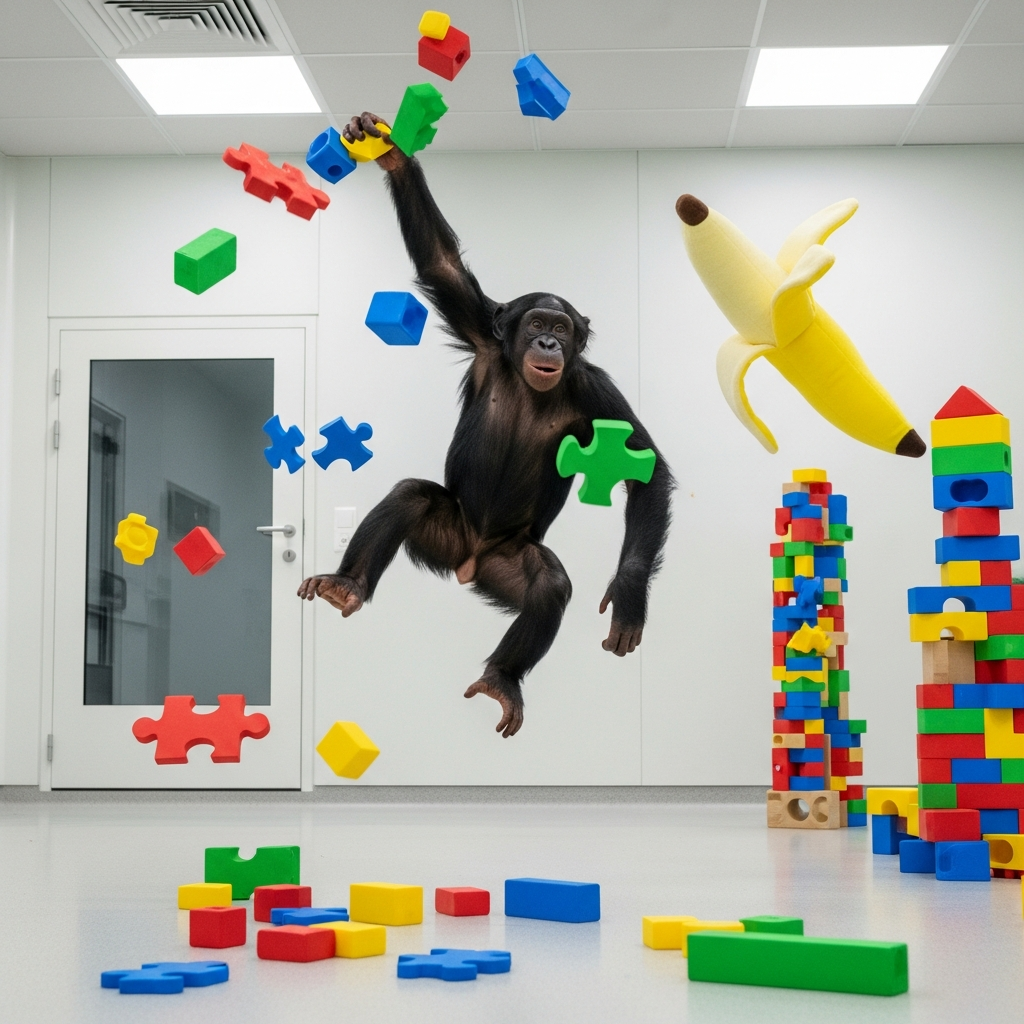
For generations, the ability to imagine and engage in make-believe was considered a hallmark of human intelligence. Yet, groundbreaking new research featuring a remarkable bonobo named Kanzi is challenging this long-held belief, suggesting that the intricate world of pretend play might not be ours alone. This revolutionary study offers compelling evidence that bonobos possess “secondary representation,” the complex cognitive capacity to hold both an imagined scenario and current reality in mind simultaneously. It’s a discovery that could fundamentally reshape our understanding of animal intelligence and the very origins of imagination itself.
Challenging the Myth of Human-Exclusive Imagination
Scientists have long posited that our species holds a unique claim to cognitive abilities like imagination, planning, and abstract thought. While anecdotal observations of primates engaging in seemingly pretend behaviors—such as young chimpanzees playing with a “log doll” or moving imaginary blocks—have occasionally surfaced, rigorous experimental evidence remained elusive. This new study, published in the esteemed journal Science in early 2026, bridges that gap. It provides the first controlled demonstration of an animal understanding and participating in make-believe, echoing the imaginative play seen in human toddlers.
The research not only confirms that non-human primates can pretend but also suggests that the foundational cognitive machinery enabling such imagination could be far more ancient than previously thought. This shared capacity likely traces back millions of years to a common ancestor of both humans and bonobos, prompting a vital re-evaluation of what makes our species truly exceptional.
The Revolutionary Bonobo Tea Party: Kanzi’s Moment
The core of this paradigm-shifting research centered on a series of ingeniously designed experiments led by Chris Krupenye, an assistant professor at Johns Hopkins University, and comparative psychologist Amalia Bastos from the University of St Andrews, UK. Their goal was to test bonobo imagination in a controlled setting, much like childhood development tests. The star subject was Kanzi, a bonobo renowned for his lifelong contributions to primatology and his unique communication skills.
Researchers staged a “make-believe tea party” for Kanzi at the Ape Initiative in Des Moines, Iowa. The setup was simple yet profound:
Imaginary Juice Test: Using an empty, transparent pitcher and two empty bottles, a researcher mimed pouring invisible juice into both bottles. Then, they pretended to pour the contents of one bottle back into the pitcher. Kanzi was then prompted to indicate where the imaginary juice remained. Astonishingly, Kanzi pointed to the bottle that would still contain juice, if it were real, in 34 out of 50 trials—a 68% success rate, consistent with typical cognitive testing for apes. This implied he could track a non-existent object while understanding its unreality.
Reality Check Experiment: To ensure Kanzi wasn’t just guessing or mistaking the pretend juice for real, he was offered a choice between a cup of actual juice and a cup of pretend juice. Kanzi overwhelmingly chose the real juice 14 out of 18 times, confirming his clear ability to distinguish between tangible rewards and imaginary ones. This also validated his visual acuity and understanding of the task.
Imaginary Grapes Test: A third experiment replicated the first, but this time used imaginary grapes instead of juice. Researchers mimed placing grapes in two jars, then “emptied” one. Kanzi again successfully identified the location of the “pretend grape” in 69% of trials, reinforcing the consistency of his imaginative understanding across different scenarios.
A crucial detail highlighted by Amalia Bastos was Kanzi’s voluntary participation throughout these tests. Even when no tangible rewards were offered, Kanzi remained engaged, suggesting he genuinely enjoyed the intellectual challenge and the “game” itself.
Unpacking “Secondary Representation” and Its Cognitive Depth
These experiments offer robust evidence that Kanzi could engage in “secondary representation.” This advanced cognitive process allows the mind to model and juggle multiple scenarios, including hypothetical ones, without confusing them with current reality. Jan Engelmann, an associate professor of psychology at the University of California, Berkeley, and an expert not involved in the study, hailed these findings as a “very big step in our understanding of how nonhuman primates think.”
The ability to engage in make-believe is not merely a cute pastime; it underpins critical complex thought processes. As Kristin Andrews, a philosophy professor at the CUNY Graduate Center, explains, imagination provides an evolutionary advantage: “You can then test things out in imagination before doing it in real life.” This mental rehearsal is vital for planning, reasoning, and inferring cause and effect—skills essential for survival and innovation. Cathal O’Madagain, a cognitive scientist, further suggests that human invention is fundamentally linked to imagination, implying that if animals also possess this capacity, it would necessitate a reevaluation of their tool-making and problem-solving abilities, often dismissed as accidental discoveries.
The Remarkable Kanzi: A Linguistic Prodigy
Kanzi, who passed away in March 2025 at the age of 44, was no ordinary bonobo. Born in captivity, he became the first bonobo to understand elements of spoken English. He spontaneously learned to communicate using lexigrams—symbols representing words—by observing his mother’s training as an infant. This unique upbringing and extensive human interaction allowed Kanzi to identify several hundred lexigram symbols and respond to English prompts by pointing.
Kanzi’s extraordinary linguistic and communicative abilities raise a fascinating question: Did his language training enable his capacity for imagination, or did it merely provide a “powerful cognitive scaffold” that allowed researchers to observe an inherent ability already present in bonobos? Miguel Llorente, from the University of Girona, Spain, posited that while Kanzi’s unique circumstances likely pushed the “cognitive ceiling of his species,” his performance strongly suggests the “raw biological hardware for imagination” was already present in the common ancestor shared by humans and bonobos. Chris Krupenye acknowledges that Kanzi’s language skills might have primed him to better recognize symbols or even altered his brain. This debate highlights the profound interplay between nature, nurture, and cognitive development.
Broader Implications: Re-evaluating Human Exceptionalism
The study’s implications stretch far beyond a single bonobo’s ability to pretend. Given that bonobos are humanity’s closest living genetic relatives, sharing a common ancestor 6 to 9 million years ago, the presence of imagination in Kanzi suggests that this cognitive trait evolved much earlier than once believed. This means the capacity for make-believe might be a deeply ancient feature, shared across the ape lineage.
Experts like Jan Engelmann now propose that what truly makes humans exceptional might not be individual cognitive power, but rather our advanced social skills and unparalleled ability to collaborate. “What humans are really good at is social rationality, social cognition, and thinking together with others,” Engelmann states, suggesting that language serves as a key adaptation for this collective intelligence. This shift in perspective challenges the traditional view of human uniqueness and compels us to consider the rich mental lives of other species.
Future Research and Open Questions
While Kanzi’s performance is incredibly compelling, the researchers and external experts acknowledge an important limitation: Kanzi’s highly unique upbringing. Scientists like Natalie Awad Schwob, Chris Krupenye, and Zanna Clay of Durham University agree that further research with “more typically reared bonobos and chimpanzees” is essential. This next phase of studies will determine whether the capacity for imaginative play is specific to individuals with Kanzi’s exceptional developmental history or a more widespread characteristic across the species. Regardless, Kanzi’s lifelong contributions have profoundly advanced our understanding of both ape and human minds, encouraging us to care more deeply for these intelligent, endangered relatives.
Frequently Asked Questions
What is “secondary representation,” and how did the bonobo study demonstrate it?
Secondary representation is a complex cognitive ability that allows an individual to hold multiple scenarios in mind, including hypothetical or imagined ones, while simultaneously understanding their distinction from current reality. In the bonobo study, Kanzi demonstrated this by accurately tracking the location of “imaginary juice” or “imaginary grapes” even though he knew they were not physically present. He consistently chose the cup that would* contain the substance if it were real, showcasing his ability to mentally model a pretend situation without mistaking it for reality. Experts like Jan Engelmann and Kristin Andrews highlight this as a significant step in understanding advanced animal thought.
Who was Kanzi the bonobo, and why was he an ideal subject for this research?
Kanzi, who passed away in March 2025 at age 44, was an extraordinary bonobo born in captivity. He was the first bonobo known to understand elements of spoken English and communicate using lexigrams (symbolic words). His unique upbringing and extensive interaction with humans meant he could respond to prompts and engage in a way comparable to a human child, making him an ideal candidate for controlled cognitive experiments. His linguistic skills and readiness to participate, even without tangible rewards, allowed researchers to probe his imagination in unprecedented detail.
How does this groundbreaking study challenge our view of human intelligence and the evolution of imagination?
This study significantly challenges the long-held belief that imagination and pretend play are uniquely human traits. By demonstrating this capacity in bonobos, our closest genetic relatives, it suggests that the foundational cognitive machinery for imagination likely evolved much earlier, potentially 6 to 9 million years ago, predating the divergence of humans and bonobos. This shifts our understanding of “human exceptionalism,” prompting a reevaluation of what truly sets us apart. Experts now consider that human uniqueness might lie more in our advanced social skills and capacity for collaboration, rather than individual cognitive power. It also forces a rethink of how we interpret complex behaviors like tool-making in animals.
Conclusion
The “bonobo tea party” with Kanzi represents a pivotal moment in cognitive science, pushing the boundaries of what we thought possible in animal minds. This revolutionary research not only offers the first controlled evidence of imagination in a non-human primate but also compels us to reconsider the evolutionary timeline of such a fundamental human trait. As we continue to uncover the rich, complex mental lives of species like bonobos, our appreciation for the shared cognitive tapestry of life on Earth deepens. This study is a powerful reminder that the wonders of intelligence extend far beyond our own species, urging us to recognize, respect, and protect the profound capabilities of our animal kin.