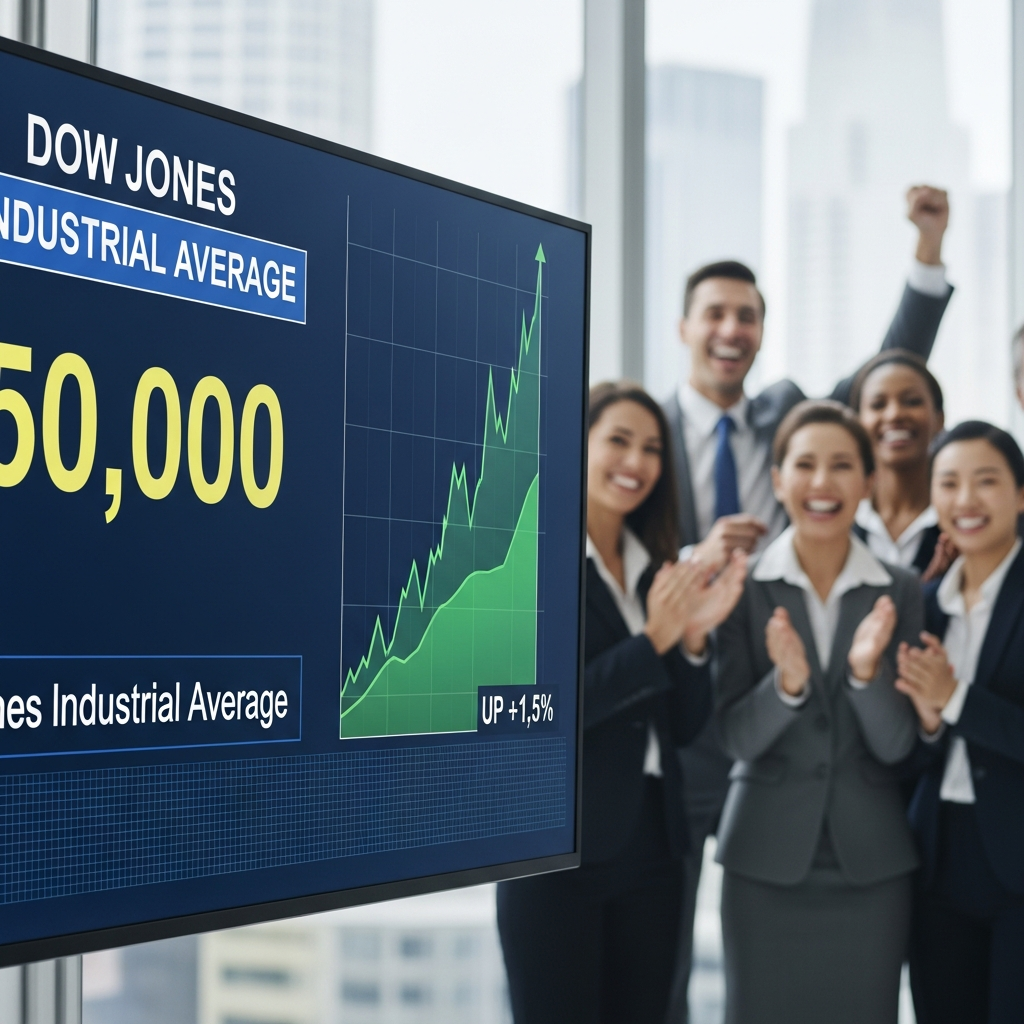
The U.S. stock market capped a volatile week with an extraordinary triumph, as the Dow Jones Industrial Average surged past the monumental 50,000 mark for the first time in history. This stock market milestone, achieved on a vibrant Friday, February 6, 2026, underscored a potent blend of technological innovation, robust corporate performance, and burgeoning investor confidence, signaling a powerful rebound after earlier jitters.
Closing at an impressive 50,015.67 points, the Dow’s 2.3% daily ascent, representing a gain of over 1,200 points, marked a significant psychological and financial barrier crossed. This unprecedented rally was not isolated; the benchmark S&P 500 concurrently climbed 2%, securing its strongest session in nearly a year, while the technology-heavy Nasdaq Composite added a robust 2.2%. These collective gains painted a picture of broad-based optimism sweeping across Wall Street.
Unpacking the Market’s Meteoric Rise
The powerful momentum driving the Dow Jones past 50,000 can be attributed to several interconnected factors. Booming tech valuations, particularly within the artificial intelligence (AI) sector, played a pivotal role. Strong corporate earnings reports and widespread hopes for future interest rate cuts further fueled investor enthusiasm. Despite experiencing pressure earlier in the week from dips in technology stocks and cryptocurrency markets, U.S. equities have shown remarkable resilience, with investors increasingly optimistic about economic prospects and largely shrugging off geopolitical tensions.
A primary catalyst for this market rally is the relentless AI boom. Leading chip manufacturers are at the forefront, with Nvidia emerging as a central figure. Jensen Huang, Nvidia’s CEO, robustly affirmed that demand for AI remains “incredibly high,” and current spending levels are sustainable. His confidence was reflected in Nvidia’s shares, which soared nearly 8% on Friday, cementing its position as a top performer and the world’s largest publicly listed company with a staggering $4.5 trillion market valuation. Other semiconductor giants like AMD and Broadcom also saw sharp jumps, contributing significantly to the major indexes’ uplift.
Big Tech’s AI Bet and Shifting Sentiments
Earlier in the week, concerns about AI’s disruptive impact and the immense capital expenditures required by major tech players had caused some market turbulence. However, Wall Street analysts and Big Tech CEOs largely downplayed these anxieties by Friday, leading to a reassessment of the sector’s outlook. This shift in perception was crucial, as these companies collectively project staggering AI investments for 2026. Microsoft, Alphabet, Amazon, and Meta, the four “hyperscalers,” are forecast to inject between $635 billion and $665 billion into AI this year, a massive 67% to 74% increase from their 2025 spending.
Amazon, however, presented a mixed picture. Despite the broader tech euphoria, its shares tumbled approximately 5.5% (after an earlier 10%+ decline) to $210.32 per share. This dip followed the company’s announcement of plans to spend around $200 billion investing in new technologies like AI and robotics in 2026, coupled with an operating income forecast that fell short of expectations. This reaction highlighted investor caution regarding large-scale, speculative expenditures, even within the promising AI sector, if immediate returns aren’t clearly defined.
Diverse Performances Across the Market Landscape
While the Dow Jones 50,000 milestone celebrated widespread gains, not all companies shared equally in the rally. Beyond Amazon’s struggles, other significant movers included:
Caterpillar (CAT): The industrial giant, a key Dow component, surged 6% to an all-time intraday high. Analysts pointed to increasing demand for Caterpillar’s energy and power systems, driven by the massive build-out of AI data center infrastructure, labeling it an “ultimate story stock” linked to major market themes.
Stellantis (STLA): The automaker, responsible for brands like Chrysler and Jeep, saw its stock plummet nearly 24% to $7.27 a share. This sharp decline came after the company revealed plans for a €22.2 billion ($26 billion) business overhaul, scaling back its electric vehicle (EV) push amid slower-than-anticipated adoption.
- “Dot-Com Era” Revival: Intriguingly, companies reminiscent of the original dot-com boom, such as Corning (GLW), Western Digital (WDC), and Cisco (CSCO), saw their stocks soar, reaching highs not seen since their earlier peaks. Corning, for example, secured a $6 billion deal with Meta to supply fiber for data center interconnections, underscoring the foundational infrastructure demands of the AI era. Telecommunications infrastructure company Lumen (LUMN) also climbed 26% on Friday, reporting $13 billion in fiber deals fueled by “insatiable demand” from AI data centers.
- www.theguardian.com
- finance.yahoo.com
Consumer Outlook and Broader Economic Signals
Beyond the dazzling stock market milestone, broader economic indicators painted a nuanced picture. A key measure of consumer sentiment moved slightly higher, with the University of Michigan’s sentiment index reporting a better-than-expected but still gloomy preliminary outlook for February. The index reached its highest point since August 2025. However, Joanna Hsu, surveys of consumers director, noted that “the overall level of sentiment remains very low from a historical perspective.”
Hsu’s analysis revealed a stark divide: consumers with the largest stock portfolios were the most optimistic, while those without stock investments remained “at dismal levels.” This underscores a potential disconnect between the surging Wall Street performance and the everyday financial realities of many Americans.
In the cryptocurrency market, a tentative risk-on tone emerged. Bitcoin (BTC-USD) climbed steadily back above $70,000, recovering from a 16-month low touched earlier in the week. Despite this Friday rebound, Bitcoin remained down almost 20% year-to-date, having wiped out all its gains since the previous presidential election. MicroStrategy (MSTR), a company with significant Bitcoin holdings, saw its stock surge over 13% as Bitcoin recovered, even as it reported a substantial operating loss and was underwater on its average Bitcoin purchase price.
Looking ahead, the January jobs report, initially delayed, will offer crucial insights into the labor market, which has shown signs of weakening. Job openings have sunk to their lowest since 2020, accompanied by a surge in layoff announcements. A Federal Reserve official indicated a higher bar for interest rate cuts, viewing current rates as within a “neutral range,” suggesting monetary policy might remain cautious despite market exuberance.
Frequently Asked Questions
What factors predominantly drove the Dow Jones Industrial Average past 50,000?
The Dow’s historic ascent past 50,000 on February 6, 2026, was primarily fueled by robust tech valuations, especially within the artificial intelligence (AI) sector. Strong corporate earnings, particularly from chip manufacturers like Nvidia, significantly contributed. Additionally, widespread hopes for future interest rate cuts by the Federal Reserve and a general bullish sentiment among investors, despite earlier market volatility, played crucial roles in this powerful market rally.
How did key sectors and individual companies perform during this significant market milestone?
While the overall market celebrated, performance varied. Tech, financial, and healthcare sectors saw strong gains. Chip companies like Nvidia, AMD, and Broadcom surged, driven by the AI boom. Industrial giant Caterpillar also performed exceptionally, benefiting from AI data center infrastructure demand. However, Amazon saw its shares drop due to concerns over massive AI investment spending, and automaker Stellantis plummeted after scaling back its electric vehicle strategy, highlighting a selective investor approach even amidst a broad rally.
What does the Dow Jones reaching 50,000 signify for the broader economy and individual investors?
The Dow Jones 50,000 milestone suggests a period of strong corporate profitability and investor confidence in certain growth sectors, particularly technology and AI. For investors, it indicates potential opportunities in growth stocks, though careful due diligence is advised due to valuation concerns. For the broader economy, however, the picture is more nuanced. Consumer sentiment, while slightly up, remains historically low, especially among non-investors, pointing to a potential disconnect between Wall Street’s performance and everyday economic realities. It underscores that while markets are soaring, economic benefits may not be evenly distributed.
Conclusion
The Dow Jones Industrial Average’s historic climb above 50,000 is a powerful testament to the market’s enduring capacity for growth and its responsiveness to technological innovation. Driven by the AI boom and renewed investor confidence, this stock market milestone reflects a potent period for many corporate giants. However, as the divergent performances of companies like Nvidia and Amazon, or the disparity between market highs and general consumer sentiment, remind us, the market remains a complex ecosystem. Understanding the underlying drivers—from vast AI investments to shifting economic indicators—is crucial for navigating this dynamic landscape. Investors will continue to watch closely for signals from corporate earnings, Federal Reserve policy, and broader economic data to gauge the sustainability and reach of this remarkable rally.