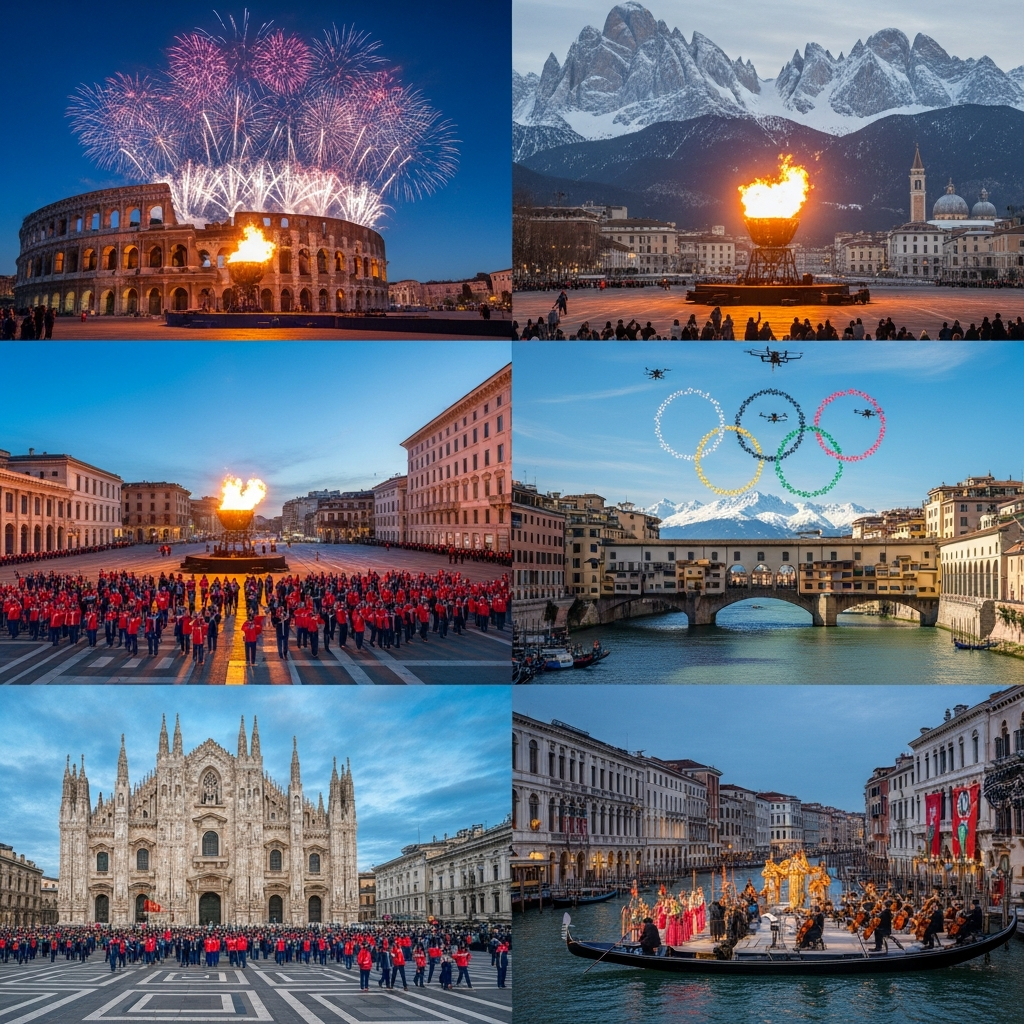
The Milano Cortina 2026 Winter Olympics officially commenced with an unprecedented opening ceremony, setting a new benchmark for global sporting events. This historic spectacle, unfolding across multiple Italian cities, captivated hundreds of millions worldwide. It celebrated Italy’s rich cultural heritage while showcasing groundbreaking logistical innovations. From a dual Olympic cauldron lighting to a multi-city athlete parade, the Games promised an unforgettable experience. This guide dives into every detail, revealing the magic and the underlying complexities of this monumental event.
The Grand Unveiling: Milano Cortina’s Historic Opening Ceremony
February 6, 2026, marked the highly anticipated launch of the Milano Cortina Winter Olympics. The opening ceremony, themed “Armonia” (Harmony), aimed to unite people through sport. It paid tribute to the delicate balance between urban vibrancy and majestic mountain landscapes. This event kicked off what is officially the most geographically dispersed Winter Games in history, spanning over 8,500 square miles across northern Italy.
A Multi-City Spectacle: Milan and Cortina Take Center Stage
Unlike previous Games, the 2026 opening ceremony was not confined to a single stadium. Milan’s iconic San Siro Stadium hosted the main festivities, welcoming a sold-out crowd of 61,000. However, athlete processions simultaneously occurred at competition venues in Predazzo, Livigno, and Cortina d’Ampezzo. This innovative, “spread out” format allowed athletes competing the following day to participate. It also ensured maximum inclusion for all delegates. Organizers hailed this multi-location approach as one of the most complex live broadcasts ever, setting a new standard for future Games. The Paralympic Games are scheduled to follow from March 6 to 15, 2026.
“Harmony” Unveiled: The Thematic Core
The chosen theme, “Armonia,” resonated throughout the entire ceremony. It symbolized the intricate union between city and mountains, nature and humanity. Creative director Marco Balich orchestrated a vibrant celebration of Italian culture. Tributes to classic Italian cinema like “La Dolce Vita” mingled with whimsical bobblehead dancers representing composers Verdi, Puccini, and Rossini. Even everyday Italian items, such as the moka pot, made appearances. The ceremony was a masterful blend of historical reverence and modern spectacle.
Stars, Symbols, and Spectacular Performances
The Milano Cortina opening ceremony boasted an array of world-class talent. It also featured several historical firsts that left a lasting impression. From musical legends to symbolic rituals, every moment was designed for impact.
Iconic Voices and Global Stars
Music played a central role in elevating the “Armonia” theme. Five-time Grammy winner Mariah Carey delivered a stunning rendition of “Nel Blu Dipinto di Blu” (“Volare”) in Italian. She also performed elements of “Nothing Is Impossible,” reportedly free of charge. Legendary tenor Andrea Bocelli serenaded the audience with Puccini’s “Nessun Dorma.” Italian pop star Laura Pausini sang the national anthem, introduced by an Olympic-first all-female color guard. Rapper Ghali performed a peace-themed hymn, and classical icons Cecilia Bartoli and Lang Lang performed the Olympic anthem. Italian astronaut Samantha Cristoforetti made a notable appearance. Actor Pierfrancesco Favino recited Giacomo Leopardi’s poem “L’infinito,” adding a touch of literary elegance. These performances transformed the ceremony into a rich cultural tapestry.
The Dual Flame: A Cauldron Lighting First
One of the most significant innovations was the lighting of two Olympic cauldrons simultaneously. The main cauldron ignited at Milan’s historic Arco della Pace. The second blazed in Cortina d’Ampezzo’s Piazza Dibona. Italian Olympic champions Alberto Tomba and Deborah Compagnoni had the honor of lighting the Milan cauldron. Sofia Goggia, a key figure in Italy’s successful bid, lit the Cortina flame. These cauldrons, inspired by Leonardo da Vinci’s intricate knot patterns, featured sun-like structures that expanded from 10.2 to 14.8 feet in diameter. The Olympic flame itself completed an epic 63-day, 7,500-mile journey across all 110 Italian provinces. Over 10,000 torchbearers, including Jackie Chan, carried the flame to its final destinations.
The Athletes’ Moment: Parade of Nations Highlights
The Parade of Nations is always a powerful symbol of unity and sportsmanship. At Milano Cortina, it carried extra significance due to the multi-location format. Athletes marched with pride, representing diverse cultures and aspirations.
Team USA and Emerging Talent
As is tradition, Greece led the procession of athletes. Host nation Italy, led by flagbearers Arianna Fontana, Federico Pellegrino, Amos Mosaner, and Federica Brignone, proudly closed the parade. Team USA, comprising its largest-ever Winter Olympics contingent of 232 athletes, marched third-to-last. Speedskater Erin Jackson, the first Black American woman to win an individual Winter Olympic gold, and bobsledder Frank Del Duca served as Team USA’s flag bearers. Two new nations, Saudi Arabia and the United Arab Emirates, made their Winter Olympics debut, signaling the global expansion of winter sports. Other notable uniforms included Stella Jean’s hand-painted designs for Haiti and Goyol Cashmere’s blue robes for Mongolia, reflecting unique cultural identities.
Beyond the Parade: Early Competitions and Milestones
Even before the official opening, some preliminary events had already begun. The US mixed doubles curling team remained unbeaten with four wins, showcasing early American dominance. Alysa Liu (USA) placed second in the figure skating team event short program. River Radamus and Jacqueline Wiles also showed strong results in downhill training. Veteran Lindsey Vonn, at 41, successfully completed her first downhill training run after rupturing her ACL. Spanish figure skater Tomas-Llorenc Guarino Sabate received clearance for his “Minions”-themed program after a copyright issue. These early performances set an exciting tone for the Games ahead, promising thrilling competition and remarkable achievements.
New Horizons: Sports and Innovation at Milano Cortina 2026
The Milano Cortina Games are not just about spectacle; they also introduce new competitive elements and innovative logistical solutions. These changes reflect an evolving Olympic landscape focused on sustainability and athlete experience.
Ski Mountaineering Debuts and Event Additions
A significant new addition to the Olympic program is ski mountaineering (Skimo). This demanding sport combines uphill endurance, using skins on skis and boot-packing, with high-speed downhill skiing across challenging alpine terrain. This addition broadens the appeal of the Winter Games and highlights the athleticism required in diverse mountain disciplines. Beyond Skimo, new medal events include dual moguls in freestyle skiing, men’s and women’s doubles in luge, a team alpine combined event, women’s large hill ski jumping, and a mixed team relay in skeleton. These innovations keep the Olympic program fresh and exciting for athletes and fans alike.
Logistics and Legacy: The Spread-Out Games
The decentralized nature of the Milano Cortina Games is a deliberate move towards sustainability. It utilizes existing venues across six main competition clusters. This approach minimizes new construction and showcases Italy’s diverse regions. Milan focuses on indoor ice events like hockey, figure skating, and speed skating. Cortina d’Ampezzo hosts alpine skiing and sliding disciplines. Livigno is home to snowboarding and freestyle skiing, while Antholz features biathlon. This geographically distributed model, while presenting logistical challenges for broadcasters and fans, aims to leave a lasting legacy by transforming new constructions into student housing. The closing ceremony, titled “Beauty in Motion,” will take place at the ancient Arena di Verona, a testament to Italy’s enduring capacity to host major international events.
Undercurrents and Conversations: Geopolitical Echoes
While celebrating unity, the opening ceremony and early Games also reflected current global realities and political discussions. These moments underscored the Olympics’ role as a stage not just for sport, but for broader societal conversations.
Navigating Global Tensions
Geopolitical tensions were noticeable during the Parade of Nations. The Ukrainian delegation received a “raucous welcome,” while Israeli athletes reportedly faced boos amidst calls for their ban over the Gaza war. U.S. Vice President JD Vance’s presence also drew mixed reactions from the crowd. Earlier, protests against the presence of U.S. immigration agents and street closures occurred in Milan. Athletes with Russian and Belarusian passports are competing as Individual Neutral Athletes (AIN) due to ongoing sanctions, a move highlighting the political sensitivities surrounding international sports. These moments served as a stark reminder of the world beyond the competition venues.
Broadcasting Challenges and Triumphs
NBC’s broadcast of the opening ceremony faced unique challenges due to the Games’ unprecedented geographic spread. The network aimed to “bounce back” from heavily criticized coverage of the 2024 Paris Summer Olympics. Veteran anchor Mary Carillo, stepping in last-minute for Savannah Guthrie, earned praise for her admirable performance. Three-time Olympic gold medalist Shaun White provided valuable athlete insights as an analyst. While the scattered nature of the Parade of Nations created a “lackluster” visual experience for some, NBC received credit for learning from past mistakes. Special correspondent Snoop Dogg’s “epic success” in Paris led to expectations of a larger role, with his segments on Jamaican bobsledders and an interview with U.S. flagbearer Frank Del Duca demonstrating his “legitimate investment in the athletes.” Despite the logistical hurdles, NBC’s efforts to reflect the Games’ unique character were generally well-received.
Frequently Asked Questions
Where was the 2026 Winter Olympics Opening Ceremony held, and what made it unique?
The 2026 Winter Olympics Opening Ceremony was primarily held at Milan’s San Siro Stadium on February 6, 2026. What made it historically unique was its multi-location approach. Athlete processions also occurred simultaneously at competition venues in Predazzo, Livigno, and Cortina d’Ampezzo, allowing more athletes to participate. Furthermore, it featured the simultaneous lighting of two Olympic cauldrons for the first time: one at Milan’s Arco della Pace and another in Cortina d’Ampezzo’s Piazza Dibona, both inspired by Leonardo da Vinci. This decentralized model reflects the Games’ status as the most geographically spread-out Winter Olympics ever.
Who performed at the Milano Cortina 2026 Opening Ceremony, and what were the key highlights?
The Milano Cortina 2026 Opening Ceremony showcased a star-studded lineup of Italian and international talent. Key performers included five-time Grammy winner Mariah Carey, who sang “Nel Blu Dipinto di Blu” (Volare) in Italian, and legendary tenor Andrea Bocelli, who performed Puccini’s “Nessun Dorma.” Italian pop star Laura Pausini sang the national anthem. Other highlights included performances by rapper Ghali, classical icons Cecilia Bartoli and Lang Lang, and appearances by Italian actor Pierfrancesco Favino and astronaut Samantha Cristoforetti. The ceremony also featured tributes to Italian culture, film, and fashion designer Giorgio Armani, all under the overarching theme of “Armonia” (Harmony).
What controversies and new sports are part of the Milano Cortina 2026 Winter Games?
The Milano Cortina 2026 Winter Games are marked by both exciting innovations and geopolitical tensions. A significant new sport making its Olympic debut is ski mountaineering (Skimo), an endurance and alpine skiing discipline. New medal events have also been added across various sports. Controversially, geopolitical issues were evident during the opening ceremony, with reports of booing towards Israeli athletes and protests against the presence of U.S. immigration agents. Athletes with Russian and Belarusian passports are only permitted to compete as Individual Neutral Athletes (AIN) due to ongoing sanctions. These elements highlight the complex interplay of sport and global affairs at these Games.
Embracing the Spirit of Milano Cortina
The 2026 Winter Olympics opening ceremony in Milano Cortina was more than just a grand spectacle. It was a testament to innovation, cultural celebration, and the enduring power of sport to unite amidst a complex world. From its pioneering multi-city approach and dual cauldrons to the debut of new sports like ski mountaineering, these Games are poised to leave a significant mark. As the competitions unfold across Italy’s stunning landscapes, athletes will chase their dreams, demonstrating courage and empathy. Milano Cortina 2026 promises to be a truly unforgettable chapter in Olympic history, redefining what future Winter Games can achieve.