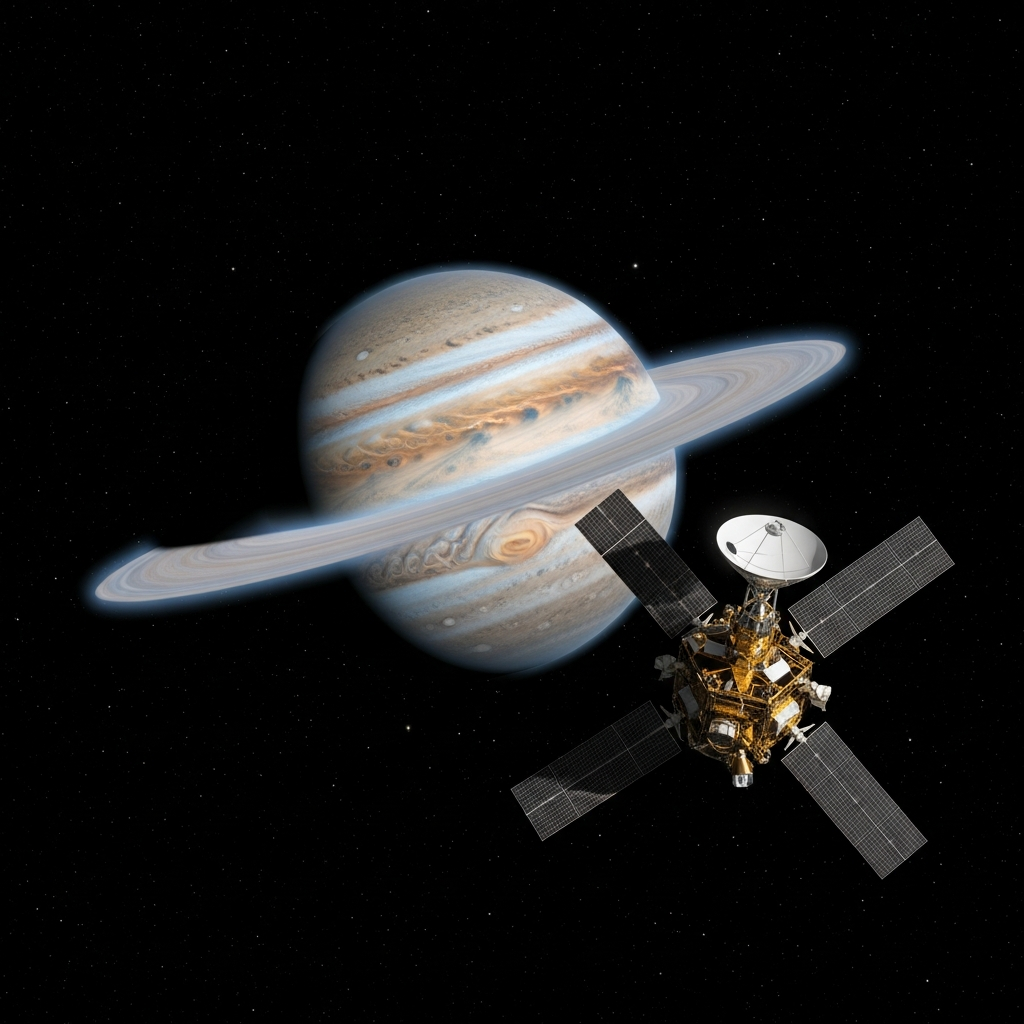
Jupiter, the colossal gas giant and architect of our solar system, just got a significant “planetary makeover,” thanks to groundbreaking data from NASA’s Juno mission. For over five decades, scientists relied on measurements from early missions, but new, highly precise observations have revealed a surprising truth: Jupiter is slightly smaller and more flattened than previously believed. These findings, published recently in Nature Astronomy, are set to rewrite textbooks and redefine our understanding of not just Jupiter, but potentially countless exoplanets beyond our solar system.
A New Look at the Solar System’s Largest Planet
The immense scale of Jupiter is undeniable. It’s more than twice as massive as all other planets in our solar system combined and approximately 11 times wider than Earth. Yet, even on this grand scale, small adjustments can carry monumental implications. The Juno mission’s meticulous work has provided the first re-evaluation of Jupiter’s dimensions in over 50 years, yielding an unprecedented level of accuracy.
These updated measurements indicate that Jupiter’s true form is a bit more compact than once thought:
Equatorial Radius: Approximately 5 miles (8 kilometers) narrower than earlier calculations.
Polar-to-Pole Distance: About 15 miles (24 kilometers) less than previous estimates, confirming a more pronounced flattening at its poles.
To put this into specific figures at the 1-bar pressure level:
The new polar radius is 66,842 kilometers, a reduction of 12 kilometers.
The equatorial radius now stands at 71,488 kilometers, 4 kilometers less than before.
The planet’s mean radius is revised to 69,886 kilometers, an 8-kilometer decrease.
While these changes might seem subtle in the context of a planet so vast, they represent an order-of-magnitude reduction in uncertainty, paving the way for a deeper understanding of its colossal interior.
Unveiling Secrets: How Juno Measured Jupiter’s Shape
How does a spacecraft, orbiting millions of miles away, manage to measure the exact dimensions of a gas giant? The secret lies in a sophisticated technique called radio occultation. The Juno spacecraft, which arrived at Jupiter in 2016, was specifically designed to probe beneath the planet’s thick, swirling cloud layers.
During multiple flybys, Juno performed radio occultation experiments. As the spacecraft passed behind Jupiter from Earth’s perspective, it beamed radio signals back to NASA’s Deep Space Network. As these signals traversed Jupiter’s charged upper atmosphere—its ionosphere—the atmospheric gases caused them to bend and slow down. By meticulously measuring the changes in frequency induced by this bending, scientists could deduce critical information. This data allowed them to infer details about Jupiter’s temperature, pressure, electron density, and even its internal structure at various depths.
This high-precision data, combined with careful accounting for the effects of Jupiter’s powerful zonal winds, enabled researchers to derive the planet’s shape with an accuracy down to about 1,300 feet (400 meters). This far surpasses the precision of measurements obtained from the Pioneer and Voyager missions in the 1970s, which served as the standard reference for decades.
Why Jupiter is Flat: The Role of Rapid Rotation
Jupiter’s distinctive “oblate spheroid” shape—bulging at the equator and flattened at the poles—is a direct consequence of its astonishingly fast rotation. Despite its immense size, Jupiter completes one full spin in less than 10 hours. This rapid rotation generates significant centrifugal forces that push material outwards at the equator, while gravity pulls inwards, creating the characteristic squashed appearance.
Scientists like Dr. Eli Galanti from the Weizmann Institute of Science explain that this shape is a delicate balance. The planet’s varying density profile, from less than 1 kg/m³ at the cloud level to thousands of kg/m³ in its deep interior, further complicates this balance. Even the strong zonal winds at cloud level significantly modify these centrifugal forces, causing additional, subtle shape variations. Accurately modeling these factors was crucial for Juno’s precise measurements.
Beyond Dimensions: Why These Changes Are Critical
Even subtle adjustments to Jupiter’s size and shape carry profound implications for planetary science. These new findings are far more than just updating numbers in a book; they represent a fundamental refinement in our understanding:
Understanding Internal Structure: More precise dimensions allow models of Jupiter’s interior to align better with gravity data and atmospheric measurements. This helps scientists to better comprehend its massive gravity field, how energy moves through its atmosphere, and the composition and dynamics of its deep interior beneath the swirling cloud tops.
A Reference for Exoplanets: Jupiter serves as a vital calibration standard for developing and refining models of giant exoplanets orbiting distant stars. Given that direct measurements of exoplanets are often limited, even minor adjustments to Jupiter’s known dimensions significantly enhance how scientists interpret observations of planets orbiting other stars.
Solar System Formation: Jupiter is believed to be the first planet to form in our solar system. Studying its internal structure and evolution provides valuable insights into the earliest stages of planetary formation. Lessons learned from Jupiter can even shed light on how planets like Earth eventually emerged, enhancing our understanding of solar system evolution across the universe.
Jupiter’s Dynamic Profile: A Planet Always Changing
Beyond its revised dimensions, Jupiter remains a world of extremes. It boasts gigantic storms larger than Australia, winds that howl at 100 mph, and a system of active moons, including Io with its constant volcanic eruptions. Its immense gravity is often credited as the “architect” of our solar system, playing a critical role in shaping the orbits of other planets and the formation of the gas and dust disk from which they originated.
A unique insight from this latest research is the understanding that Jupiter has been steadily shrinking throughout its lifetime. Astronomers estimate it was once twice its current size and continues to contract by up to two centimeters annually. This process is attributed to the planet gradually cooling, causing its internal temperature to drop and leading to a consistent loss of energy and contraction. This dynamic nature means that while our understanding of Jupiter has evolved, the gas giant itself is an ever-changing entity on a cosmic timescale.
The Ongoing Quest: Juno and Future Explorations
NASA’s Juno mission, managed by the Jet Propulsion Laboratory (JPL), has truly delivered groundbreaking insights since its arrival in 2016. While Juno’s original mission was slated to conclude around September 2025, its data continues to revolutionize our understanding of Jupiter. The spacecraft’s ultimate fate will involve a deliberate plunge into Jupiter’s atmosphere, a controlled end to prevent any contamination of potentially habitable moons.
However, the quest for Jovian understanding doesn’t end with Juno. Its successor mission, NASA’s Europa Clipper, is already on its way to Jupiter’s orbit. This dedicated mission will specifically study Europa, one of Jupiter’s enigmatic moons, in its search for conditions potentially suitable for life. The precision offered by Juno’s latest findings will undoubtedly inform and enhance the scientific endeavors of future missions, continuing humanity’s pursuit of knowledge in our vast universe.
Frequently Asked Questions
What are Jupiter’s new, revised dimensions from the Juno mission?
The Juno mission’s highly precise measurements reveal that Jupiter is slightly smaller and more flattened than previously thought. Specifically, its equatorial radius is approximately 5 miles (8 km) narrower, and its polar-to-pole distance is about 15 miles (24 km) less. At the 1-bar pressure level, the new polar radius is 66,842 km, the equatorial radius is 71,488 km, and the mean radius is 69,886 km, each representing a slight reduction from previous estimations.
How did NASA’s Juno spacecraft precisely measure Jupiter’s new shape?
Juno utilized a sophisticated technique called radio occultation. As the spacecraft passed behind Jupiter from Earth’s vantage point, it transmitted radio signals. Scientists measured how these signals bent and slowed as they passed through Jupiter’s charged upper atmosphere (ionosphere). By meticulously analyzing these changes in frequency, and accounting for the effects of Jupiter’s powerful zonal winds, researchers could infer precise details about the planet’s atmospheric structure and internal dimensions.
Why do these subtle changes in Jupiter’s size and shape matter for planetary science?
These seemingly subtle adjustments have profound implications. More accurate dimensions allow scientists to build better models of Jupiter’s deep interior, understanding its gravity field and energy transport. Crucially, Jupiter serves as a primary reference for modeling giant exoplanets in distant star systems. Enhanced precision for Jupiter directly improves our ability to interpret data from other planetary systems, and also offers valuable insights into the early stages of solar system formation, including our own.