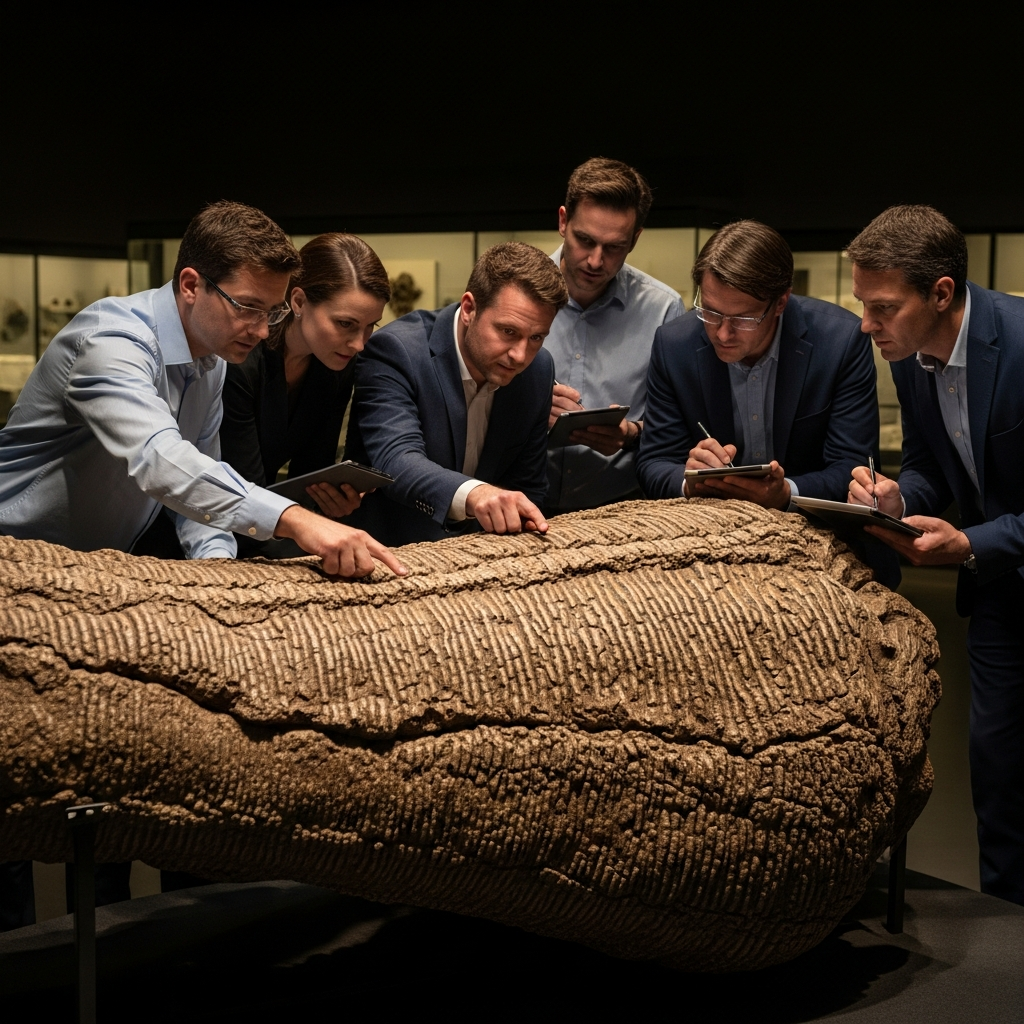
Deep within the ancient rocks of Aberdeenshire, Scotland, an extraordinary discovery has rewritten the story of early life on Earth. A colossal, 410-million-year-old Prototaxites fossil has not only joined the esteemed collections of National Museums Scotland (NMS) in Edinburgh but has also unveiled revolutionary insights into our planet’s primeval ecosystems. This monumental specimen, once thought to be a giant fungus or an early tree, is now confirmed as an entirely extinct evolutionary branch of life, challenging scientific understanding and resolving a debate that has mystified palaeontologists for over 165 years. Its addition to the national collection marks a pivotal moment, offering a tangible link to a world that existed long before dinosaurs, dominated by life unlike anything we know today.
Unearthing a Devonian Colossus: The Rhynie Chert Discovery
The newly acquired Prototaxites fossil was unearthed near the village of Rhynie in Aberdeenshire, within a remarkable sedimentary deposit known globally as the Rhynie Chert. This site is celebrated as one of the world’s oldest and best-preserved fossilized terrestrial ecosystems. Discovered by a local landowner, this particular specimen is a testament to the unparalleled preservation qualities of the Rhynie Chert, which has for decades yielded invaluable clues about life during the Devonian period.
Scotland’s Geological Treasure Trove: The Rhynie Chert
The Rhynie Chert offers a unique window into a time when land was just beginning to be colonized by complex organisms. Formed when silica-rich hot spring waters flooded and petrified an entire ecosystem, it captures intricate details of early plants, arthropods, and microbial life. The exceptional quality of these fossils allows scientists to study ancient organisms with unprecedented detail, providing “chemical fingerprints” and anatomical structures vital for accurate classification. This geological rarity made it the perfect stage for the discovery and re-evaluation of the enigmatic Prototaxites.
Prototaxites Redefined: A Revolutionary Scientific Breakthrough
For over a century and a half, the true nature of Prototaxites remained a tantalizing enigma. Its towering, trunk-like form suggested a tree, yet its internal structure and chemical makeup didn’t align with known plants. The scientific community was largely divided between classifying it as a gigantic fungus or an early, unusual lichen. However, a new paper published in Science Advances has decisively settled this long-standing debate.
Led by Dr. Sandy Hetherington, a senior lecturer in biological sciences at the University of Edinburgh and a research associate at National Museums Scotland, alongside Dr. Corentin Loron from the UK Centre for Astrobiology and PhD student Laura Cooper, the research team employed advanced analytical techniques. They concluded that Prototaxites was neither a plant nor a fungus but represents a distinct, entirely extinct evolutionary lineage—”life, but not as we now know it,” as Dr. Hetherington aptly describes.
Beyond Plant or Fungus: Chemical & Anatomical Evidence
The breakthrough came from a meticulous combination of anatomical and chemical analyses. Researchers examined the fossil’s internal features, including different tube types and “medullary spots,” which proved inconsistent with known fungi. Crucially, they employed chemical “fingerprinting,” specifically searching for the fungal biomarker perylene. While perylene was detected in the surrounding sediment, it was entirely absent from the Prototaxites material itself. This chemical evidence, combined with anatomical distinctions, provided definitive proof against a fungal classification. Previous studies had already ruled out other major groups of complex life, leading to the conclusion that Prototaxites belongs to its own, separate branch of the tree of life.
The “Independent Experiment” of Early Life
Laura Cooper, co-first author from the University of Edinburgh’s Institute of Molecular Plant Sciences, highlighted Prototaxites as an “independent experiment that life made in building large, complex organisms.” This reclassification fundamentally alters our understanding of early terrestrial ecosystems during the Devonian period, a pivotal time when life was transitioning from water to land. The existence of such a dominant and unique life form underscores the incredible diversity and experimental nature of evolution during Earth’s ancient history.
What Was Prototaxites? A Glimpse into Earth’s Ancient Past
Imagine a landscape 410 million years ago, devoid of familiar forests. Instead, towering over ancient plants and animals, stood massive, column-like organisms reaching an astonishing 26 feet (8 meters) high. This was Prototaxites. Its fossil record spans approximately 420 to 370 million years ago, placing it firmly in the Devonian, a period marked by the diversification of land plants and fungi and the emergence of early animals on land.
Dominating the Devonian: Earth’s First Giant Land Organism
Before trees as we know them became widespread, Prototaxites was the true giant of the terrestrial world. Its columnar form would have created an imposing presence, shaping the ancient environment. The new research found no evidence of reproductive structures or lichen-style symbiosis in the key specimens, further reinforcing its unique biological identity. Its disappearance around 360 million years ago marks the end of a truly bizarre and compelling chapter in Earth’s evolutionary narrative. This Prototaxites fossil offers invaluable clues to the “strangest experiments in complex life ever recorded” during a time of profound ecological reinvention.
National Museums Scotland: Preserving Palaeontological Heritage
The newly studied Prototaxites fossil now resides at the National Museums Scotland (NMS) collection centre in Edinburgh, where it will be meticulously cared for and made available for future research. Dr. Nick Fraser, Keeper of Natural Sciences at NMS, expressed delight at this significant acquisition. He emphasized how such additions enrich the museum’s collections, which document Scotland’s extraordinary place in the story of our natural world over billions of years.
Fostering Future Discoveries: The Value of Museum Collections
Dr. Fraser also underscored the critical value of museum collections in facilitating cutting-edge research. Specimens carefully collected and preserved over time become invaluable resources for scientists. They provide a vital reference for direct comparison with new finds or for analysis using modern technologies. The Prototaxites research itself is a prime example, demonstrating how historical specimens can continue to contribute to significant scientific breakthroughs, reaffirming Scotland’s important role in global palaeontology.
Unlocking Secrets with Modern Science
The recent research into Prototaxites also highlights the innovative approaches now available to palaeontologists. Dr. Corentin Loron noted the use of machine learning on fossil molecular data, demonstrating how advanced technologies can extract unparalleled information from ancient remains. This blend of meticulous observation, sophisticated chemical analysis, and computational power allows researchers to resolve long-standing mysteries and paint ever-clearer pictures of Earth’s deep past. The ongoing study of specimens from the Rhynie Chert, bolstered by museum resources, promises even more incredible discoveries in the years to come.
Frequently Asked Questions
What is the Prototaxites fossil, and why is its reclassification significant?
The Prototaxites fossil is the preserved remains of a colossal, 410-million-year-old organism that stood up to 26 feet (8 meters) tall. Found in Scotland’s Rhynie Chert, its reclassification is profoundly significant because scientists have now determined it was neither a plant nor a fungus, as previously debated for 165 years. Instead, new research identifies it as a distinct, entirely extinct evolutionary branch of life, offering unprecedented insights into the diversity and “experimental” nature of early complex terrestrial organisms during the Devonian period.
Where can the newly researched Prototaxites fossil be viewed or studied?
The newly researched Prototaxites fossil has been added to the national collection at National Museums Scotland (NMS) and will be housed and preserved at their collection centre in Edinburgh. While not necessarily on permanent public display, it is accessible for scientific study, demonstrating the crucial role of museum collections in facilitating cutting-edge palaeontological research. The original discovery site, the Rhynie Chert in Aberdeenshire, Scotland, remains a key location for further scientific exploration.
How did scientists determine Prototaxites was neither a plant nor a fungus?
Scientists, led by researchers from the University of Edinburgh and National Museums Scotland, utilized a combination of detailed anatomical and chemical analyses. Anatomically, the fossil’s internal structures, such as distinct tube types and “medullary spots,” did not match known fungi or plants. Chemically, they searched for perylene, a specific biomarker for fungi. Although perylene was present in the surrounding sediment, it was absent from the Prototaxites material itself. This decisive chemical evidence, combined with anatomical findings and previous studies ruling out other major life groups, confirmed its unique classification as a separate, extinct evolutionary lineage.
Conclusion
The acquisition and re-evaluation of the Aberdeenshire Prototaxites fossil represent a monumental stride in palaeontology. This 410-million-year-old specimen not only enriches National Museums Scotland’s invaluable collections but has also unlocked secrets about a forgotten lineage of life that once dominated the ancient Scottish landscape. The collaborative research highlights the enduring power of museum specimens to fuel scientific inquiry and reshape our understanding of Earth’s complex evolutionary journey. As we gaze upon this “independent experiment” of life, we are reminded of the planet’s dynamic past and the endless wonders that still await discovery in its geological record.