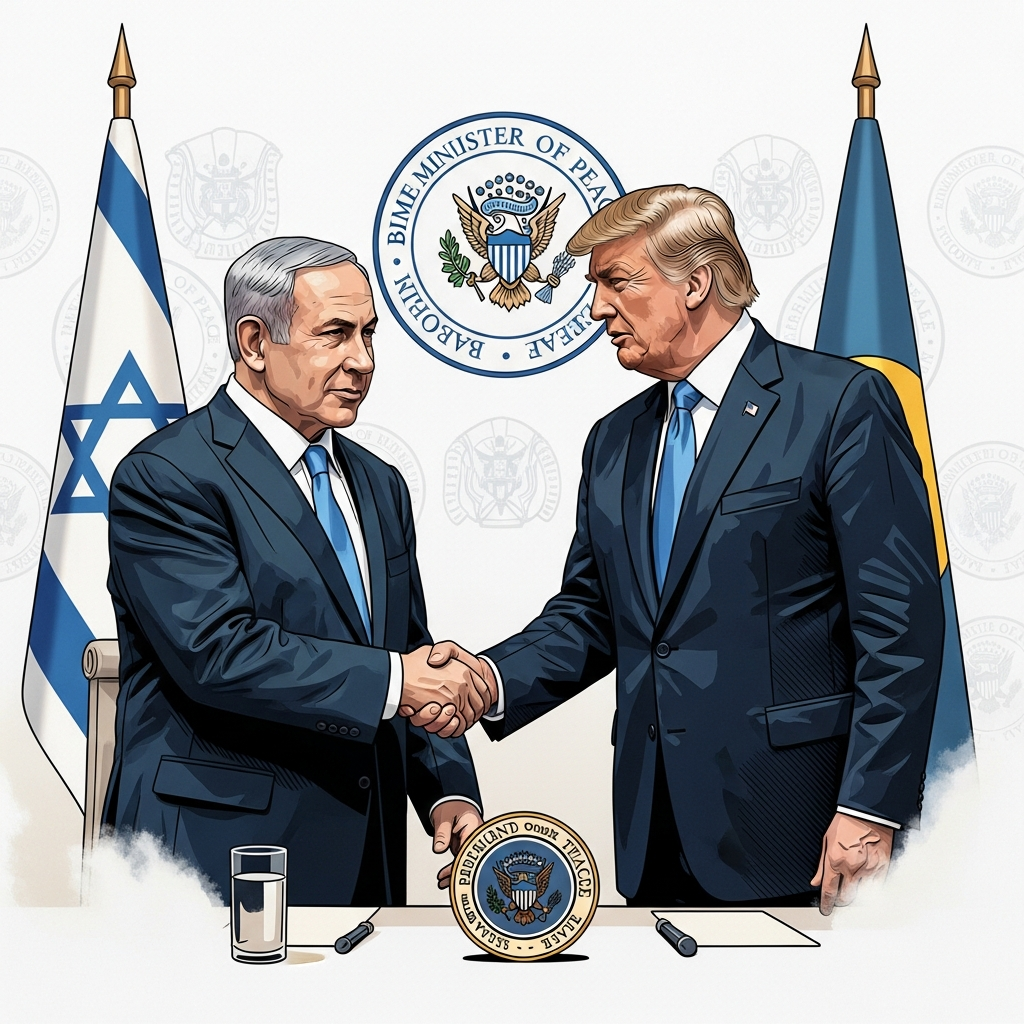
JERUSALEM (January 21, 2026) – In a significant diplomatic shift, Israeli Prime Minister Benjamin Netanyahu has officially agreed to join U.S. President Donald Trump’s ambitious “Board of Peace.” This decision, announced Wednesday, follows initial strong reservations from Netanyahu’s office regarding the proposed international body’s composition and scope. The move signals a complex interplay of regional alliances, global aspirations, and the evolving dynamics of international conflict resolution.
Initially conceived as a modest oversight group for the Gaza ceasefire, the Trump administration’s vision for the “Board of Peace” has dramatically expanded. It is now envisioned as a sprawling international forum, aiming to broker global conflicts far beyond the Middle East, potentially operating as a “pseudo-U.N. Security Council.” This bold initiative, set to be further detailed by Trump at the World Economic Forum in Davos, Switzerland, has already drawn both support and controversy across the geopolitical landscape.
The Board of Peace: An Evolving Vision
The “Board of Peace” represents a radical re-imagining of international diplomacy. What began as a focused effort to manage the Gaza ceasefire has transformed into an expansive platform. President Trump’s administration extended invitations to dozens of nations, signaling its intent to tackle a wide array of global disputes. This expansion suggests a desire to create a new center of gravity for international relations, challenging established norms and institutions.
A draft charter, obtained by The Associated Press, highlights a key, and perhaps controversial, aspect of the board: significant power appears concentrated in the hands of President Trump himself. Furthermore, the draft reveals a unique financial model for participation. Securing permanent membership on this elite board reportedly requires a substantial $1 billion contribution. This “pay-to-play” model has sparked considerable debate, questioning the nature of influence in this new diplomatic framework.
Early Members and Invitations
As of the latest announcements, a diverse group of nations has committed to joining Trump’s Board of Peace. These include Israel, the United Arab Emirates, Morocco, Vietnam, Kazakhstan, Hungary, Argentina, and Belarus. The composition of this initial group reflects a mix of traditional U.S. allies and countries seeking new geopolitical alignments.
Beyond these confirmed members, invitations have also been extended to several other world leaders. Notable figures include Paraguay’s President Santiago Peña, Canadian Prime Minister Mark Carney, Egyptian President Abdel-Fattah el-Sissi, and Turkish President Recep Tayyip Erdogan. Russia, India, Slovenia, Thailand, and the European Union’s executive arm have also confirmed receiving invitations. The Kremlin, for its part, stated it is “studying the details” and seeking clarity on “all the nuances” before making a commitment. The broad reach of these invitations underscores the initiative’s global ambition, aiming to reshape diplomatic engagements worldwide.
Israel’s Strategic Shift and Regional Rivalries
Netanyahu’s agreement to join the Board of Peace marks a significant reversal. His office had initially voiced strong criticism regarding the executive committee’s makeup, specifically objecting to the inclusion of Turkey. Israel views Turkey as a significant regional rival, and its presence on such a critical diplomatic body raised immediate concerns about coordination and policy alignment. Reports indicated that the committee’s initial composition was “contrary to [Israel’s] policy” and not coordinated with the Israeli government.
Further compounding these objections, Israel’s far-right finance minister, Bezalel Smotrich, publicly criticized the board. Smotrich advocated for Israel to unilaterally manage Gaza’s future, expressing a preference for Israeli control over any international oversight. Netanyahu’s eventual decision to join, despite these internal and external reservations, suggests a strategic calculation. It may reflect a desire to maintain close ties with the U.S. administration, secure a seat at the table in crucial regional discussions, or influence the board’s direction from within.
Leadership and Key Figures
The Executive Board of Trump’s Board of Peace comprises a prominent roster of international figures. These individuals are expected to steer the overarching objectives of this new diplomatic entity. Key members include:
U.S. Secretary of State Marco Rubio
Trump envoy Steve Witkoff
Trump’s son-in-law Jared Kushner
Former British Prime Minister Tony Blair
Apollo Global Management CEO Marc Rowan
World Bank President Ajay Banga
Trump’s deputy national security adviser Robert Gabriel
This blend of political experience, business acumen, and international development expertise highlights the multifaceted approach envisioned for the board. Their collective influence will be critical in shaping its global impact and diplomatic effectiveness.
The Gaza Executive Board: Focused on Post-Conflict Stability
Beyond the overarching Board of Peace, the White House also unveiled a separate, highly specialized entity: the Gaza Executive Board. This body is specifically tasked with the challenging implementation of the “tough second phase” of the Gaza ceasefire agreement. Its mandate is clear and critical for the future of the war-devastated territory.
The responsibilities of the Gaza Executive Board are extensive. They include:
Deploying an international security force: Crucial for maintaining order and stability.
Disarming Hamas: A complex and sensitive task essential for long-term peace.
Overseeing the rebuilding of Gaza: A massive humanitarian and infrastructural undertaking.
Nickolay Mladenov, a former Bulgarian politician and seasoned U.N. Mideast envoy, is slated to oversee the day-to-day operations of this vital board. His experience in the region is expected to provide critical guidance.
Gaza Executive Board Members
The composition of the Gaza Executive Board includes a mix of international diplomats, business leaders, and regional experts, reflecting the complexity of its mission:
Steve Witkoff (Trump envoy)
Jared Kushner (Trump’s son-in-law)
Tony Blair (Former British Prime Minister)
Marc Rowan (Apollo Global Management CEO)
Turkish Foreign Minister Hakan Fidan
Qatari diplomat Ali Al-Thawadi
Hassan Rashad, director of Egypt’s General Intelligence Agency
Emirati minister Reem Al-Hashimy
Israeli businessman Yakir Gabay
Sigrid Kaag, the Netherlands’ former deputy prime minister and a respected Mideast expert
This board will also play a supervisory role over a newly appointed committee of Palestinian technocrats. These technocrats will be responsible for managing Gaza’s daily affairs, aiming to restore civilian governance and essential services in the territory.
Controversies and Criticisms: Challenging the Global Order
The Board of Peace initiative has not been without significant controversy. A central point of contention revolves around President Trump’s suggestion that his new board “might” eventually replace the United Nations. When questioned on this prospect, Trump stated that the UN “hasn’t been very helpful” and “has never lived up to its potential,” though he also acknowledged its “great potential.” These remarks immediately sparked international debate, with many viewing the initiative as a direct challenge to the established global multilateral system.
French Foreign Minister Jean-Noel Barrot explicitly voiced support for the underlying peace plan but firmly rejected the concept of creating an organization designed to supplant the United Nations. Trump also made dismissive comments regarding French President Emmanuel Macron’s potential refusal to join, suggesting Macron would soon be “out of office,” though he later softened his stance by referring to Macron as a “friend” while reiterating his belief about Macron’s political future. The high financial barrier to permanent membership – the $1 billion contribution – has also drawn criticism. Opponents argue that such a fee could commercialize diplomacy, potentially granting disproportionate influence to wealthier nations or individuals, rather than fostering inclusive and equitable international cooperation. This model raises fundamental questions about accessibility and fairness in global governance.
Frequently Asked Questions
What is the core purpose and scope of Trump’s Board of Peace, and how has it evolved?
Initially, Trump’s Board of Peace was envisioned as a small group of world leaders primarily tasked with overseeing the Gaza ceasefire plan. However, its scope has significantly expanded under the Trump administration. It is now conceptualized as a more sprawling international body designed to broker a wide array of global conflicts. The administration hints at it functioning as a “pseudo-U.N. Security Council,” signaling ambitions to reshape international diplomatic engagement and challenge existing multilateral frameworks. This evolution reflects a desire to create a new, influential center for global conflict resolution.
Who are the key members of both the overarching Board of Peace and the specific Gaza Executive Board?
The overarching Board of Peace’s Executive Board includes prominent figures such as U.S. Secretary of State Marco Rubio, Trump envoy Steve Witkoff, Jared Kushner, former British Prime Minister Tony Blair, Apollo Global Management CEO Marc Rowan, World Bank President Ajay Banga, and Trump’s deputy national security adviser Robert Gabriel. The separate Gaza Executive Board, focused on the ceasefire’s “tough second phase,” is led by Nickolay Mladenov (U.N. Mideast envoy) and includes Witkoff, Kushner, Blair, Rowan, Turkish Foreign Minister Hakan Fidan, Qatari diplomat Ali Al-Thawadi, Hassan Rashad (Director of Egypt’s General Intelligence Agency), Emirati minister Reem Al-Hashimy, Israeli businessman Yakir Gabay, and Sigrid Kaag (Netherlands’ former deputy prime minister).
What are the main controversies surrounding the Board of Peace, particularly its funding and relationship with existing international bodies like the UN?
Key controversies surrounding the Board of Peace include its potential to replace the United Nations, a suggestion made by President Trump himself, who criticized the UN’s effectiveness. This stance drew criticism from international leaders, including French Foreign Minister Jean-Noel Barrot, who opposed replacing the UN. Another major point of contention is the reported $1 billion contribution required for permanent membership, which critics argue could commercialize diplomacy and grant undue influence to wealthy participants. Additionally, Israel initially criticized the board’s executive committee for including Turkey, a regional rival, highlighting concerns about the diplomatic implications and alignment with existing regional policies.
Looking Ahead
Netanyahu’s decision to join Trump’s Board of Peace underscores the fluid and often unpredictable nature of international diplomacy. This new initiative, with its ambitious global scope and unique operational model, is poised to become a significant player in future geopolitical discussions. While questions persist regarding its long-term efficacy, its relationship with established international bodies, and the implications of its financial structure, the Board of Peace is undoubtedly a development to watch closely. Its success, particularly in the critical task of stabilizing and rebuilding Gaza, will be a true test of its vision and the collective will of its diverse membership.