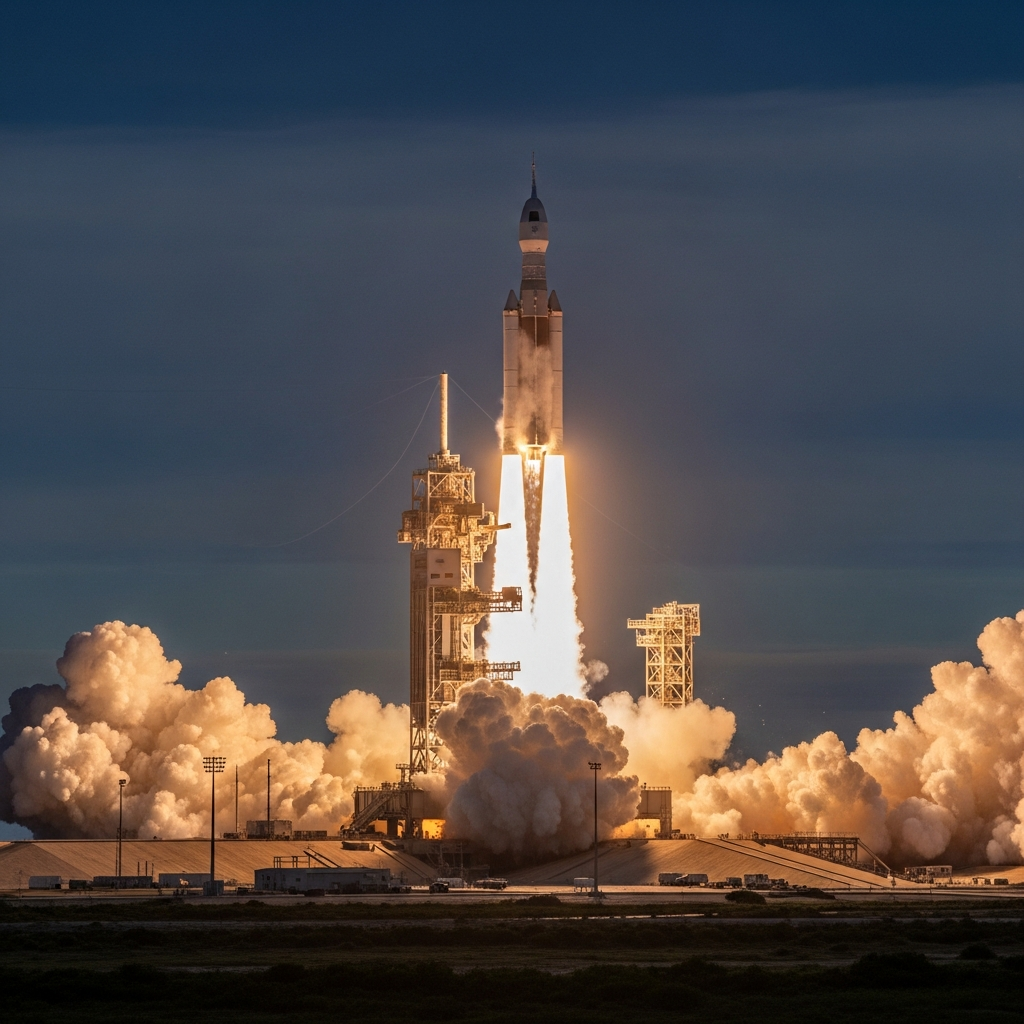
NASA’s Artemis II mission stands on the brink of history, poised to send humans beyond low Earth orbit for the first time in over half a century. This pivotal crewed lunar mission will launch four astronauts aboard the powerful Space Launch System (SLS) rocket and Orion spacecraft, embarking on an awe-inspiring journey around the Moon. More than just a flight, Artemis II is a critical test. It will validate the sophisticated systems and capabilities essential for future deep-space exploration. This trailblazing voyage lays the groundwork for a sustained human presence on the Moon and eventually, paves the way for humanity’s monumental leap to Mars.
A Historic Return to Lunar Space
The Artemis II mission builds directly on the triumphs of the uncrewed Artemis I flight in 2022. That successful demonstration proved the core capabilities of the SLS rocket and Orion spacecraft. Now, Artemis II elevates the stakes significantly by adding a human crew. This mission marks a profound shift, signaling humanity’s tangible return to the lunar vicinity. It’s a crucial stepping stone in NASA’s ambitious Artemis program, which aims not just to visit the Moon, but to establish a long-term presence. Sean Duffy, acting NASA administrator, emphasized this vision: “Our mission will lay the groundwork for future missions to the lunar surface and to Mars.”
What Makes Artemis II a Landmark Mission?
Artemis II is explicitly designated as a test flight. Its success is vital for setting the stage for Artemis III, which aims to land astronauts near the lunar south pole. The mission profile shares similarities with Artemis I, but with critical enhancements:
Human Life Support: For the first time, Orion’s full environmental control and life-support systems will be tested with astronauts aboard.
System Validation: Crew members will rigorously assess navigation, communication, and propulsion systems under real deep-space conditions.
Radiation Experience: Astronauts will experience and collect data on deep-space radiation, crucial for longer duration missions.
Enhanced Hardware: Orion has received improved navigation and communication systems. The SLS rocket also features additional external plates to mitigate vibrations.
The Artemis II Mission: What to Expect
This approximately 10-day mission is a complex ballet of precision engineering and human skill. It’s designed to push the boundaries of current spaceflight capabilities while ensuring the utmost safety for its crew. The entire mission profile is meticulously planned, with each phase serving a specific purpose.
Key Objectives of the Flight
The primary goal of Artemis II is simple yet profound: to confirm the safety and functionality of the deep-space systems with astronauts onboard. This involves validating several key areas:
Mission Planning & Operations: Proving the ground teams and flight procedures can manage a crewed deep-space mission.
Spacecraft Performance: Assessing how the Orion capsule and SLS rocket perform with humans inside.
Crew Interfaces & Habitability: Ensuring astronauts can effectively operate the spacecraft and live comfortably in a confined space for over a week.
Guidance, Navigation, & Communications: Testing critical systems that keep the crew oriented and connected with Earth.
The Flight Path: A Loop Around the Moon
After launching from Kennedy Space Center’s Launch Complex 39B, the Orion capsule will first enter Earth orbit. The initial two days will be busy, with astronauts rigorously testing life support systems and practicing a rendezvous protocol with a jettisoned rocket stage. This practice is crucial for future missions, including docking with the Lunar Gateway.
Following these tests, the Orion spacecraft will fire its main thruster. This powerful maneuver will propel it towards the Moon on a “free return” trajectory. This unique path uses gravity to loop around the Moon and naturally guide the spacecraft back to Earth, even if major system failures occur. The crew will fly a figure-of-eight loop around the Moon, without entering lunar orbit. At its closest, Orion will pass about 7,400 kilometers (approximately 4,600 miles) above the lunar surface. This will take the crew farther from Earth than any humans have ever traveled. Upon successful completion of this historic loop, the spacecraft will execute a precise splashdown in the Pacific Ocean.
Meet the Trailblazing Artemis II Crew
The four-member crew of Artemis II, announced in April 2023, represents a blend of seasoned experience and groundbreaking firsts. They embody the spirit of international collaboration, with a Canadian astronaut joining three NASA veterans. According to Joe Acaba, Chief of the NASA Astronaut Office, crew selection focuses on how astronauts work together as a cohesive team, highlighting the importance of human compatibility for living in a confined space.
Commander Reid Wiseman (NASA)
A U.S. Navy aviator, Commander Wiseman is embarking on his second spaceflight. His leadership will guide the mission through its complex maneuvers and critical tests, drawing on his extensive experience.
Pilot Victor Glover (NASA)
Victor Glover will achieve a historic milestone, becoming the first Black astronaut to fly around the Moon. Having previously piloted SpaceX’s Crew-1 mission to the International Space Station, his expertise in piloting and spacecraft systems is invaluable.
Mission Specialist Christina Koch (NASA)
Christina Koch holds the record for the longest single spaceflight by a woman, spending 328 days on the ISS. She was also part of the first all-female spacewalk. Her experience in long-duration missions and intricate spacewalks makes her a vital asset. She eloquently expressed the crew’s dedication, stating, “As astronauts, we sign up to be the people to execute and operate the missions because we believe in human spaceflight; we believe in exploration.”
Mission Specialist Jeremy Hansen (Canadian Space Agency – CSA)
A Royal Canadian Air Force fighter pilot, Jeremy Hansen will make his first journey into space, becoming the first Canadian to travel to the Moon’s vicinity. His participation underscores Canada’s crucial partnership in the Artemis program and its commitment to providing the Canadarm3 robotic arm for the future Lunar Gateway space station.
The Power Behind the Mission: SLS and Orion
The core of the Artemis II mission lies in its advanced hardware: the Space Launch System (SLS) rocket and the Orion spacecraft. The SLS is NASA’s most powerful rocket ever built, designed to carry heavy payloads and crew beyond Earth orbit. It stands as a testament to engineering prowess, providing the thrust needed to escape Earth’s gravity and send Orion on its lunar trajectory.
The Orion spacecraft, built by Lockheed Martin, is designed for human deep-space travel. It features advanced life support, navigation, and communication systems. The successful uncrewed Artemis I mission rigorously tested Orion’s heat shield during its high-speed re-entry, proving its ability to protect the crew upon returning to Earth. For Artemis II, Orion is fully outfitted with astronaut protection systems and an operational environmental control system.
Meticulous Preparations: Ensuring Crew Safety
Behind every space launch is an army of dedicated individuals working tirelessly to ensure mission success and astronaut safety. The Artemis II mission is no exception, with rigorous testing and specialized teams playing crucial roles.
The Crucial Role of the Closeout Crew
One such critical group is NASA’s Artemis closeout crew, a specialized team vital for securing astronauts into the Orion spacecraft. Led by Taylor Hose, this five-person “pit crew” includes astronaut Andre Douglas, technician Bill Owens (spacesuits), and Orion technicians Christian Warriner and Ricky Ebaugh. Their complex four-hour process involves:
Assisting astronauts in donning helmets and gloves.
Meticulously buckling each astronaut into their seat with five straps and multiple connections for environmental control, life support, and communications.
Pneumatically closing and sealing the Orion spacecraft’s hatch, a delicate process where even a single strand of hair could compromise the seal.
Installing thermal protection panels and removing purge barriers.
Hose, whose life goal was to be an astronaut, finds deep personal motivation: “I’m helping to send people to the Moon for the first time since 1972, not just to visit, but to establish a sustained presence.”
Rigorous Practice and Test Runs
Before liftoff, the Artemis II crew and support teams engage in extensive rehearsals. In December 2025, the astronauts completed a critical dress rehearsal countdown (Countdown Demonstration Test or CDT) inside the Vehicle Assembly Building (VAB) at Kennedy Space Center. Commander Reid Wiseman characterized it as “extremely successful” despite minor issues. This test involved the crew strapping into their Orion capsule and working through the countdown sequence with the launch control team, just as they would on launch day.
A previous delay to this CDT was caused by a “blemish” on the Orion crew module’s thermal barrier, which prevented the hatch from closing properly. Though quickly repaired, the incident highlights the meticulous attention to detail required for crewed spaceflight. Following rollout from the VAB to Launch Complex 39B, further preparations will include an 18-day final check phase and a Wet Dress Rehearsal (WDR), where the SLS rocket will be fully fueled.
The Road Ahead: Schedule and Future Missions
The launch of Artemis II mission is currently targeted for no later than April 2026. NASA has expressed hope of potentially moving the launch date forward to February 2026, though a slip to early March is also possible due to tight schedules and remaining work. Specific launch opportunities in February are dictated by celestial alignments, with the first on February 6.
Understanding the Delays
The Artemis program has experienced multiple delays from initial targets. These have been attributed to various factors, including:
Processing Problems: The sheer complexity of integrating the SLS rocket and Orion spacecraft.
COVID-19 Pandemic: Slowdowns impacted development and testing timelines.
Human Landing System (HLS): Challenges in the development and testing of SpaceX’s Starship lander, slated for Artemis III.
Spacesuit Development: Issues with next-generation spacesuits also contributed to schedule adjustments.
These factors have significantly impacted the broader Artemis timeline, pushing the Artemis III lunar landing mission to 2027 or potentially 2028.
Beyond Artemis II: A New Era of Exploration
The Artemis II mission is more than just a trip around the Moon; it’s a profound “small step,” as Joe Acaba describes it. Its success will demonstrate a pivotal shift in human spaceflight, marking the return of astronauts beyond low Earth orbit and signaling the advent of even grander exploratory endeavors. NASA plans increasingly complex missions throughout the 2030s, ultimately envisioning a permanent human presence on the lunar surface.
This renewed focus on lunar exploration also comes with an awareness of a “new space race,” with China planning to land its taikonauts on the Moon by 2030. NASA remains committed to winning this challenge. The data and experience gained from Artemis II will directly inform future missions, including rendezvous and docking operations with the Lunar Gateway, a crucial component for sustained lunar operations and a staging point for Mars missions.
Frequently Asked Questions
What are the primary objectives of the Artemis II mission?
The Artemis II mission’s main objectives are to validate the Orion spacecraft’s systems with a human crew and demonstrate deep-space operational capabilities. This includes testing life support, navigation, communication, and propulsion systems under real flight conditions. Astronauts will also experience and gather data on deep-space radiation, which is vital for planning longer-duration missions. Essentially, it’s a comprehensive test flight to ensure the safety and functionality of all systems before future lunar landing attempts.
Where will the Artemis II mission launch from, and how can the public experience related events?
The Artemis II mission will launch from Launch Complex 39B at NASA’s Kennedy Space Center in Florida. While specific launch viewing opportunities will be announced closer to the date, the Kennedy Space Center Visitor Complex offers bus tours that go behind NASA’s gates, allowing visitors to see the past, present, and future of this premier spaceport. Guests can also discover the legacy of NASA’s Space Shuttle Program, including a close-up view of Space Shuttle Atlantis. Signing up for email notifications on upcoming events and launches is the best way to stay informed about viewing opportunities.
When is Artemis II expected to launch, and why have there been delays?
The Artemis II mission is currently targeted for launch no later than April 2026, with potential opportunities as early as February 2026. However, the mission has experienced multiple delays from its initial target windows. These delays are primarily due to the complex processing of the Space Launch System (SLS) rocket and Orion spacecraft, slowdowns caused by the COVID-19 pandemic, and ongoing challenges in the development and testing of the Human Landing System (SpaceX’s Starship) and next-generation spacesuits for the subsequent Artemis III mission. These meticulous and sometimes time-consuming preparations are essential to ensure the safety of the crew and the success of this historic deep-space endeavor.
Conclusion
The Artemis II mission represents a thrilling and critical next step in humanity’s journey back to the Moon and beyond. It’s a testament to human ingenuity, collaboration, and our enduring desire to explore. This crewed test flight will not only push technological boundaries but also inspire a new generation of explorers. As the four courageous astronauts prepare for their epic voyage, the world watches, anticipating a new “Golden Age of innovation and exploration” that promises to expand humanity’s footprint across the solar system. Stay tuned for updates as this historic mission prepares for liftoff, ushering in a new chapter of lunar and deep-space exploration.