The United States has dramatically intensified its pressure on the Maduro regime in Venezuela, publicly acknowledging a strike on a Venezuelan port facility. This significant escalation, reportedly a CIA drone attack on an alleged drug facility, is part of a broader, more aggressive campaign by the Trump administration. The White House aims to target not only drug smugglers but also Venezuelan President Nicolás Maduro himself, fueling intense debate over legality, intent, and potential consequences for the volatile region. This article delves into the specifics of these actions, the underlying strategies, expert opinions, and the far-reaching implications of the deepening US-Venezuela tensions.
Unprecedented Actions: The Strike and Military Buildup
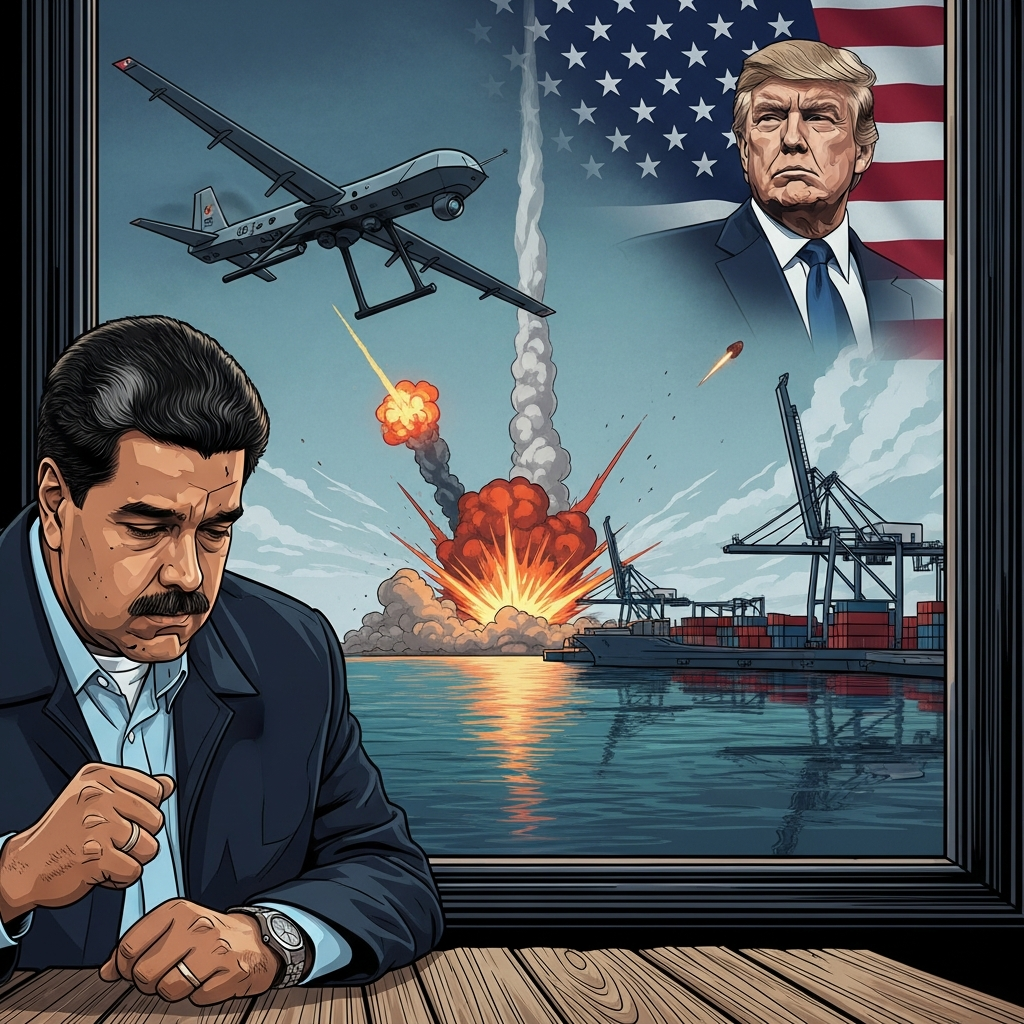
On a Monday, President Trump made the rare public admission of a covert action, confirming a strike on a port facility in Venezuela. Media outlets soon reported it as a CIA-launched drone strike against a storage facility believed to be operated by the transnational gang Tren de Aragua. The Trump administration connects this gang to President Maduro, though without public evidence. President Trump stated the strike hit the “implementation area” where drugs are loaded, leading to the destruction of boats and the facility. This strike is merely one facet of a much larger military deployment.
For months, the U.S. has assembled the Caribbean’s largest armada in half a century. This formidable force includes at least eight military vessels, a nuclear-powered submarine, spy planes, aircraft carriers like the USS Gerald R Ford, guided-missile destroyers, and amphibious assault ships. The Roosevelt Roads naval base in Puerto Rico, long closed, has even been reactivated. This military might supports “Operation Southern Spear,” a campaign featuring over 30 strikes on what the U.S. terms “narco-terrorist drug boats” across the Caribbean and Eastern Pacific. Recent actions also include the capture of two sanctioned Venezuelan oil tankers and the pursuit of a third. The scale of this buildup has raised questions about intentions beyond simple drug interdiction.
Washington’s Stated Goals: Weakening Maduro’s Grip
Elliott Abrams, a former Trump administration special envoy for Venezuela and now a senior fellow at the Council on Foreign Relations, strongly supports this aggressive pressure campaign. He argues that by targeting drug trafficking, a primary revenue source for the Venezuelan regime, the U.S. can severely diminish Maduro’s finances. This economic squeeze, Abrams contends, will worsen Venezuela’s economy and amplify both public and internal pressure on the regime. Such pressure could potentially lead to mass demonstrations, military action, or a negotiated settlement with the U.S.
Abrams dismisses predictions of civil war, asserting that if Maduro falls, Edmundo Gonzalez—elected previously—would assume the presidency. He highlights that the opposition is actively planning for a democratic transition. He warns that without Maduro’s removal, challenges such as drug trafficking, a continuing flow of migrants (projected to increase from eight million to potentially twelve million), and ongoing cooperation between the Venezuelan regime and countries like Cuba, Iran, Russia, and China will persist. The strategy aims to leverage financial and military pressure to expedite regime change.
The Broader Strategy: Targeting Drug Flow and Instability
The Trump administration’s amplified military presence and aggressive stance are partly driven by an assessment that President Maduro has not adequately addressed the flow of illegal drugs originating from Venezuela. President Trump has vowed to use “every element of American power” to stop drugs entering the U.S., claiming Venezuela is responsible for sending “gang members, their drug dealers and drugs.” While Venezuela is not a major cocaine producer or a primary source of fentanyl to the U.S. (which mainly comes from Mexico), it serves as a significant departure point for cocaine shipments. The administration sees this as a critical vulnerability to exploit.
Some officials reportedly express disappointment that previous escalations haven’t significantly weakened Maduro’s hold or provoked a desired response. While regime change isn’t officially stated, it remains a strategic aim for some within the administration, hoping to force Maduro into rash decisions that could lead to his ouster without U.S. ground troops. Secretary of State Marco Rubio is a vocal advocate for regime change, viewing the Maduro regime as illegitimate.
Legal and Ethical Dilemmas: Critics Speak Out
Not everyone agrees with the U.S. approach. Daniel Hellinger, Professor Emeritus of International Relations at Webster University, critiques the administration’s policy as illegal and imperialist. He describes the actions as “straightforward territorial intervention,” drawing parallels to early 20th-century U.S. behavior in the Caribbean. Hellinger disputes the U.S. portrayal of Maduro as a “kingpin,” arguing that Venezuela does not significantly traffic fentanyl, and most of its drug output (marijuana or cocaine) typically does not reach the United States.
Legal experts have also challenged the legality of the U.S. boat strikes in international waters, with some deeming them illegal under both international and domestic law. The UN Secretary-General has expressed concern, stating such strikes are “not compatible with international law.” Critics also point to a “double-tap” follow-up strike on September 2, where a second attack on an alleged drug boat reportedly killed survivors of an initial strike, raising grave concerns about human rights.
Strategic Costs and Regional Condemnation
Analysts Evan Cooper and Alessandro Perri of the Stimson Center argue that the Trump administration’s bellicose actions are strategically unsound, risking extensive negative repercussions. They contend that such aggression threatens to make the United States a “pariah,” exacerbate drug trafficking and migration, and lead to increased regional instability. Regional leaders have reacted strongly: Venezuelan President Maduro activated civilian militias, while Colombian President Gustavo Petro called for President Trump to face criminal repercussions at the United Nations. Brazilian President Luiz Inácio Lula da Silva also urged U.S. restraint.
Ongoing strikes on Caribbean ships have drawn widespread condemnation, diminishing commercial activity and inviting threats of legal action. Such actions are perceived as a provocation, even by anti-drug allies like Colombia, and could inadvertently bolster Maduro’s image as a defender against U.S. imperialism. Escalating to targeted strikes within Venezuela would deepen anti-American sentiment, validating Maduro’s claims of U.S. overreach and providing a pretext for political persecutions. Venezuela possesses capable defense systems (US-made F-16s, Russian S-300VM), meaning a U.S. air campaign would be costly and risky, potentially escalating into an “undeniable act of war.”
Maduro’s Defiance and International Backing
Venezuelan President Nicolás Maduro has publicly tried to downplay the pressure, interspersing boasts with bravado. He lauded Venezuela’s military as “emancipating humanist invincible warriors” ready to defend peace, sovereignty, and territorial integrity. He has not officially acknowledged the alleged CIA strike, possibly to avoid further escalation. The Venezuelan government has responded by accusing the U.S. of stoking tensions for regime change and initiated a “massive mobilisation” of 200,000 troops in November. A Venezuelan political analyst, Anibal Sanchez Ismayel, warned that any U.S. attack on Venezuelan soil would provoke widespread diplomatic protests, increased political persecutions, and unify the population in defending national sovereignty.
Venezuela maintains strong alliances with countries united by shared resistance to U.S. influence. Russia remains its most significant geopolitical backer, offering military cooperation and diplomatic support. China, Venezuela’s primary destination for oil exports, provides substantial economic backing. Venezuela and Iran also share a deepening bond, driven by an anti-Western worldview and a need for alternative economic and diplomatic channels amidst sanctions. Within Latin America, Cuba, Nicaragua, and Bolivia are long-standing ideological allies.
Humanitarian Crisis and Economic Strain
Despite possessing the world’s largest proven oil reserves, Venezuela is in deep economic crisis. This underperformance is attributed to a combination of U.S. sanctions, aging infrastructure, underinvestment, and mismanagement within its state-owned oil company, PDVSA. Sanctions have driven up import costs, leading to severe goods shortages and rampant inflation. This crisis has forced millions of Venezuelans to flee their homeland, creating a significant humanitarian crisis that burdens neighboring countries. The Stimson Center warns that continued aggression risks exacerbating this crisis, pushing the migrant count even higher.
Looking Ahead: Pathways and Perils
The situation between the U.S. and Venezuela remains highly volatile, with various pathways and perils ahead. While diplomatic avenues exist—Middle Eastern leaders reportedly acting as intermediaries for U.S.-Venezuela discussions—the Trump administration’s public stance often contradicts these private engagements. President Trump has explicitly not ruled out deploying U.S. troops on Venezuelan soil, creating an environment of uncertainty.
The prospect of regime change, whether through internal pressure or direct intervention, carries immense risks. Daniel Hellinger predicts that Maduro’s ouster could lead to chaos, given Venezuela’s heavily armed civilian population and the potential for parts of the military to engage in guerrilla warfare. The Stimson Center concurs, warning that an invasion would necessitate a major war against a powerful Venezuelan military and likely spark persistent guerrilla campaigns, drawing foreign fighters into a costly quagmire. Such chaos could spill into neighboring countries, jeopardizing fragile peace and anti-drug efforts in the wider region.
The choice between continued pressure, direct military action, or renewed diplomatic efforts will define the future of U.S.-Venezuela relations and significantly impact regional stability.
Frequently Asked Questions
What specific actions has the US taken recently to increase pressure on the Maduro regime?
The U.S. has significantly escalated its pressure, publicly acknowledging a CIA drone strike on an alleged drug facility in Venezuela. This action is complemented by an unprecedented military buildup in the Caribbean, including a large naval armada, F-35 fighter jets, and spy planes. The U.S. has conducted over 30 strikes on alleged “narco-terrorist drug boats” and captured sanctioned Venezuelan oil tankers, all part of a broader campaign targeting drug trafficking and aiming to weaken President Maduro’s hold on power.
What are the main arguments for and against the US pressure campaign in Venezuela?
Supporters, like former envoy Elliott Abrams, argue that targeting drug trafficking revenues will financially cripple the Maduro regime, leading to its collapse or a negotiated settlement. They dismiss civil war fears and believe a democratic transition under an elected leader like Edmundo Gonzalez is possible. Critics, such as Professor Daniel Hellinger and the Stimson Center, denounce the tactics as illegal “territorial intervention” and imperialist, warning of heightened anti-American sentiment, regional instability, and the exacerbation of Venezuela’s humanitarian crisis. They also question the efficacy of military strikes against drug production and dispute the U.S.’s portrayal of Maduro.
What are the potential geopolitical and humanitarian consequences of escalating US military action in Venezuela?
Escalating U.S. military action risks severe geopolitical and humanitarian repercussions. Geopolitically, it could lead to increased regional instability, draw foreign fighters, and push Latin American countries closer to rivals like China. Military intervention could result in a costly, prolonged conflict against a capable Venezuelan military, fostering persistent guerrilla warfare and potentially spilling chaos into neighboring nations like Colombia. Humanitarily, it would undoubtedly worsen Venezuela’s existing economic crisis, accelerate mass migration from the country, and burden key U.S. partners with an influx of refugees, further destabilizing the region.