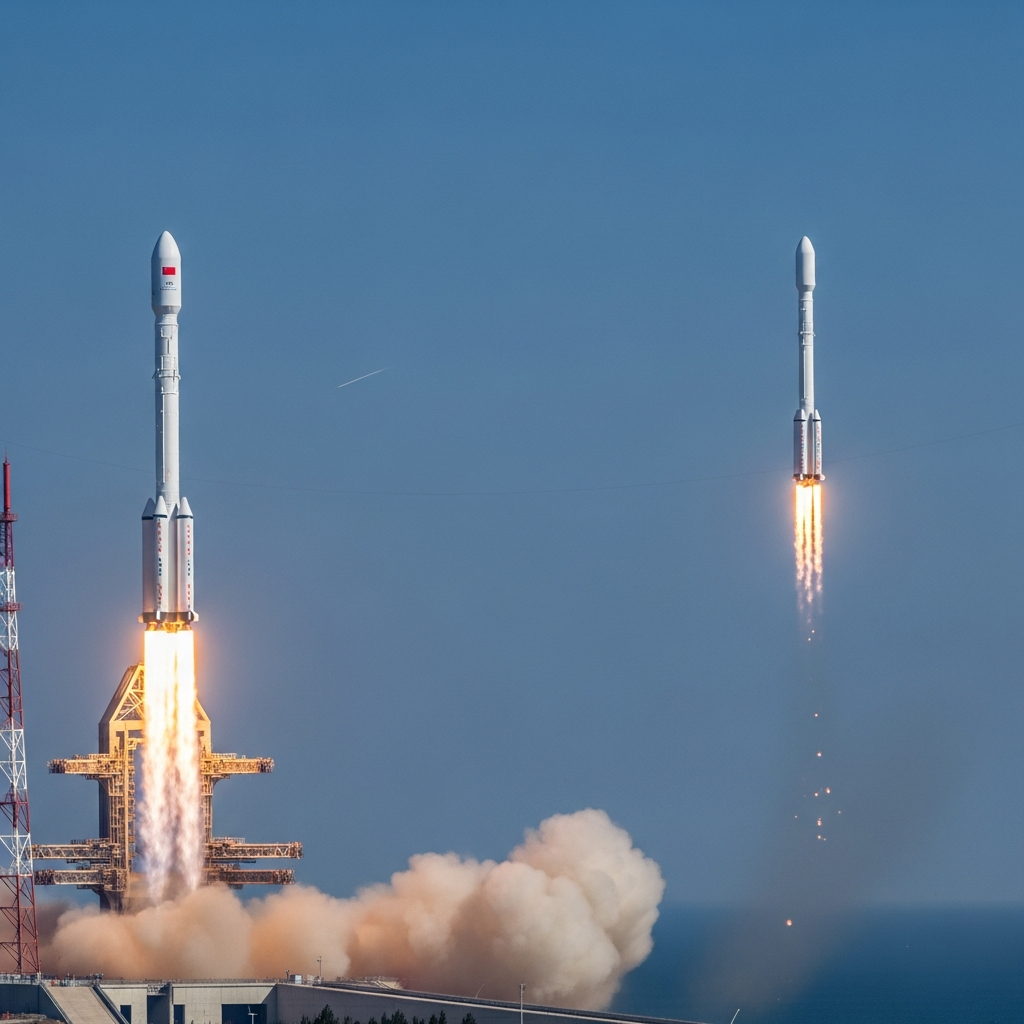
China’s ambitious pursuit of reusable rocket technology reached a critical juncture with its second launch attempt in just three weeks. This recent activity, spearheaded by the state-owned Long March 12A rocket, underscores China’s determined effort to revolutionize its access to space and significantly reduce launch costs, mirroring the transformative impact seen in the United States. While the Long March 12A successfully achieved orbit, its first-stage recovery mission encountered challenges, providing invaluable data for future advancements.
China’s Latest Reusable Rocket Endeavor: The Long March 12A
On a significant Monday evening (9:00 pm EST / 02:00 UTC Tuesday) from the Jiuquan Satellite Launch Center, China’s first Long March 12A rocket roared to life. This inaugural flight marked a pivotal moment for the Shanghai Academy of Spaceflight Technology, a subsidiary of the state-owned China Aerospace Science and Technology Corporation (CASC). The rocket, comparable in size to SpaceX’s Falcon 9, successfully propelled its upper stage into the predetermined low-Earth orbit.
However, the mission’s primary objective of recovering the methane-fueled first stage booster did not go as planned. After reaching supersonic speeds, the booster failed to execute a critical braking burn, resulting in an impact in a remote region approximately 200 miles downrange from the launch site. It missed its intended landing zone near the Gobi Desert by several miles. CASC openly acknowledged the recovery failure, stating that the specific reasons are under investigation. Despite this setback, the corporation highlighted that the mission gathered “critical engineering data under the rocket’s actual flight conditions,” laying a vital foundation for future reliable recoveries.
Echoes of Zhuque-3: A Parallel Path to Reusability
The Long March 12A’s experience remarkably parallels the first flight of another medium-class Chinese reusable rocket, the Zhuque-3, which launched on December 2. Developed by the privately funded startup LandSpace, the Zhuque-3 also successfully reached orbit on its maiden voyage, yet its recoverable booster stage similarly crashed during a downrange landing attempt. In that instance, the Zhuque-3’s first stage landed adjacent to its designated recovery zone.
LandSpace’s Zhuque-3, named after the Vermillion Bird, represents a significant private sector push, drawing inspiration from SpaceX’s Starship. Constructed from stainless steel and powered by liquid methane and oxygen, the Zhuque-3 has undergone extensive testing. Key milestones include successful Vertical Takeoff and Vertical Landing (VTVL) tests in January and September 2024, achieving hover times of 60 and over 200 seconds, respectively. A full-fueled static fire test in October 2025 further prepared it for its inaugural flight. With a design payload capacity to Low Earth Orbit (LEO) of 8,000 kg in recoverable mode, LandSpace aims to eventually deploy a larger Zhuque-3E capable of 18,300 kg for recoverable missions.
The Strategic Imperative: Why Reusable Rockets Matter to China
China’s aggressive push into reusable rocket technology is driven by a profound strategic imperative: to secure more efficient and cost-effective access to space. In 2025, Chinese rockets executed 89 orbital launch attempts. While this is less than half the US launch cadence, it significantly outpaces all other nations, with the US and China collectively accounting for nearly 90 percent of global orbital launches. Historically, China has relied on a fleet of expendable rockets. The transition to reusability promises to unlock the potential for more frequent launches at a reduced cost, fundamentally transforming China’s space capabilities.
This mirrors the impact of SpaceX’s Falcon 9, which ushered in a new era of lower-cost launch services in the United States. Beyond economic advantages, robust reusable launch capabilities are crucial for China’s broader space ambitions. These include expanding the Tiangong space station, conducting crewed lunar missions by 2030, and deploying vast satellite constellations – a strategic response to perceived national security risks from external satellite monopolies.
Investing in the Future: Diverse Approaches to Recovery and Funding
China’s reusable rocket developers are exploring various recovery methods. Unlike SpaceX’s common use of ocean barges, both the Zhuque-3 and Long March 12A boosters target landing sites in remote desert regions, far downrange from their inland launch pads. However, a significant shift is underway in China’s maritime recovery capabilities. The nation recently accepted its first dedicated sea-based rocket recovery platform, named Linghangzhe (Pathfinder), equipped with a net system and officially certified for operational readiness. This follows the August deployment of Xingjiguihang (Stellar Return), operated by i Space, a private firm, designed with a large recovery deck for its SQX-3 rocket and other medium-to-large launchers. These advancements position China as only the second country to master this crucial sea-based recovery technology.
To further accelerate this capital-intensive sector, the Shanghai Stock Exchange has introduced new guidelines for its STAR market. These “fast lane” rules exempt reusable rocket firms from standard profitability and revenue thresholds, instead requiring successful completion of one orbital launch using reusable rocket technology. LandSpace’s recent Zhuque-3 launch has already met this specific eligibility criterion, providing a vital pathway for private firms to access much-needed capital to compete globally.
A Fleet on the Horizon: China’s Upcoming Reusable Launchers
The future of China’s reusable spaceflight landscape looks crowded and competitive. Several other small-to-medium-class reusable rockets are on the horizon. Commercial startups like Space Pioneer with its Tianlong-3 and CAS Space with its Kinetica-3 are preparing for potential debuts in early 2026, both featuring recoverable boosters. Further out, around 2026, Galactic Energy’s Pallas-1, i-Space’s Hyperbola-3, and Deep Blue Aerospace’s Nebula-1 are also designed for reusability.
On the state-owned front, the China Academy of Launch Vehicle Technology is developing super-heavy rockets. The Long March 10 is designed with reusable boosters for crewed lunar missions. Looking towards the 2030s, China aims to debut the fully reusable Long March 9 rocket, envisioned to be similar in scale and ambition to SpaceX’s Starship. These comprehensive developments, encompassing both state and private enterprises, underscore China’s unwavering commitment to becoming a dominant force in reusable space technology.
Frequently Asked Questions
What was the outcome of China’s recent Long March 12A reusable rocket launch?
China’s Long March 12A rocket successfully launched from the Jiuquan Satellite Launch Center and delivered its payload to low-Earth orbit. However, its primary objective of recovering the first-stage booster was not met. The booster failed to perform a critical braking burn and impacted a remote region hundreds of miles downrange, missing its designated landing site near the Gobi Desert. Despite the recovery failure, the mission provided invaluable engineering data for future reusable launch advancements.
How does China’s reusable rocket development compare to SpaceX?
China is rapidly developing reusable rocket technology, drawing inspiration from SpaceX’s pioneering efforts. Both state-owned entities, like those behind the Long March 12A, and private firms such as LandSpace with its Zhuque-3, are adopting propulsive landing architectures similar to SpaceX’s Falcon 9. While China is catching up, its developers are also innovating, focusing on inland desert landing sites for some rockets and introducing sea-based recovery platforms like Linghangzhe. The Long March 9 is even envisioned to rival SpaceX’s Starship in scale by the 2030s.
What strategic importance do reusable rockets hold for China’s space ambitions?
Reusable rockets are strategically vital for China as they promise to significantly reduce the cost of space access and dramatically increase launch cadence. This capability is essential for sustaining China’s ambitious space program, which includes expanding the Tiangong space station, achieving crewed lunar missions by 2030, and deploying large-scale satellite constellations. By developing its own reusable technology, China aims to reduce reliance on foreign capabilities, enhance national security, and solidify its position as a leading global space power.
Conclusion
China’s recent reusable rocket launch attempts, though facing recovery challenges, represent an undeniable stride forward in its determined push for space leadership. The dual-track approach, involving both state-backed giants like CASC and agile private companies such as LandSpace, demonstrates a comprehensive national strategy. As new recovery platforms come online and more advanced reusable launchers enter development, China is setting the stage for a new era of space exploration. These efforts not only signify a revolution in China’s domestic space capabilities but also reshape the global competitive landscape, ushering in an exciting, cost-effective future for space access worldwide.
References
- arstechnica.com
- <a href="https://www.spacedaily.com/reports/SeabasedrocketnetrecoveryplatformentersserviceforChinesereusablelaunchers999.html”>www.spacedaily.com
- www.universetoday.com
- www.freemalaysiatoday.com
- www.scmp.com