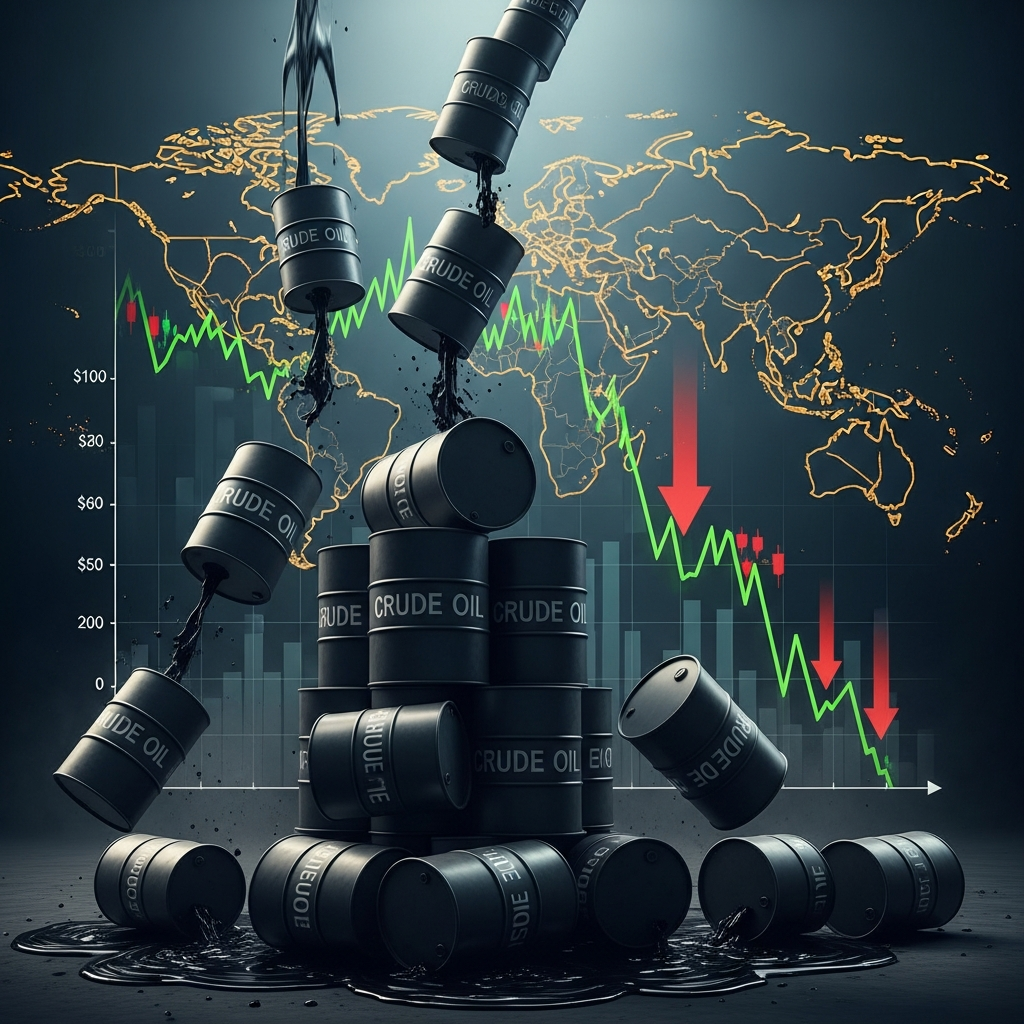
Global crude oil markets are currently navigating a significant downturn, with benchmark prices experiencing notable declines. This shift signals a complex interplay of increased supply, softening demand, and geopolitical undercurrents, creating distinct ripple effects across economies worldwide. While daily fluctuations capture headlines, understanding the deeper structural forces at play is essential for businesses, consumers, and policymakers alike.
On the London Intercontinental Exchange (ICE), Brent crude recently saw a modest dip of $0.05, settling at $62.19 per barrel. Similarly, the New York Mercantile Exchange (NYMEX) reported Light crude falling by $0.03, trading at $58.32 per barrel. These minor movements are part of a larger trend, marking the sharpest weekly drop since March and pushing prices near the critical $60-a-barrel threshold, with some analysts even forecasting a potential fall below $50 in the near future.
Unpacking the “Crude Awakening”: Key Drivers of Decline
The current market dynamic, often termed a “Crude Awakening,” stems from a perfect storm of factors fundamentally reshaping global energy landscapes. This is not merely a transient dip but reflects deeper structural shifts.
A Flood of Supply
One of the primary contributors to declining oil prices is a robust global supply. Non-OPEC+ producers, including the United States, Brazil, Canada, Guyana, and Argentina, are operating at or near record output levels. The U.S. Energy Information Administration (EIA) forecasts an unprecedented U.S. crude oil production averaging 13.5 million barrels per day (bpd) in both 2025 and 2026.
Adding to this surge, the OPEC+ alliance has begun a gradual unwinding of its voluntary production cuts. The International Energy Agency (IEA) further projects a significant global oil surplus, potentially reaching nearly 4 million bpd by 2026. This oversupply scenario means more oil is available than the market currently demands, naturally driving prices down. U.S. crude inventories, for example, recently increased by 3.5 million barrels, far exceeding analysts’ expectations, partly due to reduced refinery utilization during seasonal maintenance.
Weakening Global Demand
Alongside surging supply, global oil demand growth has softened considerably. The IEA has trimmed its demand forecasts, citing a harsher macroeconomic climate, persistent trade tariffs, and the accelerating transition towards transport electrification. Economic weaknesses, particularly in major consuming nations like China and Europe, have dampened overall consumption. This has led to substantial global oil inventory builds projected through late 2025 and into 2026, signaling a sustained period of subdued demand. Renewed trade tensions between the United States and China, especially China’s tightening export controls on critical rare-earth minerals, further fuel fears of slowing global growth, thus weakening energy demand.
The Strong Dollar Effect
A strengthening U.S. dollar also exerts significant downward pressure on crude oil prices. As crude oil is priced globally in dollars, a stronger dollar makes it more expensive for international buyers holding other currencies. This effectively dampens demand. The dollar has gained considerable strength recently, fueled by investors seeking safe-haven assets amid global uncertainties and robust U.S. economic data, coupled with the Federal Reserve’s monetary policy. This dynamic adds another layer of complexity, making oil less attractive for many international markets.
Winners and Losers: Economic Ripple Effects
The sustained period of lower oil prices creates a divergent economic landscape, producing clear “winners” and “losers” across various sectors and regions.
African Economies Face Mixed Fortunes
For Africa’s major oil-exporting nations, such as Nigeria, Angola, and Libya, the price slide presents severe fiscal challenges. Most of these economies base their national budgets on an oil price benchmark often above $75 per barrel. Brent crude trading near $60 per barrel implies significant revenue shortfalls, dwindling foreign reserves, and increased exchange rate pressures. Nigeria’s Naira has already strained due to reduced crude receipts, impacting the central bank’s capacity to stabilize the currency. Angola’s Kwanza has depreciated, and Libya’s economic recovery faces setbacks from volatile production and internal instability.
Conversely, oil-importing economies like Kenya, Egypt, and South Africa stand to gain from cheaper energy imports in the short term. Lower import costs can ease inflationary pressures. However, these benefits are often diluted by currency volatility and the persistent strength of the U.S. dollar, which raises import costs when converted to local currencies. South Africa, with its relatively stable Rand, shows a more positive outlook, with local estimates predicting potential fuel price reductions.
Industry Shifts: Refiners Soar, Producers Struggle
Within the energy sector, the impact is starkly divided. Upstream oil producers and oil majors with significant exploration and production (E&P) operations, including giants like ExxonMobil and Shell, face direct pressure on revenues and profitability. This can lead to cost cuts and reduced shareholder returns, with smaller independent producers being particularly vulnerable.
Conversely, refining companies such as Marathon Petroleum and Valero Energy are poised to benefit significantly. Lower crude input costs can expand their “crack spreads” – the difference between crude oil prices and refined product prices – boosting their profit margins. The airline industry also emerges as a clear winner, as jet fuel represents a major operating cost. Lower fuel prices directly boost profit margins for carriers like Delta Air Lines and EasyJet Plc. Similarly, shipping and logistics companies, including FedEx and Maersk, will see operational expenses decrease due to reduced bunker fuel costs. The manufacturing sector, especially energy-intensive industries and petrochemical companies, also benefits from cheaper feedstock costs.
Asia and Europe’s Response
Asian economies, generally net oil importers, experience broadly positive effects from lower oil prices. Reduced energy bills and eased inflation are welcome, though tempered by soft consumer demand and ongoing trade tariffs. European economies also see lower oil prices contributing to contained inflation and reduced input costs. Refinery margins for light sweet crude hit two-year highs in September 2025, despite broader industrial headwinds and localized price spikes for transportation fuels in some areas.
Geopolitical Nuances: Conflicting Signals in a Volatile Market
Geopolitical factors continue to influence oil market sentiment, often presenting conflicting signals. On one hand, renewed trade tensions between the United States and China, exemplified by China’s rare-earth mineral export controls and new tariffs, fuel fears of slowing global growth, inherently weakening energy demand. Discussions between world leaders, such as U.S. President Donald Trump and Russian President Vladimir Putin concerning the conflict in Ukraine, also underscore geopolitical uncertainty.
However, paradoxically, positive sentiment from ongoing U.S.-China trade negotiations can momentarily override bearish fundamentals. Markets recently reacted positively to prospects of easing chip export restrictions by the U.S. in exchange for China loosening its rare-earth limitations. This potential détente momentarily drives benchmark prices higher, creating a dichotomous market where underlying bearish trends clash with short-term geopolitical optimism.
The Long Road Ahead: Peak Oil and the Energy Transition
Beyond immediate price fluctuations, a fundamental long-term shift is underway in global energy markets. The International Energy Agency (IEA) predicts global oil demand will peak by 2029, driven by the rise of renewable energy and electrification. This transition is expected to transform the market into a “buyers’ market,” exerting long-term downward pressure on crude oil prices and eroding the economic rents many oil-rich states depend on.
MENA’s Strategic Crossroads
Oil-rich Middle East and North Africa (MENA) countries, where oil rents often exceed 10% of GDP (e.g., Gulf states, Algeria, Iran, Libya), face a strategic crossroads. Despite their low production costs (e.g., Middle East onshore at $27/barrel), many have high fiscal breakeven oil prices, often significantly above $65 per barrel, due to extensive public spending. A scenario of oversupply leading to structurally lower prices would chronically underfinance government budgets.
MENA leaders grapple with two main policy reactions:
- “Kicking the can down the road”: Many countries delay meaningful economic diversification or structural reform, relying on existing reserves and low-cost production. This approach offers short-term stability but increases long-term vulnerability to price shocks and potential social unrest without economic transformation.
- “No pain, no gain”: Countries like the UAE and Saudi Arabia (with its ambitious Vision plans) acknowledge the unsustainability of oil dependence. They pursue economic diversification and embrace new technologies, often developing domestic renewable energy to free up more hydrocarbons for export. While reforms entail short-term political risks, early adoption allows countries to manage the transition on their own terms, investing in education and competitive industries for long-term sustainability.
Future Outlook: Sub-$50 Oil?
The short-term outlook for crude oil prices, particularly for late 2025 and early 2026, remains bearish. Analysts, including those from S&P Global, predict oil prices could potentially drop below $50 per barrel. The EIA projects Brent crude to average $62 per barrel in Q4 2025, possibly dropping to $52 per barrel in 2026. This potential decline would offer significant relief to consumers, particularly American drivers, after years of gasoline price inflation.
However, the current market movements are also swayed by positive sentiment surrounding U.S.-China trade talks, particularly concerning rare earth exports. This temporary geopolitical optimism can momentarily override the fundamental bearish outlook. Yet, the long-term trend suggests oil prices will likely remain in a lower range or continue a gradual decline. Global fossil fuel demand is expected to peak by 2030, driven by the ongoing energy transition. Strategic pivots are crucial for energy companies and oil-producing nations, emphasizing cost discipline, diversification, and investment in lower-carbon solutions to adapt to this evolving energy future.
Frequently Asked Questions
What key factors are driving the current decline in global oil prices?
The decline in global oil prices is primarily driven by a confluence of oversupply, weakening global demand, and a strengthening U.S. dollar. Robust non-OPEC+ production, particularly from the U.S., combined with the gradual unwinding of OPEC+ cuts, creates an abundant supply. Simultaneously, a harsher macroeconomic climate, trade tensions, and accelerating electrification dampen global demand. A strong U.S. dollar also makes dollar-denominated crude oil more expensive for international buyers, further reducing demand.
Which regions and industries are most affected by lower oil prices?
The impact varies significantly by region and industry. Oil-exporting nations in Africa (e.g., Nigeria, Angola, Libya) face severe fiscal challenges due to revenue shortfalls. Oil-importing countries in Africa (e.g., Kenya, Egypt, South Africa), Asia, and Europe benefit from cheaper energy imports. Industrially, upstream oil producers face pressure on revenues, while refining companies, airlines, shipping and logistics firms, and energy-intensive manufacturing sectors benefit from lower input costs, leading to increased profitability.
What is the long-term outlook for crude oil prices amidst the energy transition?
The long-term outlook for crude oil prices is generally bearish, with forecasts indicating a structural shift. The International Energy Agency (IEA) predicts global oil demand will peak by 2029 due to the rise of renewables and electrification. This will likely transition the market into a “buyers’ market,” exerting sustained downward pressure on prices. While short-term geopolitical events can cause price fluctuations, the underlying trend points towards a lower price range beyond 2026, compelling energy producers and nations to diversify their economies and invest in sustainable alternatives.