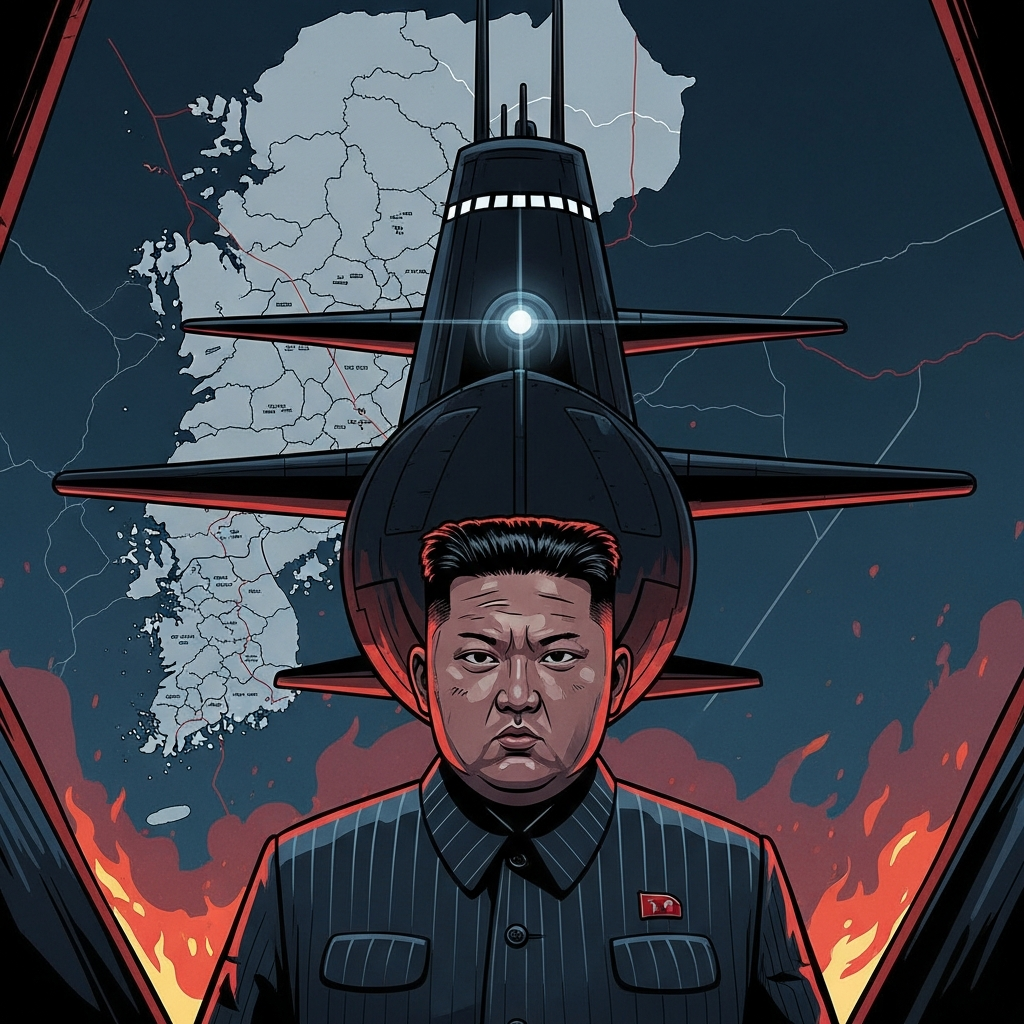
The geopolitical landscape of the Korean Peninsula is witnessing heightened tensions, sparked by North Korea’s vehement condemnation of a new nuclear submarine deal between the United States and South Korea. Leader Kim Jong Un has branded the agreement an “offensive act,” asserting it gravely threatens regional stability and Pyongyang’s national security. This sharp rebuke comes amid a flurry of North Korean military developments and a strengthening alliance with Russia, signaling a complex and volatile period for international relations.
Kim Jong Un Slams US-South Korea Nuclear Submarine Pact
North Korean leader Kim Jong Un delivered a stern warning from a naval facility, criticizing the US-South Korea nuclear submarine deal. He described the pact as a direct assault on Pyongyang’s security and maritime sovereignty. According to North Korean state media KCNA, Kim emphasized that this “threat to security must be countered” decisively. His remarks underscore a growing perception of external threats within North Korea’s leadership.
This escalating rhetoric aligns with North Korea’s unwavering commitment to bolster its military capabilities. During his inspection, Kim stressed the urgent need to “further accelerate the radical development of the modernisation and nuclear weaponisation of the naval force.” This includes the ambitious project to develop an 8,700-ton nuclear-powered strategic guided missile submarine, a critical component of Pyongyang’s long-term defense strategy.
Pyongyang’s Concurrent Military Assertions
Kim Jong Un’s condemnation was not an isolated event. It coincided with several key military activities designed to project North Korea’s growing strength. On the same day as his submarine facility tour, Kim personally oversaw the successful test firing of a new high-altitude, long-range anti-air missile. This missile, launched into the Sea of Japan (which North Korea refers to as the East Sea of Korea), reportedly struck a mock target at an altitude of 200 kilometers (124 miles), showcasing advancements in Pyongyang’s air defense capabilities.
These demonstrations serve a dual purpose: to signal resolve against perceived threats and to validate the ongoing efforts to modernize North Korea’s military arsenal. The emphasis on both offensive (submarine) and defensive (anti-air missile) systems highlights a comprehensive approach to national security.
South Korea’s Strategic Pursuit of Nuclear Submarine Technology
In parallel with North Korea’s escalating actions, South Korea has actively pursued its own strategic military enhancements. Seoul is seeking a “standalone deal” with the United States to acquire nuclear-powered submarine technology, as reported by South Korea’s Yonhap news agency. This initiative aims to bolster South Korea’s naval power and deterrent capabilities in the face of North Korean aggression.
While US law typically prohibits the transfer of nuclear material for military use, South Korea’s national security adviser, Wi Sung-lac, indicated that an exemption from US President Donald Trump could be sought. Wi held discussions with top US officials, including Secretary of State Marco Rubio and Secretary of Energy Chris Wright. The precedent for such a deal exists, with Australia having pursued a similar agreement with the US to build its own nuclear-powered submarines. Talks between Washington and Seoul are anticipated to commence early next year, marking a significant step in the strengthening of the US-South Korea alliance.
The Deepening Russia-North Korea Strategic Alliance
Adding another layer of complexity to regional dynamics is the increasingly robust military alliance between Russia and North Korea. Russian leader Vladimir Putin extended New Year’s greetings to Kim Jong Un, expressing profound gratitude for North Korea’s ongoing military support in the war in Ukraine. This cooperation signifies a pivotal shift in geopolitical alignments, with global implications.
KCNA reported Putin’s praise for the “heroic entry of soldiers of the Korean People’s Army into the battles for liberating the Kursk region from occupiers.” He also highlighted the contributions of “Korean engineers in the land of Russia,” framing these actions as irrefutable proof of “invincible friendship and militant fraternity.” Since 2024, North Korea has reportedly deployed thousands of soldiers and engineers to support Russian troops in Ukraine and in areas of Russia briefly occupied by Ukrainian forces. South Korea’s intelligence agency estimates approximately 1,000 North Korean military engineers were dispatched to Kursk for mine clearing operations in August, following an earlier dispatch of an estimated 15,000 combat troops, resulting in some 2,000 North Korean casualties.
This military collaboration is underpinned by a “comprehensive strategic partnership” treaty signed between Moscow and Pyongyang in 2024. Putin expressed his hope to “strengthen the relations of friendship and alliance in every way” and foster “constructive cooperation on regional and international issues.” This burgeoning partnership allows North Korea to prioritize Moscow in its foreign policy, leveraging the Ukraine conflict to accelerate its own military nuclear program, a development of serious concern to Western powers.
Pyongyang’s Rejection of Dialogue with Seoul
Amidst these geopolitical realignments, North Korea has consistently rejected any prospect of dialogue with South Korea. Kim Yo Jong, the influential sister of Kim Jong Un and a senior foreign policy official, has been particularly vocal. She criticized Seoul’s “blind trust” in its alliance with the United States and dismissed recent peace overtures from South Korean President Lee Jae Myung.
Kim Yo Jong stated that Pyongyang has “no interest” in improving inter-Korean relations. She firmly asserted that South Korea’s continued military ties with Washington, exemplified by ongoing US-ROK military drills (which Pyongyang views as “invasion rehearsals”), render any efforts at rapprochement meaningless. These remarks align with Kim Jong Un’s earlier statements labeling the exercises as an “obvious expression of their will to provoke war.” In a significant policy shift, North Korea revised its Constitution in October to officially declare the South a “hostile state,” abandoning the long-held goal of reunification and signaling deeply entrenched confrontational stance.
Kim’s Conditional Openness to US Talks
Despite the hardline rhetoric, Kim Jong Un has indicated a conditional willingness to engage in future talks with the United States. However, this hinges entirely on Washington abandoning its insistence on denuclearization. According to KCNA, Kim stated that dialogue is possible if the US sheds its “delusional obsession with denuclearisation” and genuinely seeks peaceful coexistence. He notably expressed that he still holds “fond memories” of current US President Donald Trump.
This stance underscores North Korea’s firm rejection of denuclearization, which has historically been the primary sticking point in negotiations. Kim has explicitly declared that North Korea will “never give up our nuclear weapons,” asserting the country as an “irreversible” nuclear state. Analysts like Yang Moo-jin suggest Kim’s detailed justifications reflect “equal parts confidence and desperation,” serving a domestic purpose to “pre-empt instability.” The strengthened alliance with Russia is seen as a key factor contributing to Kim’s emboldened position, allowing Pyongyang to withstand international sanctions and grow “stronger, building endurance and resistance that cannot be crushed by any pressure.”
The timing of Kim’s remarks is also considered strategic, preceding Trump’s expected visit to South Korea next month for the Asia-Pacific Economic Cooperation Forum (APEC). Lim Eul-chul of South Korea’s Kyungnam University suggested this timing could be “calculated,” hinting at a potential surprise summit while also playing to Trump’s known desire for a Nobel Prize.
Frequently Asked Questions
What is North Korea’s primary concern regarding the US-South Korea nuclear submarine deal?
North Korea views the US-South Korea nuclear submarine deal as a significant threat to its security and maritime sovereignty. Leader Kim Jong Un explicitly called it an “offensive act” that jeopardizes the stability of the Korean Peninsula. Pyongyang believes this agreement necessitates an urgent acceleration of its own naval modernization and nuclear weaponization efforts, including the development of an 8,700-ton nuclear-powered strategic guided missile submarine, to counter what it perceives as an escalating external threat.
How has the Russia-North Korea alliance impacted regional dynamics on the Korean Peninsula?
The deepening Russia-North Korea alliance has significantly impacted regional dynamics, bolstering Pyongyang’s resolve and military capabilities. Russia’s gratitude for North Korea’s military support in Ukraine, including the deployment of soldiers and engineers, highlights a reciprocal relationship. This strategic partnership provides North Korea with increased leverage against US and South Korean pressure, potentially offering access to advanced military technology and reducing the effectiveness of international sanctions, thereby intensifying geopolitical tensions in Northeast Asia.
Why has North Korea rejected dialogue with South Korea, despite peace overtures?
North Korea has unequivocally rejected dialogue with South Korea, primarily due to Seoul’s continued military alliance with the United States. Kim Yo Jong, a senior North Korean official, criticized South Korea’s “blind trust” in the US and dismissed peace overtures from President Lee Jae Myung as meaningless while joint US-ROK military drills continue. Pyongyang views these exercises as “invasion rehearsals.” Furthermore, North Korea’s revised constitution now designates South Korea as a “hostile state,” cementing a confrontational stance and signaling disinterest in inter-Korean rapprochement.
Conclusion
The latest developments on the Korean Peninsula paint a picture of intensifying strategic competition and profound regional instability. North Korea’s forceful condemnation of the US-South Korea nuclear submarine deal, coupled with its accelerated military advancements and a robust alliance with Russia, signals a new and potentially more perilous phase in Northeast Asian geopolitics. While Kim Jong Un has left a narrow door open for conditional talks with the US, his steadfast refusal to abandon denuclearization, combined with Pyongyang’s outright rejection of dialogue with Seoul, suggests a prolonged period of high tension. Understanding these intricate alliances and underlying motivations is crucial for navigating the complex security challenges that lie ahead on the Korean Peninsula.