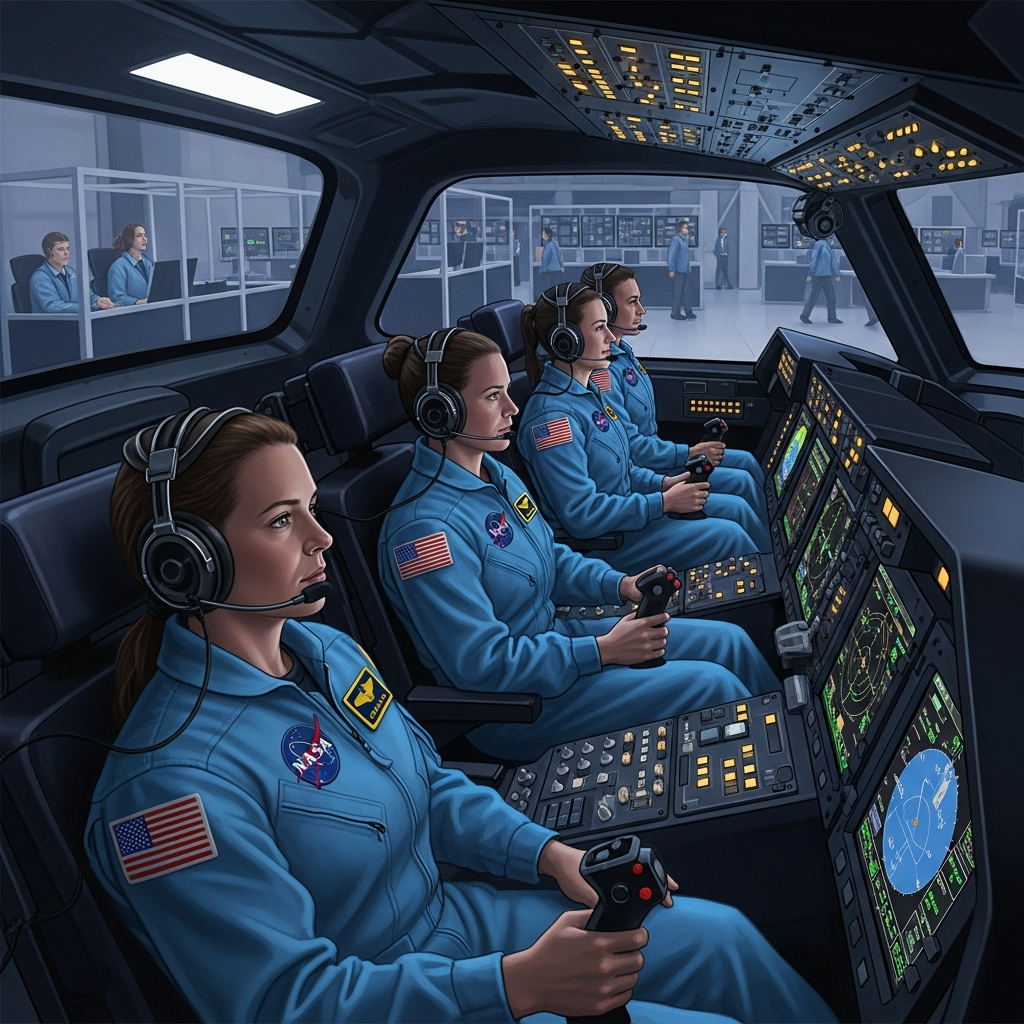
The dream of humanity returning to the Moon is closer than ever, thanks to NASA’s ambitious Artemis program. At the heart of this colossal endeavor lies Artemis II, the pioneering mission set to carry astronauts on a lunar flyby, paving the way for future lunar landings. But before a crew can embark on such an epic journey, rigorous preparation is paramount. This includes exhaustive training and, critically, the Artemis II crew rehearsal – a vital exercise that simulates every critical moment of the mission. Understanding these rehearsals offers a unique, behind-the-scenes look at the precision and dedication required for deep space exploration, ensuring unprecedented safety and success for the astronauts.
What is the Artemis II Mission? Paving the Way to the Moon
Artemis II marks a significant milestone in NASA’s journey to re-establish a permanent human presence on the Moon and eventually venture to Mars. This mission isn’t about landing; instead, it’s a meticulously planned lunar orbital flight, designed to test the critical systems of the Orion spacecraft with a human crew aboard. Slated to be the first crewed flight of the Space Launch System (SLS) rocket, Artemis II will send four astronauts beyond low-Earth orbit, around the Moon, and back. The primary goal is to thoroughly evaluate Orion’s life support systems, communications, navigation, and propulsion in a deep space environment, ensuring the capsule is safe and ready for future lunar landings. This mission is an essential stepping stone, validating the technology and procedures that will eventually land humans on the lunar south pole with Artemis III.
The Historic Crew: Meet the Artemis II Astronauts
The individuals entrusted with this pioneering mission are a diverse and highly skilled quartet, embodying the spirit of international collaboration and scientific discovery. The Artemis II crew consists of NASA astronauts Reid Wiseman (Commander), Victor Glover (Pilot), Christina Koch (Mission Specialist), and Canadian Space Agency (CSA) astronaut Jeremy Hansen (Mission Specialist). Their selection underscores a commitment to diversity and global partnership in space exploration. Each astronaut brings a wealth of experience from previous spaceflights, military careers, and scientific backgrounds, making them uniquely qualified to face the challenges of a lunar journey. Their collective expertise and rigorous training are central to the mission’s success.
The Critical Importance of Crew Rehearsals
Imagine embarking on the most complex journey of your life without a test run. Unthinkable, right? For space missions, especially those venturing to deep space, rehearsals are not just important; they are absolutely vital. The Artemis II crew rehearsal serves multiple crucial functions. First, it allows the entire team – astronauts, flight controllers, engineers – to practice complex procedures in a controlled, simulated environment. This includes everything from pre-launch checks and ascent sequences to orbital maneuvers, re-entry protocols, and emergency responses.
Secondly, rehearsals are instrumental in identifying potential issues or areas for improvement long before launch day. Small errors caught during a simulation can prevent catastrophic failures during an actual mission. They also help to refine communication protocols between the crew and mission control, ensuring clear, concise exchanges under pressure. Ultimately, these exhaustive rehearsals build confidence, foster teamwork, and provide invaluable operational experience, significantly de-risking the complex endeavor of sending humans to the Moon.
Inside the Artemis II Crew Rehearsal: Scenarios and Simulations
The Artemis II crew rehearsal is an intense, multi-day event designed to mimic the actual mission profile as closely as possible. Astronauts spend countless hours inside high-fidelity simulators at NASA’s Johnson Space Center in Houston, experiencing every phase of the mission. These aren’t just simple mock-ups; they are sophisticated environments that replicate the Orion capsule’s cockpit, complete with functional controls, realistic displays, and immersive visuals.
During the rehearsal, the crew practices launch countdowns, engine ignitions, staging events, and orbital insertions. They simulate critical maneuvers around the Moon, including the lunar flyby trajectory. Re-entry into Earth’s atmosphere, parachute deployment, and splashdown procedures are also meticulously rehearsed. Furthermore, extensive emergency scenarios are integrated into the simulations, such as cabin depressurization, propulsion system failures, and loss of communication. Each simulation pushes the crew and ground teams to their limits, forcing them to adapt, problem-solve, and execute under immense virtual pressure.
Technology Powering Deep Space Training
The effectiveness of the Artemis II crew rehearsal hinges on cutting-edge simulation technology. NASA utilizes a suite of advanced simulators that provide hyper-realistic training environments. The Orion full-motion simulator, for instance, replicates the physical sensations of launch and re-entry, complete with vibrations and G-forces. Integrated mission control centers, staffed by flight directors and specialists, operate in parallel with the crew, practicing their real-time decision-making and command execution.
These digital twins of the actual spacecraft allow engineers to test hardware and software interactions, validating system readiness before physical integration. The data collected from these rehearsals is invaluable, providing insights into human-machine interfaces, crew workload, and potential design tweaks. This blend of physical and digital simulation ensures that when the Artemis II crew finally straps into the Orion capsule atop the SLS rocket, they are not only physically prepared but also intimately familiar with every aspect of their spacecraft and mission profile.
Addressing Challenges and Continuous Refinement
Every complex mission presents unforeseen challenges, and the Artemis II program is no exception. During the crew rehearsals, teams inevitably uncover areas that require further attention or procedural adjustments. These might include refining specific checklist items, optimizing communication flows between the crew and ground control, or adjusting emergency response protocols based on how the crew reacts in a simulated crisis.
The beauty of the rehearsal process is its iterative nature. Any identified issues are meticulously analyzed, solutions are developed, and then integrated into subsequent training sessions. This continuous feedback loop of practice, evaluation, and refinement is crucial. It ensures that by the time launch day arrives, the mission plan, the spacecraft, and the human elements are as robust and resilient as possible, ready to navigate the unforgiving environment of deep space.
Frequently Asked Questions
What exactly is the Artemis II mission and its primary goal?
The Artemis II mission is the first crewed flight of NASA’s Artemis program, designed to send four astronauts on a lunar flyby. Its primary goal is to rigorously test the Orion spacecraft’s critical systems, including life support, navigation, and communication, in a deep space environment with humans aboard. This mission serves as a vital precursor to future lunar landings, validating the technology and procedures necessary for long-duration human spaceflight around the Moon and eventually to Mars. It marks a significant return to lunar exploration after decades.
Who are the astronauts chosen for the Artemis II mission?
The Artemis II mission will be crewed by a historic team of four highly experienced astronauts. The crew comprises NASA astronauts Reid Wiseman, who will serve as Commander; Victor Glover, the Pilot; and Christina Koch, a Mission Specialist. They will be joined by Canadian Space Agency (CSA) astronaut Jeremy Hansen, also a Mission Specialist. This diverse international crew represents a collaborative effort in space exploration, bringing a wealth of expertise and dedication to this pioneering journey around the Moon.
How do these crew rehearsals ensure astronaut safety for deep space missions?
Crew rehearsals are absolutely critical for ensuring astronaut safety on deep space missions like Artemis II. They allow astronauts and ground control teams to practice every phase of the mission, from launch to re-entry, in a highly realistic simulated environment. This rigorous practice helps to identify and mitigate potential risks, refine emergency procedures, and optimize communication protocols. By simulating complex scenarios, including system failures, the rehearsals train the crew to react effectively under pressure, fostering teamwork and familiarity with the spacecraft, ultimately reducing the likelihood of errors and enhancing overall mission safety.
The Road Ahead: Final Preparations for Launch
With the extensive crew rehearsals completed, the Artemis II mission moves ever closer to its anticipated launch. The insights gained from these simulations are invaluable, informing final adjustments to flight plans, software updates, and hardware checks. The focus now shifts to integrating the Orion capsule onto the powerful Space Launch System rocket at Kennedy Space Center, followed by a series of final tests and readiness reviews. The entire NASA team, along with its international partners, is working tirelessly to ensure every component, every system, and every person involved is fully prepared. The Artemis II mission represents not just a journey around the Moon, but a giant leap forward for human exploration, igniting inspiration and pushing the boundaries of what’s possible.