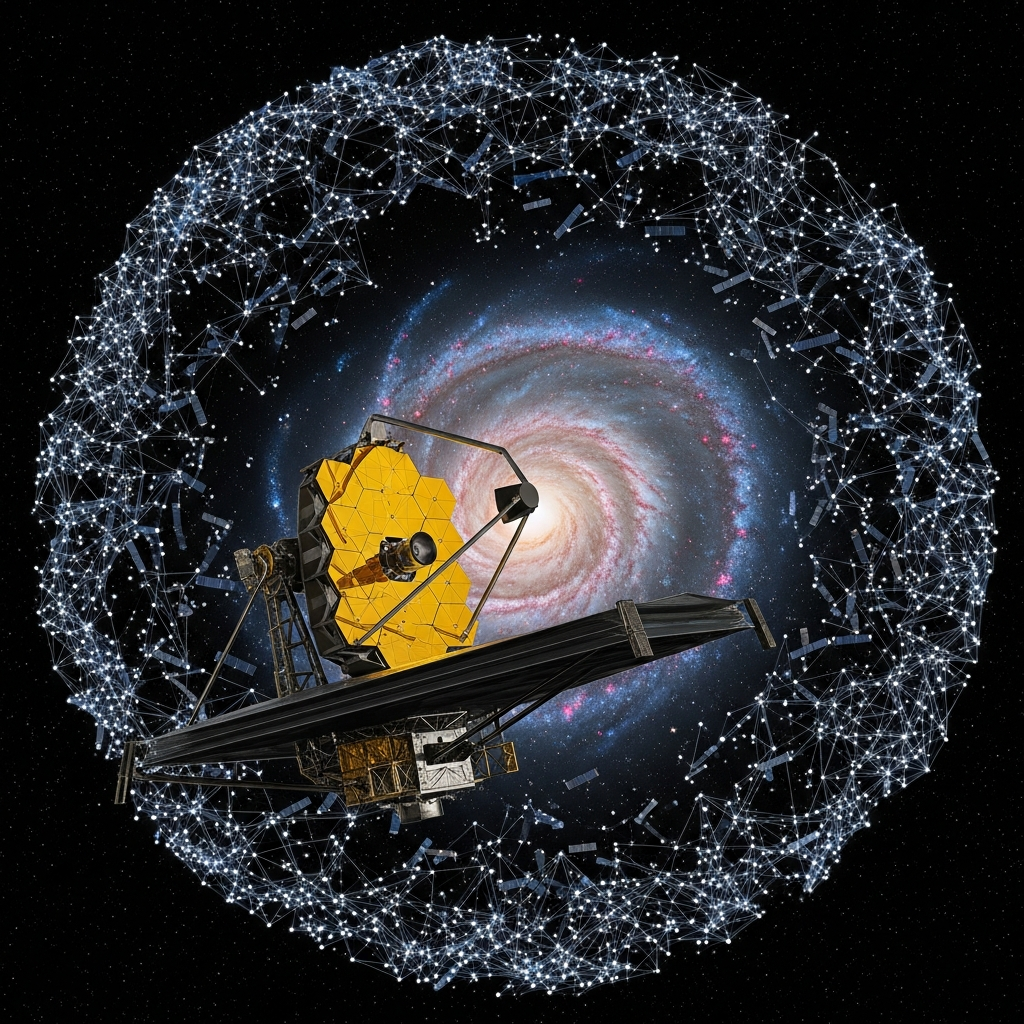
The relentless expansion of satellite mega-constellations is casting an alarming shadow over humanity’s ability to peer into the cosmos. A recent NASA study has delivered a stark warning: the burgeoning satellite boom presents a grave threat to space telescopes, jeopardizing groundbreaking discoveries and our fundamental understanding of the universe. This isn’t merely an aesthetic concern; it’s a profound challenge to scientific observation, data integrity, and the future of astronomical research. As thousands more satellites are launched into low Earth orbit (LEO), experts are grappling with unprecedented levels of light pollution and orbital congestion, directly impacting the precision instruments designed to explore deep space.
The Alarming Rise of Satellite Mega-Constellations
The past decade has witnessed an explosion in the number of operational satellites, particularly with the advent of large-scale internet mega-constellations like Starlink and OneWeb. These networks promise global connectivity, bridging digital divides and enhancing communication across the globe. However, their proliferation introduces unforeseen consequences for the scientific community.
A New Era in Low Earth Orbit (LEO)
Previously, LEO was populated by a manageable number of scientific, weather, and Earth observation satellites. Now, companies are deploying tens of thousands of communication satellites, with plans for hundreds of thousands more. These satellites orbit relatively close to Earth, making them bright and highly visible, especially during twilight hours. This dramatic shift in our orbital environment directly affects both ground-based and space-based astronomy. The sheer volume creates a new, complex backdrop for any mission observing beyond our planet.
The Stakes for Space Science
For decades, space telescopes have been invaluable assets, offering unparalleled views of distant galaxies, exoplanets, and cosmic phenomena, free from atmospheric distortion. Missions like the Hubble Space Telescope and the upcoming James Webb Space Telescope represent pinnacles of human ingenuity. Their ability to collect faint light signals from billions of light-years away is paramount. The increasing interference from nearby satellites threatens to undermine these very capabilities, potentially obscuring critical data and diminishing the scientific return on colossal investments.
How Satellites Imperil Our View of the Cosmos
The satellite boom manifests its threat to space telescopes in several critical ways. It’s a multifaceted problem that astronomers and space agencies like NASA are urgently working to understand and address.
Light Pollution: Dazzling Our Deep Space Eyes
The most immediate concern for space telescopes is light pollution. Unlike ground-based telescopes, which suffer from urban light, space telescopes are designed to operate in the pristine darkness of orbit. However, mega-constellation satellites reflect sunlight, appearing as bright streaks across images taken by these sensitive instruments. Even a single satellite passing through a telescope’s field of view during a long exposure can ruin an observation, leaving a bright trail that obscures faint celestial objects. This impact is particularly severe for wide-field surveys and instruments seeking transient events like supernovae or gamma-ray bursts. The cumulative effect of thousands of satellites means fewer clear observation windows.
Orbital Debris: A Growing Hazard
Beyond light, the sheer number of satellites significantly increases the risk of collisions, leading to orbital debris. Each collision generates thousands of smaller fragments, creating a cascading effect known as the Kessler Syndrome. While space telescopes are designed with some shielding, a high-velocity impact with even a tiny piece of debris could severely damage or destroy a mission. Protecting these invaluable assets from this growing space junk problem becomes increasingly challenging. This existential threat to space telescopes could cut short their operational lives.
Signal Interference and Data Corruption
Although less direct, electromagnetic interference can also pose problems. While most scientific observations use optical wavelengths, some space telescopes conduct radio astronomy or rely on precise communication links. The vast number of active transmitters in LEO could potentially cause subtle interference, corrupting data or requiring complex filtering processes that reduce scientific efficiency. Ensuring data integrity becomes a more complex task in a crowded orbital environment.
NASA’s Critical Findings and Future Implications
The recent NASA study serves as a vital wake-up call, providing quantifiable evidence of the accelerating impact of satellite mega-constellations. This research is crucial for shaping future policy and technological solutions.
Quantifying the Threat: What the Study Reveals
While specific details of the referenced NASA study aren’t provided, such research typically involves modeling the trajectories of existing and planned satellites, simulating their reflectivity under various lighting conditions, and predicting the frequency and severity of their interference with space telescopes. Findings often highlight specific missions most at risk, identify orbital altitudes of greatest concern, and project how the problem will escalate with future deployments. NASA’s expertise allows for a comprehensive assessment, moving beyond anecdotal observations to concrete data-driven conclusions. This includes analyzing the financial cost of re-observing ruined data.
Beyond Observational Challenges: Impact on Research
The implications extend beyond just taking pretty pictures. Astronomy is fundamentally about collecting light to understand physics, chemistry, and the history of the universe. If a significant percentage of observations are compromised, it could severely slow down or halt progress in critical areas like dark matter detection, exoplanet characterization, and the study of early universe phenomena. The satellite boom effectively adds a new layer of atmospheric “smog” for our orbital eyes. This impacts the ability to confirm theoretical models or discover entirely new cosmic entities.
Mitigating the Threat: Solutions and Collaboration
Addressing the satellite boom threat to space telescopes requires a multi-pronged approach involving innovation, regulation, and international cooperation. No single entity can solve this global challenge alone.
Technological Innovations and Design Adjustments
Satellite operators are already exploring technical solutions to reduce visibility. This includes using darker materials, deploying sunshades (like SpaceX’s VisorSat), and reorienting satellites to present a less reflective surface during critical astronomical observation times. While these efforts show promise for mitigating some light pollution, they are not complete solutions and come with their own engineering complexities and costs. Further research into optical coatings and satellite design will be essential.
Policy, Regulation, and International Cooperation
Effective policy and regulation are crucial. International bodies like the United Nations Committee on the Peaceful Uses of Outer Space (COPUOS) and national space agencies such as NASA are engaging with industry to develop best practices and voluntary guidelines. The goal is to establish orbital “speed limits,” define clear accountability for debris, and encourage sustainable space operations. A global framework is necessary to prevent a free-for-all in LEO that could permanently cripple astronomical research. This includes developing shared databases of satellite positions for better prediction.
The Role of Responsible Operators
Ultimately, responsible behavior by satellite operators is paramount. Prioritizing scientific preservation alongside commercial goals is key. This means adopting technologies that minimize reflectivity, providing accurate orbital data to astronomers, and committing to de-orbiting defunct satellites promptly. Collaborative efforts, where industry works hand-in-hand with the scientific community, are more likely to yield sustainable solutions than adversarial approaches. This proactive engagement defines the path forward.
The Long-Term Vision for Space Exploration
The dialogue surrounding the satellite boom and its threat to space telescopes forces humanity to confront a fundamental question: how do we balance immediate technological advancement with the long-term pursuit of scientific knowledge and discovery?
Preserving Our Astronomical Heritage
The ability to observe the night sky, both from Earth and from orbit, is a shared human heritage. It inspires future generations of scientists, engineers, and explorers. Allowing our view of the cosmos to be permanently degraded by orbital clutter would be a profound loss. Ensuring the continued viability of astronomical observation protects this heritage for millennia to come. NASA recognizes this intrinsic value in its advocacy.
Balancing Connectivity with Discovery
The tension between providing global internet access and preserving astronomical observation is real. However, it doesn’t have to be a zero-sum game. Innovative thinking, coupled with a commitment to sustainable space practices, can allow both endeavors to flourish. The challenge lies in finding optimal solutions that facilitate a connected world without sacrificing our window to the universe. This balance is critical for global progress.
Frequently Asked Questions
How do satellite mega-constellations threaten space telescopes?
Satellite mega-constellations primarily threaten space telescopes through increased light pollution and orbital debris. The numerous satellites reflect sunlight, appearing as bright streaks in sensitive telescope images, obscuring faint celestial objects and ruining scientific observations. Additionally, the sheer volume of satellites dramatically raises the risk of collisions, generating space junk that could damage or destroy expensive space telescopes, cutting short their operational lives. These issues can compromise data integrity and limit observation windows.
Which organizations are actively working to mitigate this satellite threat?
Several organizations are actively working to mitigate the threat. Space agencies like NASA are conducting studies to quantify the impact and advocate for solutions. The International Astronomical Union (IAU) and its Centre for the Protection of the Dark and Quiet Sky from Satellite Constellation Interference (CPS) are leading efforts to coordinate scientific responses and engage with industry. Satellite operators themselves, such as SpaceX and OneWeb, are experimenting with design modifications like sunshades and darker coatings. International bodies like the UN COPUOS are also involved in developing global guidelines and best practices for sustainable space operations.
What long-term impacts could the satellite boom have on future space exploration?
The long-term impacts could be significant and far-reaching. If the satellite boom continues unchecked, it could lead to a permanent degradation of astronomical observation from space, hindering our ability to make critical discoveries about exoplanets, dark matter, and the early universe. This could slow scientific progress and diminish our understanding of cosmic phenomena. Furthermore, an increase in orbital debris could make certain orbital regions too hazardous for future missions, restricting access to space and making the deployment of new, advanced telescopes riskier and more expensive. It represents a potential bottleneck for future space exploration and scientific endeavor.
Conclusion: A Call for Unified Action
The findings from NASA’s recent study underscore the urgent need for a unified global approach to address the satellite boom threat to space telescopes. This isn’t just an issue for astronomers; it’s a challenge for all who value scientific discovery and the future of space exploration. By fostering collaboration between industry, government, and the scientific community, we can implement innovative technical solutions, establish robust international policies, and cultivate responsible operational practices. Preserving our window to the cosmos while advancing global connectivity is a shared responsibility that demands immediate and concerted action. The universe awaits our continued exploration, unobstructed.