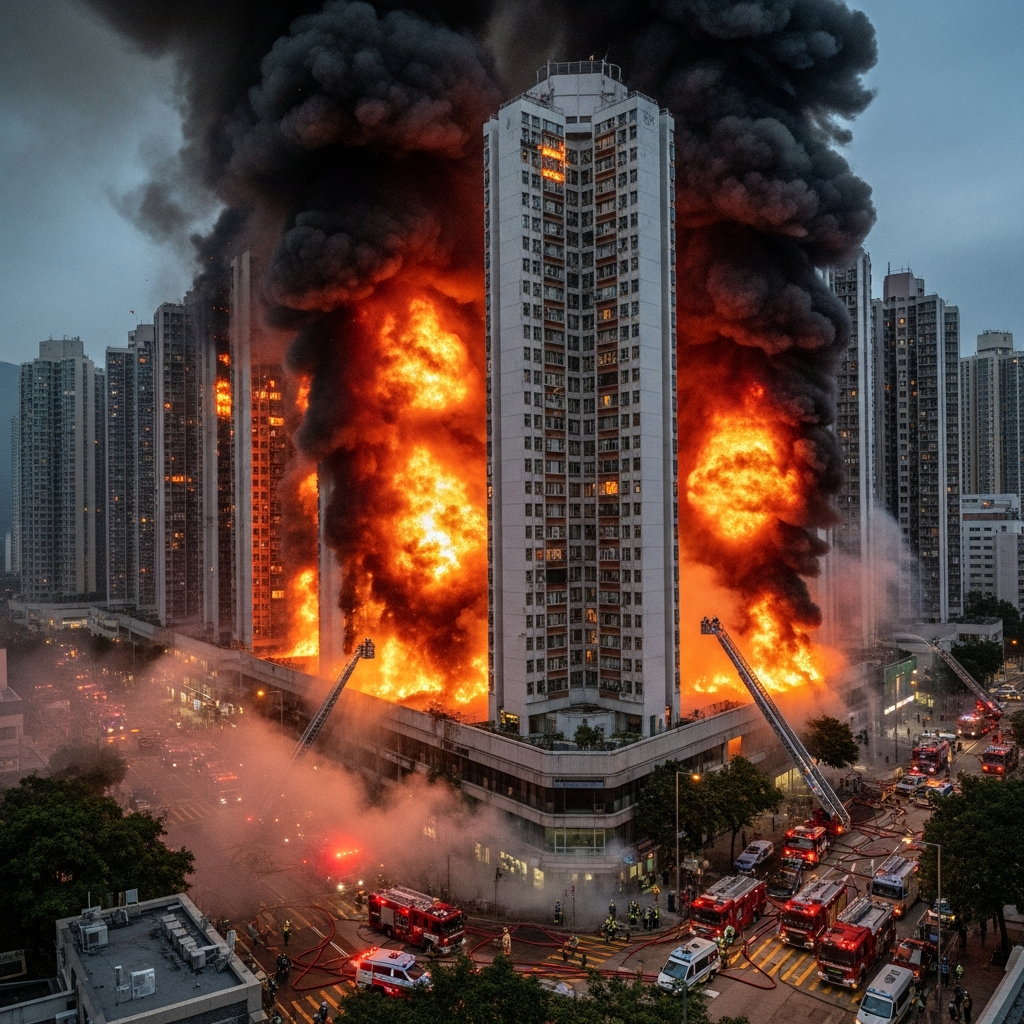
A catastrophic blaze has torn through the Wang Fuk Court residential complex in Hong Kong’s Tai Po district, claiming the lives of at least 94 people and leaving hundreds more missing in what has become the city’s deadliest fire in over seven decades. The devastating inferno, which began on Wednesday, November 26, 2025, quickly escalated to the highest alarm level, engulfing seven of the eight high-rise towers and triggering a massive criminal investigation into alleged gross negligence. Police have arrested three men from a construction company, deepening the tragedy for a city grappling with urban safety standards and its dense housing landscape.
The Catastrophic Blaze Unfolds in Tai Po
The disaster unfolded rapidly on Wednesday afternoon, sending plumes of thick smoke and raging flames high above the Tai Po district. Witnesses reported a terrifying scene as the fire, initially believed to have started on external scaffolding, spread with alarming speed. Strong winds are suspected to have acted as a powerful accelerant, pushing the flames from one building facade to another and then inwards, creating an uncontrollable inferno across multiple structures within the Wang Fuk Court complex.
Fire Services Department Director Andy Yeung confirmed the fire was upgraded to a level-5 alarm, the highest severity, within hours. Live video footage captured the dramatic and harrowing scenes: firefighters battling intense flames from towering ladder trucks as red-hot embers rained down. The sheer scale and rapidity of the blaze immediately raised questions about construction materials and fire safety protocols in the densely populated urban environment of Hong Kong.
The Staggering Human Toll and Heroic Efforts
The confirmed death toll stands at a tragic 94 individuals, a number that surpasses any fire casualty count in Hong Kong since the 1950s. Beyond the fatalities, at least 75 people sustained injuries, many suffering from severe burns and debilitating smoke inhalation, necessitating immediate hospitalization. Hundreds more were reported missing, leading to desperate searches by families and rescue teams.
Among the fallen was Ho Wai-ho, a 37-year-old firefighter with nine years of dedicated service, who collapsed while on duty. His death deeply saddened colleagues and underscored the immense risks faced by emergency responders. Tai Po District Council member Lo Hiu-fung noted that many of the residents believed to be trapped were elderly, a demographic particularly vulnerable to rapid evacuations from high-rise buildings. Heart-wrenching scenes included a 71-year-old man, Wong, photographed in tears outside the burning complex, fearing for his wife trapped inside. The tragedy also impacted the international community, with reports of two Indonesian domestic workers among the deceased.
Investigation Points to Negligence and Unsafe Materials
Authorities have swiftly launched a criminal investigation into the fire’s origin and rapid spread, focusing heavily on potential negligence by a construction firm. Police have arrested three men – two directors and an engineering consultant, aged 52 to 68 – from Prestige Construction and Engineering Co. on suspicion of manslaughter. Senior Superintendent Eileen Chung stated, “We have reason to believe that those in charge of the construction company were grossly negligent,” directly attributing the uncontrolled spread and major casualties to the firm’s actions. Police searched the company’s offices, seizing documents as part of their evidence gathering.
Initial findings suggest several critical factors exacerbated the fire’s severity:
Substandard Materials: Authorities suspect exterior wall materials may not have met fire resistance standards. The presence of non-fireproof mesh material, plastic sheets, and styrofoam on the outside of the buildings is believed to have significantly contributed to the flames’ rapid propagation.
Flammable Foam: Highly flammable foam materials were found installed outside windows on each floor near elevator lobbies in an unaffected tower, further raising concerns about the safety practices employed by the construction company.
Bamboo Scaffolding: The complex was undergoing major renovations, and the buildings were enveloped in extensive bamboo scaffolding and green construction netting. Experts and Fire Services Deputy Director Derek Armstrong Chan indicated these traditional materials likely played a crucial role in the fire spreading quickly between structures. Some engineers highlighted that most mesh netting used in Hong Kong construction is not fire-retardant.
Building Age: Wang Fuk Court, built in 1983, likely features single-pane glass windows, which are less fire-resilient than modern double-pane alternatives. Professor Jiang Liming from Hong Kong Polytechnic University noted that these older windows can easily break, allowing flames to penetrate the building’s facade more readily.
The anticorruption agency has also launched its own probe into potential corruption linked to the renovation project, underscoring the multi-faceted nature of the investigation.
Challenges for Emergency Responders
The scale of the Hong Kong high-rise fire presented immense challenges for emergency services. More than 140 fire trucks and 60 ambulances were deployed, along with 767 firefighters and around 400 police officers. However, rescue operations were severely hampered by several factors:
Intense Heat and Smoke: The raging inferno generated extreme temperatures and thick, toxic smoke, making internal searches and rescue efforts exceedingly difficult and dangerous for crews.
Falling Debris: Collapsing scaffolding and falling debris posed a constant threat, limiting access and creating hazardous conditions around the complex.
- Access Limitations: Fire hoses reportedly struggled to reach the highest levels of the 31- and 32-story towers, further complicating efforts to contain the blaze from the exterior.
- www.cbsnews.com
- www.nbcnews.com
- www.bbc.com
- www.theguardian.com
- www.aljazeera.com
Despite these obstacles, firefighters tirelessly battled the flames for over 24 hours. By Thursday afternoon, blazes in four towers were brought under control, and efforts continued overnight to ensure all remaining units were extinguished and thoroughly searched. Approximately 900 people were evacuated to temporary shelters, with over 500 currently housed in facilities such as the Tung Cheong Street Sports Centre.
Government Response and Broader Implications
Hong Kong’s leader, Chief Executive John Lee, addressed the public, expressing deep sorrow over the tragedy. He announced several measures in response, including establishing a HK$300 million (US$38.6 million) fund to aid displaced residents, providing an emergency cash allowance of HK$10,000 (US$1,285) to each affected household. Lee also pledged immediate inspections of all housing estates undergoing major improvements across Hong Kong.
Crucially, the Chief Executive revealed discussions with industry representatives about gradually replacing the city’s iconic bamboo scaffolding with metal alternatives. This announcement follows expert opinions highlighting bamboo’s role in the rapid spread of the fire and its potential contribution to past construction-related fatalities. While some Hongkongers view bamboo scaffolding as a significant part of local heritage, the incident has intensified calls for stricter safety standards. The Hong Kong Construction Industry Council notes approximately 2,500 registered bamboo scaffolders in the territory, signaling the scale of potential industry changes.
The international community, including Chinese leader Xi Jinping, Pope Leo XIV, and Russian President Vladimir Putin, extended condolences. Major corporations like Tencent, Xiaomi, and Alibaba, along with Chinese billionaire Jack Ma, pledged substantial donations to support victims. The local community also rallied, setting up makeshift relief points and assisting displaced residents.
This tragedy tragically surpasses the November 1996 commercial building fire in Kowloon, which claimed 41 lives, in terms of fatalities. The Wang Fuk Court inferno not only highlights critical failures in construction safety and oversight but also underscores enduring social anxieties in Hong Kong regarding affordable housing and the inherent risks of densely packed high-rise living. The incident is expected to prompt a serious review of fire and site safety management across the entire construction industry and government oversight, shaping future urban development and safety policies in the city.
Frequently Asked Questions
What factors contributed to the rapid spread of the Hong Kong high-rise fire?
Several critical factors likely contributed to the unusual rapidity and scale of the Wang Fuk Court fire. Initial investigations point to flames starting on external bamboo scaffolding, which experts suggest can act as a fuel source and conduit. The presence of non-fireproof mesh netting, plastic sheets, and highly flammable styrofoam on the building exteriors and near windows is also suspected to have accelerated the blaze. Strong winds further aided the fire’s propagation across multiple towers. Additionally, the age of the 1980s-era buildings, possibly featuring less resilient single-pane glass windows, may have allowed flames to penetrate interiors more easily.
What measures has the Hong Kong government taken in response to the Wang Fuk Court fire?
In response to the devastating Hong Kong high-rise fire, Chief Executive John Lee announced several key measures. These include establishing a HK$300 million fund to aid displaced residents, with an immediate HK$10,000 cash allowance for each affected household. The government is also arranging temporary accommodation for the hundreds evacuated. Furthermore, Chief Executive Lee has pledged immediate inspections of all housing estates currently undergoing major renovations across Hong Kong and initiated discussions about potentially phasing out traditional bamboo scaffolding in favor of metal alternatives to enhance fire safety.
How is Hong Kong addressing broader fire safety concerns in its high-rise buildings following this tragedy?
The Wang Fuk Court tragedy has ignited a comprehensive review of fire safety standards and construction practices in Hong Kong’s high-rise buildings. Beyond immediate inspections of renovation sites and a re-evaluation of bamboo scaffolding use, authorities are scrutinizing the fire resistance of exterior building materials and the oversight of construction companies. The criminal investigation into the alleged gross negligence of a construction firm signals a stronger stance against non-compliance. This incident is expected to drive significant reforms in building codes, material specifications, and regulatory enforcement to prevent similar disasters in the city’s dense urban landscape.
The Hong Kong high-rise fire at Wang Fuk Court stands as a grim reminder of the critical importance of stringent safety standards, responsible construction practices, and robust emergency preparedness in dense urban environments. As investigations continue and the city mourns its devastating losses, the hope remains that this tragedy will lead to lasting reforms, ensuring greater safety for all its residents.