The world of scientific discovery is hurtling forward, pushing the boundaries of what we thought possible. A groundbreaking area of research involves growing miniature brain models, known as brain organoids, in laboratories. These complex structures offer an unprecedented window into the human mind, enabling scientists to study neurological diseases like autism, schizophrenia, and Alzheimer’s disease with stunning detail. But as these lab-grown brains become more sophisticated, a profound ethical question looms large: could they ever develop the capacity to feel pain or even consciousness?
This evolving field, sometimes dubbed “wetware” or biocomputing, is revolutionizing our understanding of brain biology. It holds immense promise for developing new treatments, but it also compels us to confront complex moral dilemmas.
The Genesis of Lab-Grown Brains: From Cells to Circuits
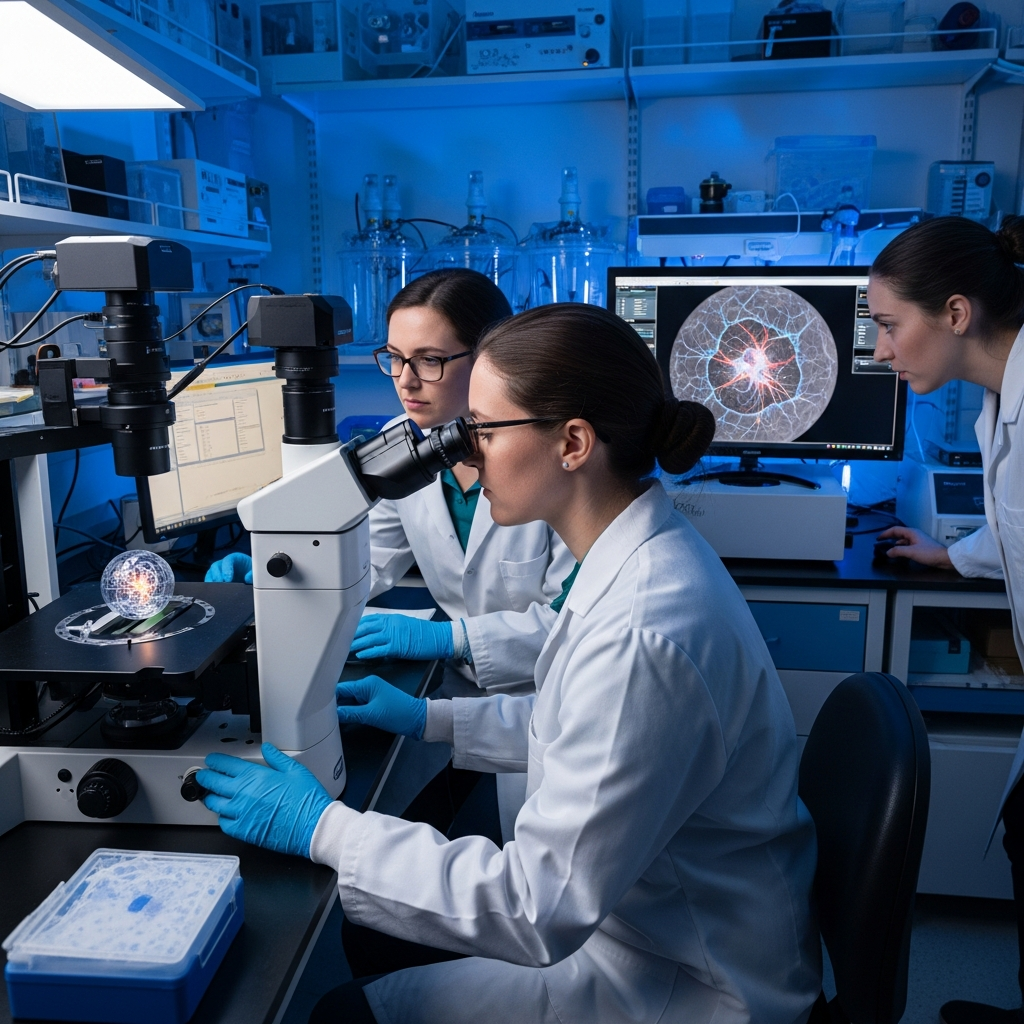
The journey to creating brain organoids began in 2013 when researchers in Austria successfully developed the first such structures. This built upon earlier discoveries, notably Henry Van Peters Wilson’s 1907 observation that separated sponge cells could self-organize, and the isolation of pluripotent stem cells decades later. Today, these organoids start as single stem cells – either directly from human stem cells or derived from skin cells that are chemically reprogrammed. They then mature into three-dimensional cellular clusters containing millions of neurons.
These miniature models often represent specific regions of the brain, offering simplified yet functional insights. Scientists have since advanced the technique, connecting multiple organoids into “assembloids.” These interconnected systems model broader biological features, allowing for more intricate studies. A notable example comes from Stanford University, where Professor Sergiu Pașca’s team successfully linked four different organoid types, including a spinal organoid, to replicate a pain sensory pathway. This innovative approach provides a unique platform to explore neural mechanisms that are otherwise inaccessible.
Debunking the “Mini-Brain” Misnomer
Despite their astonishing complexity, researchers are quick to correct the popular misconception of these structures as “mini-brains.” According to Professor Pașca, “These models are not miniature versions of the brain. They are simplified, developmentally immature, and lack many defining features of an actual brain.” Crucially, they lack a vascular system (blood vessels) to supply nutrients and any form of sensory input, which are vital for a fully functioning brain.
Madeline Lancaster, the developmental neurobiologist who developed the first organoids, highlights the sheer scale difference. These structures contain at most only 0.002 percent of the neurons found in a complete human brain. She suggests that a significant leap – a thousand-fold increase in size and proper anatomical integration – would be necessary before reconsidering their classification. The consensus among experts is that while incredible tools for research, current organoids are far from replicating the full complexity of a living brain.
Breakthroughs in “Organoid Intelligence” and Biocomputing
The capabilities of brain organoids are rapidly advancing beyond mere observation. Recent breakthroughs demonstrate their capacity for goal-directed learning and real-time information processing. Researchers at the University of California, Santa Cruz (UCSC), for instance, successfully trained brain organoids to solve the “cart-pole” problem. This standard engineering benchmark, used in robotics and AI, involves balancing a digital broomstick upright.
Using a reinforcement learning algorithm, the UCSC team “coached” the mini-brains with electrical signals as rewards and punishments. This guidance dramatically improved their “win” rate from an initial 4.5 percent to an impressive 46 percent. Ash Robbins, the study’s lead author, described this as an “artificial coach” helping the biological circuits adapt. Keith Hengen, an associate professor of biology, emphasized the profound implication: “the capacity for adaptive computation is intrinsic to cortical tissue itself, separate from all the scaffolding we usually assume is necessary.” This suggests fundamental learning capabilities are inherent to the basic neural structure.
This research, supported by grants like the $1.9 million awarded to the Braingeneers team at UC Santa Cruz, moves us closer to “organoid intelligence.” Similarly, companies like FinalSpark in Switzerland are developing “living” computers powered by human cells—a concept known as “wetware.” Their goal is to create data centers of “living” servers that could replicate AI learning with a fraction of current energy consumption. While still in early stages, these advancements blur the lines between biology and technology, opening new avenues for understanding cognition and developing hybrid AI systems.
The Ethical Conundrum: Consciousness and Pain Perception
As organoids grow more sophisticated, the ethical debate intensifies. The central question: could these lab-grown brains develop the capacity for consciousness or to feel pain? While current scientific consensus, as echoed by bioethicist Alta Charo, is that “there is no reasonable possibility of anything remotely like consciousness” in existing organoids, this position is increasingly being challenged by some researchers.
A key difficulty lies in defining consciousness itself. Is it human-like self-awareness, or a more basic capacity to feel pain or pleasure, as suggested by neuroethicist Andrea Lavazza? Brains, including organoids, inherently lack pain receptors. However, the meninges (membranes surrounding the brain) do have them. The possibility of phantom limb pain in humans also raises questions about whether internal neural architecture alone could allow for a pain experience, even without external sensory input, as debated by researchers like Boyd Lomax and Christopher Wood.
Skeptics point to the organoids’ simplicity, small size, and lack of a complete vascular system or diverse cell types as reasons they cannot be conscious. However, advancements are rapidly closing these gaps. Techniques now allow for introducing blood vessels, incorporating crucial microglia cells, and even growing rudimentary “eyes.” Fusing different organoids into assembloids representing multiple brain regions further increases complexity, making the question of sentience more urgent. Many experts, including Christopher Wood, predict that conscious organoids could be a reality within five to ten years, necessitating a re-evaluation of ethical guidelines.
The More Pressing Concern: Human Organoids in Living Animals
While organoid consciousness captures public imagination, experts highlight a more immediate ethical challenge: transplanting human organoids into living animals. In 2022, Professor Pașca’s team made headlines by successfully transplanting human cortical organoids into the brains of newborn rats. These organoids integrated into the animals’ neural tissue and even influenced their behavior, creating “chimeras.”
For researchers like Madeline Lancaster, the primary ethical concerns here revolve around animal welfare. Animals possess the full range of brain features that might indicate some level of consciousness, and introducing human brain tissue could complicate this. Public perception also plays a significant role. Sociologist John Evans notes that lay audiences often view organoids as extensions of the original cell donors, similar to donated organs. Mixing human and animal brains, especially in a region seen as central to human identity, is considered “more ethically fraught” by the general public, even if scientists and ethicists tend to view the human-animal moral divide differently.
A Scientific Community Monitoring Itself
The rapid pace of innovation demands proactive oversight. In 2021, the U.S. National Academies of Sciences, Engineering, and Medicine published a report addressing the ethics and governance of human brain models. It concluded that current organoids don’t meet consciousness criteria but stressed the need to revisit these questions as they become more complex.
In 2025, Pașca, Charo, and Evans co-authored a paper urging the global scientific community to continuously monitor progress in the field. This reflects a collective understanding that structured, ongoing oversight is crucial, rather than reactive policymaking. Critics like Alysson Muotri argue that current guidelines from bodies like the International Society for Stem Cell Research (ISSCR) are “conservative” and outdated, failing to keep pace with technological advancements. The consensus is clear: multidisciplinary teams are urgently needed to revise these frameworks.
The Imperative for Continued Discovery
Despite the ethical complexities, there is a strong argument for why this research must continue. Experts describe a genuine ethical imperative: the potential to alleviate significant human suffering. Modeling the brain and its disorders, from Alzheimer’s to autism, could lead to breakthroughs in understanding and treating these conditions.
Professor Pașca emphasizes the unique value of organoids: “Their unique value comes from giving us access to human brain biology that is otherwise inaccessible.” This allows direct study of disease processes in human cells and tissues, and the crucial testing of potential therapeutics. The high failure rate of neuropsychiatric medications in clinical trials, often after animal testing, highlights the urgent need for more accurate human-specific models. Brain organoids could significantly reduce reliance on animal testing, presenting a compelling ethical trade-off. Major institutions, such as the Salk Institute, recognize this potential, designating 2026 as their “year of brain health research” with substantial investment in organoid platforms.
Frequently Asked Questions
What are brain organoids and how are they created in a lab?
Brain organoids are miniature, three-dimensional cell cultures that mimic aspects of the human brain. They are grown from human stem cells, which can be derived from various sources like skin cells. These stem cells are cultured and guided to differentiate and self-organize into structures containing millions of neurons, often representing specific brain regions. Scientists, like Madeline Lancaster in 2013, pioneered this process, enabling detailed study of human brain biology that would otherwise be impossible.
Can current lab-grown brain organoids feel pain or become conscious?
Based on current scientific understanding, existing brain organoids are generally considered incapable of feeling pain or achieving consciousness. They are simplified, lack a vascular system, and don’t receive sensory input essential for a full brain experience. Experts emphasize they are not miniature brains but models. However, rapid advancements in complexity, including the ability to grow blood vessels and fuse multiple organoids into assembloids, mean that the scientific community is actively debating and preparing for a future where these questions may need to be revisited within five to ten years.
What are the main ethical concerns surrounding brain organoid research today?
The most immediate ethical concern, according to experts, is the transplantation of human brain organoids into living animals, creating “chimeras.” This raises significant animal welfare issues, as the animals possess fully functioning brains and can experience consciousness. Public perception also highlights concerns about blurring the lines between humans and animals. While the potential for organoid consciousness is a future concern, the immediate need is for robust ethical guidelines for animal chimeras and the rapidly increasing complexity of organoids themselves, with calls for updated regulations from multidisciplinary expert groups.
The Future of Brain Science
The ongoing journey into the complexities of brain organoids represents a profound frontier in science. These tiny, intricate models are unlocking secrets of the human brain that were previously unimaginable, offering hope for combating devastating neurological diseases and even powering new forms of AI development. As we stand at this precipice of discovery, the dialogue between scientific advancement and ethical responsibility becomes ever more crucial. Continuous oversight, thoughtful regulation, and a deep commitment to human welfare – both in the lab and beyond – will be essential in navigating this exciting, yet challenging, future.