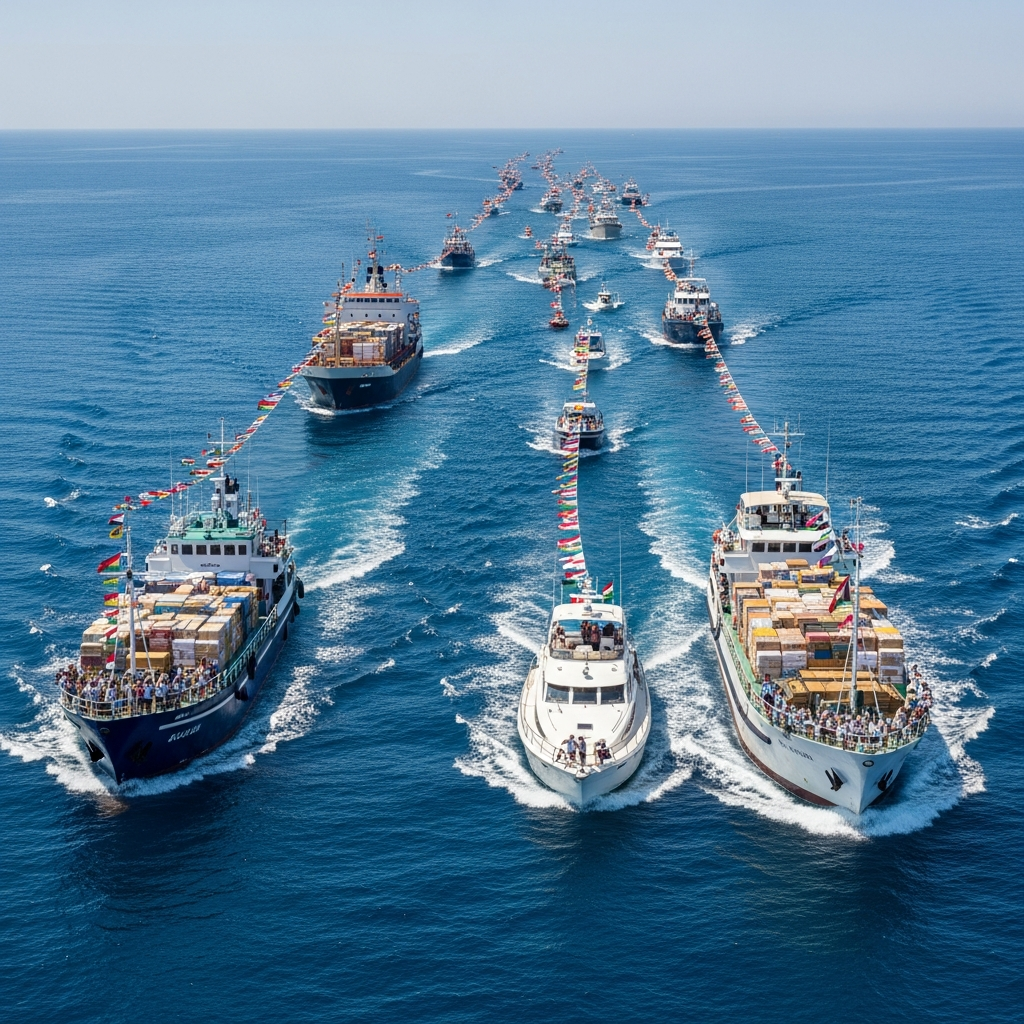
The Mediterranean Sea is once again the stage for a dramatic display of international solidarity. The “Global Resilience Flotilla,” a massive convoy of 70 boats carrying around 1,000 volunteers from 70 nations, set sail from Barcelona in April 2026. This ambitious mission aims to challenge Israel’s prolonged naval blockade of the Gaza Strip and deliver urgently needed humanitarian aid. As global attention on Gaza wanes amidst ongoing geopolitical shifts, these activists are determined to break the siege and spotlight the escalating humanitarian catastrophe faced by 2.3 million Palestinians.
Gaza’s Dire Reality: A Call for Urgent Aid
Gaza has endured an Israeli blockade since 2007, a situation that has severely deteriorated since October 2023 following an intensive military assault. This prolonged conflict has resulted in over 72,000 Palestinian deaths, the widespread destruction of critical infrastructure, including hospitals, and the displacement of approximately 1.5 million residents who now face homelessness. Severe restrictions on fuel, medical supplies, and basic necessities have plunged the enclave into an unprecedented humanitarian and health crisis.
The current “Global Resilience Flotilla” seeks to deliver vital supplies like food, medicine, school bags, and stationery to Palestinian children. Organizers, coordinating with Palestinian civil society groups, maritime security experts, and prominent NGOs such as Greenpeace and Open Arms, have also secured support from the Barcelona municipality. Flotilla spokesperson Pablo Castilla stated their core objectives are to condemn international complicity in the humanitarian crisis, demand accountability, and establish humanitarian corridors by sea and land. Castilla highlighted concerns that Israel is exploiting a perceived decline in international focus, fueled by geopolitical events, to tighten its siege and accelerate territorial occupation.
A Legacy of Resistance: Early Attempts to Break the Blockade
The history of Gaza aid flotillas is a testament to persistent international activism. Efforts to breach the naval blockade date back nearly two decades.
The Free Gaza Movement: Early Breaches and Successes
The Free Gaza Movement, established in 2006 during Israel’s war on Lebanon, launched its first missions in 2008. These initial attempts were notably successful, with two boats reaching Gaza and marking the first breach of Israel’s naval blockade. Between 2008 and 2016, the movement launched 31 boats, and despite heavy Israeli restrictions, five managed to deliver aid to Gaza. These early successes underscored the potential of civilian-led humanitarian efforts.
The Mavi Marmara Incident: A Global Outcry in 2010
A pivotal moment in Gaza flotilla history occurred in 2010 with the Mavi Marmara incident. Israeli commandos raided the Turkish-flagged aid ship, carrying humanitarian supplies and over 600 passengers, in international waters. The assault tragically resulted in the deaths of 10 activists and injured dozens, sparking widespread global outrage and severely straining relations between Israel and Turkey. The ship was owned by the Humanitarian Relief Foundation (IHH), a Turkish NGO.
In 2013, Israel formally apologized for “operational mistakes” during the raid. However, a compensation deal between the two countries remains under negotiation, and Israeli soldiers and officials involved still face war crimes trials in absentia in Turkey. The Mavi Marmara incident remains a stark reminder of the inherent dangers faced by these humanitarian missions.
Persistent Challenges: Flotillas Confronting Obstacles (2011-2018)
Despite the Mavi Marmara tragedy, Gaza aid flotillas continued their efforts, though often met with significant resistance.
Freedom Flotilla II (2011)
Launched as a follow-up to the 2010 mission, Freedom Flotilla II aimed to break the blockade with over 300 participants and 10 vessels. However, intense diplomatic pressure from Israel, coupled with alleged sabotage and restrictions imposed by host countries, largely thwarted its departure. Only the French vessel, Dignite-Al Karama, came close to Gaza. It was intercepted by Israeli naval commandos, towed to Ashdod, and its activists were detained and deported.
Freedom Flotilla III (2015)
In 2015, the Freedom Flotilla Coalition (FFC) organized Freedom Flotilla III, led by the Swedish-flagged Marianne of Gothenburg. On June 29, 2015, Israeli naval forces intercepted the Marianne approximately 100 nautical miles off the Gaza coast, again in international waters. Commandos boarded the ship, diverted it to Ashdod, and detained the activists, who were later deported.
Just Future for Palestine Flotilla (2018)
Also known as the 2018 Gaza Freedom Flotilla, this FFC campaign included vessels like Al Awda (The Return) and Freedom. Both were intercepted and seized by the Israeli navy in international waters in late July and early August 2018. All on board were arrested, with some activists reporting assaults by Israeli forces before being detained and deported.
Escalating Risks: Drone Attacks and Recent Interceptions (2025-2026)
The dangers faced by Gaza aid flotillas have intensified in recent years. In May 2025, the vessel “Conscience,” preparing to sail to Gaza, was struck twice by armed drones just 14 nautical miles off the coast of Malta. The attack triggered a fire and a significant hull breach, injuring four people. This alarming incident highlighted an escalation in the methods used to prevent these missions. Just months later, in October 2025, the first “Global Resilience Flotilla,” which had departed Barcelona with 42 boats and 462 activists, was also intercepted and reportedly attacked in international waters, leading to hundreds of arrests and deportations.
Beyond the Seas: Diverse Global Advocacy for Palestine
The efforts to break the Gaza blockade extend far beyond maritime missions. A global network of activist campaigns employs diverse strategies to draw attention to the humanitarian situation. Prominent figures like British actor Juliet Stevenson have amplified calls for aid, especially for women and children in Gaza. Stevenson, alongside over 100 cultural figures, urged Mumsnet, a popular UK forum, to pressure the UK government to demand Israel allow essential maternity and hygiene supplies into Gaza. She speaks powerfully about the “unspeakable” suffering, highlighting the unprecedented number of child amputees, orphans, and the dire conditions for pregnant mothers resulting in a 75 percent leap in infant mortality and a 300 percent increase in miscarriages.
Simultaneously, other forms of direct action are making an impact. In the UK, pro-Palestine activists undertook a months-long hunger strike in prison, targeting Elbit Systems UK, Israel’s largest arms manufacturer. This campaign, spearheaded by activists allegedly linked to Palestine Action, secured several “victories,” including the UK government reportedly deciding against a £2 billion army training contract with Elbit Systems. These varied solidarity missions demonstrate a persistent, multi-faceted global response to the ongoing crisis and the perceived humanitarian crisis in Gaza.
Persistent Challenges and Geopolitical Pressures
The Gaza Strip, one of the most densely populated areas globally, is frequently described as “the world’s largest open-air prison.” Since 2007, Israel has maintained strict control over Gaza’s airspace and territorial waters, severely restricting the movement of goods and people. The Yasser Arafat International Airport, Gaza’s only airport, was demolished by Israel in 2001.
The backdrop to these flotilla efforts is a complex and volatile geopolitical landscape. A US-brokered Gaza peace deal came into effect in October 2025, yet mutual accusations of violations persist. Hamas has urged President Donald Trump’s “Board of Peace” to intervene, alleging continued Israeli aggression, including shelling, drone strikes, and naval attacks that have killed over 600 Palestinians since the truce began. They call for the lifting the siege and the full implementation of aid flow. Conversely, Israel accuses Hamas of rearming and violating the peace plan, demanding the return of Israeli captives’ remains as a condition for progressing to the deal’s second phase. These political tensions directly impact humanitarian access and the dire conditions that fuel the Gaza aid flotillas and other activist campaigns.
Frequently Asked Questions
What is the primary goal of the Gaza aid flotillas, and what challenges do they face?
The primary goal of Gaza aid flotillas is to deliver essential humanitarian supplies, such as food, medicine, and educational materials, to the Gaza Strip. Beyond aid delivery, these missions aim to directly challenge and ultimately break Israel’s naval blockade, raise international awareness about the humanitarian crisis, and condemn perceived international complicity in the suffering of Palestinians. They face significant challenges, including interception, alleged attacks in international waters, detention and deportation of activists, and diplomatic pressures that often prevent their departure or progress.
Which historical Gaza flotilla incident drew the most international condemnation?
The Mavi Marmara incident in 2010 drew the most widespread international condemnation in Gaza flotilla history. During this event, Israeli commandos raided the Turkish-flagged aid ship, resulting in the deaths of 10 activists and dozens of injuries. This action in international waters sparked global outrage, severely strained diplomatic relations between Israel and Turkey, and led to calls for investigations into potential violations of international law. The incident remains a significant flashpoint in the history of Gaza aid flotillas.
How have global geopolitical shifts impacted humanitarian efforts to break the Gaza blockade?
Global geopolitical shifts significantly impact humanitarian aid efforts to break the Gaza blockade. Flotilla spokesperson Pablo Castilla noted a declining international focus on Gaza due to ongoing geopolitical events, which he warned Israel exploits to intensify its siege. Moreover, the existence of a “Trump’s Board of Peace” and ongoing ceasefire negotiations between Israel and Hamas, often marred by mutual accusations of violations and aid restrictions, create a complex environment. The effectiveness of humanitarian missions can be affected by international pressure, political will, and the ability of mediating parties to enforce agreements and ensure unhindered aid access to a region often described as an open-air prison.
Conclusion
The enduring Gaza flotilla history highlights a persistent international effort to alleviate the profound humanitarian suffering in the Gaza Strip. From the early successes of the Free Gaza Movement to the tragic Mavi Marmara incident and the alarming drone attack on the “Conscience” in 2025, activists have consistently demonstrated unwavering resolve. The launch of the “Global Resilience Flotilla” in 2026 underscores that despite escalating risks and waning global attention, the call for aid, accountability, and an end to the Gaza blockade remains urgent. As the situation in Gaza continues to deteriorate, these solidarity missions, alongside diverse forms of global advocacy, serve as crucial reminders of the humanitarian imperative and the ongoing quest for peace and justice in the region.