The historic Artemis II mission captivated the world, pushing the boundaries of human spaceflight. Yet, a recent Earth-to-space call between the record-breaking crew and former President Donald Trump sparked considerable debate. During the conversation, Trump controversially claimed he “saved” NASA from closure during his first presidency. This assertion immediately drew scrutiny, contrasting sharply with his administration’s consistent attempts to slash the agency’s vital budget.
This article delves into the unprecedented achievements of the Artemis II crew, the awkward political exchange, and the ongoing fiscal challenges facing NASA. It explores how a mission celebrating human ingenuity became intertwined with contentious political rhetoric surrounding essential funding.
A Controversial Call from Deep Space
On Monday, the Artemis II crew, soaring above the moon, made contact with Earth. Their call to Donald Trump, broadcast from the Orion spacecraft, became a focal point of discussion. Trump asserted that during his initial term, he made a pivotal decision to “revive” NASA, stating he had “very little hesitation” in doing so. This declaration was met with visible discomfort from the astronauts.
The 12-minute conversation, facilitated by NASA Administrator Jared Isaacman, featured several peculiar moments. There were noticeable periods of silence. Trump repeatedly mentioned his friendship with Canadian ice hockey legend Wayne Gretzky. He also declared “America is the hottest country in the world right now,” and proudly proclaimed the nation would be “second to none” in space. These interjections created an intermittently awkward atmosphere for the astronauts, who were tossing a microphone in zero gravity.
The Crew’s Gracious Response
Despite the political undertones, the Artemis II crew remained focused on their monumental mission. Canadian astronaut Jeremy Hansen praised the US’s “intentional decision to lead by example,” allowing international partners like Canada to contribute. This prompted Trump to reiterate his conversations with Gretzky and Canadian Prime Minister Mark Carney. Following another silence, commander Reid Wiseman confirmed, “Yes Mr President, we heard that,” after Trump repeated his anecdotes.
Trump concluded by inviting the four crew members to an Oval Office reception after their scheduled splashdown. He expressed a rare desire for their autographs, acknowledging their “incredible journey into the stars.” Pilot Victor Glover graciously thanked the president for the “really special” call. He emphasized that the journey was made possible by the dedication of both the American and Canadian people.
Artemis II’s Historic Journey and Lunar Revelations
Beyond the political discourse, the Artemis II mission itself represents a monumental leap for human space exploration. Launched on April 1 from the Kennedy Space Center, the Orion spacecraft, powered by NASA’s Space Launch System, has set new benchmarks. The mission marks the first time humans have ventured beyond lower Earth orbit in over 50 years.
On Monday, the crew established a new record for human space travel, reaching an astonishing 252,756 miles from Earth. This surpassed the 1970 Apollo 13 record of 248,655 miles. Their closest approach to the moon was within 4,070 miles of its surface, offering unparalleled views.
Astronauts’ Profound Lunar Experience
The astronauts reported profound and “overwhelming” emotional responses during their close observations of the moon. Astronaut Christina Koch, the first woman to fly around the moon, described an intense moment looking at the lunar landscape. She found herself “thrown in suddenly” to its reality, particularly struck by “bright new craters that shone from the surface like pinpricks in a lampshade.”
Victor Glover, the first black man to travel beyond low Earth orbit, echoed these sentiments. He found the experience “very moving,” imagining himself “walking around down there on the surface.” During their lunar flyby, the crew captured eagerly anticipated images. These included stunning views of Earth rising from behind the moon and a solar eclipse. They also observed previously unseen parts of the vast 590-mile wide Orientale impact basin. Further analysis is expected to explain unusual brown, green, and orange hues reported on the moon’s typically greyish landscape.
The Factual Divide: NASA Funding Battles
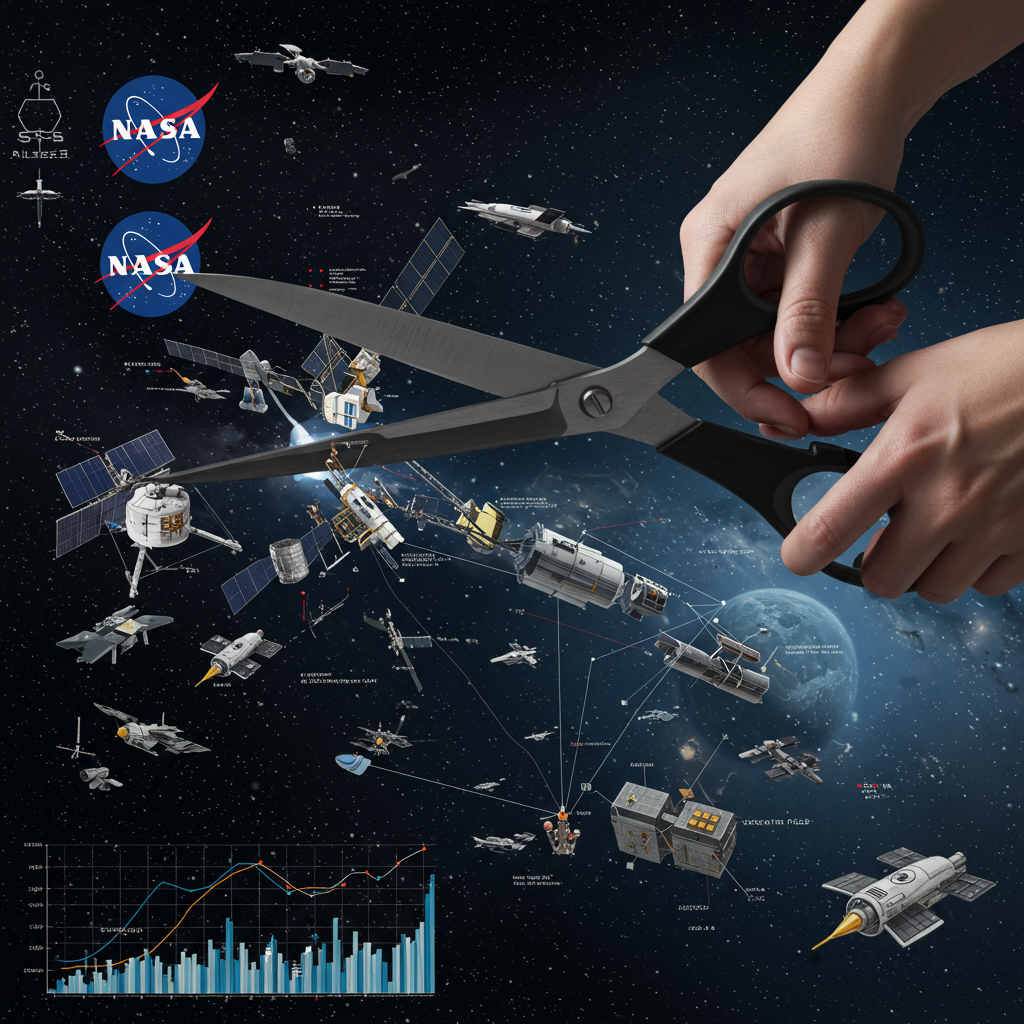
Trump’s claim of “saving” NASA stands in stark contrast to his administration’s consistent efforts to reduce its overall spending. While he did direct resources towards human spaceflight programs like Artemis, his broader budgetary proposals paint a different picture. After his second presidency began in early 2025, the White House proposed a substantial 24% cut to NASA’s budget. This would have reduced it to $18.8 billion, the lowest level in a decade.
Experts quickly denounced these proposed reductions, warning of “extinction-level” impacts on the agency’s crucial science programs. In a rare display of bipartisanship, Congress united to oppose these drastic cuts. Lawmakers successfully passed an almost fully funded budget of $24.4 billion in January.
Persistent Budgetary Challenges
Despite congressional pushback, Trump continued to propose significant reductions. Just two days after Artemis II embarked on its mission to the moon, Trump unveiled his 2027 NASA budget request. This proposal included another substantial 23% reduction. Democrats swiftly vowed to fight this “morally bankrupt” move.
Meanwhile, NASA Administrator Jared Isaacman, described as a “Trump acolyte,” publicly supported the president’s fiscal policies. He urged NASA workers to “leave the politics for the politicians and remain focused on the mission.” This ongoing tension between presidential budget proposals and congressional allocations highlights the complex political landscape influencing NASA’s future.
Navigating Re-entry and Future Ambitions
The Artemis II crew has begun their journey home after successfully completing their lunar flyby. Their mission, a 10-day odyssey, is set to conclude with a splashdown in the Pacific Ocean on Friday. The return journey includes one of the most critical and risky stages: re-entry into Earth’s atmosphere.
The Orion capsule will slam into the atmosphere at speeds exceeding 20,000 mph. This intense friction will cause its heat shield to reach extreme temperatures, surpassing 1,600°C (2,900°F). Learning from the Artemis I mission in 2022, which experienced some heat shield damage, NASA has adjusted its approach for Artemis II. The capsule will now enter at a steeper angle. This design aims to minimize the duration the heat shield spends at problematic high temperatures, enhancing safety. Following atmospheric re-entry, parachutes will deploy to slow the spacecraft before its planned splashdown.
Looking Ahead: Lunar Bases and Mars
Beyond this immediate mission, Artemis II serves as a vital stepping stone for NASA’s ambitious future goals. Trump praised the crew for inspiring the world as the US works towards building a permanent lunar base. Ultimately, the long-term vision includes sending humans to Mars. The success of Artemis II is crucial for validating the systems and procedures necessary for these even more complex missions. It affirms America’s commitment to leading global space exploration, reinforcing the nation’s position at the forefront of scientific discovery.
—
Frequently Asked Questions
What records did the Artemis II mission set during its journey?
The Artemis II mission made significant history, setting new records for human space travel. The crew reached a distance of 252,756 miles from Earth, surpassing the 1970 Apollo 13 record. This marked the first time in over 50 years that humans ventured beyond lower Earth orbit. The mission also involved a close lunar flyby, where the Orion spacecraft came within 4,070 miles of the moon’s surface, providing unparalleled observational opportunities for the astronauts.
What were Donald Trump’s claims regarding NASA’s budget during the Artemis II call, and what are the facts?
During his call with the Artemis II crew, Donald Trump claimed he “saved” NASA from closing during his first presidency. However, this assertion contradicts his administration’s consistent efforts to cut NASA’s overall budget. For instance, after his second presidency began in 2025, the White House proposed a 24% cut to NASA, followed by another 23% reduction in the 2027 budget request. Congress, in a bipartisan effort, opposed these cuts and ultimately passed a nearly fully funded budget of $24.4 billion, demonstrating a clear factual divergence from Trump’s claims.
What are the next critical steps for the Artemis II crew and the broader Artemis program?
The Artemis II crew is now on their journey back to Earth, with a scheduled splashdown in the Pacific Ocean. A critical next step involves safely navigating atmospheric re-entry, where the Orion capsule’s heat shield will endure extreme temperatures. For the broader Artemis program, Artemis II is a crucial test flight. Its success validates technologies and procedures essential for future missions, including building a permanent lunar base and eventually sending humans to Mars, solidifying NASA’s long-term deep-space exploration goals.
—