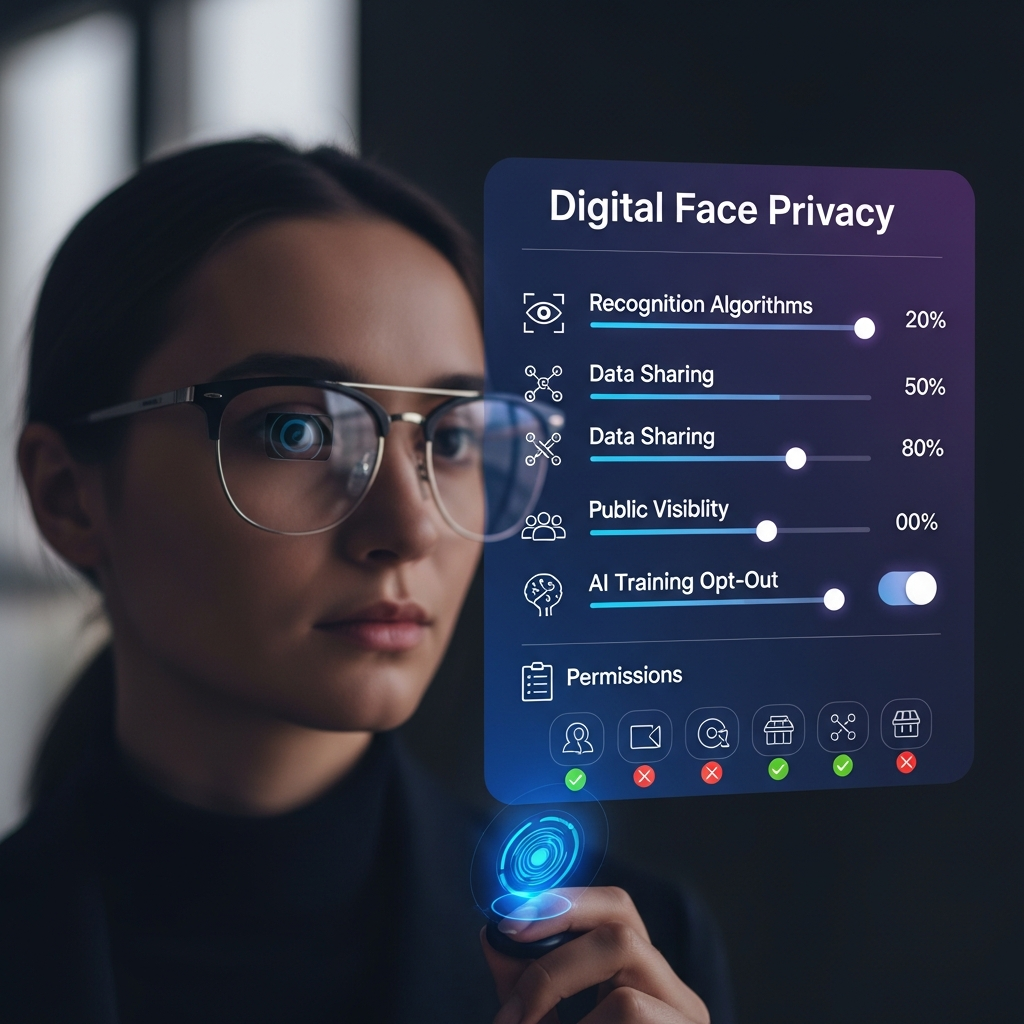
The dream of seamless augmented reality often clashes with a stark reality: personal privacy. As smartglasses and other wearable cameras become more common, the specter of pervasive, non-consensual recording looms large. Who controls the images of your face captured by these devices? A growing movement, fueled by innovative research and mounting public concern, aims to empower individuals to reclaim their digital image and assert true smartglasses privacy. This guide dives into the urgent need for privacy controls, the groundbreaking technologies designed to offer them, and the ethical dilemmas inherent in a world constantly watching.
The Pervasive Gaze: Why Smartglasses Spark Privacy Fears
Imagine walking down the street, unaware that multiple smartglasses users are recording your every move, analyzing your face, and storing your biometric data without your consent. This isn’t science fiction; it’s a looming concern with the widespread adoption of wearable cameras. Smartglasses offer incredible utility, but they also bring significant challenges to personal privacy, transforming public spaces into potential surveillance zones. The core issue revolves around the capture and use of images of bystanders who have not opted in. This raises profound questions about individual autonomy and the right to be unrecorded.
The problem extends beyond smartglasses. Home security cameras, like Ring devices, also push the boundaries of privacy. Amazon’s upcoming “Familiar Faces” AI feature, set to launch in December 2025, sparked immediate backlash from privacy advocates like the Electronic Frontier Foundation (EFF) and Senator Ed Markey. This feature allows Ring cameras to recognize “trusted” individuals, reducing nuisance alerts. However, it achieves this through facial scanning of anyone entering the camera’s view, often without their consent or knowledge. Critics argue this violates state biometric privacy laws, especially in states like Illinois and Texas where the feature will not be available due to stringent regulations. This highlights a critical societal debate: the perceived benefits of enhanced security versus the fundamental right to personal privacy.
BLINDSPOT: A Glimmer of Hope for Bystander Privacy Control
Amidst these growing concerns, researchers at the University of California, Irvine, offer a pioneering solution: BLINDSPOT. This novel privacy signaling system empowers individuals to communicate their “don’t record me” preferences directly to nearby camera-equipped devices. It represents a significant step towards real-time bystander control over their digital likeness.
BLINDSPOT operates as an on-device solution, crucially preserving privacy by avoiding identity registration, biometric uploads, or cloud processing. A prototype, successfully evaluated on a Google Pixel smartphone, allows a bystander to signal a request. The system then detects and tracks that person’s face within the camera’s field of view. It applies a blurring effect before the video is stored or shared. A clever spatial consistency check verifies if the signal’s physical origin matches the detected face, preventing accidental triggers or impersonation attempts.
The study explored three distinct methods for bystanders to signal their privacy preferences:
Hand Gestures: Simple hand swipes across the face requested blurring, with reverse gestures removing it. This method excelled at close ranges (1-2 meters), achieving near-perfect accuracy and rapid response times under 200 milliseconds.
Small LED Beacon: Bystanders carried a tiny light source blinking a coded digital signal. This significantly extended the range to about 10 meters indoors, maintaining approximately 90% accuracy with no false triggers.
Ultra-Wideband (UWB) Radio: Utilizing a UWB tag communicating with the camera device via Bluetooth, this method offered consistent performance across lighting conditions and handled multiple people simultaneously, often exceeding 95% accuracy with zero false triggers.
While BLINDSPOT demonstrates the feasibility of real-time bystander signaling on consumer smartphones, the research also identified practical limitations. These include effective range (up to 10 meters), performance degradation in large crowds (over eight people), variability in environmental conditions (e.g., bright sunlight impacting light-based signaling), and a brief lag before privacy changes take effect. Furthermore, two of the most effective methods require bystanders to carry additional, currently uncommon, accessories. These challenges highlight the ongoing development needed for widespread adoption, but BLINDSPOT undeniably paves the way for a future where smartglasses privacy can be truly user-controlled.
Beyond Surveillance: The Ethical Blind Spots of Facial Recognition
The debate around cameras on faces isn’t just about if we’re recorded, but how that recording is interpreted. Facial recognition technology, often deployed for “authentication” in everything from phone access to government services, frequently fails to accurately recognize individuals with facial differences. This critical flaw leads to systemic discrimination and profound distress for many.
Autumn Gardiner, who lives with Freeman-Sheldon syndrome, faced repeated rejections when trying to update her driver’s license photo, feeling a machine was telling her, “I don’t have a human face.” Her experience is far from isolated. Organisations like Face Equality International (FEI) highlight that people with birthmarks, craniofacial conditions, or other facial disfigurements routinely struggle with airport passport gates, photo apps, and even social media filters.
The problem stems from biased training data. Machine learning models underpinning these AI systems are often not trained on diverse datasets that represent the full spectrum of human appearances. Consequently, they create “faceprints” that fail to accommodate natural variations, effectively shutting out millions from essential services. Crystal Hodges, with Sturge-Weber syndrome, couldn’t access her credit score due to verification failures, while her husband with a beard was recognized easily. This illustrates how AI amplifies existing prejudices and underrepresentation. Experts like psychology professor Kathleen Bogart stress that inclusive development processes are crucial to overcome these biases. The current lack of alternative verification methods exacerbates the issue, forcing individuals into humiliating and frustrating loops just to access basic societal functions.
When Cameras Become Weapons: Real-World Stakes of Recorded Footage
The power of personal recording devices, be they smartglasses or cellphones, extends into contentious real-world situations, sometimes with tragic consequences. The fatal shooting of Renee Nicole Good by an ICE agent in Minneapolis in January 2026 exemplifies the high stakes of personal recordings and their contested interpretations. A cellphone video, captured from the agent’s perspective, became central to the narrative, yet sparked intense controversy.
The 47-second video, first posted by Alpha News, showed Good in her car before gunshots erupted. The agent, Jonathan E. Ross, claimed Good “weaponized her vehicle” and he “was in fear of his own life.” However, other reports suggested Good’s car only “slightly brushed” the agent as it moved slowly, and he easily retained his balance. Post-shooting, the agent was reportedly heard calling Good a “fucking bitch.” This stark contrast in interpretation, supported by different political narratives (with figures like JD Vance defending the agent and Minneapolis Mayor Jacob Frey condemning ICE), highlights the problematic nature of relying solely on recordings from one party in high-stress situations.
This incident, while not directly involving smartglasses, powerfully underscores the impact of ubiquitous personal recording. It shows how such footage, even from a casual device like a cellphone, can become a critical, yet contested, piece of evidence with profound legal and societal ramifications. It adds gravity to the demand for smartglasses privacy controls and ethical guidelines for all personal recording technologies, especially those used in public or by law enforcement. The incident underscores Rebecca Good’s poignant statement, “We had whistles. They had guns,” reflecting the vast power imbalance that technology can exacerbate.
Navigating the Future: Towards a More Private Digital Landscape
The quest for smartglasses privacy is multifaceted, touching upon technological innovation, ethical design, and robust legal frameworks. The rise of always-on cameras demands a paradigm shift in how we approach consent and data capture in public spaces. Solutions like BLINDSPOT offer a promising path forward, giving individuals agency over their image in real-time. Yet, the limitations of current technology mean comprehensive protection is still a distant goal.
The challenges of biased facial recognition systems further complicate the landscape. If AI cannot reliably identify all faces, then its deployment without careful oversight and alternative verification methods creates a discriminatory barrier for many. The incidents involving Ring’s “Familiar Faces” and the tragic Minneapolis shooting underline the urgent need for accountability from tech companies and law enforcement alike. As smartglasses become more integrated into our daily lives, ensuring ethical development, transparent usage, and effective user controls will be paramount. Our digital future depends on building technologies that respect, rather than erode, personal privacy and human dignity.
Frequently Asked Questions
What is BLINDSPOT and how does it propose to enhance smartglasses privacy?
BLINDSPOT is a novel privacy signaling system developed by University of California, Irvine researchers. It aims to empower individuals to directly communicate their “don’t record me” preference to nearby camera-equipped devices, including smartglasses. The system works on-device, blurring a person’s face before* video is stored or shared, without requiring identity registration or cloud processing. It uses methods like hand gestures, LED beacons, or Ultra-Wideband (UWB) radio to signal privacy requests in real-time.
Why are facial recognition systems criticized for bias, and what are the consequences for individuals?
Facial recognition systems are heavily criticized for bias because their underlying machine learning models are often trained on limited datasets that do not adequately represent the diversity of human faces, particularly individuals with facial differences. This leads to inaccurate recognition, causing real-world problems. People with conditions like Freeman-Sheldon syndrome or Sturge-Weber syndrome have reported being denied access to essential services such as updating driver’s licenses, accessing credit scores, or creating online government accounts, leading to exclusion and distress.
What are the main privacy implications of smartglasses and home security cameras like Ring?
Smartglasses and home security cameras like Ring pose significant privacy implications primarily due to the non-consensual recording and facial scanning of bystanders. For smartglasses, the concern is pervasive, unaware recording in public spaces. For Ring’s “Familiar Faces” feature, the issue is that it scans faces without explicit consent from those being recorded, potentially violating state biometric privacy laws. These technologies raise questions about the right to be unrecorded, the collection of biometric data without consent, and the balance between perceived security benefits and individual privacy rights.
Conclusion
The evolution of smartglasses and ubiquitous cameras presents a pivotal moment for digital rights. While the convenience and capabilities of these devices continue to advance, the need for robust smartglasses privacy safeguards has never been more critical. Innovations like BLINDSPOT offer a glimpse into a future where individuals can assert control over their digital image. However, overcoming challenges like AI bias in facial recognition and ensuring ethical deployment by companies and authorities remains a collective responsibility. As we move forward, fostering informed dialogue, supporting privacy-enhancing technologies, and advocating for clear legal frameworks will be essential in shaping a digital landscape where technology serves humanity without sacrificing our fundamental right to privacy.