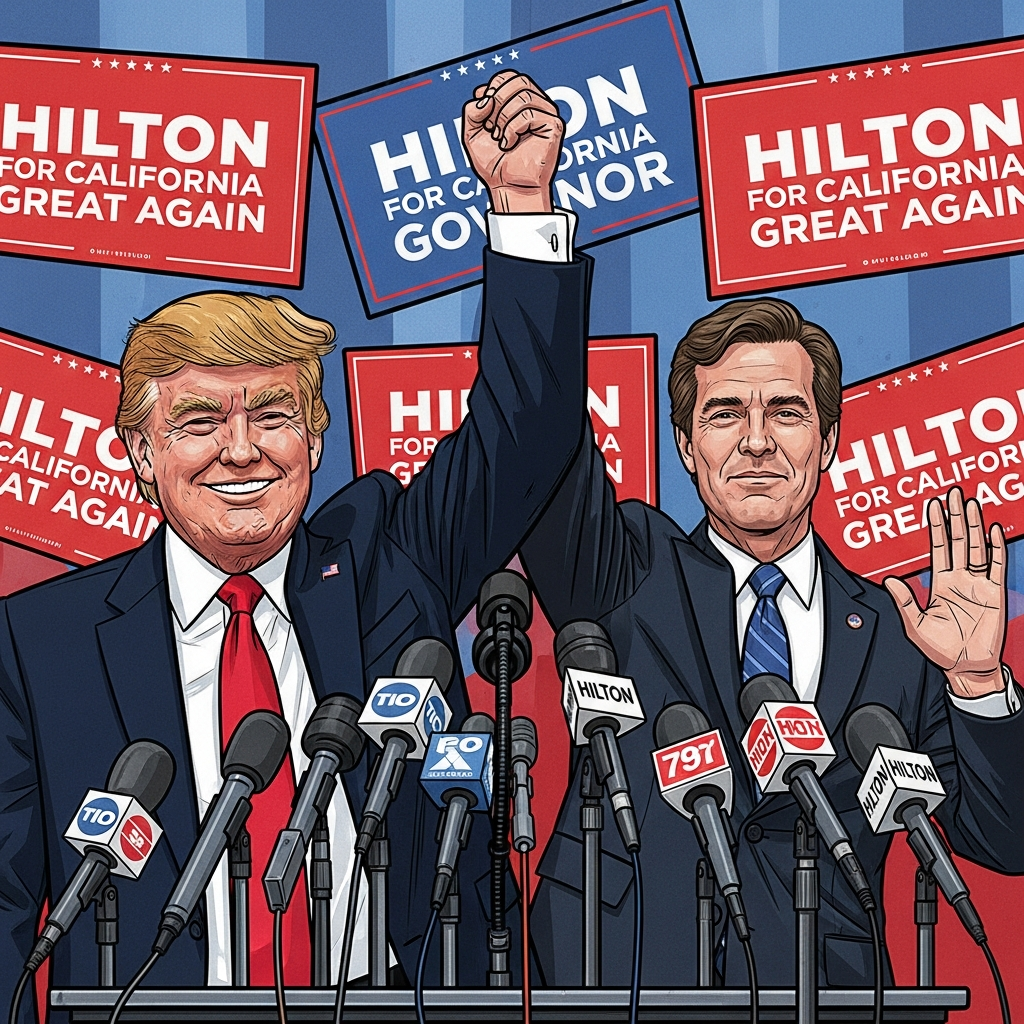
A seismic shift has rocked California’s 2026 gubernatorial race. Former President Donald Trump has officially endorsed conservative commentator Steve Hilton for governor, a move announced late Sunday. This high-profile backing instantly reshapes the crowded Republican field, sparking intense debate about its complex implications for California’s unique “top-two” primary system and the state’s political future. Experts are already weighing in on how this unexpected endorsement could dramatically alter the path to the general election.
The Endorsement Heard ‘Round California
President Trump’s declaration of support for Steve Hilton, a former Fox News host and UK political strategist, arrived late Sunday via a Truth Social post. Trump heralded Hilton as a “truly fine man” destined to be a “great governor.” He launched into a familiar critique of current California leadership, lambasting Governor Gavin Newsom and state Democrats for a “horrendous job” that has seen “people fleeing, crime increasing, and Taxes at the highest of any State.” Trump explicitly promised federal assistance if he were re-elected president, vowing to help Hilton “turn it around.”
Trump’s Digital Declaration
The former president’s endorsement, posted at 10:21 p.m. Pacific time, was unequivocal. Trump asserted his long-standing relationship with Hilton, emphasizing his respect for the candidate. His criticisms extended beyond Newsom, using a derogatory nickname for the outgoing governor, who is in the final year of his term and considering a 2028 presidential bid. Trump’s intervention comes just days before California Republicans are set to gather in San Diego to consider their own official endorsement.
Hilton’s Response and “Califordable” Vision
Steve Hilton’s campaign swiftly embraced the presidential nod, expressing deep gratitude on social media. “Thank you, Mr. President!” his campaign posted on X, declaring it “the moment California has been waiting for!” Hilton himself stated he was “deeply honored” and pledged to “fight like you’ve never seen before to save our beautiful state.” His campaign platform, branded “Califordable,” prioritizes lowering the cost of living. Key proposals include reducing gas prices to $3 a gallon, halving energy costs through deregulation, and eliminating state income tax for residents earning $100,000 or less. Hilton also advocates for restricting Medi-Cal coverage for undocumented immigrants and combating state waste and fraud.
Navigating California’s “Jungle Primary”
California operates under a distinctive “top-two” primary system. In this setup, the two candidates who garner the most votes in the June 2 primary advance to the general election, regardless of their political party. This unique system sets the stage for potentially unpredictable outcomes, especially in a state dominated by Democratic voters. The 2026 gubernatorial contest is particularly crowded, with 61 names on the primary ballot, including ten major candidates.
The Strategy: Republicans’ Primary Path
Initially, some Republicans hoped that two strong conservative candidates, Hilton and Riverside County Sheriff Chad Bianco, could split the vote relatively evenly. This strategy aimed to secure both top spots in the November runoff, effectively locking out Democratic contenders. Such a scenario would have presented a rare opportunity for the GOP in a state where they haven’t won a statewide election in two decades. However, Trump’s singular endorsement of Hilton has complicated this intricate strategy.
The Polls: A Crowded, Volatile Field
Recent polling data has highlighted the volatility of the race. A March poll by UC Berkeley’s Institute of Governmental Studies, co-sponsored by The Times, showed both Hilton and Bianco leading the crowded field of candidates. This unexpected finding reportedly “rattled the political establishment.” Separately, a state Democratic party poll in March indicated Hilton leading with 16%, closely followed by Bianco at 14%. Leading Democrats—Congressman Eric Swalwell, former Congresswoman Katie Porter, and billionaire activist Tom Steyer—were in a dead heat, each polling around 10%. The significant number of Democratic candidates has splintered their party’s voter base, creating a potential opening for Republicans.
The Bianco Factor: A Rival’s Response
Chad Bianco, Riverside County Sheriff and a fellow prominent Republican contender, found himself directly impacted by Trump’s decision. Bianco, also a staunch supporter of the former president, had reportedly been in discussions with Trump’s advisors, openly stating he would welcome an endorsement. However, Trump ultimately sided with Hilton.
Sheriff Bianco’s Stance
On Monday, Sheriff Bianco responded to the endorsement in a video message. He stated, “President Trump made his endorsement. That’s his decision. But this race is about the future of California, not any one endorsement.” Bianco went on to reframe his campaign, positioning himself as “the only candidate in this race fighting for every Californian.” He urged his supporters to “saddle up,” a call to action meant to rally his base despite the lack of presidential backing. Political observers note Bianco’s previous actions, such as “seizing ballots in Riverside County,” were likely an attempt to gain Trump’s attention.
Unpacking the Unintended Consequences
Political experts are scrutinizing Trump’s endorsement, with many suggesting it could have unexpected and potentially ironic outcomes. While designed to boost Hilton, the move may inadvertently benefit Democrats by altering the primary dynamics in a way that prevents a Republican shutout in the general election.
Expert Analysis: A Democratic Opportunity?
“This is bizarro political judgment,” stated Jack Pitney, a political science professor at Claremont McKenna College. He argued that Trump’s decision could effectively hand the election to the Democrats. Political data analyst Rob Pyers of California Target Book concurred, suggesting the endorsement “likely frees up tens of millions of dollars for Democratic groups.” These funds would have otherwise been spent to prevent two Republicans from advancing to the general election. UCLA public policy professor Jim Newton characterized the endorsement as “short-term helpful and long-term damaging” for Hilton, given Trump’s deep unpopularity in California. By consolidating Republican votes around Hilton, Bianco’s support might drop, creating more room for a Democrat to secure the second runoff spot. This could ease the “big panic” Democrats faced about two Republicans advancing.
Historical Precedent and Future Outlook
California’s political history offers mixed signals regarding presidential endorsements. In the 2018 governor’s race, Trump’s endorsement of Republican businessman John Cox helped him secure a second-place finish in the primary. However, Cox was ultimately trounced by Gavin Newsom in the general election. While Republicans perceive a rare opportunity to capture the governor’s mansion due citing Arnold Schwarzenegger’s two terms (2003-2011), the state remains a reliably “blue state,” not having elected a Republican governor or to any statewide office since 2006. The complexities of the “top-two” primary, coupled with Trump’s polarizing influence, make the 2026 race unusually unpredictable.
Steve Hilton: From British Politics to Golden State Race
Steve Hilton, 56, brings a unique and extensive background to the California gubernatorial race. Born in England to Hungarian immigrant parents who fled communism, his personal story shapes his political outlook. He became an American citizen in 2021, making him eligible for the state’s highest office.
A Unique Background
Hilton’s career began in British politics, where he worked for the Conservative Party during Margaret Thatcher’s tenure. He later served as a senior advisor and confidant to then-British Prime Minister David Cameron from 2010 to 2012. Hilton is credited with “designing the modernized British Conservative image” that contributed to Cameron’s victory. After moving to California in 2012, he became a visiting scholar at Stanford University. He gained significant public prominence in the US as the host of Fox News’ “The Next Revolution” for several years, a show that examined American government and the populist movement. He also co-founded Crowdpac, a nonpartisan political fundraising website based in Silicon Valley.
Policy Priorities and Campaign Focus
Hilton’s campaign, “Califordable,” underscores his focus on affordability and quality of life. Beyond the aforementioned proposals on gas, energy, and taxes, he also advocates for tackling waste and fraud in state programs, claiming $430 billion has been squandered over five years. On tech policy, Hilton expresses skepticism about regulating AI and uniquely proposes that children under 16 years old should not own a smartphone. His platform aims to prioritize “common sense ahead of ideology” and clean up corruption in Sacramento, with the ultimate goal to “make California truly Golden Again.”
The Road Ahead: High Stakes in Sacramento
The 2026 California gubernatorial primary is drawing intense national attention. CNN has already announced it will host a gubernatorial debate on May 5, signaling the growing significance of this contest. With early voting set to commence on May 23 and conclude on June 2, candidates face a crucial period to rally support. The impact of Trump’s endorsement, particularly whether it consolidates the Republican vote behind Hilton or inadvertently clears a path for a Democrat, will become clearer as the primary approaches. The outcome will not only determine California’s next leader but could also send significant signals about the national political landscape.
Frequently Asked Questions
Why is Trump’s endorsement of Steve Hilton considered a complex move for Republicans in California?
Former President Trump’s endorsement of Steve Hilton in the 2026 California gubernatorial race is seen as complex because it could paradoxically hurt Republicans. In California’s “top-two” primary, the original strategy was for two strong Republican candidates (Hilton and Chad Bianco) to split the vote, both advancing to the general election. By backing only Hilton, Trump might consolidate Republican votes behind him, potentially causing Bianco’s support to drop. This creates an opening for a Democrat to secure the second primary spot, leading to a Democrat-vs-Republican general election, which a Republican is historically unlikely to win in heavily Democratic California.
Which other candidates are significant contenders in the 2026 California gubernatorial primary?
The 2026 California gubernatorial primary features a crowded field of candidates. Besides Steve Hilton and Riverside County Sheriff Chad Bianco, who are the leading Republican contenders, several prominent Democrats are also vying for the nomination. These include Congressman Eric Swalwell, former Congresswoman Katie Porter (who lost the 2024 Senate race), and billionaire climate activist Tom Steyer. Polls have shown these Democratic candidates in a tight race, with their votes potentially splintered due to the large number of contenders. The primary system means any of these candidates could potentially advance.
What are Steve Hilton’s key policy proposals for California?
Steve Hilton’s campaign, dubbed “Califordable,” focuses on making California more affordable for residents. His key policy proposals include:
Reducing gas prices to $3 a gallon.
Halving energy costs through deregulation.
Eliminating state income tax for residents earning $100,000 or less.
Restricting Medi-Cal coverage for undocumented immigrants.
Combating fraud, waste, and abuse in government programs, claiming over $430 billion has been squandered.
Proposing that children under 16 years old should not own a smartphone.
He aims to prioritize “common sense” and clean up corruption in Sacramento.