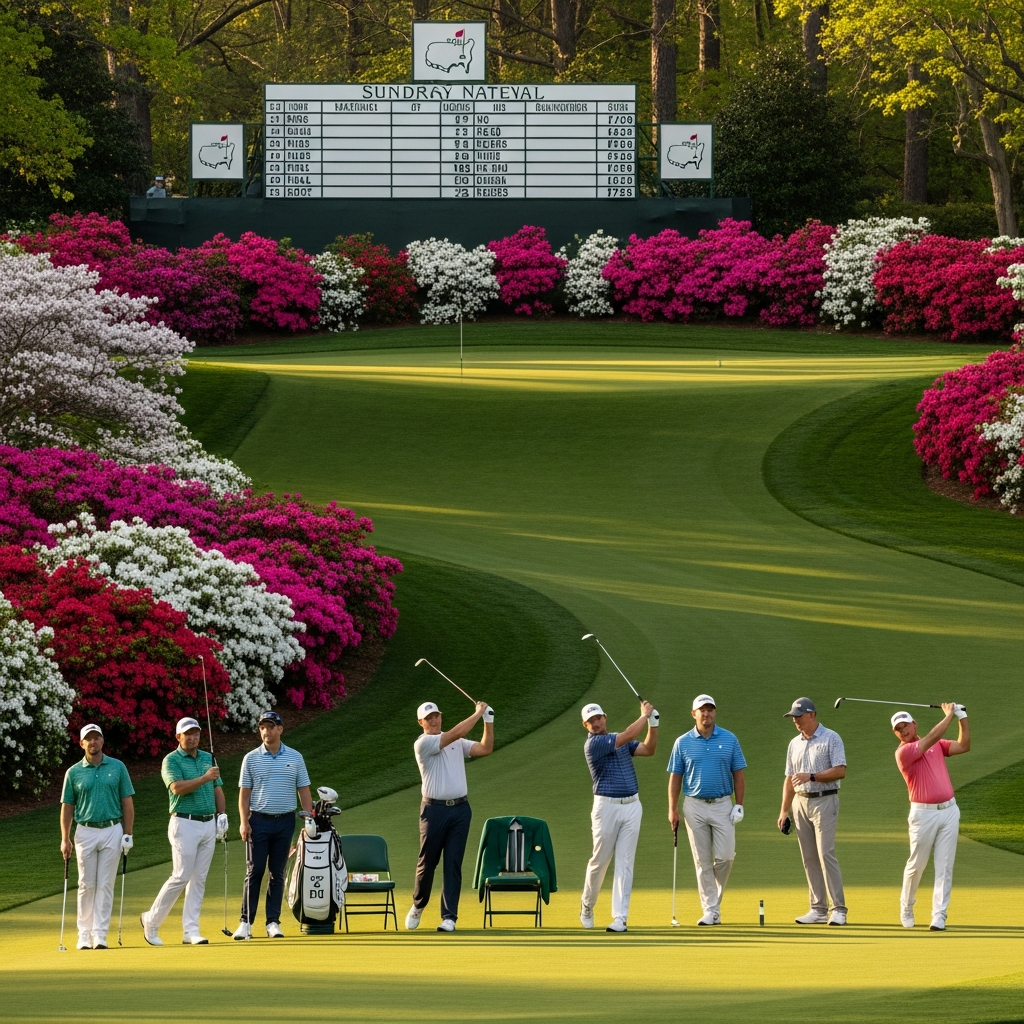
The Masters Tournament in 2026 is shaping up to be one of the most unpredictable in recent memory. With golf’s biggest names facing challenges and a wave of emerging talent on the rise, the iconic Augusta National Golf Club is poised for a truly wide-open contest. This comprehensive guide breaks down all 91 players, analyzing their form, Augusta National experience, and statistical strengths to predict who might don the coveted Green Jacket. From seasoned champions to surprising rookies, every player has a unique path to victory in this year’s Masters 2026.
The Unpredictable Masters 2026: Why This Year is Different
Augusta National traditionally favors experience and familiarity. Yet, the 2026 Masters defies easy predictions. Traditional superstars have shown vulnerabilities, whether due to recent injuries or inconsistent play. Meanwhile, a fresh cohort of rising stars is consistently contending, injecting new energy into the field. Even a few first-time Masters participants are displaying the kind of statistical prowess that could challenge historical norms, despite the long-standing “rookie hex”—Fuzzy Zoeller in 1979 remains the last debutant winner.
This dynamic blend creates an atmosphere of genuine suspense. Analysts point to several factors making the Masters 2026 particularly intriguing. The competitive landscape, especially with players transitioning between tours, adds another layer of complexity. Each player arrives with a unique story, making this year’s tournament one to watch closely.
Navigating Augusta: Key Factors for Success
Success at Augusta National isn’t just about raw talent. It demands a specific blend of skills, mental fortitude, and course knowledge. While some major tournaments are less predictable, the Masters often rewards players who check particular boxes.
Course Experience is Paramount: Historical data strongly supports the value of prior appearances. The average Masters champion over the past two decades has played in their ninth Masters Tournament. This emphasizes the critical role of understanding Augusta’s nuances, elevation changes, and treacherous greens. A player’s ability to “unlock the key” to Augusta often comes with repeat attempts.
Current Form and Momentum: Recent performance is a significant indicator. Players entering the Masters with wins or multiple top-5 finishes on the PGA Tour or LIV Golf circuit often carry crucial confidence. As some analysts note, Augusta National rewards recent form.
Statistical Strengths: While approach play is frequently discussed, skill “around the green” might be an even more critical indicator. Excellent chipping and pitching are essential for navigating Augusta’s demanding greens. Strong par-5 scoring, elite ball-striking, and strokes gained tee-to-green are also vital metrics.
Player Scheduling: An interesting historical trend suggests a disadvantage for players taking three weeks off before the Masters. Only Adam Scott in 2013 has won under such circumstances in the last 40 years. This factor can influence the outlook for even the sport’s top players.
Top Contenders for the Green Jacket
This year’s Masters 2026 features a compelling lineup of favorites, each bringing unique strengths and challenges to Augusta. Here’s a detailed look at the players positioned for a deep run.
The Elite Favorites (Ranked 1-5)
- Jon Rahm: The 2023 Masters champion enters this year with exceptional form. On the LIV Tour, he’s consistently finished in the top five, including a win and three runner-up finishes in his last five starts. His Data Golf skill profile is robust, and he boasts an impeccable record at Augusta National, never missing a cut in nine appearances. With his powerful iron play and proven major championship pedigree, Rahm is a strong candidate to reclaim the Green Jacket.
- Ludvig Åberg: This young star checks every box, ranking highly in predictive models. He’s been on an incredible trend, securing three consecutive top-5 finishes in his recent starts. His Masters record is particularly impressive for a relative newcomer, with a second-place finish in 2024 and a seventh in 2025. While some analysts note potential for late-round falters, his exceptional ball-striking and consistent performance make him a formidable contender.
- Scottie Scheffler: The world No. 1 and a two-time Masters winner is always a threat. Scheffler has never finished worse than T-19 at Augusta, showcasing remarkable consistency. Despite a recent “mini-slump” of back-to-back starts without a top-20 finish, and with the impending arrival of his second child, his underlying statistics remain elite. He’s still top 10 in strokes gained tee-to-green and around the green. If his iron play rebounds, he remains the player to beat. The birth of his second child might even be a “good luck charm,” echoing his strong performance after his first child’s arrival.
- Matt Fitzpatrick: Fitzpatrick arrives at the Masters 2026 with immense momentum. He recently posted a second-place finish followed by a win in his last two Tour starts. His model ranking places him in the top five, and he’s second on Tour in strokes gained tee-to-green. With a remarkable streak of 10 consecutive made Masters cuts, Fitzpatrick’s improved iron play and consistent putting on difficult greens position him as a prime contender.
- Xander Schauffele: A model of consistency at Augusta National, Schauffele has cracked the top 10 in four of his last five Masters starts. He also brings strong recent form, with three top-7 finishes in his last four events. In his ninth Masters appearance, his elite ball-striking and proven major championship pedigree from 2024 (including PGA and Open wins) make him a consistent threat.
- Rory McIlroy: As the reigning 2025 Masters champion, McIlroy faces the monumental challenge of a back-to-back victory—a feat achieved by only Tiger Woods, Jack Nicklaus, and Nick Faldo. After recovering from a back injury, a healthy McIlroy, who typically leads the Tour in strokes gained tee-to-green, will factor heavily. However, concerns about putting and a similar three-week layoff leading into the tournament pose questions.
- Bryson DeChambeau: DeChambeau has truly “figured out” Augusta National, evidenced by two consecutive top-6 finishes. He’s also riding a wave of confidence with two recent LIV titles. Known for his powerful driving and improved putting, if his iron play and short game hold up, particularly under firm conditions, he could be a dominant force.
- Cameron Young: While his Masters record has been inconsistent (two top-10s followed by a missed cut), Young’s recent Players Championship win signals a significant uplift in form. He ranks second in proximity and top 10 in strokes gained tee-to-green. Despite not being renowned for his play around the greens, his improved putting makes him a popular pick.
- Min Woo Lee: Considered a “surprise” pick by some, Lee is currently one of the hottest players according to Data Golf’s trend table. He’s nearly top 10 in strokes gained tee-to-green, second in par-5 scoring, and has significantly improved his approach play this year. His dynamic game could translate into a breakout Masters performance.
- Patrick Reed: The 2018 Masters champion consistently performs well at Augusta, with four T-12 or better finishes in his last five appearances. Often lauded as potentially the “best chipper in the world,” Reed’s comfort level at Augusta is undeniable. His return to the PGA Tour conversation, fueled by recent wins on the DP World Tour, brings a renewed sense of confidence. Notably, Reed recently declined a LIV Golf renewal, citing a desire for more family time and expressing a clear longing for the competitive environment and recognition of the PGA Tour and major championships. This shift has led to a scaled-back schedule, with the Masters being only his eighth start of the year—a rare break that could leave him refreshed.
- Hideki Matsuyama: The 2021 champion is recognized for his excellent ball-striking and chipping. He consistently posts top-25 finishes at Augusta since his victory, making him a perennial threat.
- Akshay Bhatia: A rising star with a recent win and four top-16 finishes. He ranks top 10 in strokes gained approach, though his Masters record could use improvement.
- Collin Morikawa: Leads the Tour in strokes gained approach and is fourth in par-5 scoring. He’s a significant threat if he overcomes recent back injury concerns that led to a withdrawal at The Players.
- Brooks Koepka: His ball-striking remains elite (second in strokes gained approach). Despite a mixed Masters history, including some missed cuts, his T-2 finish three years ago shows his potential.
- Jacob Bridgeman: A top first-timer with a recent win at Riviera and consistent top-18 finishes this year. His only concern is his chipping, but his consistent form makes him an exciting debutant.
- Tommy Fleetwood: A complete player, top 10 in par-5 scoring and strokes gained tee-to-green, and second around the green. He has consistent top-10 finishes and a T-3 at Augusta.
- Chris Gotterup: Another strong rookie with power, ranking top 10 in par-5 scoring and strokes gained tee-to-green. His top 25 ranking around the green suggests he could surprise many.
- Jordan Spieth: Spieth often finds his best game at Augusta National, highlighted by his gritty T-14 last year. Despite some recent struggles, his course history keeps him in contention.
- Nicolai Højgaard: Followed a T-16 Masters debut with a missed cut, but enters the Masters 2026 trending upward after a second-place finish in Houston.
- Adam Scott: While he hasn’t cracked the Masters top 20 since 2018, Scott is experiencing a ball-striking renaissance, ranking third in strokes gained approach and proximity.
- Justin Rose: The 2026 Valero Texas Open playoff loser to Rory McIlroy, he is top 10 in strokes gained approach and recently found form with a T-13 at The Players.
- Si Woo Kim: A “top-30 machine” at Augusta National, Kim ranks fourth in strokes gained tee-to-green, third on approach, and first in proximity, making him consistently dangerous.
- Jake Knapp: Leads the Tour in par-5 scoring and putting from outside 10 feet, skills that are highly valuable at Augusta.
- Russell Henley: Another excellent putter with strong recent form, though his last two Masters appearances were less stellar.
- Viktor Hovland: Despite only one top-10 in six Masters, he’s typically around the top 30. Recent driver issues and a dip in par-5 scoring have impacted his momentum.
- Maverick McNealy: Building on a T-32 Masters debut last year, his ball-striking is improving (top 30 in strokes gained tee-to-green), but his putter has been surprisingly frustrating.
- Robert MacIntyre: Fresh off strong finishes at The Players (4th) and Valero (T-2), he returns to a course where he has past top-25s.
- Corey Conners: An Augusta specialist with four top-10s in his last six Masters starts, his consistent ball-striking makes him a strong fit for the course.
- J.J. Spaun: The recent Valero winner is one of the best ball-strikers in the field, though his putting from longer distances can be a concern.
- Justin Thomas: Still shaking off rust from back surgery, Thomas has struggled in recent Masters with two missed cuts, but his talent means he can never be fully counted out.
- 91. Mike Weir
- www.golfchannel.com
- www.nbcsports.com
- www.skratch.golf
- sports.yahoo.com
- www.golfchannel.com
The Next Tier of Challengers (Ranked 6-10)
Rising Stars and Seasoned Veterans (Ranked 11-30)
The Masters 2026 field runs deep with talent, featuring both established champions and emerging players eager to make their mark.
The Full Masters 2026 Field: Players 31-91
The remainder of the 91-player field for the Masters 2026 comprises a mix of established tour players, past champions, and promising amateurs. While the top of the leaderboard typically features players with strong current form and extensive Augusta experience, the “wide-open” nature of this year’s tournament means any player finding their stride could surprise. Past champions, many now on the PGA Tour Champions, continue to compete, though the course’s length presents increasing challenges for older players. Amateurs, often collegiate stars, bring youthful exuberance and raw talent, but face the historical “rookie hex.”
31. Shane Lowry
32. Sepp Straka
33. Ryan Gerard
34. Harry Hall
35. Rasmus Højgaard
36. Daniel Berger
37. Keegan Bradley
38. Patrick Cantlay
39. Gary Woodland
40. Cameron Smith
41. Haotong Li
42. Sam Stevens
43. Nick Taylor
44. Ryan Fox
45. Ben Griffin
46. Tyrrell Hatton
47. Carlos Ortiz
48. Jason Day
49. Kurt Kitayama
50. Wyndham Clark
51. Alex Noren
52. Casey Jarvis
53. Sam Burns
54. Harris English
55. Sungjae Im
56. Max Homa
57. Johnny Keefer
58. Brian Harman
59. Max Greyserman
60. Michael Brennan
61. Marco Penge
62. Aaron Rai
63. a-Jackson Herrington
64. Andrew Novak
65. a-Mason Howell
66. Michael Kim
67. Matt McCarty
68. Nico Echavarria
69. Sami Valimaki
70. Dustin Johnson
71. Kristoffer Reitan
72. Tom McKibbin
73. Rasmus Neergaard-Petersen
74. Sergio Garcia
75. Brian Campbell
76. Zach Johnson
77. Charl Schwartzel
78. Bubba Watson
79. Aldrich Potgieter
80. Davis Riley
81. Danny Willett
82. Angel Cabrera
83. Fred Couples
84. Jose Maria Olazabal
85. a-Fifa Laopakdee
86. a-Ethan Fang
87. Naoyuki Kataoka
88. a-Brandon Holtz
89. Vijay Singh
90. a-Mateo Pulcini
Frequently Asked Questions
Why is the Masters 2026 considered “wide-open” compared to previous years?
The Masters 2026 is uniquely wide-open due to a confluence of factors. Many traditional golf superstars have shown recent vulnerability, either through inconsistent play or injury concerns. Concurrently, a new generation of rising stars is demonstrating exceptional form and consistently contending in major events. This creates a less predictable field where a wider range of players statistically have a legitimate chance to win, challenging the usual favorites and making for an exciting, unpredictable tournament at Augusta National.
Which key statistics and player attributes are most crucial for Masters success at Augusta National?
Success at Augusta National highly correlates with several key attributes. Experience on the course is paramount, as the average winner has made multiple prior appearances. Strong current form, including recent wins or high finishes, is also a critical indicator. Statistically, skill “around the green” (chipping and pitching) is often more crucial than pure approach play, given Augusta’s challenging green complexes. Additionally, excellent ball-striking, high rankings in strokes gained tee-to-green, and aggressive play on the par-5s are consistently associated with Masters champions.
How does a player’s recent form or Masters experience impact their chances of winning the Green Jacket?
Both recent form and Masters experience are strong predictors of success. Players in strong current form, evidenced by consistent top finishes or recent victories, often carry momentum and confidence into Augusta. However, the unique challenges of Augusta National mean that experience, particularly knowing how to navigate the course’s nuances and respond to pressure, is overwhelmingly important. While a player with great form but limited experience might contend, historical data suggests that multiple prior starts significantly increase a player’s probability of ultimately securing the Green Jacket.
Conclusion
The Masters 2026 is poised to deliver a captivating blend of tradition and unpredictability. From the established prowess of two-time champions like Scottie Scheffler and returning legends like Jon Rahm and Rory McIlroy, to the surging talent of Ludvig Åberg and Jacob Bridgeman, the path to the Green Jacket is anything but clear. Key factors like Augusta National experience, recent statistical form, and mental toughness will undoubtedly separate the contenders from the rest. As the golf world converges on Augusta, every player in this 91-person field holds a unique narrative and the potential to etch their name into Masters history. Prepare for a thrilling week of golf where the next champion could emerge from anywhere on the leaderboard.