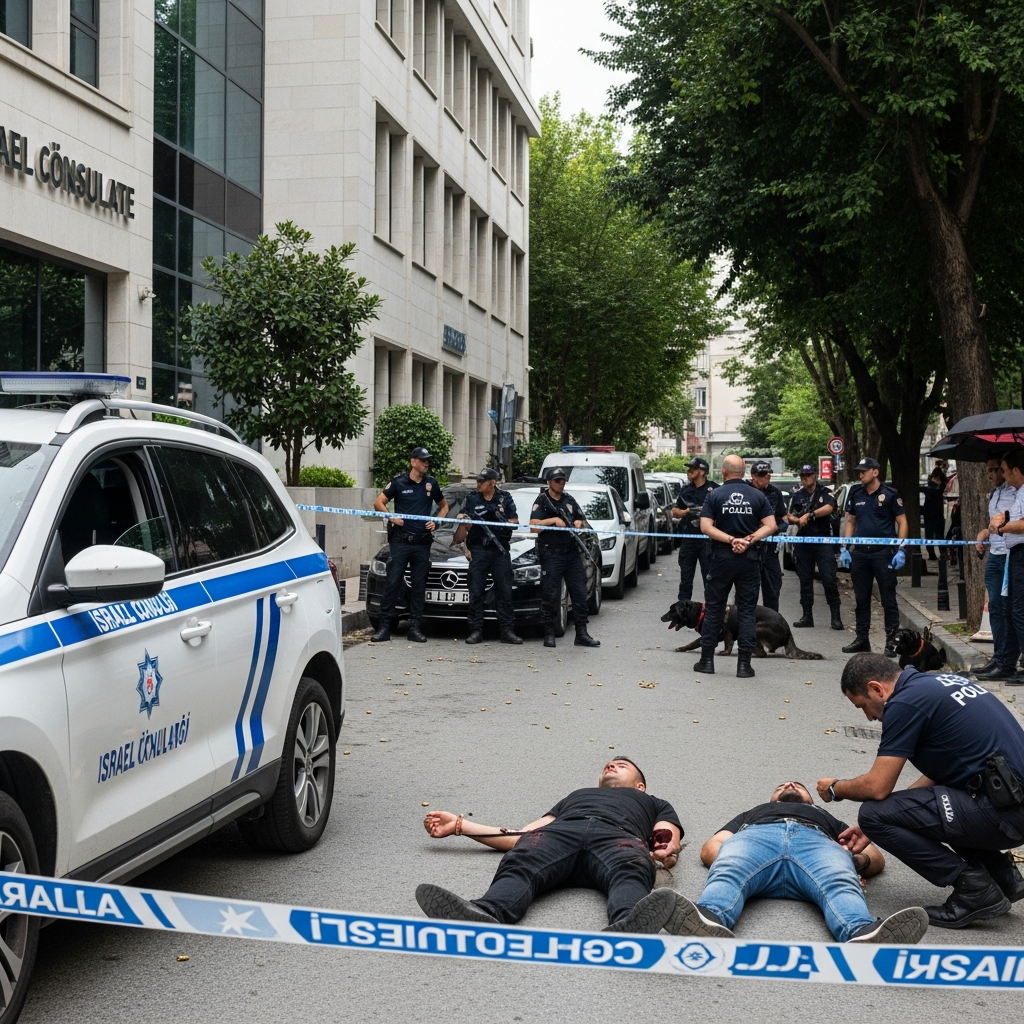
Istanbul’s bustling Levent business district was plunged into chaos on Tuesday, April 7, 2026, as three assailants launched a brazen gun attack on police guarding a building housing the Israeli Consulate. The shocking incident sparked a fierce shootout, leaving one attacker dead, two others wounded and captured, and two police officers with minor injuries. This violent confrontation, quickly condemned by Turkish and international leaders, highlights the volatile geopolitical climate and casts a shadow over Turkey’s robust security environment, particularly amidst ongoing tensions related to the Gaza conflict. Turkish authorities have swiftly launched a meticulous investigation, piecing together details of the attackers’ origins and potential affiliations, while reassuring the public that the nation remains resolute against all forms of terrorism.
Intense Gunfight Erupts Near Israeli Consulate
The dramatic events unfolded when three armed individuals approached the high-rise building in Levent where the Israeli Consulate is located. Witnesses described a sudden burst of gunfire as the assailants opened fire on police officers stationed outside. The officers immediately returned fire, transforming the busy street into a scene of intense combat.
Video footage from the scene captured the raw intensity of the gunfight. One assailant, armed with what appeared to be an assault rifle and carrying a brown backpack, was seen taking cover behind a public bus while exchanging fire with police. Another segment showed a police officer falling to the ground, seemingly hit, before quickly rolling away to find cover behind a tree. The exchange of fire lasted approximately ten minutes, an eternity for those caught in its vicinity. Omer Dilki, 34, a witness, initially mistook the sounds for typical city noise but quickly realized the gravity of the situation as the continuous gunshots revealed a serious attack. Another local worker, Ali Rıza Arpacı, described witnessing “serious clashes” right in front of him, emphasizing how close he felt to the danger.
Turkish officials confirmed the swift police response. Istanbul Governor Davut Gul reported that two police officers sustained slight injuries, one in the leg and the other in the ear. Their prompt and decisive actions prevented what could have been a far more devastating incident. The confrontation resulted in one assailant being killed on site, identified as Yunus E.S. by Turkish media. The other two attackers were wounded and subsequently captured by security forces.
Unraveling the Identities and Motives of the Attackers
Following the immediate aftermath, Turkish authorities moved quickly to identify the assailants and investigate their motives. The two wounded and captured individuals were identified as brothers Onur C. and Enes C. Reports from the Interior Ministry indicated that Onur C. has a prior criminal record, specifically related to drug offenses. Both brothers are currently undergoing intensive interrogation to uncover the full scope of their plans and affiliations.
Interior Minister Mustafa Cifti revealed crucial details about the attackers’ origins and travel. He stated that the assailants had traveled to Istanbul from Izmit, a city about 100 kilometers (60 miles) east, or the northwestern province of Kocaeli, using a rented car. More significantly, Minister Cifti noted that one of the assailants had ties to a group he vaguely described as “exploiting religion.” While Turkish officials initially refrained from naming the specific organization, Turkish journalists and media outlets, including NTV, quickly speculated a link to the Islamic State (ISIS) group, citing its history of deadly attacks within Turkey. The Interior Ministry’s cautious phrasing underscores the complexity and sensitivity of identifying such groups, even as the investigation proceeds.
The coordinated nature of the attack, coupled with the assailants’ heavy weaponry and alleged connections, suggests a deliberate act rather than an isolated incident. Prosecutors, including a deputy chief public prosecutor, have been assigned to lead a “meticulous and multifaceted” inquiry, demonstrating the high priority given to uncovering all aspects of this security breach. This comprehensive investigation aims to determine if the group has a wider network and what their ultimate objectives were.
The Unstaffed Consulate: A Target Amidst Geopolitical Strain
A critical detail in understanding the Istanbul Israeli Consulate attack is the status of the diplomatic mission itself. Turkish and Israeli authorities confirmed that the Israeli Consulate was unstaffed at the time of the incident. In fact, Israeli missions in Turkey had been largely unoperational for approximately two and a half years, with diplomats withdrawn due to escalating security concerns and significantly deteriorating relations between Turkey and Israel. This diplomatic chill intensified following the October 7, 2023 Hamas terror attack on Israel and the subsequent conflict in Gaza.
This raises an important question: if the consulate was unstaffed, was it still the direct target? Journalists like Tamer Oskay reported that Istanbul police had received intelligence days prior about a potential attack, indicating a premeditated attempt. Furthermore, initial reports suggested the attackers had specifically intended to reach the seventh-floor office of the Israeli Consulate within the plaza building. Even an unstaffed diplomatic mission can serve as a symbolic target, especially in a climate of heightened regional tensions. The location choice itself, within a prominent business district, suggests a deliberate selection for maximum impact and visibility.
The broader geopolitical context of strained Turkey-Israel relations cannot be overstated. Turkish President Recep Tayyip Erdoğan has been a vocal critic of Israeli military operations in Gaza, creating a challenging environment for diplomatic engagement. This attack, regardless of its immediate success in targeting personnel, undeniably plays into the existing narrative of regional instability and the potential for spillover from conflicts like the one in Gaza.
Swift Response and International Condemnation
Turkish authorities reacted with speed and precision following the attack. Police immediately sealed off the building housing the consulate and blocked several surrounding roads, securing the area. Forensic experts in protective suits were dispatched to meticulously comb the site for evidence, a critical step in building a case and understanding the full sequence of events. The swift action of the Istanbul police and army, who quickly secured the perimeter, was instrumental in containing the threat and preventing further casualties.
The attack drew strong condemnation from both Turkish and international figures. Turkish President Recep Tayyip Erdogan denounced the incident as a “treacherous” act. He reiterated Turkey’s unwavering commitment, stating, “We will resolutely continue our fight against all forms of terrorism, and we will not allow the climate of security in Turkey to be harmed by vile and timed provocations like today’s.” This powerful statement underscores Turkey’s resolve to maintain stability and confront threats head-on.
The international community also expressed solidarity with Turkey. U.S. Ambassador to Turkey, Tom Barrack, swiftly condemned the assault, praising Turkish authorities for “their swift and decisive response.” He emphasized on X (formerly Twitter) that “Attacks on diplomatic missions are attacks on the international order — and an assault on the principles that bind nations together.” Similarly, Israel’s Foreign Ministry denounced the “terrorist attack” and commended Turkish security forces for their rapid action. Their statement reaffirmed Israel’s resilience: “Israeli missions around the world have been subjected to countless threats and terrorist attacks. Terror will not deter us.” Such strong international reactions highlight the universal condemnation of attacks targeting diplomatic facilities and the importance of collaborative efforts in combating terrorism.
The Broader Fight Against Terrorism in Turkey
The Istanbul Israeli Consulate attack serves as a stark reminder of the persistent threat of terrorism in Turkey. The mention of an organization “exploiting religion” and the speculation of an ISIS link recall a history of brutal attacks carried out by the Islamic State group within Turkey. In the past, ISIS has been responsible for numerous deadly incidents, targeting both civilians and security forces across the country. These past events underscore the serious nature of the current investigation and the imperative for Turkish authorities to thoroughly dismantle any active cells.
Turkey’s government has long been engaged in a multi-front fight against various terror organizations. President Erdogan’s resolute stance against “all forms of terrorism” reflects this ongoing commitment. The immediate and effective response to the Istanbul incident demonstrates the readiness and capability of Turkish security forces to neutralize threats quickly. While the specific motives behind this particular attack are still under investigation, its occurrence in a high-profile location like Istanbul’s Levent district near a diplomatic mission underscores the continued vigilance required to protect national security and public safety. This incident will likely lead to further enhancements in security protocols around sensitive areas and diplomatic sites across Turkey.
Frequently Asked Questions
What happened during the Istanbul Israeli Consulate attack on April 7, 2026?
On Tuesday, April 7, 2026, three assailants launched a gun attack on police outside a building housing the Israeli Consulate in Istanbul’s Levent business district. A fierce shootout ensued, resulting in the death of one attacker and the wounding and capture of the other two. Two Turkish police officers sustained minor injuries, one in the leg and one in the ear. Turkish authorities swiftly secured the area and launched a comprehensive investigation into the incident.
Why was the Israeli Consulate unstaffed during the Istanbul attack?
The Israeli Consulate in Istanbul was confirmed to be unstaffed at the time of the attack. Israeli diplomats had been withdrawn from Turkey approximately two and a half years prior due to escalating security concerns and significantly strained diplomatic relations between the two countries. These tensions intensified following the October 7, 2023 Hamas terror attack on Israel and the subsequent conflict in Gaza, leading to Israel’s decision to maintain its diplomatic missions in Turkey without personnel.
Who were the assailants in the Istanbul consulate attack and what are the potential motives?
The two wounded and captured assailants were identified as brothers Onur C. and Enes C., with Onur C. having a prior criminal record related to drugs. The third assailant, who was killed, was identified as Yunus E.S. by Turkish media. Interior Minister Mustafa Cifti stated that one of the assailants was linked to a group “exploiting religion,” and Turkish media widely speculated this to be the Islamic State (ISIS) group, citing its history of attacks in Turkey. The investigation is ongoing to confirm the specific group affiliation and the precise motives behind this high-profile attack.
Conclusion
The Istanbul Israeli Consulate attack on April 7, 2026, was a jarring reminder of persistent security threats and the complex geopolitical landscape influencing regional stability. The swift and decisive actions of Turkish security forces prevented a potentially far more severe outcome, earning praise both domestically and internationally. As the investigation into the assailants’ identities, motives, and affiliations continues, Turkey reaffirms its unwavering commitment to combating terrorism in all its forms. This incident underscores the ongoing need for vigilance and robust security measures, particularly around diplomatic missions and in bustling urban centers, as nations grapple with the repercussions of regional conflicts and the ever-present challenge of extremist ideologies. The world watches as Turkish authorities work to uncover the full truth behind this provocative assault.