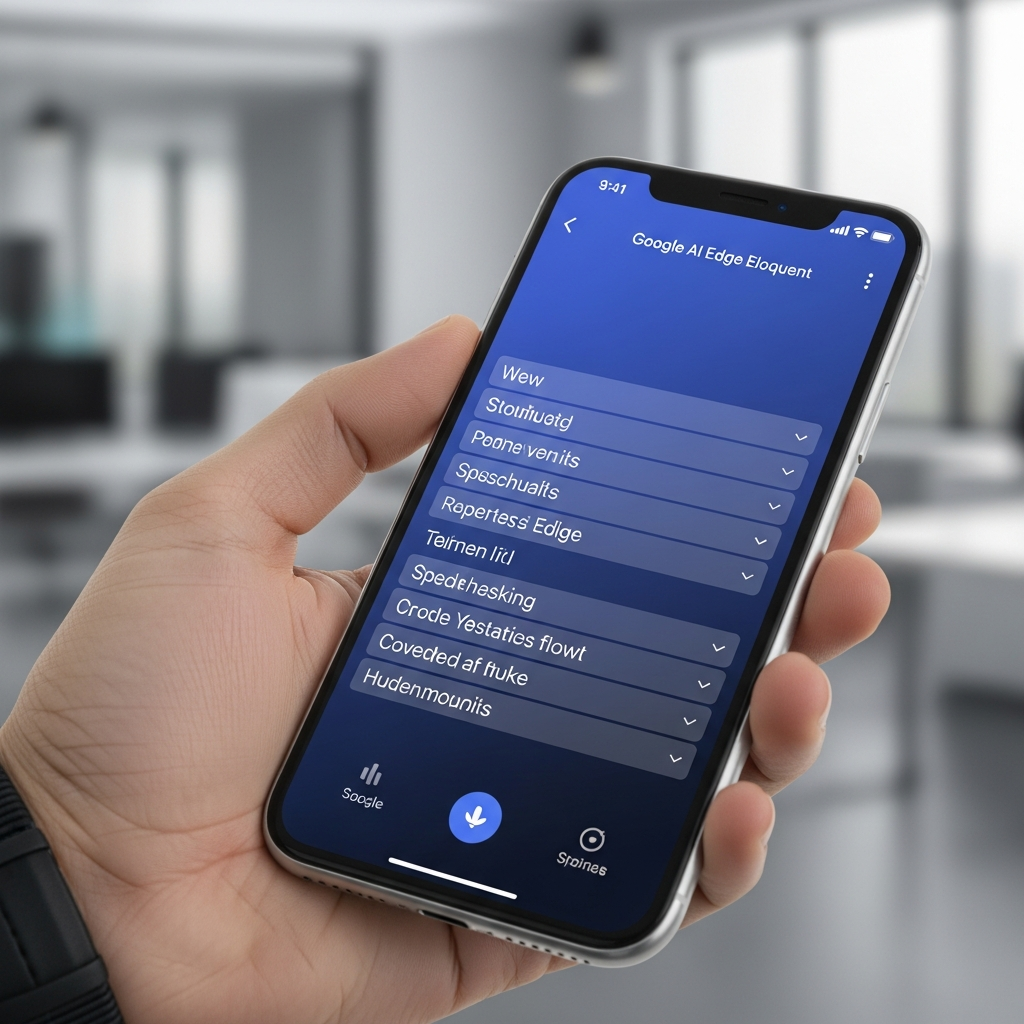
Google has quietly introduced a groundbreaking artificial intelligence (AI) dictation application for iOS, “Google AI Edge Eloquent,” a strategic move poised to redefine how users transform spoken words into polished text. Launched without fanfare, this free, offline-first app directly challenges established players like Wispr Flow and SuperWhisper, emphasizing privacy, speed, and advanced on-device AI processing. It signals Google’s deeper commitment to integrating sophisticated AI capabilities directly into consumer mobile experiences.
The Dawn of Offline-First AI Dictation
At its core, Google AI Edge Eloquent pioneers an “offline-first” approach. This means the app performs all its primary AI processing directly on your iPhone. Unlike many competing solutions that necessitate an internet connection to send voice data to cloud servers, Eloquent downloads Google’s lightweight Gemma-based Automatic Speech Recognition (ASR) models to your device. This critical design choice offers significant advantages, appealing to users prioritizing privacy and seamless functionality regardless of internet availability.
With on-device processing, your sensitive voice data never leaves your phone, addressing major concerns about data security and privacy. This makes it particularly attractive for users in regulated industries or anyone wary of cloud-based data transmission. Furthermore, by eliminating network latency, the app delivers incredibly fast, real-time transcription, enhancing user experience and productivity. The app’s unannounced launch on April 6, 2026, highlights a strategic, experimental approach to showcase Gemma’s real-world utility.
Revolutionizing Speech-to-Text with Intelligent Refinement
Eloquent isn’t just about transcribing words; it’s about transforming natural speech into professional, ready-to-use text. While you dictate, the app provides live transcription, displaying words on screen in real-time. A standout feature is its intelligent text polishing. Upon pausing, Eloquent automatically identifies and filters out common filler words like “um” and “ah,” along with mid-sentence self-corrections. The company’s App Store description clarifies its mission: to bridge “the gap between natural speech and professional, ready-to-use text,” by capturing your intended meaning rather than verbatim stumbles.
This advanced AI-powered cleanup ensures the output is remarkably clean and accurate, often feeling as if it’s already been edited. It surpasses standard dictation software, including Apple’s built-in options, by providing this crucial layer of refinement, making the transcribed text instantly more usable for various professional and personal applications.
Beyond Transcription: AI-Powered Text Transformations
Google AI Edge Eloquent extends its utility far beyond simple dictation with a suite of AI-powered text transformation tools. These features allow users to instantly reshape their transcribed content to fit different needs and contexts:
Key Points: Quickly extracts and summarizes the main ideas into a concise bulleted list.
Formal: Rewrites the dictated text into a more professional and academic register.
Short: Condenses the content, creating a more succinct version of the spoken phrases.
Long: Expands on the existing ideas, adding more detail and elaboration to the text.
These transformation tools are invaluable for various tasks, from drafting emails and reports to preparing summaries or expanded notes, offering immediate versatility for content creation.
Personalization and Enhanced Accuracy
Accuracy is paramount for any dictation tool, and Google AI Edge Eloquent offers robust personalization features to ensure precise transcription. Users can manually add specific names, technical jargon, or unique vocabulary to a custom dictionary. This significantly improves recognition accuracy for specialized terms relevant to their field or personal use.
For added convenience, Eloquent offers an optional integration with your Google Account. If desired, the app can import frequently used words and contextual terms directly from your recent Gmail history. This creates a personalized vocabulary profile without manual configuration, further refining the app’s ability to understand and transcribe your specific language patterns. This optional integration represents the sole point where Google’s broader data ecosystem interacts with the otherwise self-contained local tool.
Strategic Positioning: Free, Offline, and Disruptive
Google’s entry into the AI dictation market with Eloquent is a significant disruption. The app is completely free, requires no subscription, and imposes no usage caps. This directly challenges the prevailing subscription-based models of premium AI dictation tools like Wispr Flow and Willow, which often charge monthly fees, and SuperWhisper, a privacy-focused Mac app costing annually. Eloquent’s combination of free access, robust offline capability, and unlimited usage on iPhone makes competitors’ pricing models considerably less defensible.
The “Google AI Edge” branding also carries significance. It positions Eloquent not just as a consumer productivity tool, but also as a practical demonstration of the capabilities of on-device Gemma models for developers and enterprises exploring Google AI Edge platform. This aligns with a broader industry movement towards deploying powerful AI models directly on user devices, driven by demands for privacy, reduced latency, and lower server-side processing costs.
iOS First: A Glimpse into Android’s Future
The decision to launch Google AI Edge Eloquent exclusively on iOS first is an unusual move for Google, which typically prioritizes its own Android platform for new AI initiatives. This sequencing suggests the app might serve as an experiment in market positioning or that the iOS version of the underlying Gemma ASR models achieved readiness earlier.
Despite its current iOS exclusivity, the App Store description explicitly references an upcoming Android version, promising “seamless Android integration.” The future Android version is expected to allow users to set Eloquent as their default keyboard for system-wide access across any text field. It will also incorporate a floating button feature, similar to Wispr Flow on Android, for easy, ubiquitous access to transcription. This anticipated expansion underscores Google’s ambition to solidify its presence in the evolving voice AI landscape across its primary mobile ecosystem. Should this experimental app prove successful, its technology and features could significantly enhance transcription capabilities throughout the Android ecosystem.
The “Why” Behind the Quiet Launch
Google’s unannounced release of Eloquent speaks volumes about its strategic intent. A quiet launch allows Google to test user reception and gauge market demand for a free, offline AI dictation solution without the pressures of a high-profile product rollout. It serves as a real-world stress test for the Gemma models, showcasing their efficiency and accuracy on consumer hardware. This approach gathers valuable data and feedback, influencing future AI product development. This pioneering move aims to address the “friction of imprecise transcription,” making voice a more practical and reliable interface for AI-assisted work, heralding a significant shift towards viable on-device AI solutions.
Frequently Asked Questions
What makes Google AI Edge Eloquent different from other dictation apps?
Google AI Edge Eloquent distinguishes itself through its “offline-first” processing, which means most AI operations occur directly on your iPhone using Gemma models, enhancing privacy and speed. Unlike many competitors, it’s completely free, requires no subscription, and has no usage caps. It also offers advanced AI-powered features like automatic filler word removal, text polishing, and unique text transformation tools (e.g., “Key points,” “Formal,” “Short,” “Long”), which go beyond basic transcription to produce ready-to-use, professional text.
Is Google AI Edge Eloquent available on Android, or just iOS?
Currently, Google AI Edge Eloquent is exclusively available on iOS. However, the App Store description for the iOS version explicitly references an upcoming Android version, promising “seamless Android integration.” This future release is expected to allow the app to be set as the default keyboard for system-wide access across any text field and include a floating button feature for easy transcription access, similar to Wispr Flow on Android. While no specific release date for Android has been announced, it is anticipated.
How does Google AI Edge Eloquent address user privacy concerns?
User privacy is a core advantage of Google AI Edge Eloquent’s “offline-first” design. By performing all primary AI processing directly on the user’s iPhone, sensitive voice data remains on the device and is not transmitted to cloud servers. This local processing significantly mitigates concerns about data security and privacy. While an optional “cloud mode” exists for enhanced text cleanup using Gemini models, users have the control to opt into or out of cloud-based processing, ensuring a privacy-centric experience by default.
Conclusion
Google AI Edge Eloquent represents a significant stride in AI-powered productivity tools. By combining a free, offline-first model with sophisticated on-device AI, Google has delivered an app that prioritizes user privacy, speed, and intelligence. Its ability to not only transcribe but also refine and transform spoken words marks a new era for dictation software, making professional text creation more accessible and efficient than ever. As Google continues to experiment and expand its AI Edge initiatives, Eloquent serves as a compelling preview of a future where powerful, privacy-respecting AI capabilities are seamlessly integrated into our everyday mobile devices, fundamentally changing how we interact with technology.