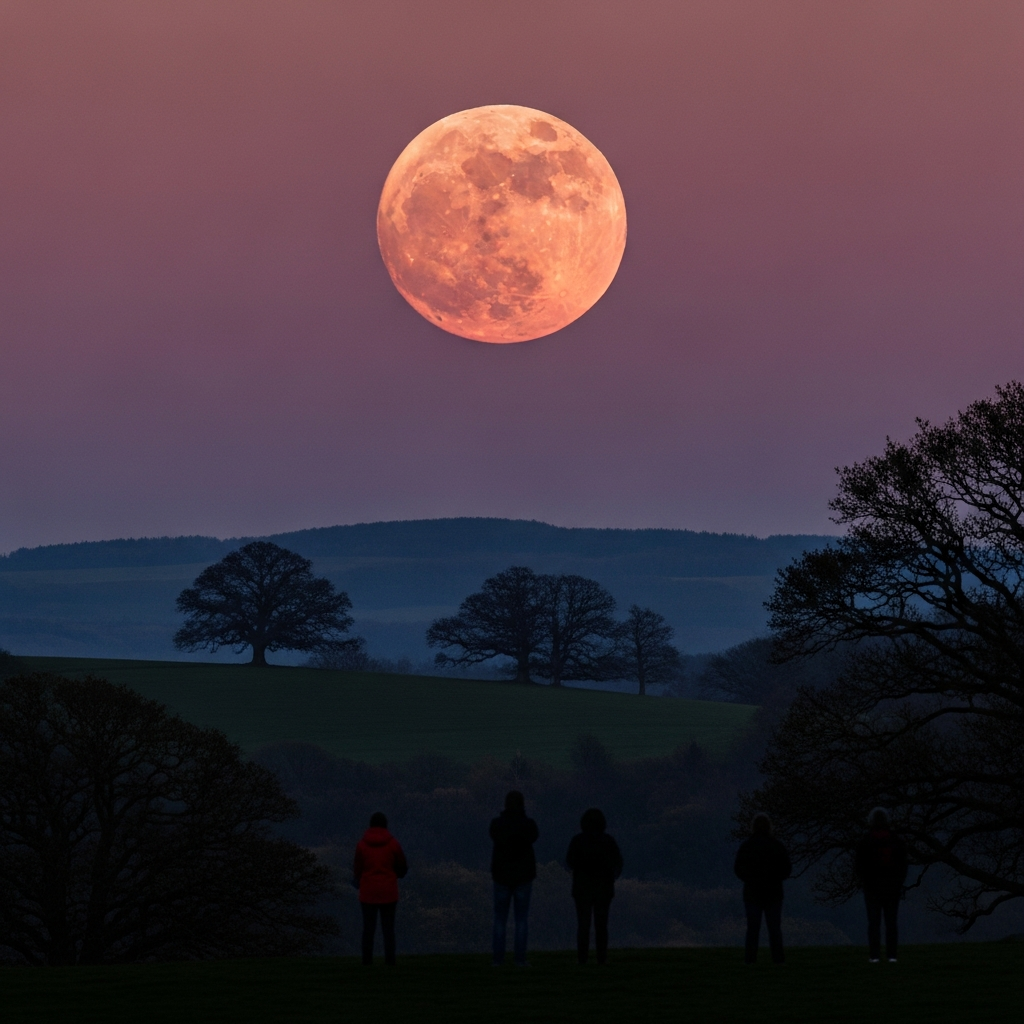
Get ready for a captivating celestial event! April 2026 ushers in the stunning Pink Moon, the fourth full moon of the year, promising an enchanting display for skywatchers across the Northern Hemisphere. This guide provides everything you need to know about this significant lunation, from its precise timing and optimal viewing locations to its rich cultural and astrological meanings, ensuring you don’t miss a moment of its dramatic rise.
Unveiling the April 2026 Pink Moon: A Celestial Spectacle
The Pink Moon April 2026 is set to illuminate our skies, reaching its peak illumination on Wednesday, April 1, 2026. While its name conjures images of a rose-hued orb, the “Pink Moon” actually draws its moniker from the vibrant pink creeping phlox wildflowers. These ground-covering blooms carpet landscapes across North America in early spring, signaling the season’s lush awakening. The Old Farmer’s Almanac credits this beautiful botanical connection for the moon’s popular name.
Beyond this well-known designation, various Native American cultures have their own evocative names for April’s full moon. These include the Breaking Ice Moon (Algonquin), the Budding Moon, the Moon When the Ducks Come Back, and the Sucker Moon. The Anishinaabeg (Ojibwe) Indigenous people of the Great Lakes region refer to it as the Broken Snowshoe Moon, highlighting the melting snows of spring.
For those eager to mark their calendars, the moon will officially be full at 10:13 p.m. EDT (7:13 p.m. PDT) on April 1. However, the moon will appear impressively bright and full on the nights surrounding this peak, specifically Tuesday, March 31, and Thursday, April 2. Other significant lunar phases for April 2026 include the Last Quarter on April 10, the New Moon on April 17, and the First Quarter on April 23.
Your Essential Guide to Viewing the Pink Moon
To truly appreciate the Pink Moon April 2026, timing and location are everything. Full moons are often most dramatic when they first appear above the eastern horizon during dusk. This magical period, often called “blue hour,” offers a stunning contrast as the bright moon ascends into the fading daylight.
Optimal Viewing Conditions and Local Timings
To maximize your viewing experience, seek out an elevated location, an open field, or an east-facing coastline. Anywhere with a clear, unobstructed view of the eastern horizon will provide the best spectacle. For precise moonrise times tailored to your specific location, consult a reliable moonrise calculator.
Here are some sample timings for April 1, 2026:
New York: Sunset at 7:20 p.m. EDT, with moonrise following closely at 7:15 p.m. EDT.
Los Angeles: A rare and remarkable celestial synchronization will occur on the West Coast. The exact moment of the full moon, sunset, and moonrise will all align at 7:13 p.m. PDT. This promises an exceptionally dramatic and visually stunning event.
Unfortunately, for stargazers in Central Indiana, the forecast as of late March predicts an 80% chance of precipitation and thunderstorms on April 1. If clouds persist, your best bet for catching a glimpse of the almost-full moon might be the night of Monday, March 30, before the official peak.
To further enhance your night sky navigation, several excellent free mobile applications can help you locate stars, planets, and constellations. Consider downloading SkyView Lite, Star Walk 2, Star Chart, or the official NASA app, all available on popular app stores.
Celestial Companions: Spica and Star-Hopping Techniques
The Pink Moon April 2026 offers an additional treat: a close encounter with the bright star Spica. On the night of April 2, the waning gibbous moon will shine less than two degrees from Spica, the 16th brightest star in our night sky, located within the constellation Virgo. This provides a fantastic “double skywatching treat” for observers.
For those keen on learning how to locate celestial objects, here’s a popular “star-hop” guide to find Spica as the Pink Moon rises and the sky darkens:
- Look to the northeast for the iconic Big Dipper, which will appear to be “standing on its handle.”
- Trace the curved line of stars forming the Big Dipper’s handle. Follow this arc to “Arc to Arcturus,” leading you to Arcturus, another bright star low in the east.
- From bright Arcturus, continue by “speeding on to Spica,” darting your gaze along the horizon to locate the luminous star positioned just below the Pink Moon.
The Pink Moon’s Rich Cultural and Astrological Tapestry
The Pink Moon April 2026 is more than just an astronomical event; it carries deep cultural and spiritual significance across various traditions.
Paschal Moon and Easter’s Timing
This April full moon is also known as the Paschal Moon, a term directly linked to Easter. In Western Christian tradition, Easter Sunday is celebrated on the Sunday following the first full moon after the spring equinox. With the spring equinox having occurred on March 20, 2026 (or fixed at March 21 by the church), the April 1 Pink Moon definitively sets Easter Sunday 2026 for April 5. Interestingly, Easter in the Eastern Orthodox tradition will fall a week later, on April 12.
The Pink Moon also marks the commencement of the Jewish festival of Pesach (Passover), which begins at sunset on April 1, corresponding to the 15th day of the Hebrew month of Nisan. This synchronization is a result of the Hebrew calendar’s lunisolar structure. Across various pagan and Christian traditions, this full moon often symbolizes themes of seasonal transition, rebirth, growth, and spiritual renewal.
Astrological Insights: A Full Moon in Libra
Astrologically, the Pink Moon April 2026 occurs in the balanced sign of Libra at 10:12 p.m. EDT on April 1. As the first full moon of the astrological year, it brings a much-needed period of peaceful and harmonizing energy, following a rather intense March characterized by Mercury retrograde and eclipses.
Full moons are generally associated with realizations, culminations, and letting go of what no longer serves us. This Libra full moon specifically encourages us to seek greater balance and harmony in our lives. While everyone will feel its influence, three zodiac signs are expected to be most profoundly impacted:
Libra (1st House of Self): For Libras, this full moon lands directly in their sign, marking a crucial six-month checkpoint since their birthday. It prompts reflection on personal identity and progress, encouraging them to release limiting beliefs or one-sided relationships hindering their new chapter.
Aries (7th House of Relationships): As Libra is Aries’ opposing sign, this lunation will activate their house of partnerships. Aries individuals are encouraged to find diplomatic and graceful approaches in their closest relationships, balancing “self versus other” and letting go of patterns that impede deeper connections.
Capricorn (10th House of Career & Destiny): Ambitious Capricorns will feel the lunar lift in their public image and career sector. This is an opportunity to infuse more balance and beauty into professional life, assessing work-life balance and releasing counterproductive habits to shape their destiny.
Overall, the Pink Moon April 2026 invites all of us to find equilibrium and release burdens, paving the way for a more harmonious future.
Beyond April: The 2026 Lunar Calendar Highlights
The Pink Moon April 2026 is not just a singular event; it’s the fourth of an unusual 13 full moons expected in 2026. This occurs because a solar year (approximately 365.24 days) is slightly longer than a lunar year (around 354.37 days), allowing an extra full moon to sneak into the calendar sometimes.
2026 is shaping up to be a busy year for skywatchers, with several other significant lunar and celestial events:
March’s “Blood Moon”: The year already saw a spectacular total lunar eclipse, dubbed a “blood moon,” in March.
May’s Double Full Moons: The next full moon after April will be the “Flower Moon,” arriving on May 1. This is known by other names like the “Corn Planting Moon” and “Milk Moon.” Remarkably, May will feature a second full moon on May 31, qualifying it as a rare “Blue Moon” (the second full moon within a single calendar month).
Supermoons Ahead: Keep an eye out for impressive Supermoons in November and December, with the December supermoon making a special appearance on Christmas Eve.
Upcoming Meteor Showers
April also brings exciting meteor shower activity:
Lyrid Meteor Shower: Peaking around April 22 (Earth Day), this is the oldest recorded meteor shower, first observed in 687 BCE. The Lyrids are known for producing good rates of “zipping” meteors, sometimes including fireballs. The best viewing times are in the early, predawn hours of April 22, and for a few nights before and after. An advanced forecast suggests largely clear skies for Central Indiana during this peak, offering a better viewing prospect than the Pink Moon itself.
Aquariids Shower: This stronger shower actually overlaps with the Lyrids, running from April 19 to May 28, with its peak anticipated around May 5-6.
Frequently Asked Questions
What is the actual meaning behind the “Pink Moon” name, and will it truly appear pink?
The “Pink Moon” name does not mean the moon will appear pink in color. Instead, it originates from the widespread bloom of pink phlox wildflowers across North America during early spring. These vibrant ground-covering flowers give the full moon its popular seasonal association. While atmospheric conditions like dust or smoke can sometimes give the moon a reddish or orange tint, the Pink Moon itself is not inherently pink. Its appearance will be that of a normal, luminous full moon, making for a beautiful sight.
How can I find the best local time to see the Pink Moon and locate Spica in the sky?
To find the best time for the Pink Moon’s rise in your specific location, use an online moonrise calculator. Simply enter your city or zip code for precise local timings. The moon is most dramatic when it appears above the eastern horizon during dusk. To locate Spica, look northeast for the Big Dipper. Follow the curve of its handle to “Arc to Arcturus,” a bright star low in the east. From Arcturus, “speed on to Spica,” which will appear just below the moon on the night of April 2nd.
Given potential weather challenges, what’s the optimal strategy for observing the Pink Moon and other April celestial events?
If local forecasts predict cloudy skies for the peak of the Pink Moon on April 1, prioritize looking up on the nights immediately surrounding it, such as March 31 or April 2, when the moon will still appear nearly full. For the Lyrid Meteor Shower, which peaks around April 22, meteor showers are typically best viewed away from city lights in the predawn hours, looking eastward towards the star Vega. Always check current local weather forecasts before planning your stargazing, and consider using astronomy apps to aid your navigation and identify celestial objects.
As the Pink Moon April 2026 graces our skies, it offers a perfect opportunity to reconnect with the cosmos. Whether you’re tracking its precise timing, star-hopping to Spica, or contemplating its rich cultural and astrological significance, take a moment to look up. This enchanting full moon is just one highlight in a year packed with lunar wonders, inviting us all to appreciate the vast beauty above. Get ready to witness a truly unforgettable celestial display!