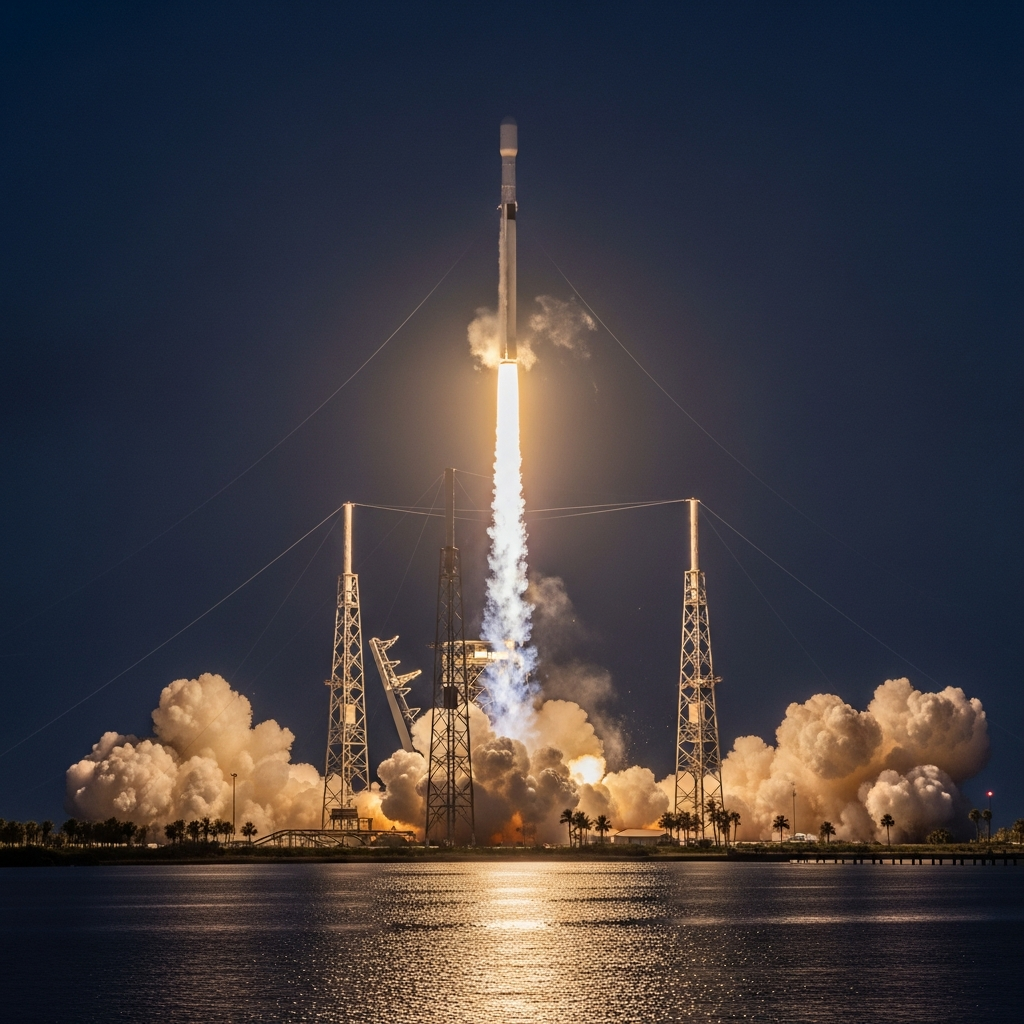
SpaceX has once again demonstrated its unwavering commitment to global internet connectivity and reusable rocket technology with the successful launch of the Starlink 10-48 mission. On Saturday, March 14, 2026, a Falcon 9 rocket soared from Florida’s Space Coast, deploying 29 advanced Starlink satellites into low-Earth orbit. This crucial mission marks another significant step in expanding Starlink’s high-speed broadband network, bringing reliable internet access to more corners of the world.
The launch, which took place at 8:37:10 a.m. EDT (1237:10 UTC) from Space Launch Complex 40 (SLC-40) at Cape Canaveral Space Force Station, was a testament to SpaceX’s operational precision. Despite cloudy morning skies, the weather conditions proved favorable for liftoff. Mission commander Anthony Leone guided the Falcon 9 through a flawless ascent on a north-easterly trajectory.
The Mission: Starlink 10-48 Unveiled
The primary objective of the Starlink 10-48 mission was to deploy 29 Starlink V2 Mini Optimized satellites. These advanced satellites are designed to enhance the existing Starlink constellation. They contribute to a more robust and expansive satellite internet service. Each launch pushes the boundaries of global connectivity.
Starlink’s ambitious network aims to provide low-latency, high-bandwidth internet. This service is particularly valuable in remote or underserved areas. The continuous deployment of these satellites ensures the network’s capacity and coverage grow steadily. This mission specifically targeted a low-Earth orbit inclined at 53.16 degrees.
Falcon 9’s Proven Power: Booster B1095’s Sixth Flight
Central to SpaceX’s success is its revolutionary reusability program, prominently featured in the Starlink 10-48 mission. The Falcon 9 first stage booster, designated B1095, completed its sixth flight. Remarkably, all previous five missions for this particular booster also involved launching Starlink satellites. This consistent reuse highlights the reliability and economic efficiency of SpaceX’s approach.
Following a successful ascent and stage separation, booster B1095 executed a precise landing. It touched down on the autonomous drone ship ‘Just Read the Instructions.’ The drone ship was stationed in the Atlantic Ocean, awaiting its return. This marked the 153rd successful recovery for this specific vessel. It further added to SpaceX’s impressive cumulative record of 584 booster landings to date across its fleet.
Expanding the Starlink Constellation for Global Reach
The 29 Starlink V2 Mini satellites successfully deployed from this mission are critical additions to the ever-growing constellation. Once they reach their operational orbits, they will integrate into the vast network. They will begin providing or enhancing internet service to users worldwide. This continuous expansion solidifies Starlink’s position as a leading global broadband provider.
Dr. Jonathan McDowell of the Harvard-Smithsonian Center for Astrophysics meticulously tracks the Starlink constellation. Prior to the 10-48 launch, his records indicated a staggering 9,924 Starlink satellites in orbit. Of these, 8,088 were considered fully operational. The Starlink 10-48 mission significantly augmented this impressive fleet.
The Impact of Starlink on Connectivity
Starlink’s deployment model focuses on rapidly building out its network. This strategy enables quicker global coverage. It also ensures redundancy and increased bandwidth. The V2 Mini satellites offer improved performance and capacity.
These advancements translate directly to better service for subscribers. Users in previously unconnected regions can access high-speed internet. This technological leap bridges the digital divide for communities globally. It empowers education, commerce, and communication in remote areas.
Overcoming Delays: The Road to Launch Success
The Starlink 10-48 mission did not occur without its share of anticipation and adjustments. The launch had experienced two prior delays earlier in the week. It was initially scheduled for Thursday, March 12, then postponed to Friday. Ultimately, it achieved its successful liftoff on Saturday, March 14, 2026.
SpaceX did not provide official explanations for these earlier postponements. Reports indicated that preparations for the initial Friday attempt were not on schedule. The rocket was not yet at SLC-40 at the time of that delay. Despite the cloudy conditions on launch day, the 45th Weather Squadron had forecast a 75 percent chance of favorable conditions. This prediction held true, as weather did not impede the mission, though it may have limited local viewing opportunities.
Viewing from Cape Canaveral: A Unique Experience
For those eager to witness the marvel of spaceflight firsthand, Cape Canaveral remains a premier viewing destination. While the Starlink 10-48 launch window began before the Kennedy Space Center Visitor Complex opened, such events often offer public viewing opportunities. If a launch attempt shifts into operating hours, guests with admission can access designated viewing sites. It’s always advisable to check signage upon arrival for the best viewing locations.
Capacity at these viewing spots is typically available on a first-come, first-served basis. A visit to the Kennedy Space Center also offers a deeper dive into space exploration. The Bus Tour goes behind NASA’s gates, showcasing the past, present, and future of this historic spaceport. Visitors can get a close-up view of Space Shuttle Atlantis, displayed in flight, discovering the legacy of NASA’s Space Shuttle Program.
SpaceX’s Relentless Pace: A Glimpse at Future Missions
The Starlink 10-48 mission is but one example of SpaceX’s incredibly busy operational schedule. In the week surrounding this launch, SpaceX dominated the global launch manifest. The company undertook five of eight scheduled missions, flying from both Florida and California facilities. This relentless pace underscores SpaceX’s commitment to frequent and reliable access to space.
This high launch cadence is vital for rapidly deploying Starlink satellites. It also supports other commercial and government payloads. Such operational intensity solidifies SpaceX’s role as a leader in the commercial space industry. The company continually pushes the boundaries of what is possible in space exploration.
Frequently Asked Questions
What was the primary objective of the SpaceX Starlink 10-48 mission?
The primary objective of the SpaceX Starlink 10-48 mission, successfully launched on March 14, 2026, was to deploy 29 Starlink V2 Mini Optimized satellites into low-Earth orbit. These satellites are crucial for expanding and enhancing Starlink’s global broadband internet constellation. The goal is to provide high-speed, low-latency internet access, especially in remote and underserved regions, thereby bridging the digital divide and improving connectivity worldwide.
Where can visitors view future SpaceX Starlink launches from Cape Canaveral?
Visitors interested in viewing future SpaceX Starlink launches can do so from various locations around Cape Canaveral, Florida. The Kennedy Space Center Visitor Complex often provides viewing opportunities if launch windows occur during operating hours. Guests with admission can access designated viewing sites, which are available on a first-come, first-served basis. It is recommended to check the Visitor Complex’s official website and signage upon arrival for specific viewing information and availability for upcoming missions.
How do Starlink V2 Mini satellites improve global internet connectivity?
Starlink V2 Mini satellites significantly improve global internet connectivity by offering enhanced performance and capacity compared to earlier versions. Their advanced design allows for higher bandwidth and lower latency, translating to faster and more reliable internet service. By continuously adding these V2 Mini satellites to the constellation, Starlink can expand its coverage, increase network redundancy, and better serve a growing number of subscribers, especially in areas where traditional internet infrastructure is limited or nonexistent.
Conclusion
The successful SpaceX Starlink 10-48 mission on March 14, 2026, from Cape Canaveral, marks another triumphant chapter in space history. The launch of 29 Starlink V2 Mini Optimized satellites aboard a Falcon 9 rocket, with booster B1095 completing its sixth flight and a precise landing on ‘Just Read the Instructions,’ underscores SpaceX’s innovative reusability and relentless drive. As Starlink’s constellation continues to grow, powered by missions like 10-48, the dream of universal, high-speed internet moves closer to reality, transforming connectivity for countless individuals and communities across the globe. Stay tuned for more groundbreaking achievements from SpaceX.