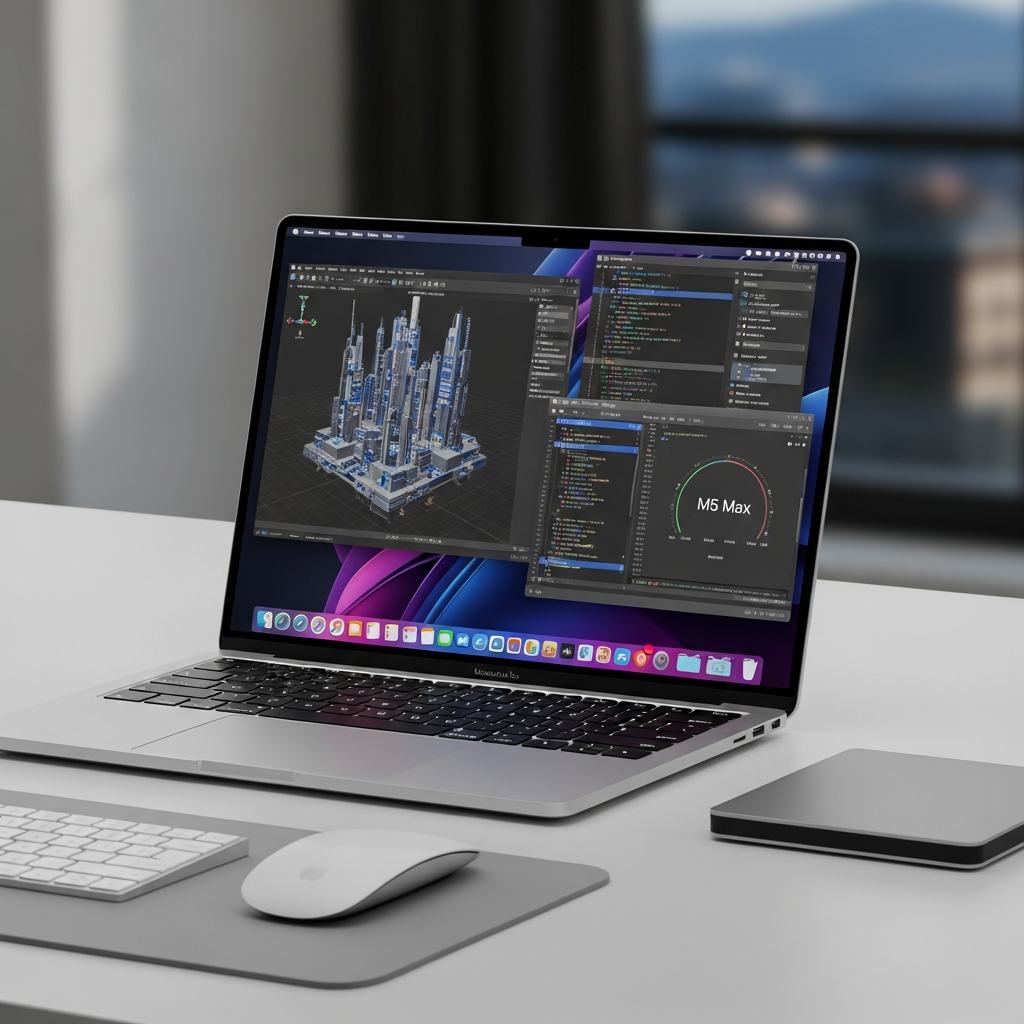
The Apple MacBook Pro M5 Max arrives as a titan of performance, a testament to Apple Silicon’s relentless advancement. Marketed as the “fastest MacBook yet,” this formidable machine redefines what’s possible in a portable workstation. Yet, it also ushers in what some critics call an “awkward era” for the iconic laptop, pairing groundbreaking internal power with a design that largely retains its 2021 aesthetic. For professionals demanding peak performance today, the M5 Max MacBook Pro offers an unparalleled computing experience, especially in creative and AI-driven workflows. However, its premium price tag and the anticipation of a redesigned M6 MacBook Pro later this year prompt a critical question: is this ultimate powerhouse the right investment right now?
Unpacking the M5 Max Performance Juggernaut
At the heart of the latest 16-inch MacBook Pro lies the M5 Max chip, a marvel of engineering that pushes the boundaries of laptop capabilities. This isn’t just an incremental update; it’s a significant leap, particularly for users moving from older Apple Silicon generations. The M5 Max leverages an innovative Fusion architecture, a departure from Apple’s previous single-chip strategy, combining two pieces of silicon to deliver truly outrageous speeds.
Record-Setting Benchmarks and CPU Prowess
Independent benchmarks consistently position the M5 Max as a leader in raw processing power. In Cinebench and Geekbench 6, it sets new records, demonstrating substantial gains over its predecessors. The 18-core CPU configuration, featuring a mix of “super cores” (formerly performance cores) and efficiency-focused “performance cores,” delivers a notable 12-23% speed increase over the M4 Max in multi-core tasks, and around a 7% boost in single-core operations. For those needing every ounce of CPU muscle, engaging the “High Power mode” further unlocks about 7% more multicore performance, albeit with increased fan activity.
GPU Excellence: Gaming and Graphics Redefined
Perhaps the most surprising aspect of the M5 Max is its integrated graphics capability. With up to a 40-core GPU, it offers performance comparable to dedicated gaming laptop GPUs, specifically an RTX 5070 Ti. Gaming on a Mac has never been more viable. Titles like Cyberpunk 2077 can run at 62 frames per second (fps) on Ultra settings without upscaling, jumping to 88 fps on Medium. Intensive games such as Resident Evil Village and Lies of P maintain over 60 fps at max settings, with Lies of P even scaling to 2560 x 1600 resolution. Benchmarks like 3DMark Steel Nomad show a 35% improvement over the M3 Max, solidifying the M5 Max’s position as the new king for Mac gaming.
However, some expert reviews, such as Gizmodo’s, note a potential drawback: while initial bursts of performance are “jaw-dropping,” the M5 Max can experience thermal throttling under sustained heavy loads. For example, Cyberpunk 2077 frame rates were observed to dip from an initial 50 fps to 37 fps after 15 minutes of continuous play, suggesting the current chassis, designed years ago, might not fully accommodate the chip’s maximum sustained thermal output.
Powering AI and Creative Workflows
Beyond raw speed, the M5 Max MacBook Pro is meticulously designed for the future of computing: on-device AI and demanding media creation. The powerful GPU and insane multicore performance make it a dream machine for video editors, 3D artists, and developers.
AI Acceleration and Unified Memory
With up to 128 GB of unified memory (available only in Max configurations), the M5 Max is an exceptional platform for running large AI models locally. Each of the M5’s GPU cores now includes a neural accelerator, stacking up significantly with the M5 Max’s 40 cores. This contributes to a 49% faster score in the Geekbench AI benchmark compared to the M3 Max, even with similar GPU core counts.
Apple has demonstrated compelling AI use cases, from coding assistants in Xcode to AI-enhanced post-production workflows in DaVinci Resolve and ComfyUI. Testing with a 17-billion parameter Llama-2 model in LM Studio yielded 12.61 tokens per second, a 31% speed increase over the M3 Max, bringing “conversational speed” to fairly large AI models on a laptop. This makes the M5 Max one of the most powerful AI laptops currently available.
Blazing-Fast Storage: A Silent Revolution
While CPU and GPU gains are often highlighted, one of the most significant and universally beneficial improvements in the M5 Max MacBook Pro is its storage speed. Thanks to upgraded SSD controllers and the adoption of PCIe 5, the read and write speeds have seen a “drastic improvement” that Macworld describes as “yowza.”
Specifically, a 4TB SSD in the 16-inch M5 Max model can achieve sustained read speeds of 13.6GB/s and write speeds of 17.8GB/s. This represents an 86% increase in read speeds and a staggering 123% increase in write speeds compared to a 4TB drive in an M4 Max unit. This “night-and-day difference” (as noted by MacDailyNews, citing The Verge’s tests) is a game-changer for content creators, programmers, and anyone working with large files, dramatically accelerating file transfers, project loading, and rendering times.
Design: Familiarity Meets Future Anticipation
Despite the revolutionary internal upgrades, the external design of the MacBook Pro M5 Max largely remains unchanged from the critically acclaimed 2021 redesign. This continuity, while maintaining a premium feel, has led to its “awkward era” moniker. The competition is catching up, and the laptop’s robust 4.7-pound weight (for the 16-inch model) and relatively thick chassis may feel dated compared to evolving market expectations.
A minor physical tweak is the change in keycaps on American keyboards, where words like Enter, Caps Lock, and Shift have been replaced with arrows, aligning with models sold in the UK. This is the only discernible physical difference from the M4 Max generation, which introduced the Space Black colorway and nano-texture screen option.
Anticipation is high for a potential “dramatic reinvention” with the M6 MacBook Pro, rumored to feature a touchscreen, tandem OLED display, and a thinner chassis. For those not in immediate need of this power, waiting for the rumored M6 could be a compelling option, especially if a complete design refresh is a priority.
Connectivity, Display, and Battery Excellence
The M5 Max MacBook Pro continues to offer a top-of-class user experience across its core features. The Liquid Retina XDR Mini-LED display remains gorgeous, delivering outstanding HDR performance with a peak brightness of 1,600 nits. The optional $150 nano-texture glass upgrade is recommended by some for its glare-deflecting properties, though Gizmodo suggests it might dull brightness indoors.
Audio performance is exceptional, thanks to the six-speaker system, which is capable of delivering sound loud, bassy, and full enough to rival many standalone Bluetooth speakers. The 12-megapixel webcam also remains excellent.
Connectivity sees an upgrade with Wi-Fi 7 (802.11be) and Bluetooth 6, facilitated by Apple’s N1 chip, replacing previous standards. The robust port selection includes three Thunderbolt 5/USB-C ports, HDMI 2.1, MagSafe 3, and an SDXC card slot, offering extensive external display support for up to four 6K displays.
Battery life remains a strong suit, a hallmark of Apple Silicon. While real-world usage won’t typically hit the claimed 24 hours of video playback, the M5 Max MacBook Pro still offers significantly better endurance than competing Windows laptops like the Asus ProArt P16, easily powering through most of a workday. In continuous video loop tests, the 16-inch model lasted over 24 hours.
Pricing and Upgrade Considerations
The MacBook Pro M5 Max is an investment. Apple has increased starting prices, partly by doubling base storage configurations (e.g., 2TB for the 16-inch model starting at $3,899). This positions it as an expensive laptop, but one that is competitively priced within its niche of high-end professional workstations.
This laptop is squarely aimed at professionals in creative and AI-intensive fields: video editors, game developers, AI entrepreneurs, and programmers who demand uncompromising performance. For hobbyists, even the M5 Pro models offer more power than most will ever fully utilize.
Who should upgrade?
M1 Max or M2 Max users: This is a meaningful, “night-and-day” upgrade, especially given the dramatic leaps in CPU, GPU, AI, and SSD performance.
M3 Max or M4 Max users: The decision is less clear. CPU gains are incremental. However, if your daily work involves extremely disk-intensive tasks, the “drastically faster SSD” alone could justify the upgrade. Otherwise, holding off for the M6 might be prudent.
New buyers: If you need the absolute maximum performance available in a laptop right now*, and your professional workflow depends on it, the M5 Max MacBook Pro is an excellent, albeit costly, choice.
A point of caution: some reports suggest the 14-inch M5 Max model might drop charge under heavy loads due to its 96-watt charger. This issue was not observed on the 16-inch model, which benefits from a more robust cooling system and larger battery.
Frequently Asked Questions
How does the M5 Max MacBook Pro’s performance compare to previous generations?
The M5 Max MacBook Pro offers significant performance gains, particularly over M1 Max and M2 Max chips, providing a “night-and-day difference” in CPU, GPU, and AI tasks, with multi-core CPU performance nearly doubling compared to M2 Max. Compared to the M4 Max, the M5 Max shows incremental CPU gains (7-12%) but a more substantial 18-32% improvement in GPU performance and an “outrageous” 86-123% faster SSD read/write speeds, making it a powerful leap for disk-intensive workflows.
Who should consider upgrading to the M5 Max MacBook Pro, and who should wait?
Professionals in creative fields (video editing, 3D rendering) and AI development who are currently using M1 Max or M2 Max models will find the M5 Max a highly meaningful upgrade. M3 Max or M4 Max users might consider it if they heavily rely on disk-intensive tasks, due to the drastically improved SSD speeds. However, if immediate maximum performance isn’t critical and you prioritize a refreshed design, waiting for the rumored M6 MacBook Pro later in 2026, which may feature an OLED touchscreen and thinner chassis, could be a better option.
What key features distinguish the M5 Max MacBook Pro’s design and display?
The M5 Max MacBook Pro largely retains the definitive design introduced in 2021, featuring a sturdy unibody aluminum chassis, a 120-hertz ProMotion Mini-LED Liquid Retina XDR display with 1,600 nits peak HDR brightness, and a top-tier six-speaker audio system. While physically similar to its M4 Max predecessor, it does include minor keyboard keycap changes (icons instead of words). New internal features include Wi-Fi 7 and Bluetooth 6 connectivity, and an optional nano-texture display for reduced glare.
The Verdict: Unrivaled Power for the Demanding Professional
The MacBook Pro M5 Max is an undeniably potent machine, setting new benchmarks for laptop performance in CPU, GPU, AI, and storage speed. It stands as the most powerful, high-end laptop on the market for media creation and on-device AI in 2026, a true workstation powerhouse. Its ability to handle intensive gaming, rip through video edits, and run complex AI models with conversational speed is genuinely impressive.
While the design may feel familiar, and the price tag commands serious consideration, the M5 Max delivers on its promise of unparalleled power for the right user. If your professional workflow demands the absolute best performance available today, and you’re upgrading from an M2 Max or older, this MacBook Pro is a phenomenal investment. For those content with their M3 or M4 Max, or who eagerly anticipate a complete design overhaul, patience might be a virtue. Ultimately, the M5 Max MacBook Pro is more than just a laptop; it’s a testament to what Apple Silicon can achieve, offering a glimpse into the future of high-performance portable computing, even as it navigates its “awkward era” with grace and immense power.