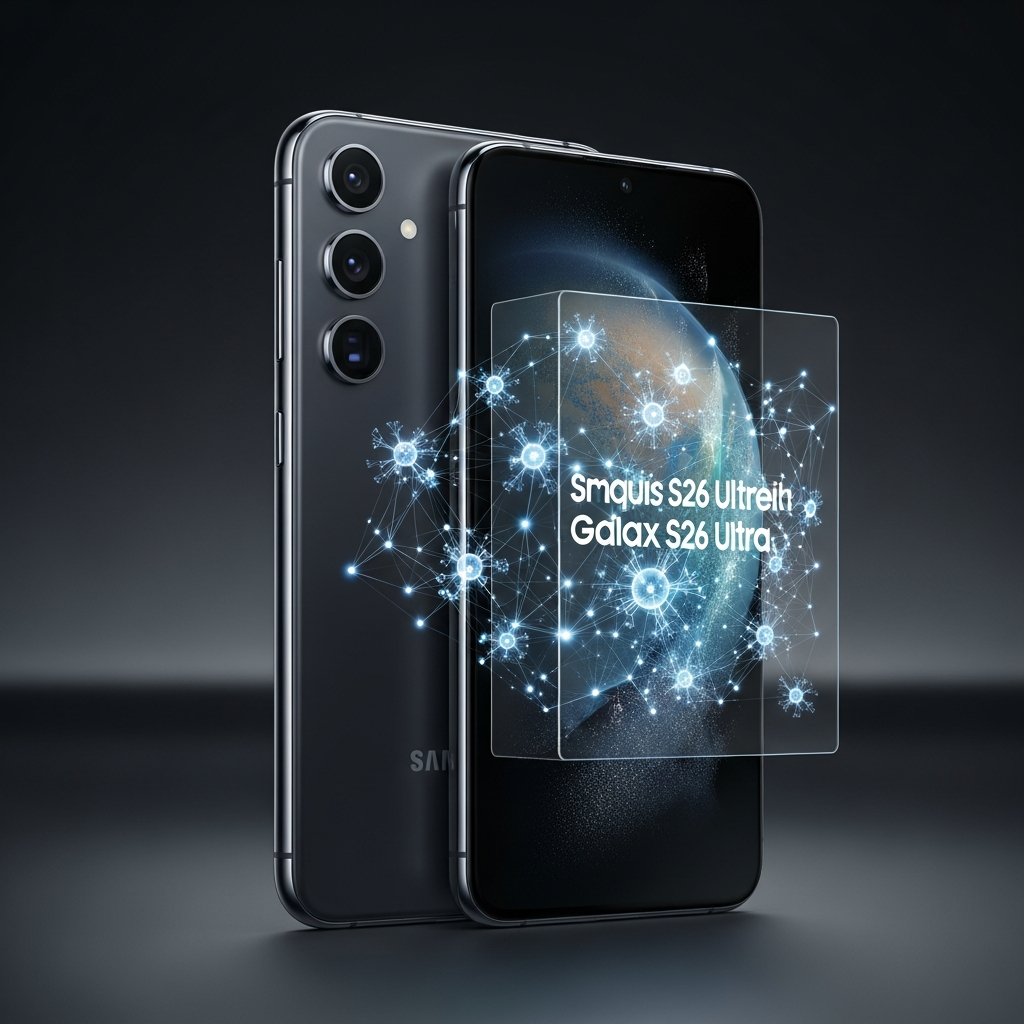
Samsung’s latest flagship, the Galaxy S26 Ultra, arrives on the scene not with a roar, but with a series of sophisticated, stealthy upgrades that redefine the premium smartphone experience. Far more than just an iterative update, this device pioneers advanced privacy features and deepens its commitment to Artificial Intelligence, setting a new benchmark for what users can expect. This comprehensive review dives deep into the S26 Ultra’s most talked-about innovations, from its groundbreaking Privacy Display to its enhanced camera system and the potent AI capabilities powering its “Elite” performance.
Unveiling the Samsung Galaxy S26 Ultra: A Deeper Look
The Samsung Galaxy S26 Ultra, maintaining its familiar $1,299-$1,300 price point, delivers a subtly refined experience. While its exterior echoes previous models, the true innovation lies beneath the surface, offering compelling reasons for an upgrade, especially for those prioritizing security and smart functionalities.
The Revolutionary Privacy Display: Your Digital Shield
The undisputed standout feature of the S26 Ultra is its integrated Privacy Display. This cutting-edge technology allows screen content to be fully visible when viewed head-on but appears significantly dimmed or black from acute angles. It’s a game-changer for public commutes or busy environments, ensuring sensitive information remains for your eyes only.
Samsung offers robust customization for this feature. Users can:
Toggle it on or off as needed.
Activate it specifically for notifications.
Set it to engage automatically for chosen apps (e.g., banking apps).
Trigger it when a PIN or password prompt appears.
An optional “Maximum Privacy Protection” mode offers extreme obscurity, though with some compromise to contrast. However, the standard mode maintains excellent image quality and brightness. This privacy-focused innovation is likely to become a standard expectation for future premium smartphones.
Design Refinements: Subtle Yet Significant
While visually consistent with its predecessors, the S26 Ultra introduces several design tweaks. It marks a return to an aluminum frame, a departure from titanium, which Samsung states assists with color-matching to the new Corning Gorilla Armor 2 panels. This iteration is also marginally lighter (214g vs. 218g) and thinner (7.9mm vs. 8.2mm), though these differences are barely perceptible in daily use. The integrated S Pen makes its return, offering familiar functionalities like circle-to-search and handwriting-to-text, although it still lacks remote photography capabilities. The display itself is a generous 6.9-inch AMOLED, maintaining a sharp 3,120 x 1,440 resolution and a dynamic 120Hz refresh rate, peaking at 2,600 nits brightness.
Performance & AI: The S26 Ultra’s New Soul
Samsung clearly positions AI as the core of the Galaxy S26 Ultra, with its “AI for everyone” mantra echoing through every aspect of the device. This focus is underpinned by substantial hardware upgrades.
Power Under the Hood: Snapdragon 8 Elite Gen 5
Driving the S26 Ultra is Qualcomm’s custom Snapdragon 8 Elite Gen 5 chip for Galaxy, paired with either 12GB or a new 16GB of RAM option (for 512GB/1TB models). This processor delivers significant performance boosts across the board:
Neural Processing Unit (NPU): A staggering 39% more powerful, directly enhancing AI capabilities.
CPU: Sees a 19% improvement, reflected in a Geekbench 6 multi-core score of 11,240.
GPU: Gains a 24% boost, achieving a Geekbench 6 GPU score of 25,403.
These enhancements make the S26 Ultra one of the fastest Android phones available, ensuring smooth multitasking and handling of demanding AI functions. Improved vapor chambers also contribute to better heat dissipation.
Galaxy AI: Beyond the Hype?
Samsung has woven a rich tapestry of AI features into the S26 Ultra, aiming to integrate intelligence into everyday tasks. While some functionalities are now appearing on rival devices like the Pixel 10 Pro, Samsung’s implementation is robust.
Key AI tools include:
Photo Assist: Comprehensive image editing using natural language prompts, allowing for advanced content generation.
Creative Studio: For digital art creation and manipulation.
Improved Document Scanner: More accurately removes wrinkles and stains from scanned documents.
Enhanced Call Screener: Smarter and more effective at screening unwanted calls.
Now Nudge: Provides contextual prompts within the keyboard, suggesting calendar shortcuts or relevant photos.
Agentic Google Gemini Assistant: Set to launch with initial integrations in apps like ridesharing, allowing the AI to perform complex tasks in the background or with user supervision.
These AI features aim to streamline workflows and offer intelligent assistance, reflecting Samsung’s strategic pivot towards making AI the “soul” of its devices.
Camera Innovations & Controversies: A Photographer’s Perspective
The S26 Ultra’s camera system, while reusing several sensors from its predecessor, benefits from meaningful hardware upgrades and advanced AI processing, yet also sparks ethical debates.
Aperture Upgrades: Brighter Lenses for Low Light
The core camera hardware remains impressive, with a 200-megapixel main sensor, a 50-megapixel ultrawide, a 10-megapixel 3x telephoto, and a 50-megapixel 5x telephoto. The most impactful changes are in aperture:
Main Camera: Upgraded from f/1.7 to a much brighter f/1.4, significantly improving light capture and low-light performance.
5x Telephoto: Also sees an aperture boost from f/3.4 to f/2.9, enhancing its utility in challenging lighting and offering a shallower depth of field.
These brighter lenses translate to noticeably less noisy images in dim conditions and superior performance in backlit scenarios. While the ultra-wide and 3x telephoto lenses remain largely unchanged, the main and 5x telephoto cameras are now formidable tools for capturing stunning photos. The S26 Ultra also introduces Advanced Professional Video (APV) codec for consistent quality and a new horizon lock feature for ultra-stable footage, even with 360-degree rotation.
The Generative AI Debate: Blurring Photographic Lines
Generative AI in photography reaches new heights on the S26 Ultra, allowing for remarkably convincing edits. Leveraging Google’s data, the AI can effortlessly:
Erase unwanted subjects.
Add new elements to a scene.
Realistically alter lighting, transforming a midday shot into a golden hour masterpiece with accurate shadows.
While impressive, these capabilities raise profound ethical questions. Critics argue that such effortless alteration transforms photography from an “hunt for light” into “well-crafted fabrications,” blurring the lines between reality and artistic capture. For serious photographers, Samsung’s Expert RAW mode is highly recommended, as it uses image stacking for superior dynamic range and less destructive noise reduction compared to standard RAW files.
The Display Debate: 8-bit vs. 10-bit Color
A significant point of contention for the Galaxy S26 Ultra involves its display’s color depth. Initially, some reports indicated a 10-bit color display, leading to excitement among enthusiasts. However, Samsung later clarified that the device features an 8-bit display panel, sparking frustration and accusations of a “bait-and-switch.”
Samsung explained that the “10-bit” reference referred to “10-bit mDNIe color processing,” a software enhancement providing up to 4x image processing power for improved viewing, rather than the native hardware panel’s bit depth.
An 8-bit display shows approximately 16 million colors.
A 10-bit display can render over 1 billion colors.
For most users, the difference may not be immediately apparent. However, for content creators, a 10-bit display minimizes “banding”—where color gradients appear as distinct steps instead of a smooth transition, particularly noticeable in subtle hues like sunsets. While competitors like OnePlus and Honor offer 10-bit displays, the iPhone 17 family also uses 8-bit. This highlights a tension between Samsung’s AI-centric marketing and consumer expectations for top-tier hardware specifications in a premium “Ultra” device.
Powering Your Day: Battery & Charging
The S26 Ultra retains its robust 5,000mAh battery, offering excellent longevity. Thanks to the new Snapdragon 8 Elite Gen 5 chip’s power efficiency, it achieves a modest but noticeable improvement, reaching over 30 hours in video rundown tests. More significantly, charging speeds receive a substantial upgrade:
Wired Charging: Now supports up to 60 watts, a significant jump from 45W on previous models.
Wireless Charging: Reaches 25 watts, up from 15W/20W.
It’s important to note that the phone does not include a charger in the box. A minor drawback for some is the continued absence of a built-in magnetic ring for Qi2 charging or other magnetic accessories, which Samsung attributes to design priorities for thinness.
Frequently Asked Questions
What makes the Samsung Galaxy S26 Ultra’s Privacy Display unique?
The Samsung Galaxy S26 Ultra introduces an innovative built-in Privacy Display that obscures screen content from acute viewing angles. Unlike screen protectors, this pixel-level technology allows direct viewers to see content clearly while making it difficult or impossible for side-viewers to snoop. It can be customized to activate for specific apps, notifications, or PIN prompts, offering unparalleled digital security in public settings without compromising the main user experience.
Is the Galaxy S26 Ultra a worthwhile upgrade for photographers and content creators?
For photographers and content creators, the Galaxy S26 Ultra offers a mixed but generally positive upgrade. It features brighter f/1.4 main and f/2.9 5x telephoto lenses for superior low-light performance. Expert RAW mode provides excellent dynamic range for serious editing. However, the generative AI photo tools, while powerful, raise ethical questions about authenticity. The display’s 8-bit panel might also be a concern for those who prioritize 10-bit color depth for critical editing work, despite Samsung’s 10-bit mDNIe processing. Overall, it’s a capable creative tool, particularly for video with its APV codec and horizon lock.
How does the S26 Ultra’s AI stack up against competitors?
The S26 Ultra’s AI capabilities, powered by its significantly enhanced NPU and the Snapdragon 8 Elite Gen 5 chip, are highly competitive. Features like Photo Assist, Creative Studio, advanced call screening, and “Now Nudge” integrate AI seamlessly into the user experience. While some of these AI functionalities, such as advanced generative photo editing, are also seen on rivals like the Google Pixel 10 Pro, Samsung’s deep integration and upcoming “agentic Google Gemini assistant” signify a strong commitment to AI as a core differentiator. Samsung aims to deliver widespread AI utility across its ecosystem.
Conclusion
The Samsung Galaxy S26 Ultra emerges as a compelling, albeit subtly enhanced, flagship. Its “stealth upgrade” moniker perfectly encapsulates the device’s philosophy: familiar on the surface, profoundly innovative within. The Privacy Display stands out as a genuinely groundbreaking feature, directly addressing a critical user need for digital security. Coupled with a significant leap in AI capabilities, powered by the new Snapdragon 8 Elite Gen 5 chip, and meaningful camera improvements, the S26 Ultra solidifies Samsung’s position at the forefront of smartphone technology. While debates around display specifications and the ethical implications of generative AI persist, the S26 Ultra undeniably delivers a powerful, versatile, and forward-looking experience, making it a strong contender for those seeking the ultimate Android device with an eye towards the future of AI.