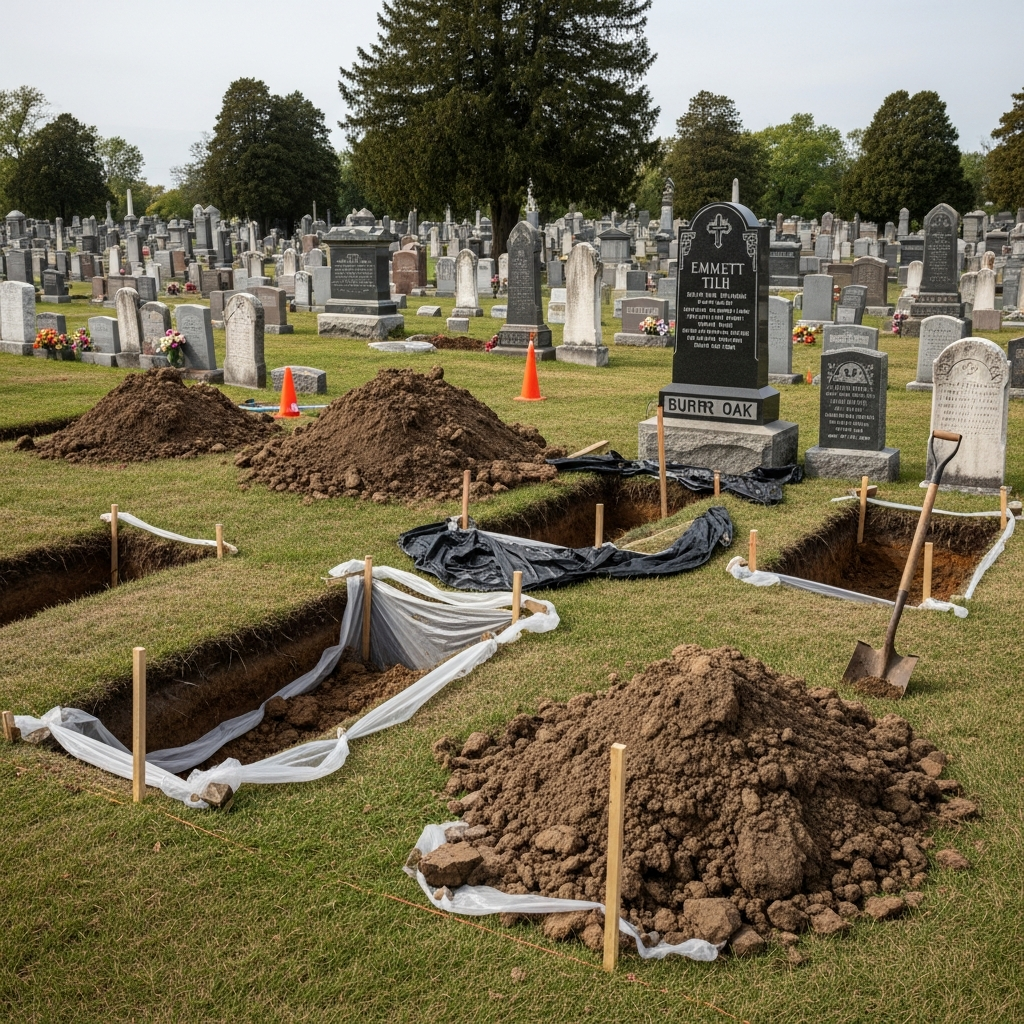
The solemn silence of a cemetery is rarely broken by crime, yet in 2009, a shocking scandal rocked Burr Oak Cemetery in Alsip, Illinois. This historic final resting place, significant to Chicago’s African American community and home to figures like Emmett Till, became the scene of a heinous grave-robbing operation. Cemetery employees were accused of exhuming older graves, disposing of human remains, and reselling the emptied plots for profit. An unlikely hero emerged from this macabre scene: a tiny clump of moss. This article delves into the unprecedented role forensic moss played in unraveling the Burr Oak conspiracy and securing convictions, highlighting the groundbreaking potential of botanical evidence in criminal investigations.
The Unearthing of a Heinous Crime
Burr Oak Cemetery, established in 1927, served as a revered burial ground for over 100,000 individuals. However, behind its tranquil facade, a disturbing scheme was unfolding. Cemetery director Carolyn Towns, along with grounds foreman Keith Nicks and other employees, systematically desecrated graves. They used backhoes to dig up old plots, smashed skeletons, and unceremoniously dumped human remains in remote corners of the grounds. Their motive was clear: to create new burial sites that could be sold again, maximizing illicit profits.
A Sacred Ground Desecrated
The full scale of the crime was chilling. Initial estimates suggested hundreds of graves were disturbed. Investigators later recovered approximately 1,500 bones, identified as belonging to at least 38 individuals, although the true number of desecrated graves could be as high as 400. Even the decaying casket of Emmett Till, a pivotal figure in the Civil Rights Movement, was found covered by a tarp in a garage behind the cemetery. The perpetrators’ increasing recklessness ultimately led to their downfall, but concrete evidence was needed to prove their actions and secure justice for the victim’s families.
The Scale of the Betrayal
The scandal sent shockwaves through the community, not just because of the disrespect shown to the dead, but also due to the sheer logistical challenge of identifying and reburying scattered remains. For years, families had sought solace in Burr Oak, only to discover their loved ones’ graves had been disturbed or outright destroyed. With official records in disarray and employees denying involvement, investigators faced an uphill battle. They needed irrefutable evidence that linked the suspects directly to the recent desecration of graves.
Enter Forensic Botany: A Green Detective
Amidst the piles of displaced earth and human remains, forensic specialists discovered tiny bits of dirt and plant material. Crucially, a small clump of moss was found approximately eight inches below the topsoil, inexplicably buried alongside re-interred human remains. This discovery prompted the FBI to seek expertise from an unusual source: the botany world. The potential of botanical evidence was about to be put to the ultimate test.
The Call to the Field Museum
In 2009, the FBI contacted Dr. Matt von Konrat, head of botany collections at Chicago’s renowned Field Museum. Agents presented him with the peculiar moss sample, posing two critical questions: Could he identify the moss species? And perhaps more importantly, could he determine how long it had been buried? The answers to these questions would be instrumental in establishing a timeline for the reburials and pinpointing the original location of the disturbed graves. Dr. von Konrat and his team embarked on a painstaking scientific journey.
Identifying the Key Evidence: Fissidens taxifolius
Using meticulous microscopic examination and comparing the sample to thousands of dried specimens in the Field Museum’s extensive collections, von Konrat’s team identified the moss. The species was Fissidens taxifolius, commonly known as common pocket moss. This identification was just the first step. The next challenge was to understand where this particular moss thrived within the sprawling cemetery grounds and, crucially, where it did not.
Unlocking Secrets: Moss as a Forensic Timestamp
The investigation moved from the lab to the field. Researchers conducted a comprehensive survey of Burr Oak Cemetery. They discovered that Fissidens taxifolius was completely absent from the specific areas where the human remains had been reburied. However, a significant colony of this identical moss species was found thriving in a different, lightly shaded section of the cemetery—precisely where investigators suspected the original, older graves had been exhumed. This geographical mismatch provided compelling forensic evidence: the moss, and by extension the human remains, had been moved from one distinct part of the cemetery to another.
Pinpointing the Crime Scene Location
This finding was crucial. It confirmed investigators’ suspicions that the remains had been exhumed from older, established plots and then haphazardly dumped elsewhere on the property to make way for new sales. The presence of the specific moss in the initial burial site, and its absence from the dumping grounds, directly linked the scattered remains to their original, disturbed resting places. This botanical link provided a powerful narrative for the prosecution.
The “Freaky Physiology” of Moss
Beyond identifying the origin, prosecutors needed to establish when the crimes occurred. The defendants maintained that any grave disturbances had taken place years prior to their employment. This is where the unique biology of moss became a game-changer. Dr. von Konrat explained that mosses possess a “freaky physiology.” Unlike most plants, even when dry, dead, or preserved, moss can retain some level of active metabolic activity in its cells. This activity gradually deteriorates over time as the cells decay, offering a botanical clock.
Dating the Evidence: A Critical Timeline
To determine the moss’s burial duration, scientists focused on chlorophyll, the green pigment essential for photosynthesis. As plant cells degrade, chlorophyll breaks down. By measuring the light absorption of chlorophyll in the crime scene moss and comparing it to control samples of known ages—including freshly collected moss and specimens preserved in the museum for 14 years—von Konrat’s team reached a definitive conclusion. The moss found with the reburied remains was only one to two years old and had been buried for less than six months. This scientific dating directly refuted the defense’s claims, unequivocally placing the reburial incidents during the defendants’ tenure at the cemetery.
Justice Served: Convictions and Aftermath
The botanical evidence provided by Dr. von Konrat and the Field Museum team was pivotal. It offered both irrefutable proof that the remains had been moved and a precise timeline that exposed the defendants’ lies. This scientific breakthrough significantly bolstered the prosecution’s case, transforming a complex investigation into a clear path toward justice.
Irrefutable Evidence in Court
In 2015, the key players in the Burr Oak Cemetery scandal were brought to justice. Carolyn Towns, the mastermind and cemetery director, received a 12-year prison sentence. Grounds foreman Keith Nicks was sentenced to six years, his brother Terrence Nicks to three years, and Maurice Dailey was placed on probation. Former FBI agent Doug Seccombe, a co-author of the scientific paper detailing the moss’s role, affirmed that the plant material analysis was “extremely invaluable” in securing these convictions.
Long-Awaited Justice for Families
The convictions brought a measure of closure to the grieving families whose loved ones had been so callously disrespected. In 2016, the recovered remains were reburied in a common grave at the original dump site, finally offering a more dignified resting place. The Burr Oak case stands as a testament to how scientific ingenuity, combined with relentless investigative work, can illuminate even the darkest crimes.
The Future of Forensic Botany: Beyond Burr Oak
While the Burr Oak case was a resounding success for forensic botany, such instances remain relatively rare. Dr. von Konrat and his colleagues published a review in 2025, revealing only about a dozen cases over the past century where bryophytes (mosses, liverworts, hornworts) were used as crucial forensic evidence. This highlights a significant, yet largely untapped, potential in criminal investigations.
An Overlooked Forensic Tool
Mosses, often overlooked due to their diminutive size, are “ubiquitous, resilient, and capable of preserving timeline and habitat information” in ways that complement traditional forensic tools. They thrive in diverse environments and can remain dormant for extended periods, retaining critical biological data. Their microscopic features allow for precise identification, while their unique physiology provides a natural “clock” for dating evidence.
Elevating Bryophytes in Investigations
Dr. von Konrat hopes his research will raise awareness among law enforcement and the scientific community about the profound forensic utility of mosses and other non-flowering plants. The Burr Oak case underscores the critical importance of natural history collections, demonstrating that museum specimens, often seen as mere curiosities, can hold the keys to solving real-world crimes. By elevating bryophytes as a valuable forensic tool, future investigations may find crucial assistance, providing answers and justice for families in need. The “green detectives” of the plant world are ready to tell their stories.
Frequently Asked Questions
How did moss help solve the Burr Oak Cemetery grave-robbery case?
Moss provided two critical pieces of forensic evidence. First, the specific species of moss (Fissidens taxifolius) found with the reburied human remains was not growing in the dump sites but was abundant in the cemetery sections where older graves were originally located. This proved the remains had been moved. Second, scientists leveraged moss’s unique physiology, where chlorophyll degradation indicates age, to determine the moss was only one to two years old and buried for less than six months. This directly contradicted the defendants’ claims that the crimes occurred years earlier, securing convictions.
What makes moss a unique forensic tool compared to other plant evidence?
Moss possesses several unique characteristics that make it invaluable in forensic science. Its “freaky physiology” allows it to retain active metabolic traces even when dry or preserved, which can be analyzed to determine its age and the duration of its burial. Mosses are also ubiquitous and resilient, meaning they can be found in many environments and persist as evidence. Their microscopic features allow for precise species identification, and their specific habitat requirements can help pinpoint the geographical origin of a sample, providing crucial links between a crime scene and other locations.
How often is forensic botany used in criminal investigations?
While incredibly impactful in cases like Burr Oak, the use of forensic botany, especially involving mosses and other bryophytes, is relatively rare. A 2025 study co-authored by Dr. Matt von Konrat found only about a dozen instances over the past century where mosses played a crucial role as forensic evidence globally. This rarity highlights an underutilized potential in criminal investigations. Experts like Dr. von Konrat advocate for increased awareness and training for law enforcement to recognize and preserve botanical evidence, asserting its untapped value for solving future crimes.