The Kurdish people in Iran represent a vibrant cultural tapestry woven into the nation’s history, yet they also endure a complex legacy of marginalization and persistent calls for greater rights. As one of the Middle East’s largest stateless ethnic groups, Kurds living in Iran face unique challenges stemming from their distinct identity, language, and the broader geopolitical landscape. Recent events, particularly the powerful “Woman, Life, Freedom” movement sparked by the death of a young Kurdish woman, Jina Mahsa Amini, have thrust the issues faced by Iranian Kurds into global consciousness, highlighting their vital role in shaping Iran’s future and the ongoing struggle for human dignity and autonomy.
Who Are the Kurds in Iran? Identity and Demographics
Iranian Kurds are an integral part of the larger Kurdish nation, a people predominantly Sunni Muslim who speak various dialects of the Indo-European Kurdish language. Concentrated in western and northwestern Iran, particularly in provinces bordering Iraq and Turkey, their presence is deeply rooted in these mountainous regions.
A Stateless Nation’s Presence
Globally, Kurds constitute the fourth largest ethnic group in the Middle East, yet they famously lack a sovereign state of their own. This statelessness is a central theme defining their experience across the region, including within Iran. Despite residing within Iran’s borders for centuries, Kurdish communities maintain strong tribal structures, unique customs, music, and dance, preserving a distinct cultural identity separate from the Persian majority.
Cultural and Linguistic Heritage
The Kurdish language, with its two main dialects (Kurmanji and Sorani), serves as a crucial marker of identity. While Persian is the official language of Iran, Kurdish is spoken widely in Kurdish-majority areas, alongside other minority languages like Azeri and Balochi. The preservation of their language and cultural practices is a continuous act of resilience against pressures for assimilation, reflecting a deep connection to their ancestral heritage.
A History of Marginalization and Resistance
The history of Kurds in Iran, much like their counterparts in Iraq, Turkey, and Syria, has been marked by a recurring struggle against central government control and a consistent demand for self-determination. Post-World War I promises of an independent Kurdish state failed to materialize, leading to their inclusion within the newly formed states, where they often faced varying degrees of suppression.
Historical Grievances and Central Government Policies
Over generations, Iranian Kurds have experienced policies aimed at cultural suppression and political marginalization. Efforts to dilute their identity, restrict their language, and limit their political participation have fueled cycles of protest and government crackdown. This mirrors the broader Kurdish experience, such as the aggressive tactics of Saddam Hussein’s Baʿth regime against Iraqi Kurds, which included forced relocations and even chemical weapon attacks in the late 1980s. These historical grievances underscore a deep-seated desire for recognition and autonomy.
The Legacy of Suppression
The continuous struggle has forged a strong sense of collective identity and a legacy of resistance among Iranian Kurds. From localized uprisings to broader calls for change, their fight for self-determination is a testament to an enduring spirit. This ongoing narrative of resistance against governmental oppression connects them to the wider Kurdish movement for rights across the Middle East.
The “Woman, Life, Freedom” Movement: A Kurdish Spark Ignites a Nation
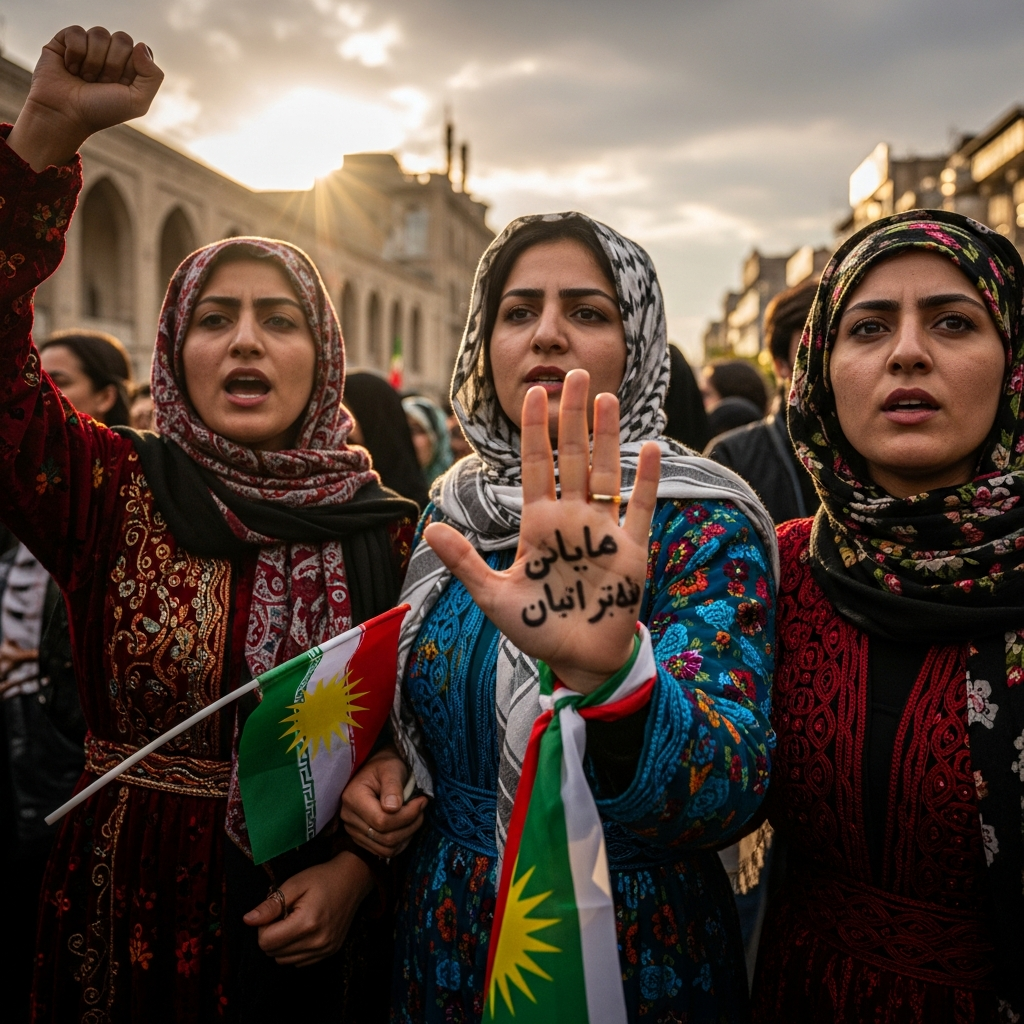
In September 2022, the death of Jina Mahsa Amini in the custody of Iran’s “morality police” ignited an unprecedented wave of protests, the “Woman, Life, Freedom” (Jin, Jiyan, Azadî) movement. This pivotal event brought the plight of Iranian Kurds and the systemic oppression faced by minorities and women to the forefront of global attention.
Jina Mahsa Amini: A Symbol of Systemic Oppression
Jina Mahsa Amini, a 22-year-old Sunni woman from Iran’s minority Kurdish community, died after being detained for “improper” attire. Her Kurdish name, Jina (meaning “life”), was not officially recognized by Iranian authorities, who insisted on the Persian name “Mahsa,” highlighting the regime’s cultural suppression of minority identities. Her death became a powerful symbol of the confluence of social ills in Iran: the subjugation of women, repression of minorities, religious chauvinism, and government brutality.
Origins of “Jin, Jiyan, Azadî” in Kurdish Activism
The protest slogan “Woman, Life, Freedom” (Jin, Jiyan, Azadî in Kurdish) has much deeper roots than the 2022 protests. It originated within the Kurdish women’s movement, specifically in the 1980s and 2000s, as Kurdish women emerged as crucial combatants and organizers in their struggle for self-determination. The slogan gained significant amplification through Abdullah Öcalan, the ideological leader of the Kurdistan Workers’ Party (PKK), who emphasized that “until woman is free, a society cannot be free.” It linked the deaths of women, whether from state violence or honor killings, to a broader demand for societal transformation.
The Nationwide Uprising and its Impact
Amini’s funeral in Saqqez, Kurdistan province, quickly transformed into a protest, where the chant “Jin, Jiyan, Azadî” first erupted, accompanied by women defiantly removing their headscarves. This act resonated across Iran, galvanizing a diverse range of Iranians—women, men, and various ethnic and religious minorities—into a nationwide movement. The protests, unprecedented since the 1979 revolution, highlighted widespread discontent over economic hardship, government corruption, and intensified state repression, leading to thousands of arrests and hundreds of deaths as the regime brutally cracked down.
Kurdish Influence in Iranian Politics
While often marginalized, individuals with Kurdish heritage have occasionally reached prominent positions within the Iranian political structure, reflecting the complex interplay of ethnicity, loyalty, and political pragmatism.
Masoud Pezeshkian: A President with Kurdish Roots
Masoud Pezeshkian, who assumed the Iranian presidency in 2024, notably has a Kurdish mother and an Azerbaijani father. Despite being considered a regime loyalist, Pezeshkian is presented as the most reform-oriented president since Mohammad Khatami. His political career has seen him criticize government actions, including the brutal crackdown on 2009 post-election demonstrations. Crucially, he openly criticized the government in 2022 for the death of Jina Mahsa Amini and voiced support for the “Woman, Life, Freedom” protests, albeit while deeming calls to oust the supreme leader as unproductive. This stance demonstrates a nuanced position, balancing reformist inclinations with ultimate loyalty to the existing system.
Navigating Reform and Regime Loyalty
Pezeshkian’s background and political actions illustrate the delicate balance some Iranian politicians must strike. His ability to implement significant changes is often constrained by a conservative parliament (Majles) and the ultimate authority of the Supreme Leader. His initial cabinet appointments, for example, were notably conservative. Yet, his public acknowledgment of grievances, particularly those relating to Amini’s death and the broader protests, offers a glimpse into the internal discussions and pressures concerning minority rights within the Iranian political sphere.
Regional Context: The Broader Kurdish Narrative
Understanding the situation of Kurds in Iran requires acknowledging their connections to the larger Kurdish population across the Middle East. The aspiration for autonomy and self-determination is a shared thread.
Contrasting Autonomy: Lessons from Iraqi Kurdistan
The experience of Iraqi Kurdistan provides a stark contrast. After the 2003 Iraq War, a U.S.-led coalition established a “safe haven” for Kurds in northern Iraq, which eventually led to the formal designation of Iraqi Kurdistan as an autonomous federal region in the 2005 Iraqi constitution. Figures like Jalal Talabani, a prominent Iraqi Kurdish politician and founder of the Patriotic Union of Kurdistan (PUK), played a pivotal role in establishing this autonomy and later served as the president of Iraq from 2005 to 2014. This relative autonomy, while not without its own challenges, represents a degree of self-governance that Iranian Kurds largely aspire to but have not achieved.
Cross-Border Connections and Challenges
Kurdish communities frequently have cross-border familial, cultural, and political ties. This interconnectedness means that developments in one part of Kurdistan can resonate strongly in others. For Iranian Kurds, the autonomy in Iraqi Kurdistan might serve as both an inspiration and a source of continued frustration, as they observe their kin exercising greater political and cultural freedom just across the border. Regional instability and geopolitical shifts consistently impact all Kurdish populations, complicating their pursuit of rights and recognition.
The Future of Kurds in Iran: Navigating Complexities
The future of Kurds in Iran remains intertwined with the broader trajectory of the Islamic Republic, which is currently grappling with deep public disaffection, economic instability, and intense geopolitical pressures.
Persistent Demands for Rights and Recognition
Despite government crackdowns, the demands of Iranian Kurds for cultural rights, linguistic freedom, and greater political representation persist. The “Woman, Life, Freedom” movement vividly demonstrated that issues concerning minorities and women are not isolated but are deeply connected to the overall quest for a more just and equitable society in Iran. The resilience of Kurdish communities, their continued advocacy, and their prominent role in recent protests suggest that these demands will not diminish.
The Path Forward Amidst Geopolitical Shifts
As Iran navigates a tumultuous geopolitical landscape, including heightened tensions with the West and internal challenges, the situation of its Kurdish minority will continue to be a crucial indicator of the country’s human rights record and its capacity for reform. The calls for dialogue and acknowledgment of legitimate grievances, even from within the regime, highlight a recognition of the need for internal solutions. However, the consistent prioritization of security over reform suggests a difficult path ahead for meaningful change for Kurds in Iran.
Frequently Asked Questions
Who was Jina Mahsa Amini and why is she significant to Kurds in Iran?
Jina Mahsa Amini was a 22-year-old Kurdish woman whose death in September 2022, while in the custody of Iran’s “morality police” for alleged “improper” attire, ignited the widespread “Woman, Life, Freedom” protests across Iran. Her significance to Kurds in Iran is profound: she became a symbol of systemic oppression against ethnic minorities and women, embodying the regime’s cultural suppression (her Kurdish name, Jina, was not officially recognized) and its brutal enforcement of social codes. Her death sparked a movement rooted in Kurdish women’s activism, bringing their long-standing grievances to national and international attention.
What is the “Woman, Life, Freedom” slogan’s origin and meaning?
The “Woman, Life, Freedom” (Jin, Jiyan, Azadî in Kurdish) slogan originated much earlier within the Kurdish women’s movement, dating back to the 1980s and 2000s. It was amplified by Abdullah Öcalan, the ideological leader of the Kurdistan Workers’ Party (PKK), emphasizing the belief that societal freedom is impossible without women’s liberation. Its meaning asserts the centrality of women’s rights to the concepts of life and liberty, linking the struggle against patriarchy and state oppression. It became the unifying chant for nationwide protests in Iran following Jina Mahsa Amini’s death, symbolizing a demand for fundamental change.
How do Kurds in Iran relate to the broader Kurdish struggle for self-determination?
Kurds in Iran are an integral part of the larger, stateless Kurdish nation spread across the Middle East. Their struggle for cultural rights, linguistic freedom, and political representation mirrors the broader Kurdish quest for self-determination in countries like Iraq, Turkey, and Syria. While Iranian Kurds face unique challenges within Iran’s political context, their aspirations for greater autonomy and recognition are deeply connected to the regional Kurdish narrative. The relative autonomy achieved by Iraqi Kurds, for example, often serves as both an inspiration and a point of comparison for Iranian Kurds, highlighting their shared identity and common goals across national borders.