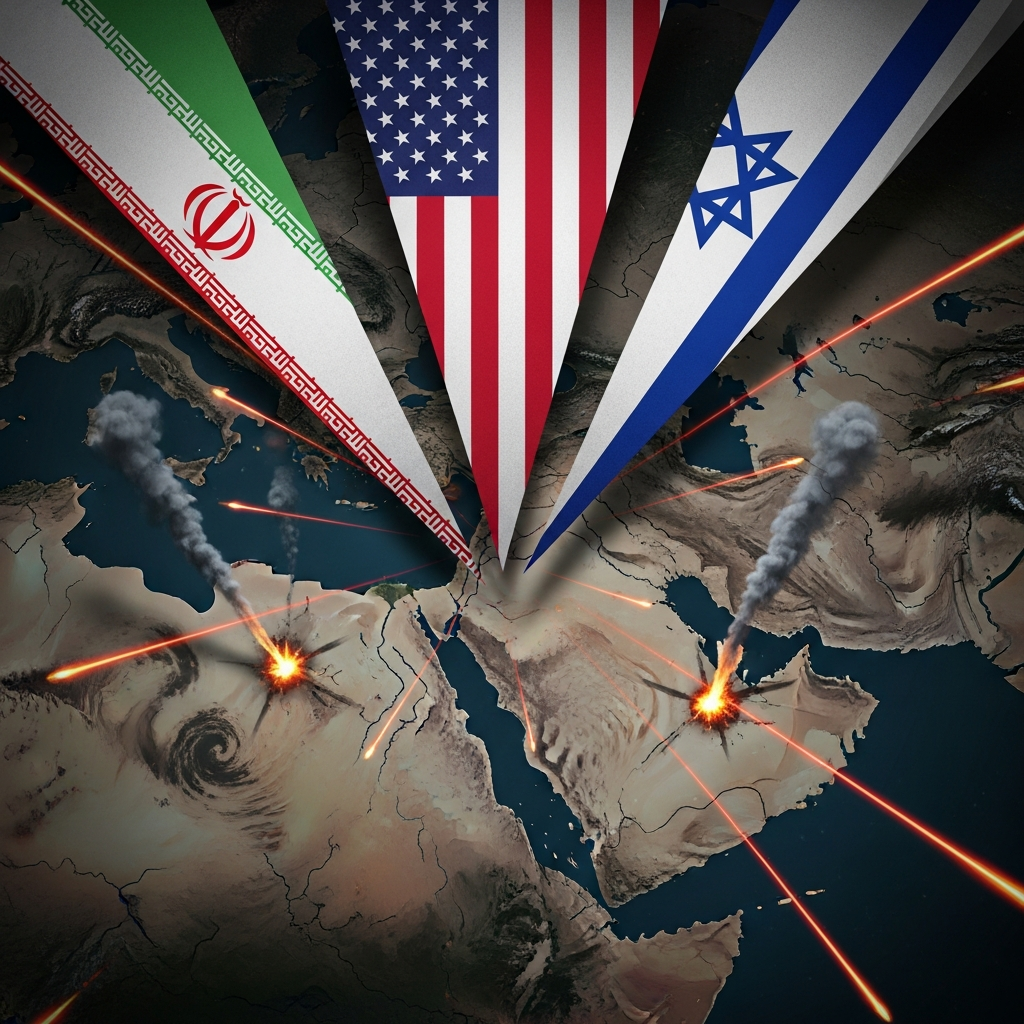
The Middle East faces escalating tensions as a major conflict involving Iran, the United States, and Israel intensifies. Recent developments show the conflict widening, drawing in regional and global actors, and sparking international concern over its economic and humanitarian fallout. From retaliatory strikes to diplomatic maneuvering and warnings against separatist groups, the situation remains highly volatile. This article provides a comprehensive overview of the unfolding crisis, integrating the latest insights and international reactions as of early March 2026.
The Spark: “Epic Fury” and Initial Strikes
The current phase of the Iran conflict dramatically escalated on February 28, 2026. On this date, the United States and Israel launched a joint aerial bombardment against Iran. This operation, codenamed “Epic Fury,” targeted critical Iranian military and governmental sites. These included command and control facilities of the Islamic Revolutionary Guard Corps (IRGC), key air defense capabilities, and various missile and drone launch sites. Military airfields across Iran also faced significant strikes.
U.S. Central Command described the operation as a monumental display of American military strength, calling it the “largest regional concentration of American military firepower in a generation.” Precision munitions from air, land, and sea were employed, marking the first combat use of low-cost, one-way attack drones. Israel’s military confirmed its substantial involvement, reporting that approximately 200 fighter jets participated. This initial attack struck around 500 targets, representing the largest “military flyover” in Israeli air force history. While the U.S. reported no American casualties, Iranian state media claimed 201 people were killed and 747 injured across 24 Iranian provinces, including tragic deaths at a girls’ school.
Iran’s Retaliation and Widening Conflict
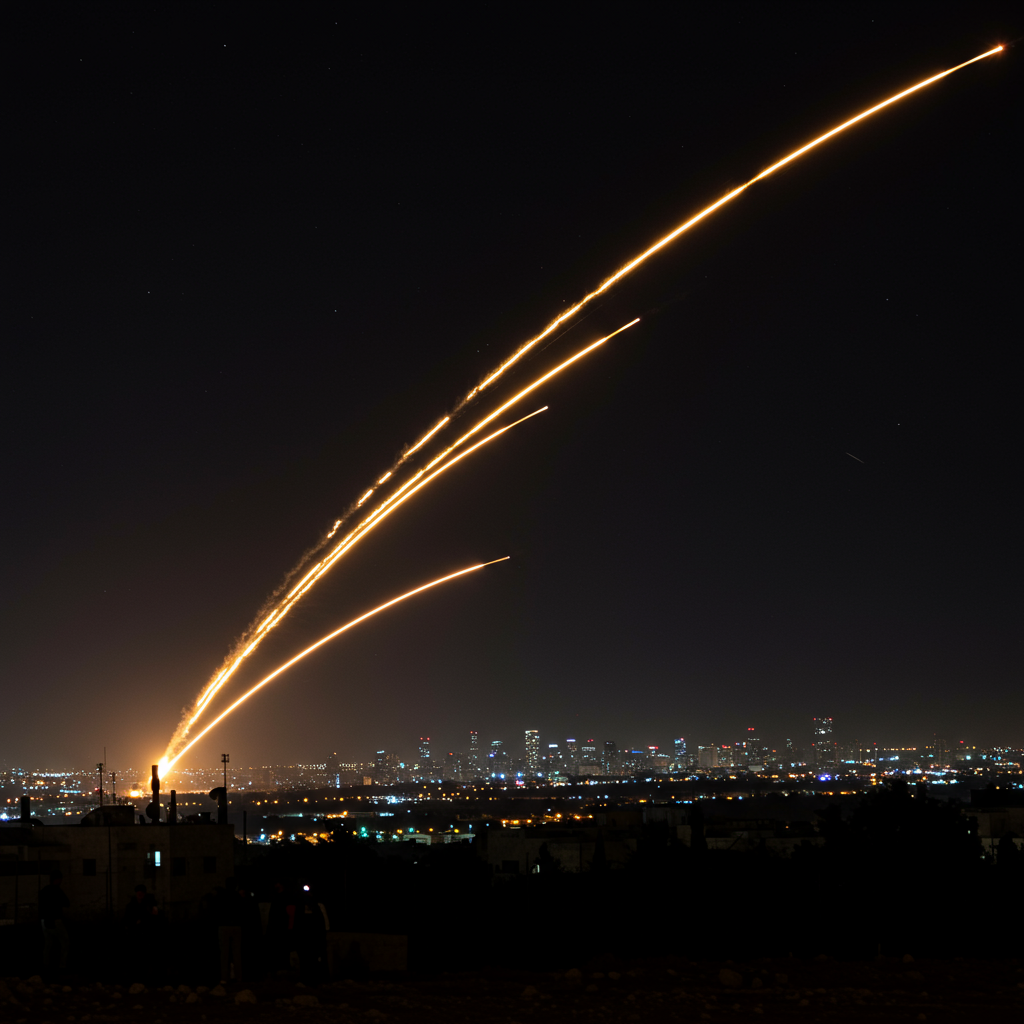
Iran swiftly responded to the U.S.-Israeli strikes with its own wave of missile and drone attacks. These retaliatory measures targeted Israel and U.S. military bases throughout the region. Specific targets included the command of the U.S. 5th Fleet in Bahrain, U.S. bases in Qatar and the United Arab Emirates, and various military sites within Israel. These attacks inflicted casualties, with one woman killed near Tel Aviv and one man seriously injured in central Israel. Additionally, one person died from shrapnel in the UAE.
The escalating military actions had immediate and far-reaching consequences. Dubai International Airport and Kuwait International Airport reported strikes and injuries, leading to widespread flight disruptions. Airspace closures became common across the Middle East. The war quickly expanded beyond initial borders, involving Iranian-backed militias firing missiles at Israel and Arab states. Notably, the U.S. Embassy compound in Kuwait was reportedly hit. Israel and the United States continued to pound targets inside Iran. The human toll mounted rapidly, with reports indicating at least 555 people killed in Iran across more than 130 cities. Israel suffered 11 fatalities, while Lebanon saw 31 killed and 154 wounded, with a specific wave of Israeli airstrikes causing 52 deaths and 154 injuries. Five foreign nationals also lost their lives in attacks on Gulf nations. U.S. forces reported 6 deaths, including Army soldiers in Kuwait, and 18 serious injuries. Kuwait also mistakenly shot down three American F-15E Strike Eagles during a combat mission.
Specific Targets and Engagements
Further military engagements highlighted the conflict’s breadth. Iran and its proxies launched missile and drone attacks on northern Israel. This prompted Israeli retaliatory airstrikes on Beirut’s southern suburbs and southern Lebanon, targeting Hezbollah command centers, weapons storage facilities, and media outlets. Reports indicated the killing of senior Hezbollah and Islamic Jihad officials in these strikes. Iranian-backed Iraqi militias also threatened U.S. military bases in Jordan. Other significant attacks included drone strikes on a fuel terminal in the UAE, power plants and energy facilities in Qatar, and a bomb-carrying drone boat hitting an oil tanker in the Gulf of Oman, killing a mariner. Saudi Arabia’s Ras Tanura oil refinery was targeted, leading to its temporary shutdown. Iran claimed to have downed 20 “enemy drones” and alleged its Natanz nuclear enrichment site was targeted, a claim unacknowledged by the U.S. and Israel. Cyprus also reported drone strikes on the UK’s RAF Akrotiri air base.
On the U.S.-Israeli side, the U.S. military reported neutralizing 11 Iranian warships and largely destroying their Naval Headquarters. U.S. Joint Chiefs of Staff Chairman Air Force Gen. Dan Caine confirmed increased U.S. force deployment. He also revealed the use of cyberattacks to “disrupt, disorient and confuse” Iranian forces prior to the kinetic strikes.
Iran’s Warning to Kurdish Groups
Amidst the broader regional conflict, Iran issued strong warnings and launched strikes against Kurdish groups in Iraq. Tehran claimed it targeted Iraq-based Kurdish organizations “opposed to the revolution.” These actions followed explicit warnings from Iranian officials directed at “separatist groups” against any action in the escalating war. Reports suggested that the U.S. was considering arming Kurdish guerrillas for infiltration into Iran, adding another layer of complexity.
Ali Larijani, secretary of Iran’s Supreme National Security Council, stated, “Separatist groups should not think that a breeze has blown and try to take action. We will not tolerate them in any way.” The strikes resulted in the death of a member from an exiled Iranian Kurdish group, according to a group representative. This demonstrates Iran’s internal security concerns and its determination to prevent any perceived destabilization during the wider conflict.
International Reactions and Canada’s Position
The international community reacted with a mixture of condemnation, concern, and calls for restraint. UN Secretary-General António Guterres condemned both the U.S.-Israeli strikes for violating international law and Iran’s retaliatory attacks for violating the sovereignty of its neighbors. Russia and China strongly condemned the U.S.-Israeli actions, with Russia warning of a potential “catastrophe.” Conversely, Ukraine’s President Volodymyr Zelenskyy supported the U.S.-led strikes, labeling Iran an “accomplice of Putin.” Most Middle Eastern governments, including Saudi Arabia, Kuwait, Qatar, UAE, Bahrain, and Syria, condemned Iran’s attacks on their sovereignty. The EU called for restraint and dialogue, emphasizing nuclear safety, and labeled Iran’s regime a “threat to global security.”
Canada’s Stance and Global Order
Canadian Prime Minister Mark Carney, during a joint press conference with Australian Prime Minister Anthony Albanese in Canberra, addressed the escalating Middle East conflict. Carney dismissed calls for an immediate ceasefire as “premature.” He argued that “before there can be a ceasefire, there needs to be a de-escalation of hostilities,” emphasizing that currently, there is a “spreading of hostilities.” He stressed that the “ending of targeting civilians, civilian infrastructure” are necessary preconditions. Crucially, Carney linked any de-escalation to the complete cessation of Iran’s ability “to acquire a nuclear weapon, develop a nuclear weapon and to export terrorism.”
While Carney did not “categorically rule out participation” by the Canadian military in the conflict, he reiterated that Canada played no role in the initial strikes. Both leaders explicitly backed international efforts to prevent Iran from obtaining nuclear weapons. Carney also used his address to articulate a broader vision for international relations. He famously referred to Australia and Canada as “strategic cousins” and declared that the post-World War II global order had “dissolved” due to consecutive crises. In this “post-rupture world,” Carney argued, middle powers like Australia and Canada must actively form new coalitions, stick together, and help shape global rules.
Humanitarian and Economic Fallout
The human cost of this expanding conflict is immense. The U.S. State Department urged all American citizens to depart over a dozen Middle Eastern countries due to safety risks. The Israeli closure of Gaza crossings initially caused severe shortages of food, water, and fuel, though the Kerem Shalom crossing later reopened for humanitarian aid. Israel extended nationwide restrictions on public activities, closing schools, workplaces, and beaches. The U.S. Embassy in Jordan temporarily evacuated staff due to threats. Iranian media reported 171 students killed, including 168 in a single girls’ elementary school bombing. Migrant workers in Gulf states were identified as particularly vulnerable, with casualties among foreign nationals prompting deployment bans from countries like the Philippines. U.N. political chief Rosemary DiCarlo highlighted the immediate impact on children and education across the region.
Globally, financial markets have been significantly rattled. Natural gas futures spiked 42% after QatarEnergy halted LNG production due to attacks, while oil prices surged. Global stock indices fell, and gold, a traditional safe-haven asset, rose over 3%. International travel faced severe disruption, with major airlines canceling flights and thousands of tourists stranded. The UAE also temporarily closed its main stock exchanges. These economic impacts underscore the far-reaching consequences of the deepening Iran conflict.
Frequently Asked Questions
What triggered the recent escalation between Iran, the U.S., and Israel?
The current surge in the Iran conflict began on February 28, 2026, with a joint U.S.-Israeli aerial bombardment of Iran, codenamed “Epic Fury.” This operation targeted key Iranian military and governmental sites, including IRGC command centers and missile facilities. The U.S. and Israel justified these strikes by citing an “intolerable” risk from Iran’s conventional missile capability and its alleged pursuit of nuclear weapons, asserting that diplomatic options had been exhausted. Iran swiftly retaliated with missile and drone attacks on Israel and U.S. bases.
Why is Iran targeting Kurdish groups in Iraq amidst the broader regional conflict?
Iran has stated it is targeting Iraq-based Kurdish groups “opposed to the revolution” and has warned “separatist groups” against taking action during the widening war. This move appears to be driven by internal security concerns, aiming to prevent any perceived destabilization from within while the country is engaged in external conflict. Reports of potential U.S. efforts to arm Kurdish guerrillas for infiltration into Iran further highlight Iran’s anxieties about these groups’ activities and their potential to exacerbate internal tensions.
How might the expanding Middle East conflict impact global stability and economics?
The expanding Iran conflict poses significant threats to global stability and economics. Economically, oil prices have surged, natural gas futures spiked, and global stock markets have experienced significant downturns. Disruptions to vital shipping lanes, such as the Strait of Hormuz, could severely impact global energy supplies. Geopolitically, Canadian Prime Minister Mark Carney noted the “dissolution” of the post-World War II global order, advocating for middle powers to form new coalitions. Humanitarian impacts include widespread casualties, displacement, travel disruptions, and severe shortages of essential goods in affected regions. The conflict also heightens nuclear safety risks, as warned by the IAEA.
Conclusion
The escalating Iran conflict represents a critical and rapidly evolving geopolitical crisis. From the initial “Epic Fury” strikes to Iran’s widespread retaliatory attacks and internal actions against Kurdish groups, the region is grappling with immense instability. The involvement of major global powers, the shifting stances of international allies like Canada, and the devastating humanitarian and economic consequences underscore the gravity of the situation. As diplomatic efforts struggle against ongoing military engagements, the world watches closely for further developments and the ultimate trajectory of this profound rupture in global order.