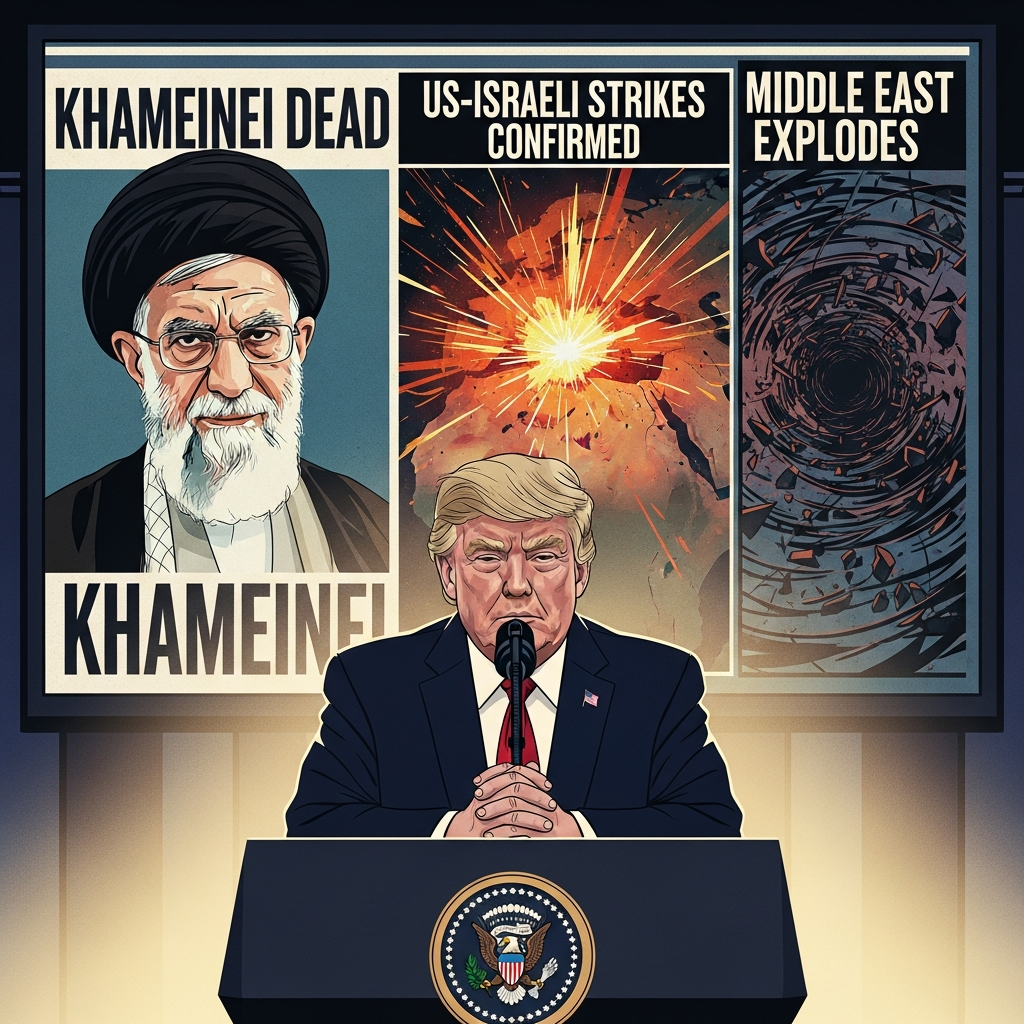
The Middle East finds itself on a precipice following the confirmed death of Iran’s Supreme Leader, Ayatollah Ali Khamenei. Joint United States and Israeli strikes led to the demise of the 86-year-old leader, thrusting the Islamic Republic into an unprecedented leadership void and sparking fears of widespread regional instability. U.S. President Donald Trump characterized Khamenei’s death as a pivotal moment, offering Iranians “the greatest chance” to reclaim their nation. This dramatic event has ignited a cascade of military actions, protests, and diplomatic maneuvering, marking a volatile new chapter in global geopolitics.
US-Israel Strikes Target Iran, Claiming Top Leadership
The coordinated US-Israeli military operation, codenamed “Operation Epic Fury,” delivered devastating blows across Iran. Initial reports indicated widespread targeting of military and governmental sites, including ballistic missile stockpiles, air defense systems, and intelligence headquarters. Satellite imagery confirmed significant damage to Khamenei’s office within the Leadership House compound in Tehran, where he was reportedly killed.
These strikes were described by President Trump as the “largest regional concentration of American military firepower in a generation.” They followed unsuccessful negotiations over Iran’s nuclear program and long-standing warnings. Tragically, a strike on a girls’ school in Minab county, southern Iran, resulted in a grim death toll of 148, with 95 wounded, according to local prosecutors.
The attacks also severely impacted Iran’s command structure. Key military figures confirmed killed include Iran’s Chief of Army Staff, Gen. Abdol Rahim Mousavi, and Defense Minister, Gen. Aziz Nasirzadeh. The head of Iran’s paramilitary Revolutionary Guard, Maj. Gen. Mohammad Pakpour, and security adviser Ali Shamkhani also perished. The elimination of such high-ranking officials represents a profound blow to Tehran’s leadership.
Iran Unleashes “Ferocious” Retaliation Across the Region
Iran’s response was swift and uncompromising. Its Islamic Revolutionary Guard Corps (IRGC) launched multiple waves of missile and drone attacks. These targeted Israel and various US military bases across the Gulf region, including facilities in Bahrain, the United Arab Emirates, and Qatar. Iran’s Parliament Speaker, Mohammad Bagher Qalibaf, vowed “devastating blows” against perceived adversaries, asserting Iran’s “red line” had been crossed.
In Israel, defensive systems engaged numerous incoming projectiles. Despite interceptions, a residential building in Tel Aviv was destroyed, causing one fatality—the first Israeli casualty of this conflict—and 120 injuries. Explosions rocked major cities across the Gulf. A CNN team in Dubai reported multiple blasts and plumes of smoke, with debris from an aerial interception causing a fire at the vital Jebel Ali Port. Doha, Qatar, also experienced loud explosions, resulting in 16 injuries and material damage. Reports from Manama, Bahrain, and Erbil, Iraq, similarly detailed smoke and explosions near critical infrastructure and US troop bases.
These widespread retaliatory strikes disrupted air travel extensively. Airports across the Middle East, including Dubai, Qatar, and Israeli airspace, closed or experienced severe delays. This left hundreds of thousands of travelers stranded, underscoring the immediate and far-reaching impact of the escalating conflict.
Khamenei’s Decades-Long Rule Ends Amid Division
Ayatollah Ali Khamenei had wielded supreme authority over Iran for nearly four decades. His death leaves a massive void, plunging the future of the Islamic Republic into uncertainty. While state TV tearfully eulogized him as a “steadfast mountain,” the news sparked deeply divided reactions both within Iran and among the diaspora.
Pro-government mourning events quickly materialized in Tehran and other cities, featuring large crowds waving flags and chanting “Death to America.” Conversely, anti-regime activist accounts shared videos of celebrations in cities like Isfahan and Karaj. People honked car horns, set off fireworks, and danced in the streets, reflecting a yearning for change. Exiled opposition figures, such as Reza Pahlavi, the son of Iran’s last shah, welcomed Khamenei’s death as a step towards a new, democratic Iran.
Analysts observed that Khamenei’s regime, despite decades of resilience against sanctions and internal unrest, had grown increasingly isolated. Its network of allied militias in Iraq, Lebanon, Yemen, and Gaza, once robust, showed signs of weakening support. The analysis suggested the regime had few friends willing to stand by it, leading some to label it a “zombie regime” – brutal yet internally struggling. This internal erosion of legitimacy, combined with past instances of incompetence like the downing of Ukrainian Airlines Flight 752 and the helicopter crash that killed President Raisi, contributed to a complex domestic landscape at the time of Khamenei’s demise.
The Looming Question of Succession and Regional Stability
Constitutionally, an interim body consisting of the president, the head of the judiciary, and a senior cleric from the Guardian Council is to assume Khamenei’s duties. The Assembly of Experts, a clerical body, faces the critical task of selecting a successor “as soon as possible.” However, convening this body securely amid ongoing attacks presents a significant challenge. The swiftness of this process will be crucial in determining Iran’s immediate political trajectory.
The international community reacted with a mixture of condemnation, calls for de-escalation, and expressions of concern. U.S. President Trump issued a forceful warning against further Iranian escalation, threatening “a force that has never been seen before.” Russia condemned the US-Israeli actions as “unprovoked armed aggression.” Meanwhile, the UN Secretary-General urged restraint to prevent “comprehensive chaos.”
Regional dynamics also shifted. While some Gulf monarchies condemned Iran’s retaliatory attacks, their silence on the initial US-Israeli strikes highlighted complex allegiances. Saudi Arabia and the UAE expressed concern, while Oman, a historical mediator, urged the US “not to get sucked in further.” The conflict also reignited a war powers debate in the US Congress, with some members calling for immediate briefings and a vote on military actions. The implications for global oil markets, particularly concerning the Strait of Hormuz, remain a significant concern, with potential for price spikes.
The death of Iran’s Supreme Leader, coupled with severe military escalation, has undeniably plunged the Middle East into an era of profound uncertainty. The immediate future hinges on the nature of Iran’s succession process and the willingness of all parties to de-escalate, or the region risks spiraling into a wider, more devastating conflict.
Frequently Asked Questions
What are the immediate political ramifications of Ayatollah Ali Khamenei’s death?
The confirmed death of Ayatollah Ali Khamenei creates an immediate and profound leadership vacuum in Iran. An interim body comprising the president, the head of the judiciary, and a senior cleric from the Guardian Council is constitutionally mandated to assume his duties. The critical task of selecting a successor falls to the Assembly of Experts, a clerical body. This process is expected to be challenging given the ongoing military conflict, making the future political direction and stability of the Islamic Republic highly uncertain.
Where have Iranian retaliatory strikes targeted across the Middle East?
Following the US-Israeli strikes, Iran launched extensive retaliatory missile and drone attacks across the Middle East. Key targets included Israeli cities, notably Tel Aviv, causing damage and casualties. Iranian forces also targeted US military bases and interests in various Gulf nations. These included the US Navy’s 5th Fleet headquarters in Bahrain, military installations and vital ports like Jebel Ali in Dubai, and facilities in Qatar and Iraq. These widespread attacks caused significant disruptions, including airport closures and civilian injuries, underscoring the regional scope of the conflict.
What are the international warnings and travel implications for the Middle East following these attacks?
International reactions have been swift, with major powers issuing strong warnings and travel advisories. U.S. President Donald Trump warned Iran against further retaliation, threatening unprecedented force. The U.N. Secretary-General called for de-escalation to prevent wider conflict. Travel implications are severe, with widespread airport closures and flight cancellations across Israel, the UAE, Qatar, and southern Syria, stranding hundreds of thousands of travelers. The U.S. Embassy in Bahrain authorized family members and non-essential personnel to depart, and Qatar issued emergency alerts for residents to stay home. These measures reflect heightened security concerns and the volatile nature of the situation.