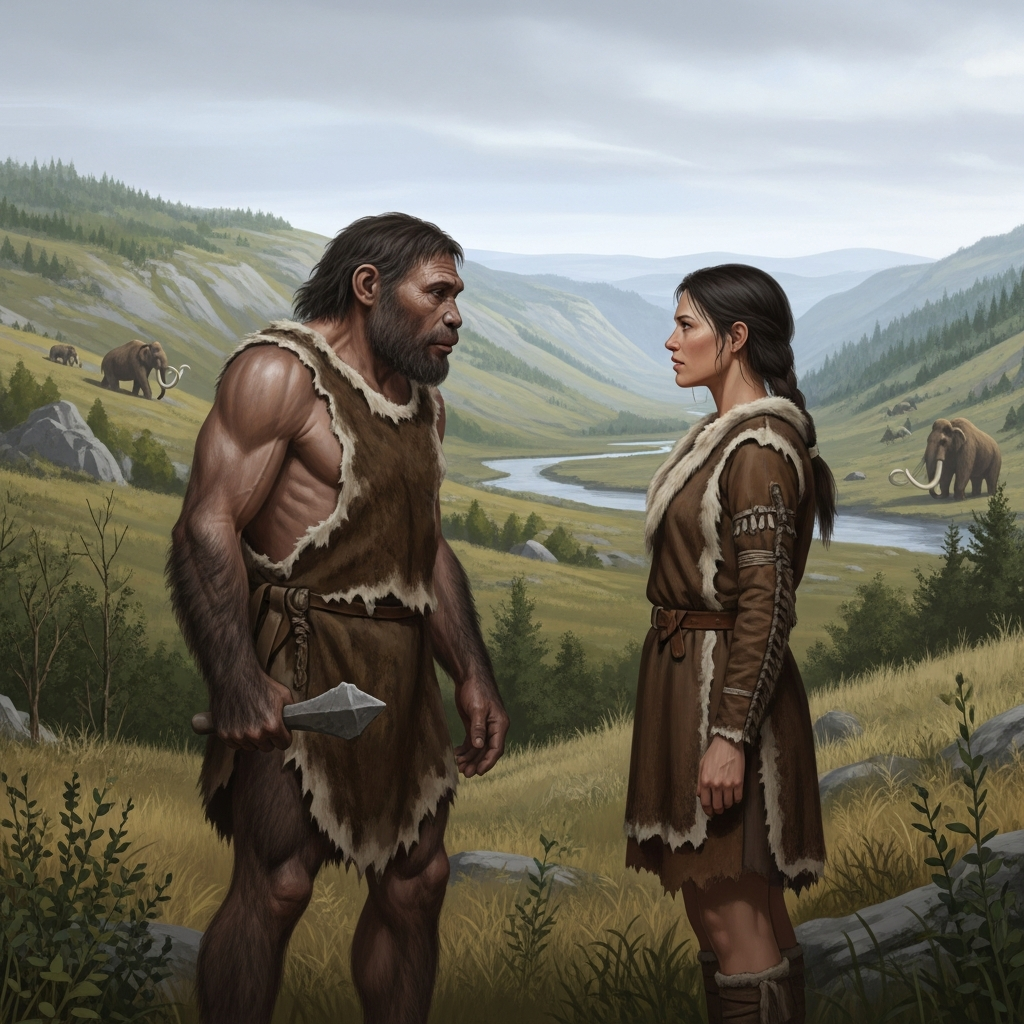
For millennia, the shadowy interactions between our Homo sapiens ancestors and their Neanderthal cousins have captivated scientists and fueled countless questions about our shared evolutionary past. Modern genetics has revealed a startling truth: most people outside Africa carry a small, yet significant, percentage of Neanderthal DNA. Now, groundbreaking research is peeling back another layer of this ancient story, suggesting that these interspecies encounters were not random, but followed a distinct, surprising pattern: primarily involving male Neanderthals and female modern humans. This revolutionary discovery challenges long-held theories and offers a fresh perspective on how our ancestors shaped the human genome we carry today.
Unraveling Our Ancient Genetic Legacy
The presence of Neanderthal DNA in the modern human genome is a powerful testament to ancient interbreeding events that occurred tens of thousands of years ago, predominantly when Homo sapiens migrated out of Africa into Eurasia, territories long inhabited by Neanderthals. This genetic inheritance isn’t just a historical curiosity; it’s linked to various traits, from aspects of our immune system to even tendencies for certain diseases. However, for years, scientists observed an intriguing anomaly: Neanderthal DNA was not uniformly distributed across the human genome.
The Mystery of the Missing X Chromosome DNA
Specifically, researchers noted a disproportionately low amount of Neanderthal genetic material on the human X chromosome compared to other chromosomes. These areas, dubbed “Neanderthal deserts,” presented a significant puzzle. One prevailing theory for this scarcity was the “evolutionary disadvantage” hypothesis. This idea suggested that genes on the Neanderthal X chromosome might have been biologically incompatible or “toxic” when incorporated into the Homo sapiens genome, leading natural selection to gradually eliminate them over generations. In essence, these hybrid offspring might have faced health problems, reducing their ability to survive and reproduce.
A Revolutionary Discovery: Sex-Biased Interbreeding
A new study published in the journal Science, led by Alexander Platt and Sarah Tishkoff from the University of Pennsylvania, has dramatically reshaped our understanding of these ancient encounters. Their research challenges the “evolutionary disadvantage” theory by shifting the focus of genetic inquiry. Instead of just looking for Neanderthal DNA in human genomes, they also meticulously searched for modern human DNA within Neanderthal genomes. This innovative approach uncovered a genetic “mirror image” that strongly points to a specific, sex-biased mating pattern.
Shifting Focus: What Neanderthal Genomes Revealed
The research team, which included comparing ancient Neanderthal DNA with genomes from present-day African populations (who largely lack Neanderthal ancestry), theorized that if biological incompatibility was truly the primary driver, then Neanderthal genomes should also show similar “gaps” or scarcity of human DNA on their X chromosomes. This would reflect a universal disadvantage for such genes, regardless of which species contributed them.
The “Mirror Image” Genetic Pattern
What the study actually found contradicted this expectation. Far from finding gaps, the scientists discovered a significantly higher proportion of anatomically modern human ancestry on Neanderthal X chromosomes than anticipated—about 60 percent more human DNA on Neanderthal X chromosomes compared to their non-sex chromosomes. This “mirror image” pattern—low Neanderthal DNA on human X chromosomes, but high human DNA on Neanderthal X chromosomes—was a critical breakthrough. It demonstrated that the scarcity of Neanderthal DNA in human X chromosomes was not due to a generalized incompatibility.
Decoding the Genetic Blueprint of Ancient Love
This reciprocal genetic pattern provides compelling evidence for a consistent, sex-biased mating direction. The key lies in understanding X chromosome inheritance. Females possess two X chromosomes (XX), inheriting one from each parent, while males have one X and one Y chromosome (XY), inheriting the X from their mother and the Y from their father. This means that, on average, two-thirds of the X chromosomes in a population are inherited from mothers.
If successful interbreeding occurred predominantly between male Neanderthals and female modern humans, the genetic consequences align perfectly with the observed data. When a male Neanderthal mated with a female Homo sapiens, any male offspring would receive his Y chromosome and his mother’s (human) X chromosome. Female offspring would receive one X from him (Neanderthal) and one X from her (human). However, for Neanderthal X chromosomes to enter the modern human gene pool via male Neanderthals, they would only do so in female offspring. If this pairing was more frequent, it would lead to fewer Neanderthal X chromosomes entering the broader Homo sapiens gene pool over time, yet simultaneously increase the proportion of human X chromosomes within Neanderthal populations.
Mathematical Models Confirm the Bias
To further validate their theory, Platt and his team employed sophisticated mathematical models. They simulated various pairing scenarios to determine which would best explain the observed low levels of Neanderthal DNA on human X chromosomes. Their simulations strongly indicated that scenarios with a significant bias towards male Neanderthals mating with human women consistently produced the genetic patterns seen in real-world data. This wasn’t a subtle effect; the models required a very high degree of bias to match the genomic evidence, suggesting a robust and frequent sex-biased interaction rather than mere random chance or “survival of the fittest.”
Why the Bias? Uncovering Ancient Social Dynamics
While the genetic evidence for this sex-biased interbreeding is strong, the underlying social dynamics that led to such pairings remain a profound mystery, sparking much speculation among researchers. It’s a tantalizing glimpse into the social and cultural landscapes of our ancient ancestors.
Mate Preference: A Compelling Hypothesis
Alexander Platt and his colleagues propose that mate preference is the simplest and most compelling explanation for this bias. This doesn’t necessarily imply that one group found the other physically more attractive in a modern sense, but rather that one direction of interspecies mating might have been perceived as “better, or less worse, than the other.” External experts, such as Lars Fehren-Schmitz and Matilda Brindle, support the plausibility of mate preference, noting its historical significance in shaping human populations. Other potential factors, such as demographic imbalances (e.g., a scarcity of Neanderthal women or an abundance of modern human women), have been considered, but Platt finds the mate preference model more parsimonious. The strength of the genetic effect suggests this bias was not limited to initial encounters but persisted across generations, influencing subsequent gene flow within populations.
Limitations and Future Research
It’s important to acknowledge the study’s limitations. The scarcity of high-quality Neanderthal genomes available for analysis means that current findings offer only a snapshot of the complex, fluctuating interbreeding dynamics that occurred over vast periods. As paleontological research uncovers more ancient DNA, the genetic picture of human-Neanderthal interactions is expected to become even clearer and more nuanced. This research also opens new avenues for interdisciplinary collaboration, inviting geneticists to work closely with evolutionary biologists and anthropologists to explore the deeper reasons behind these ancient reproductive encounters.
The Enduring Impact of Ancient Encounters
This groundbreaking study significantly deepens our understanding of human evolutionary history. It challenges a long-standing genetic puzzle and proposes a compelling explanation rooted in ancient social behaviors rather than solely biological incompatibility. The findings underscore that the genetic landscape of modern humans is not just a product of strict Darwinian natural selection, but also a testament to complex social interactions, cultural factors, and mating preferences that existed between different hominin groups. By examining the genetic makeup of Neanderthals – the “other half” of these ancient interactions – scientists gain a far richer and more comprehensive understanding of our own ancestry and the intricate tapestry of life that shaped us.
Frequently Asked Questions
What did the new study reveal about Neanderthal-human interbreeding patterns?
A new study published in Science found compelling evidence that interbreeding between Neanderthals and modern humans was predominantly biased. Specifically, it suggests that male Neanderthals mated more frequently with female anatomically modern humans than the reverse pairing. This challenges previous assumptions about the nature of these ancient encounters.
Why was the “Neanderthal desert” on the human X chromosome a puzzle, and how did this study resolve it?
For years, scientists observed “Neanderthal deserts”—areas on the human X chromosome almost entirely devoid of Neanderthal DNA. The prevailing theory was that Neanderthal genes in these regions were incompatible or “toxic” to Homo sapiens, causing them to be purged by natural selection. This new study challenged that by looking at Neanderthal genomes, finding a “mirror image” with excess human DNA on Neanderthal X chromosomes. This reciprocal pattern, explained by X-chromosome inheritance, strongly suggests a sex-biased mating preference, rather than simple biological incompatibility.
What are the potential reasons for the observed sex-biased mating between Neanderthals and modern humans?
While the precise reasons remain speculative, the study’s authors, led by Alexander Platt, propose mate preference as the simplest explanation for the bias. This doesn’t necessarily mean one group found the other physically more appealing, but that one direction of interspecies mating was more common or advantageous for social or cultural reasons. Other factors like demographic imbalances (e.g., fewer Neanderthal females) are also considered, though mate preference is favored by researchers for its explanatory power. Further interdisciplinary research into ancient social structures may provide more insights.