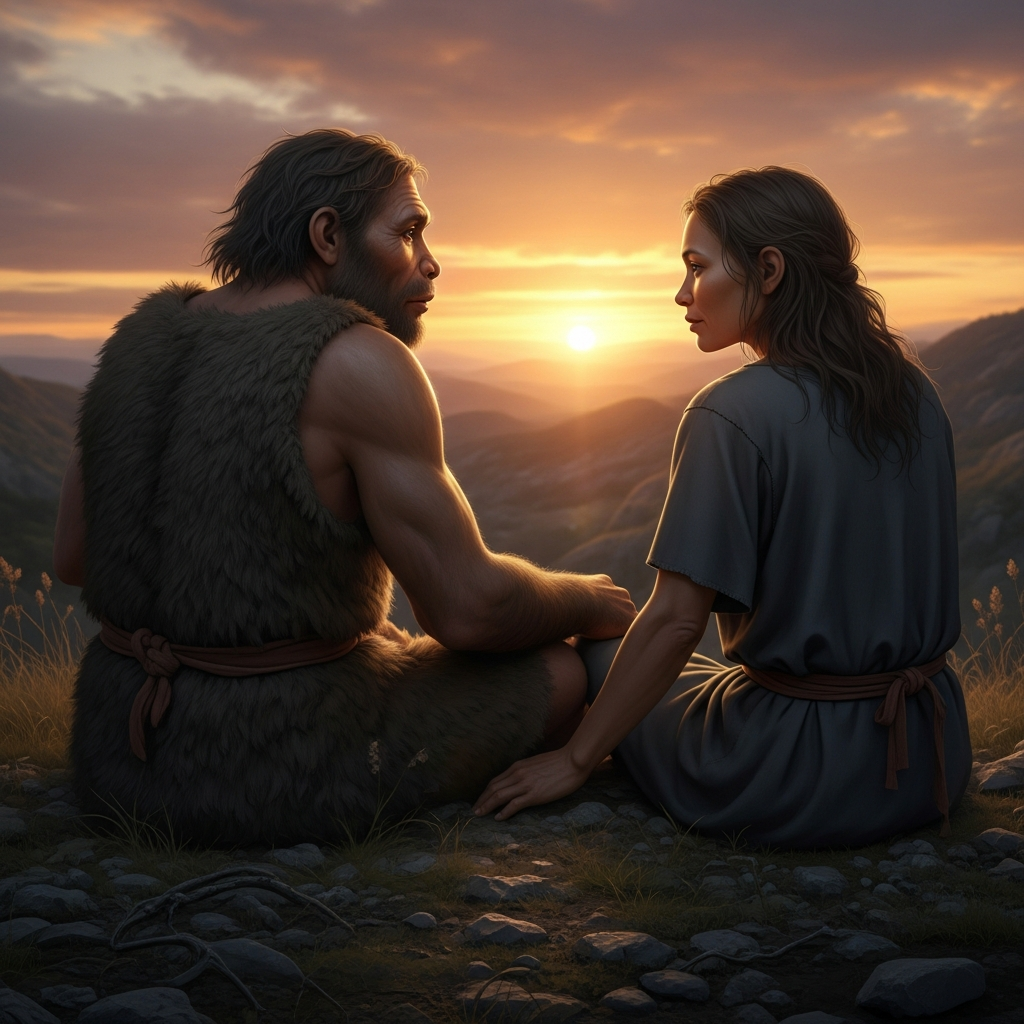
Tens of thousands of years ago, when early modern humans expanded across Eurasia, they encountered their ancient cousins, the Neanderthals. These interactions weren’t just territorial; new genetic research now reveals a surprising and intimate history of interbreeding. For years, scientists puzzled over the sparse presence of Neanderthal DNA on the human X chromosome, hypothesizing genetic incompatibility. However, groundbreaking new findings from a study published in Science offer an alternative and more compelling explanation: a significant mating bias, primarily between male Neanderthals and female modern humans. This discovery redefines our understanding of early human history, suggesting that ancient social dynamics, rather than just biological barriers, sculpted our genetic legacy.
Unraveling the Mystery of Ancient Interbreeding
Our story begins approximately 600,000 years ago when the evolutionary paths of modern humans and Neanderthals diverged. While our ancestors evolved in Africa, Neanderthals adapted to the unique environments of Eurasia. Yet, this separation wasn’t permanent. As human populations migrated, they repeatedly met and interbred with Neanderthals, leaving a genetic imprint still visible today. Most individuals of non-African descent carry a small percentage of Neanderthal DNA—typically 1-2%—a tangible reminder of these prehistoric encounters. Even some African populations carry a trace, inherited from Homo sapiens who interbred in Eurasia before returning to Africa.
Despite this widespread genetic exchange, one puzzle persisted: the uneven distribution of Neanderthal DNA across the human genome. Specifically, researchers observed “Neanderthal deserts”—regions, particularly on the X chromosome, where Neanderthal genetic material was notably absent. This consistent scarcity begged for an explanation.
The Previous Theory: Biological Incompatibility
For decades, the leading hypothesis to explain these “Neanderthal deserts” revolved around biological incompatibility. Scientists theorized that certain Neanderthal genes, especially those on the X chromosome, might have been detrimental or “toxic” to modern humans. This could have led to reduced fertility, developmental issues in hybrid offspring, or other health problems. Under this scenario, natural selection would have actively purged these incompatible Neanderthal gene variants from the human gene pool over many generations.
Dr. Alexander Platt, a senior research scientist at the University of Pennsylvania and a lead author of the recent study, acknowledged this long-held assumption: “For years, we just assumed these deserts existed because certain Neanderthal genes were biologically ‘toxic’ to humans…so we thought the genes may have caused health problems and were likely purged by natural selection.” If this biological incompatibility theory were true, one would expect to see a similar pattern: a depletion of modern human DNA on Neanderthal X chromosomes, should they have inherited DNA from us.
The Groundbreaking New Evidence: A Mating Direction Bias
The latest research, led by Dr. Platt and Professor Sarah Tishkoff from the University of Pennsylvania, challenged this established view with a revolutionary genetic “deep dive.” Instead of solely focusing on Neanderthal DNA in modern humans, their team inverted the perspective. They analyzed the presence of modern human DNA preserved within the genomes of three well-preserved Neanderthal individuals from sites like Altai, Chagyrskaya, and Vindija. This dataset was then compared with genetic information from specific sub-Saharan African populations, chosen because they largely lack Neanderthal ancestry, providing a crucial baseline.
The findings were striking and provided a “mirror-like reversal” of previous observations. While modern humans show a deficit of Neanderthal DNA on their X chromosomes, the Neanderthal X chromosomes actually exhibited a 62% excess of modern human DNA compared to their other chromosomes. This discovery directly contradicted the biological incompatibility theory. If Neanderthal genes were toxic to humans, and vice versa, then human DNA should also have been scarce on Neanderthal X chromosomes. The observed enrichment of human DNA on Neanderthal X chromosomes, therefore, pointed to a different, more nuanced explanation.
How Sex-Biased Mating Shaped Our DNA
The key to understanding this “mirror pattern” lies in the mechanics of X chromosome inheritance and the direction of interspecies mating. Females carry two X chromosomes (XX), while males possess one X and one Y chromosome (XY). This fundamental difference means that the flow of genetic material, particularly from the X chromosome, is highly sensitive to the sex of the parents in a cross-species pairing.
The researchers concluded that the most plausible explanation for the observed genetic asymmetry was a consistent, long-term pattern where male Neanderthals predominantly mated with female anatomically modern humans.
Here’s how this explains the genetic patterns:
For modern humans: If Neanderthal males partnered more often with human females, fewer Neanderthal X chromosomes (which males only pass to their daughters) would enter the human gene pool from Neanderthal males. This would lead to the scarcity, or “deserts,” of Neanderthal DNA seen on the human X chromosome today.
For Neanderthals: Conversely, if modern human females frequently mated with Neanderthal males, more human X chromosomes would be introduced into Neanderthal populations. Human females contribute one X chromosome to all their offspring, ensuring a steady influx into the Neanderthal gene pool. This explains the 62% excess of human DNA found on Neanderthal X chromosomes.
Dr. Platt stated unequivocally that “mating preferences provided the simplest explanation” for this complex genetic signature. This model accurately recreates the genetic patterns observed in both modern human and Neanderthal genomes.
Beyond Biology: Social Dynamics and Ancient Choices
This groundbreaking research suggests that the structure of our genomes reflects more than just biological barriers; it preserves tangible traces of ancient social behavior and intergroup dynamics. While the study doesn’t suggest that Neanderthal males were inherently more “attractive” or vice versa, it does imply a specific social or behavioral dynamic. As Platt noted, it seems “one direction was viewed as better, or less worse, than the other.”
The strength of the observed genetic effect further indicates that this mating bias was not limited to isolated, initial encounters. It suggests a sustained dynamic within populations. Within predominantly modern human groups, for instance, there might have been a preference for males with Neanderthal heritage over females with such ancestry, implying a continuing influence on gene flow long after the initial interbreeding events.
While “mate preference” offers the simplest and most robust explanation, researchers acknowledge that other intricate evolutionary scenarios, possibly involving sex-specific migration patterns or other societal dynamics, could also have played a role. Future research delving into the social structures and gender roles of Neanderthal societies could offer even deeper insights into these ancient mate choices. Ultimately, this study offers a compelling new lens through which to view the complex interactions that shaped the very blueprint of humanity.
Frequently Asked Questions
What are “Neanderthal deserts” on the human X chromosome?
“Neanderthal deserts” refer to specific regions within the modern human genome where Neanderthal DNA is notably rare or entirely absent. This phenomenon is particularly striking on the X chromosome, one of the sex chromosomes. For a long time, scientists speculated that these areas were empty of Neanderthal DNA because certain Neanderthal genes might have been incompatible or “toxic” to modern humans, causing health issues and being subsequently removed by natural selection. The new study, however, proposes a different explanation based on ancient mating patterns.
How did scientists discover this specific mating bias?
Researchers, led by Dr. Alexander Platt and Professor Sarah Tishkoff, conducted a detailed genetic analysis. Instead of just looking for Neanderthal DNA in modern humans, they investigated modern human DNA present in the genomes of three Neanderthal individuals (Altai, Chagyrskaya, and Vindija). They compared this data with genetic information from sub-Saharan African populations that largely lack Neanderthal ancestry. Their key finding was a “mirror-like reversal”: Neanderthal X chromosomes showed a 62% excess of modern human DNA, which directly contradicted the old incompatibility theory and strongly supported a mating bias primarily between male Neanderthals and female modern humans.
Does this mean male Neanderthals were considered more “attractive” than human males by ancient human females?
Not necessarily. The study’s findings do not directly suggest inherent physical attractiveness. Dr. Platt clarified that the preference could be a complex social or cultural dynamic, implying that “one direction [of mating] was viewed as better, or less worse, than the other.” This bias might have been influenced by factors such as social structures, group dynamics, cultural norms, or even practical considerations during interspecies encounters, rather than purely physical appeal. The genetic evidence primarily points to a statistical pattern of who paired with whom, not the underlying reasons for those choices.
Redefining Our Ancestral Story
This pioneering research significantly refines our understanding of the dynamic interactions between Neanderthals and early modern humans. It moves beyond a purely biological explanation for genomic patterns, bringing ancient social behavior and sexual selection to the forefront. The discovery of a consistent mating bias, with male Neanderthals more frequently interbreeding with female modern humans, etched onto our X chromosomes, offers invaluable insights. It reminds us that our genetic heritage is a rich tapestry woven not just by survival, but also by the choices, preferences, and complex social interactions of our deep past. As scientists continue to explore ancient genomes, we can expect even more revelations about the nuanced relationships that shaped who we are today.