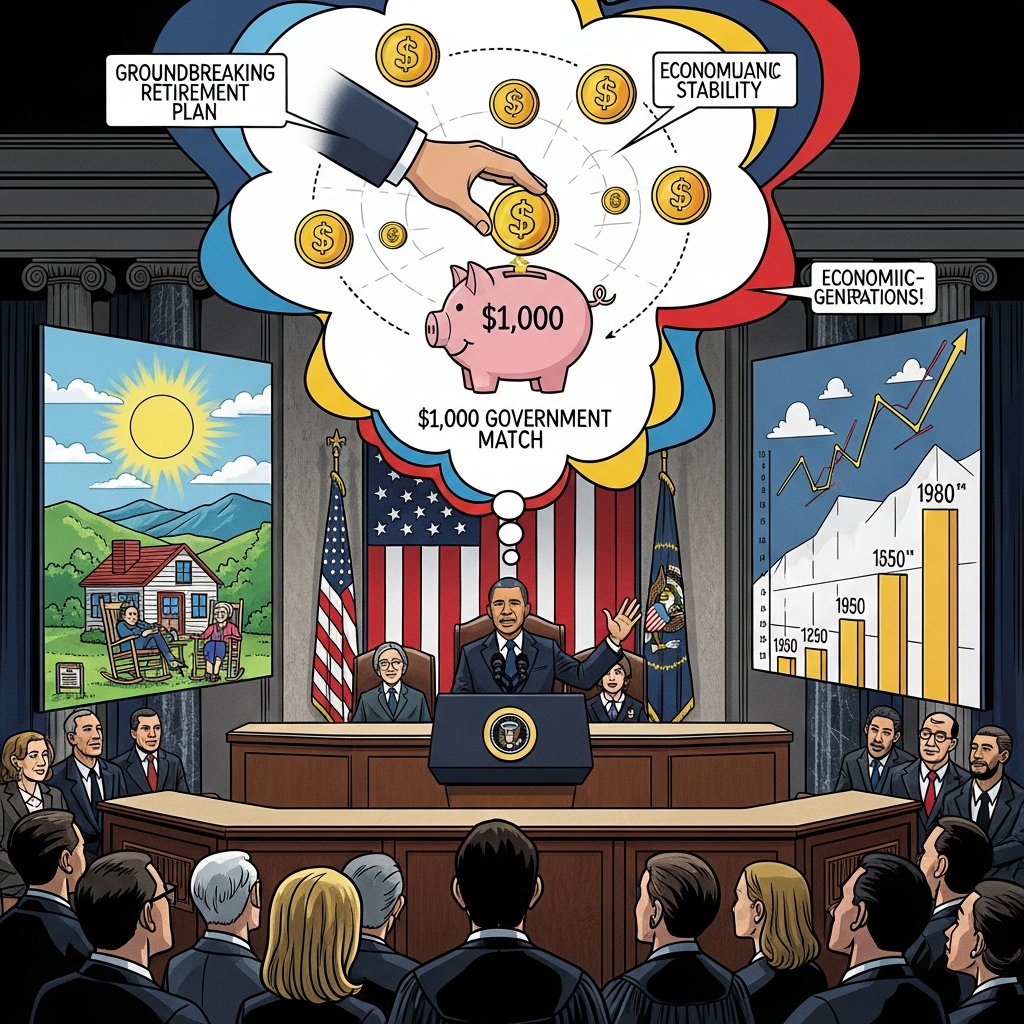
In a landmark State of the Union address on February 24, 2026, President Donald Trump unveiled a groundbreaking retirement plan designed to reshape the financial future for millions of Americans. This ambitious proposal, targeting approximately 56 million individuals currently without employer-sponsored savings, aims to bridge a significant retirement savings gap. At its core, the plan promises a substantial U.S. government matching contribution of up to $1,000 annually, signaling a direct intervention to ensure more citizens can benefit from a robust stock market.
This new initiative seeks to offer a “401(k) for all,” addressing what the administration described as a “gross disparity” in America’s current retirement system. It’s a bold move to empower “often forgotten American workers” by providing them access to powerful, low-fee investment opportunities. As we delve into the specifics, it’s clear this Trump retirement plan could fundamentally alter how many Americans approach their golden years.
Bridging the Retirement Gap: A $1,000 Federal Match
The central pillar of President Trump’s retirement plan is the introduction of a federal matching contribution. Workers without access to employer-sponsored plans would receive up to $1,000 each year into their retirement accounts, contingent on their own contributions. This direct governmental support is intended to incentivize savings and help those who currently miss out on the wealth-building potential of a rising stock market.
The proposal draws parallels to the highly successful Thrift Savings Plan (TSP) used by federal employees. This structure would grant participants access to a range of low-cost index funds, including investments in U.S. Treasury bonds, aggregate U.S. bond funds, S&P 500 funds, total U.S. stock market indices, and international stock indices (excluding China and Hong Kong). Crucially, these accounts would be portable, meaning they are tied to the individual, not their job, allowing for seamless savings continuity across different employers. The plan also uniquely allows private philanthropists to contribute, adding another layer of potential funding.
The Stark Reality of America’s Retirement Crisis
The need for such a federal match program is underscored by sobering statistics. Reports from the National Institute on Retirement Security (NIRS) reveal that the average American worker has less than $1,000 saved for retirement. Even for those with some savings, the median balance stands at a mere $40,000, far short of the estimated $1.5 million often cited for a comfortable retirement. This crisis is particularly acute for lower-income workers, with the Economic Innovation Group noting that nearly 79% of full-time employees earning under $27,400 annually lack any access to a retirement plan. Overall, almost half of the private sector workforce – nearly 57 million American workers – lack workplace retirement benefits. The Pew Charitable Trusts estimates that insufficient retirement savings could cost federal and state governments a staggering $1.3 trillion over two decades, due to reduced spending and increased demand on social programs.
Building on Existing Frameworks: SECURE Act 2.0 and Beyond
President Trump’s retirement savings initiative isn’t entirely new territory. It expands upon the bipartisan Securing a Strong Retirement Act (SECURE Act 2.0), signed into law by President Biden in 2022. SECURE Act 2.0 already established a “Saver’s Match” program, scheduled to launch in 2027. This existing program offers a 50% matching contribution, up to $1,000 (or $2,000 for couples), delivered as a federal tax credit directly into qualified pre-tax retirement accounts. However, its eligibility is income-dependent, phasing out for individuals earning between $20,501 and $35,500.
The new proposal from President Trump aims to broaden this reach, offering a direct government match and structuring it like the TSP to simplify access to diverse investment options. By leveraging these existing legislative precedents, the administration seeks to create a more inclusive and robust framework for national retirement security.
Expert Reactions: Praise and Practical Concerns
The announcement of this Trump retirement plan sparked varied reactions from financial experts. Many lauded the plan for directly addressing the long-standing shortfall in workplace retirement coverage. Teresa Ghilarducci, a prominent retirement expert, praised the proposal, calling it a significant step to “get money into low-income workers’ retirement accounts.” Treasury Secretary Scott Bessent also expressed optimism, suggesting it could become a vital component of working Americans’ financial security. Chris Spence of TIAA welcomed the focus on expanding retirement access.
However, a chorus of concerns quickly followed. Ghilarducci herself predicted that perhaps only half of low-income workers might open accounts due to persistent challenges like limited disposable income and existing debt. Bankrate analyst Stephen Kates noted that existing Individual Retirement Accounts (IRAs) are often “underutilized” precisely because they lack the employer match that this new proposal seeks to provide.
More critical views focused on the practicalities of implementation. Romina Boccia of the Cato Institute questioned the administration’s fiscal capacity to fund a $1,000 taxpayer match, suggesting simpler “universal savings accounts” might be a better approach. Jaret Seiberg, an analyst with TD Cowen, indicated significant political hurdles, seeing “no viable path to enact this plan” through Congress. These expert opinions highlight that while the goal is commendable, its path to becoming law and its ultimate effectiveness face considerable challenges.
Beyond Retirement: A Push for Ethical Conduct
During the same State of the Union address, President Trump also championed a call for stricter ethics rules concerning insider trading by members of Congress. He explicitly linked this plea to his retirement savings initiative, stating, “As we ensure that all Americans can profit from a rising stock market, let’s also ensure that members of Congress cannot corruptly profit from using insider information.” This proposal aligns with the pending “Stop Insider Trading Act,” which aims to restrict individual stock trading by lawmakers and their immediate families, while increasing penalties for non-compliance. This dual focus underscores a broader administration push for economic fairness and public trust.
The Broader Political Landscape of 2026
President Trump’s State of the Union address unfolded against a backdrop of intense political activity and public sentiment. The 13 months leading up to the speech were characterized by “break-neck deregulation,” a “record number of executive actions,” “mass layoffs,” and “aggressive immigration tactics.” Just days prior, the Supreme Court had dealt a blow to the administration by striking down Trump’s “sweeping tariffs.” A partial government shutdown also lingered, impacting the Department of Homeland Security due to immigration policy disputes. Ongoing scrutiny around the Jeffrey Epstein investigation further colored the political environment.
Despite these “pain points,” the stock market showed positive trends, with the S&P 500 experiencing a 2% jump and the Dow Jones Industrial Average reaching a record 50,000 points. Public opinion, however, was mixed; a PBS News/NPR/Marist poll indicated that 60% of Americans believed the country was “worse off” compared to a year prior. In this complex environment, the Trump retirement plan emerged as a key economic initiative aimed at demonstrating tangible benefits for American families.
Frequently Asked Questions
What exactly is the new retirement plan President Trump proposed in 2026?
President Trump’s proposed retirement plan aims to provide a federal matching contribution of up to $1,000 annually to American workers who lack employer-sponsored retirement programs. The plan is designed to be similar to the Thrift Savings Plan (TSP) for federal employees, offering access to low-fee funds investing in stocks and bonds. These accounts would be portable, tied to the individual, and would also allow private philanthropic contributions, aiming to ensure more Americans can benefit from market growth and improve their retirement savings.
Who is eligible for the proposed $1,000 federal match under this new plan?
The proposed Trump retirement plan specifically targets the estimated 56 million Americans who do not currently have access to an employer-sponsored retirement plan with matching contributions. This includes a significant portion of the workforce, particularly lower-income and part-time workers who are often underserved by traditional workplace benefits. The plan is intended to rectify a “gross disparity” in retirement savings access, ensuring broader participation in wealth-building opportunities.
What are the potential benefits and challenges of this “401(k) for all” proposal?
Potential benefits include significantly expanding retirement savings access for millions, providing a direct federal match to incentivize contributions, and offering low-cost, diversified investment options similar to the TSP. This could boost financial security for many. However, challenges include the substantial cost of funding a nationwide $1,000 match, the political hurdles required to pass such legislation through Congress, and concerns that some low-income workers may still struggle to contribute due to existing financial burdens, even with the matching incentive.
Conclusion: A Vision for Broader Financial Security
President Trump’s proposed retirement plan represents a significant push to democratize access to wealth-building opportunities in the United States. By introducing a direct federal match and structuring the accounts akin to the successful Thrift Savings Plan, the initiative seeks to empower millions of workers currently on the sidelines of the nation’s economic growth. While the plan faces considerable political and fiscal challenges, its core intent—to address a deep-seated disparity in retirement savings—resonates strongly with the needs of many American families. As discussions continue, its potential to reshape the landscape of personal finance for generations remains a pivotal point of economic debate.