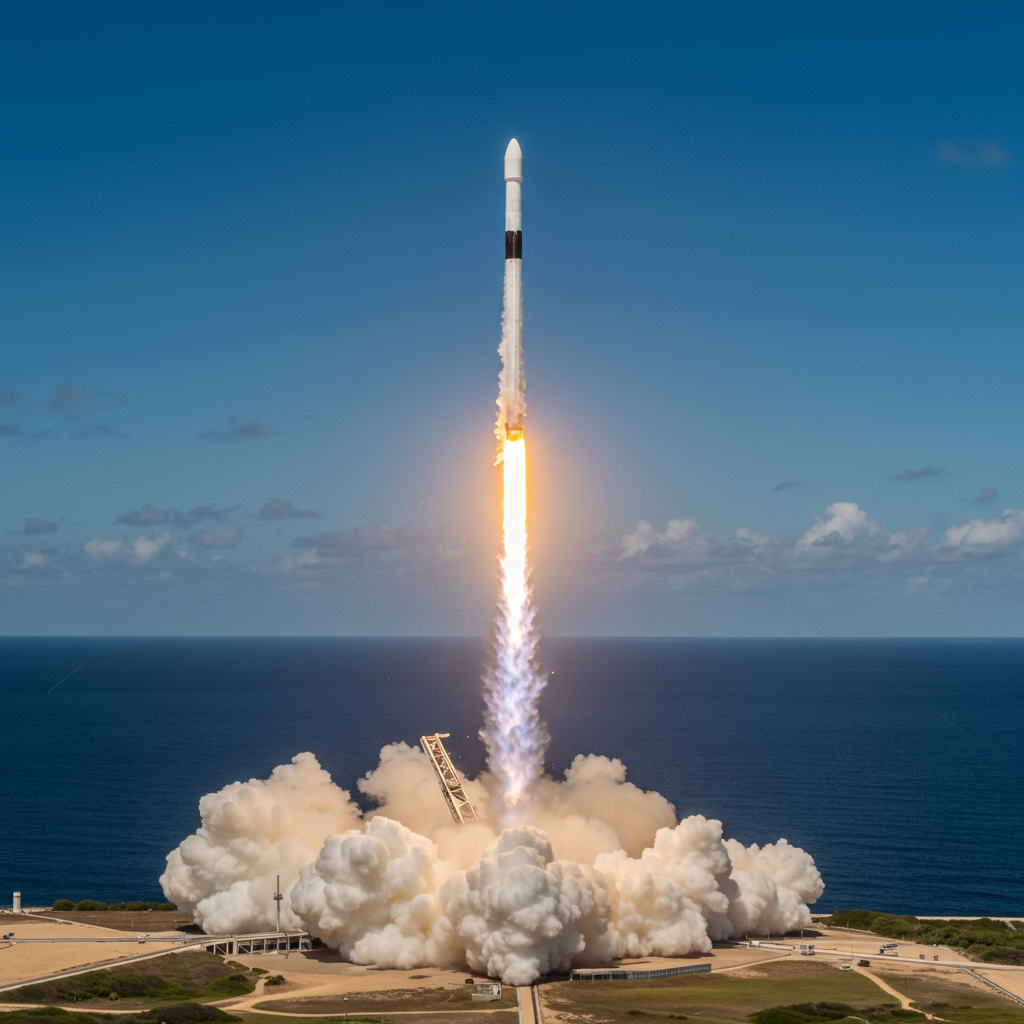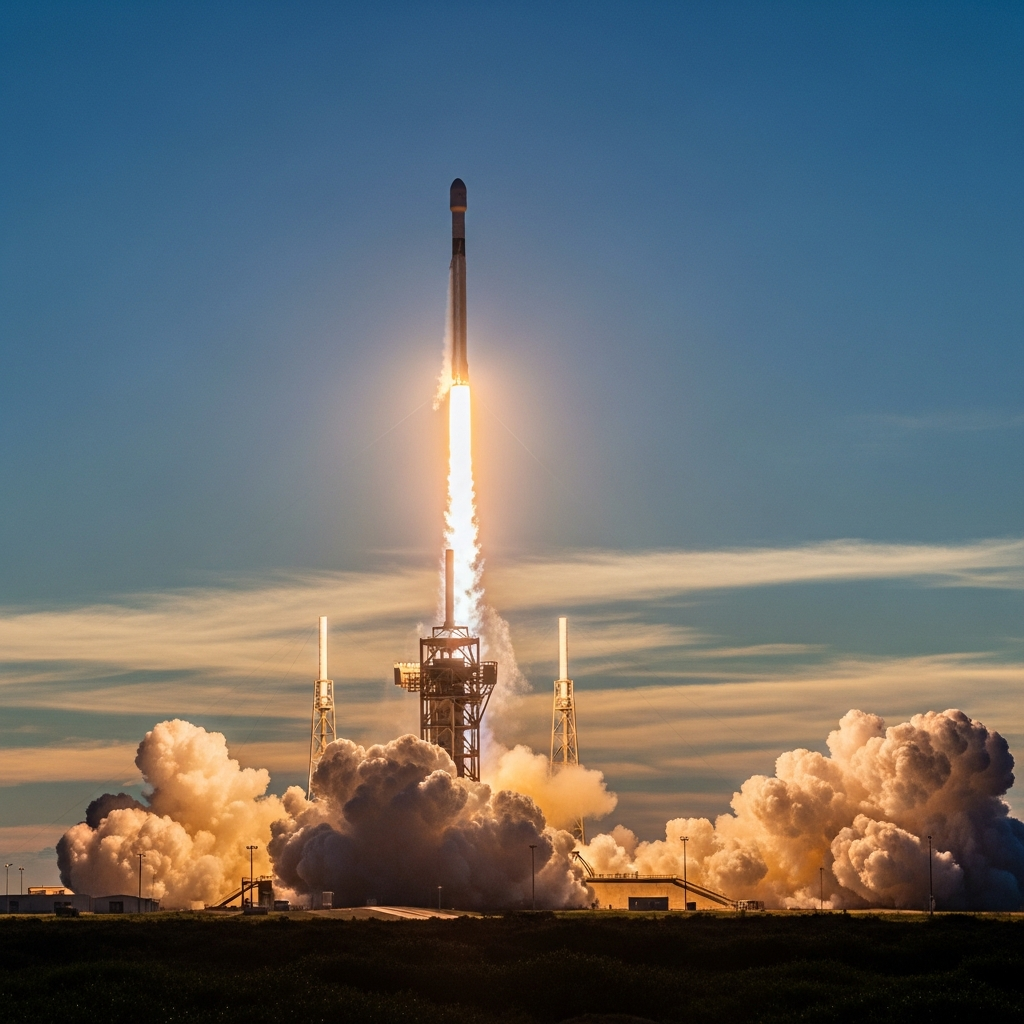
The skies over Florida witnessed another spectacular display of modern spaceflight as SpaceX successfully launched its Starlink 6-110 mission. On Tuesday, February 24, 2026, a powerful Falcon 9 rocket soared from Cape Canaveral Space Force Station, adding another cohort of Starlink satellites to the growing constellation designed to deliver high-speed internet across the globe. This latest launch underscores SpaceX’s relentless pace in expanding its satellite network and refining its reusable rocket technology.
This successful liftoff was particularly notable for its exceptionally favorable weather conditions, a testament to meticulous planning and coordination. With minimal atmospheric concerns, the mission proceeded smoothly, captivating onlookers and marking another milestone in the company’s ambitious mission to connect the world.
A Flawless Liftoff from Florida’s Space Coast
The Starlink 6-110 mission commenced its journey from Space Launch Complex 40 (SLC-40) at Cape Canaveral Space Force Station. The Falcon 9 rocket roared to life precisely at 6:04 p.m. ET, well within its four-hour launch window that had opened earlier at 3:56 p.m. ET. Meteorologists from the 45th Weather Squadron had predicted a remarkable 95% chance of optimal liftoff conditions, and their forecast held true, providing a clear path for the rocket’s ascent.
Such pristine weather conditions are always a welcome sight in the dynamic world of rocket launches. The absence of forecast restrictions ensured that SpaceX could execute its mission without delay, reflecting the precision and readiness that have become hallmarks of its operations. This Starlink launch was just one example of the busy week for SpaceX, with another Falcon 9 mission simultaneously targeting a launch from Vandenberg Space Force Base in California, highlighting the company’s increasing cadence.
The Falcon 9’s Reusable Workhorse: Booster B1092
Central to SpaceX’s cost-efficiency and rapid launch schedule is its commitment to rocket reusability. The Falcon 9’s first-stage booster, identified as B1092, played a pivotal role in the Starlink 6-110 mission. This flight marked an impressive tenth journey into space for B1092, showcasing its durability and the advanced engineering behind SpaceX’s recovery operations.
Booster B1092 is a veteran of numerous critical missions, having previously supported a diverse range of payloads. Its past endeavors include Starlink 12-13, NROL-69, Bandwagon-3, GPS III-7, Starlink 10-34, USSF-36, Starlink 10-61, Starlink 6-89, and Starlink 6-82. Each successful recovery and reuse of a booster significantly reduces the expense of spaceflight, pushing the boundaries of what’s possible in commercial space. Following a clean stage separation, the first-stage rocket executed a precise autonomous landing on the droneship “Just Read the Instructions,” stationed reliably in the Atlantic Ocean. This recovery added another success to SpaceX’s remarkable tally of booster landings.
Expanding the Global Internet Constellation
This particular Starlink launch deployed 29 advanced satellites into low-Earth orbit (LEO). These satellites are crucial additions to the ever-expanding Starlink constellation, which is owned by SpaceX. Once deployed and integrated into their operational orbits, these new satellites will contribute to providing high-speed, low-latency internet service to underserved and remote areas across Earth.
The Starlink network has grown at an astonishing pace since its inception. To put the scale into perspective, Dr. Jonathan McDowell, a renowned astrophysicist from the Harvard-Smithsonian Center for Astrophysics, meticulously tracks Starlink satellite deployments. Before this specific February 2026 launch, McDowell’s data indicated that an astounding 9,779 Starlink satellites were already in orbit, with a substantial 8,436 of them fully operational. These figures highlight the unprecedented scale of this private satellite network, which aims to revolutionize global connectivity.
The Evolution of Starlink and Reusable Rockets
The Starlink 6-110 mission is a snapshot of SpaceX’s broader strategy. The company continuously refines its satellite designs, with missions like Starlink 10-37 (October 2025) deploying optimized V2 Mini satellites, representing increased payload efficiency for the Falcon 9. The rapid iteration in both satellite technology and launch operations demonstrates SpaceX’s commitment to innovation.
The concept of reusable rockets, pioneered by SpaceX, has fundamentally changed the economics of space access. While B1092 completed its tenth flight, other boosters have achieved even more remarkable feats. For instance, Falcon 9 first stage booster B1083 completed its fifteenth flight in late 2025, having supported high-profile missions like Crew-8 and Polaris Dawn. Even more impressively, Booster 1067 set a new record in August 2024 by completing its thirtieth successful launch and landing, deploying 28 Starlink satellites. This singular booster’s history, alongside the company’s 500th Falcon 9 flight milestone, underscores the profound impact of reusability on spaceflight.
SpaceX’s vision, led by founder and CEO Elon Musk, extends far beyond Starlink. The Falcon 9’s success in reusability is a stepping stone towards the company’s next-generation vehicle, Starship, which aims for even greater reusability and ultimately, human exploration of the Moon and Mars.
What Starlink Means for Global Connectivity
The Starlink constellation offers a unique solution for internet access. Unlike traditional satellite internet, which relies on a few geostationary satellites orbiting at much higher altitudes, Starlink operates thousands of satellites in low-Earth orbit, approximately 341 miles above Earth. This lower altitude drastically reduces latency, making Starlink suitable for applications that demand quick response times, such as online gaming, video conferencing, and streaming, in areas where traditional broadband infrastructure is lacking.
From remote Alaskan villages to disaster-stricken regions, Starlink provides essential internet service, bridging the digital divide. The continuous deployment of satellites, as seen with missions like Starlink 6-110, ensures the network’s robustness, capacity, and global reach. SpaceX’s efforts not only revolutionize internet access but also push the entire space industry forward with innovations in rocket recovery, satellite manufacturing, and mission planning. The journey of each Falcon 9, like that of B1092, is a step towards a more connected and space-faring future.
Frequently Asked Questions
What were the key details of the recent Starlink 6-110 mission from Cape Canaveral?
The Starlink 6-110 mission, launched on February 24, 2026, from Space Launch Complex 40 at Cape Canaveral Space Force Station, saw a Falcon 9 rocket successfully deploy 29 Starlink satellites. The launch occurred at 6:04 p.m. ET under exceptionally favorable weather conditions, with the 45th Weather Squadron reporting a 95% chance of good liftoff. The first-stage booster, B1092, achieved its tenth flight and subsequently landed on the droneship “Just Read the Instructions” in the Atlantic Ocean.
How does SpaceX’s Falcon 9 booster reusability contribute to the rapid expansion of the Starlink constellation?
SpaceX’s reusable Falcon 9 boosters significantly reduce the cost and time required for launches. By recovering and refurbishing the first stage, SpaceX avoids the expense of building a new booster for each mission. This efficiency allows for a much higher launch cadence, enabling the rapid deployment of thousands of Starlink satellites to continuously expand and upgrade the global internet constellation, ultimately accelerating the availability of service worldwide.
What is the primary goal of the Starlink constellation, and how many satellites are currently in orbit?
The primary goal of the Starlink constellation is to provide high-speed, low-latency internet service to underserved and remote areas across the Earth. By operating a vast network of thousands of satellites in low-Earth orbit, Starlink aims to bridge the global digital divide. As of the February 24, 2026, Starlink 6-110 launch, Dr. Jonathan McDowell reported approximately 9,779 Starlink satellites in orbit, with 8,436 of them actively operational.
Conclusion
The Starlink 6-110 mission stands as another clear demonstration of SpaceX’s ongoing commitment to advancing space technology and global connectivity. From the remarkable reusability of its Falcon 9 boosters, exemplified by B1092’s tenth flight, to the relentless expansion of the Starlink internet constellation, each launch pushes the boundaries of innovation. As thousands more satellites join the network, the promise of worldwide high-speed internet moves closer to reality, thanks to the vision and engineering prowess of SpaceX. Stay tuned for more groundbreaking missions as the future of spaceflight continues to unfold.