
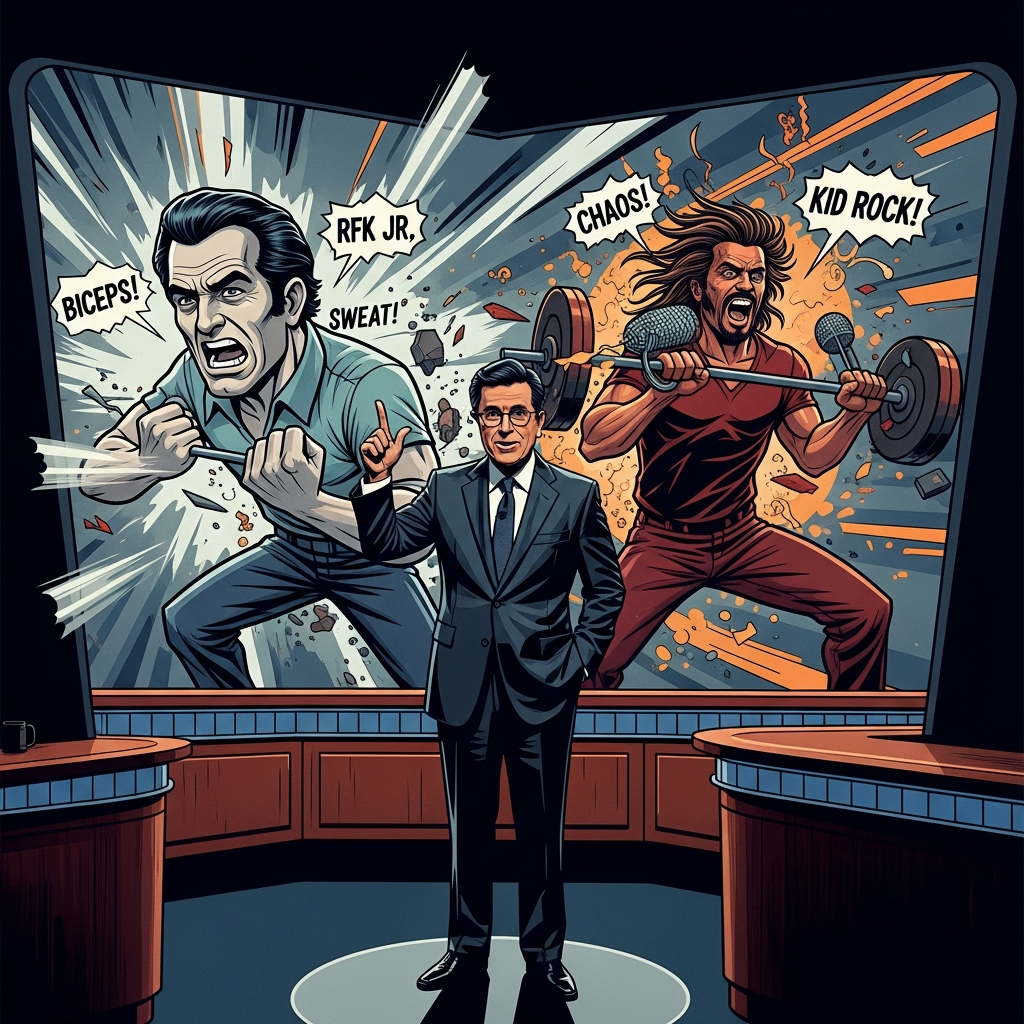
Stephen Colbert, even while battling a cold and joking about being “on enough steroids to be named the secretary of health and human services,” didn’t hold back on Wednesday night. The late-night host dissected a bizarre workout video featuring Robert F. Kennedy Jr. and Kid Rock, dubbing it “senior softcore.” This segment sparked widespread discussion, not just for its outlandish content but also for its underlying health message and the varied media reactions it provoked.
The “Rock Out Work Out” video, intended to promote RFK Jr.’s “Make America Healthy Again” (MAHA) initiative, quickly became an internet sensation for all the wrong reasons. It showcased Kennedy Jr., identified as the U.S. Secretary of Health and Human Services (HHS), and musician Kid Rock engaging in a series of surreal fitness activities. From shirtless workouts in a sauna to bizarre gym apparel choices, the clip offered plenty for Colbert – and the internet – to lampoon.
Colbert’s Caustic Critique: “Dropping Acid at a Cracker Barrel”
Colbert’s monologue on The Late Show minced no words. He described watching the RFK Jr. and Kid Rock video as feeling like “dropping acid at a Cracker Barrel.” The host played several clips, highlighting the video’s disorienting blend of shark attacks, taxidermied bears, and numerous American flags. This visual cacophony, coupled with the duo’s peculiar workout regimen, set the stage for Colbert’s biting commentary.
A major point of contention for Colbert was the duo’s attire. He particularly fixated on RFK Jr.’s choice to wear tight jeans throughout the entire workout. “Working out in tight jeans is not what a sauna is for,” Colbert quipped, offering a crude, comedic alternative purpose for saunas that elicited audience laughter. The absurdity continued as a clip showed Kennedy Jr. taking a cold plunge bath while still fully clad in denim. Colbert humorously questioned if RFK Jr. was “one of those action figures where his jeans are his legs?” He mused, “You can change the shirt, but you can’t change the pants?” The host further speculated that the entire production looked less like two friends exercising and “more like RFK Jr picked up a drifter at the carnival as he’s fattening him up to eat.”
Unpacking the “Rock Out Work Out” Phenomenon
The “Rock Out Work Out” video, posted by Kennedy Jr. on X, aimed to convey two straightforward messages: “GET ACTIVE + EAT REAL FOOD.” It depicted the 72-year-old Kennedy Jr. and Kid Rock hitting the gym, performing push-ups, riding stationary bikes, and even sharing whole milk in a pool. The video also featured Kid Rock famously flashing a middle finger to the camera, adding to its controversial edge. This collaboration aligns with Kennedy Jr.’s ongoing MAHA campaign, which previously saw him partner with boxing legend Mike Tyson. The campaign advocates for an “inverted food pyramid,” prioritizing nutrient-dense proteins, healthy fats, fruits, and vegetables, while urging a significant reduction in highly processed foods.
The choice of celebrity endorsement, specifically Kid Rock, for a public health initiative, highlights Kennedy Jr.’s strategy to reach diverse audiences. The video, though mocked by Colbert, generated massive online discussion. Social media users expressed confusion and humor over Kennedy’s persistent use of jeans. Comments ranged from “Who wears jeans in a pool?” to describing the act as “even more deranged.”
Beyond Colbert: Diverse Media Reactions and Health Messages
While Colbert offered sharp satire, other media outlets approached the video differently. On Fox News’ The Five, the panel initially expressed bewilderment. Greg Gutfeld questioned the influence dynamic, wondering “who rubs off on who?” He jokingly anticipated Kid Rock’s negative influence on Kennedy but was surprised to see Kid Rock engaging in workouts and cold plunges. Panelists like Emily Compagno and Johnny Jones echoed Colbert’s sartorial critique, declaring “jeans at the gym” their new pet peeve.
However, the Fox News discussion also found merit in the video’s underlying message. Dana Perino supported the goal of promoting healthier eating and increasing access to health information. Harold Ford Jr., while humorously distancing himself from “cold plunges with guys,” expressed being “impressed by the video” and Kennedy’s focus on food policy. Ford Jr. even delivered an “under-the-radar critique,” suggesting Kennedy’s expertise might be more genuinely aligned with food issues than “some of the professional medical and scientific, other things that he talks about.” This contrast in reactions underscores the polarized nature of celebrity and political commentary in modern media.
Broader Late-Night Insights: From Primates to Politics
Colbert’s Wednesday night show wasn’t solely focused on the RFK Jr. and Kid Rock spectacle. The host also injected lighter moments, discussing the internet’s latest animal sensation: Punch, a six-month-old macaque. Rejected by his mother, Punch found comfort in an Ikea Djungelskog orangutan plushie, leading to viral, adorable clips. Colbert, acknowledging the universal need for comfort, revealed he bought one himself, eliciting warm audience reactions.
The show also took a moment for sober reflection, paying tribute to civil rights leader Jesse Jackson, who passed away at 84. Colbert remembered Jackson as a “compassionate leader, something we’re in short supply of these days.” Shifting back to politics, Colbert addressed a recent Economist/YouGov poll revealing concerning public perceptions of Donald Trump. The poll indicated that 47% of Americans found Trump racist, 49% corrupt, 46% cruel, and 50% dangerous. Colbert sarcastically noted it was “not a great sign that it seems reasonable to include that question in the poll.” He then joked that the other 50% believed “ladies love a bad boy,” a quip met with audience disapproval. This blend of political satire, social commentary, and heartfelt tributes is characteristic of late-night television.
Frequently Asked Questions
What specific criticisms did Stephen Colbert have about the RFK Jr. and Kid Rock workout video?
Stephen Colbert extensively mocked the RFK Jr. and Kid Rock “Rock Out Work Out” video during his late-night monologue. His primary criticisms focused on the video’s overall bizarre and surreal aesthetic, likening it to “dropping acid at a Cracker Barrel.” He heavily critiqued RFK Jr.’s unusual attire, particularly his tight jeans worn throughout the workout, including in a sauna and during a cold plunge. Colbert made humorous, and often crude, jokes about the impracticality and strangeness of exercising in denim, suggesting RFK Jr. was like an action figure with fixed jeans or that the video portrayed RFK Jr. “fattening up” Kid Rock.
What is the ‘Make America Healthy Again’ initiative, and how does the RFK Jr. and Kid Rock video relate to it?
The “Make America Healthy Again” (MAHA) initiative is a public health campaign led by Robert F. Kennedy Jr., aimed at improving American health through better diet and increased physical activity. The “Rock Out Work Out” video featuring Kid Rock was explicitly created to promote MAHA’s core messages: “GET ACTIVE + EAT REAL FOOD.” The initiative advocates for an “inverted food pyramid,” emphasizing nutrient-dense proteins, healthy fats, fruits, and vegetables over highly processed foods. The collaboration with Kid Rock, and previous ones with figures like Mike Tyson, represents Kennedy Jr.’s strategy to leverage celebrity influence to amplify his health-focused agenda across diverse demographics.
How did the RFK Jr. and Kid Rock workout video, and Colbert’s reaction, reflect broader public and media responses?
The RFK Jr. and Kid Rock workout video generated diverse responses across media and social platforms. Stephen Colbert’s segment exemplified the satirical, often incredulous, take, focusing on the video’s surreal elements and Kennedy’s attire for comedic effect. However, the external summaries show that reactions varied. On one hand, social media users largely echoed Colbert’s amusement and confusion over the video’s bizarre aspects, especially the jeans. On the other hand, some media, like Fox News’ The Five, despite initial bewilderment and similar criticisms about the attire, found merit in the video’s underlying health message, praising RFK Jr.’s advocacy for healthier eating. This divergence highlights how political figures and their initiatives can be interpreted and amplified differently based on media lens and audience predispositions.
Final Thoughts on Viral Content and Political Messaging
The viral “Rock Out Work Out” video and Stephen Colbert’s pointed response serve as a fascinating case study in modern political communication and media satire. It underscores how attempts at public health messaging, when combined with celebrity endorsements and unconventional aesthetics, can quickly become cultural phenomena—often for reasons unintended by their creators. The varied reactions, from outright mockery to nuanced praise, reflect the complex landscape of public opinion and media interpretation in the digital age. Ultimately, content that aims to engage, whether through humor or serious advocacy, inevitably navigates a gauntlet of diverse perspectives, proving that in today’s fast-paced news cycle, authenticity, and perception often intertwine.