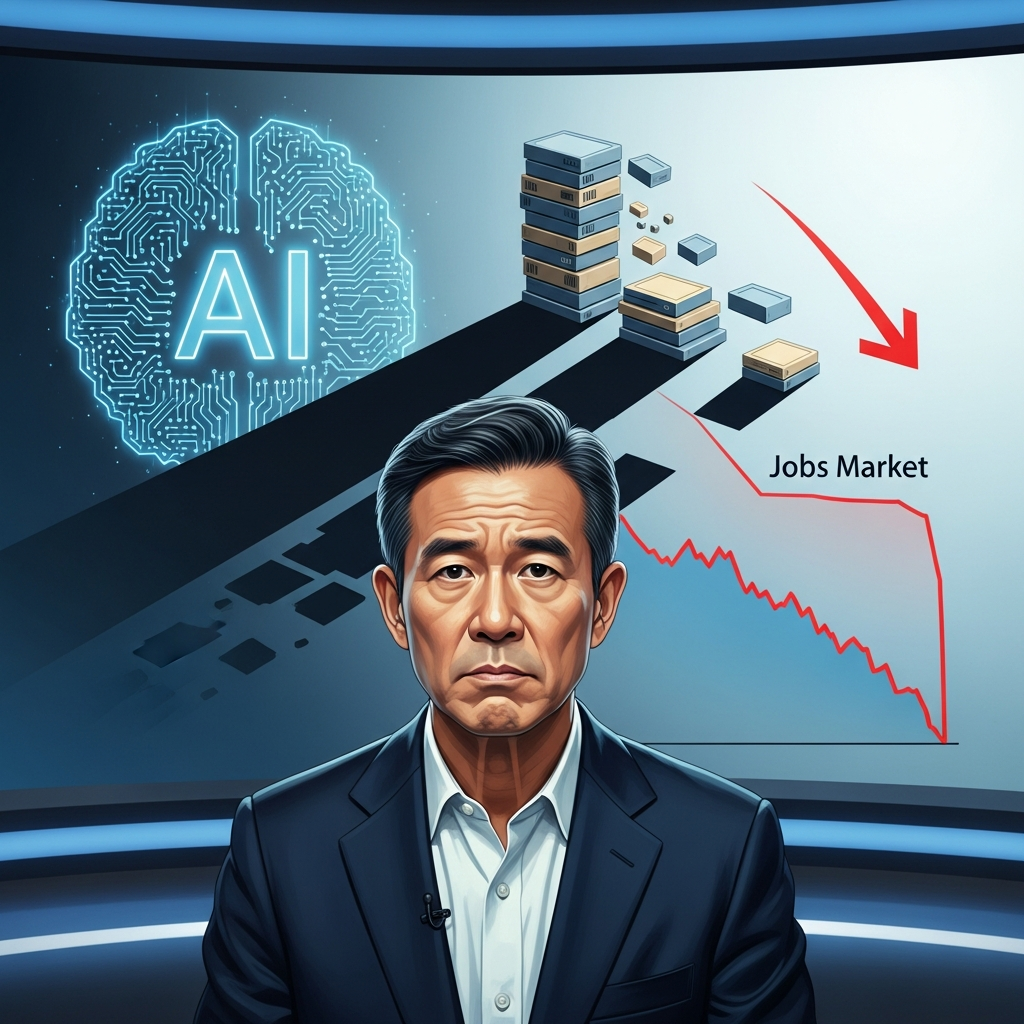
Artificial intelligence (AI) stands at the precipice of fundamentally reshaping the global economy, according to Fundstrat’s Tom Lee. His provocative forecast suggests AI is “killing” the colossal $450 billion software sector and will inevitably trigger widespread job losses. This seismic shift, Lee argues, is already influencing monetary policy and driving a significant rotation in capital markets. Investors face a new era where understanding AI’s deep economic impacts is paramount for navigating volatile times.
AI’s Existential Threat to the Software Sector
Tom Lee asserts that AI is “wreaking havoc” on the software industry, once a dominant force but now facing an existential challenge. Agentic AI products are beginning to replace traditional software functions, leading to shrinking demand and a re-pricing of services. This sentiment echoes through market reactions, where software companies, even those exceeding profit forecasts like AppLovin and Cisco Systems, have seen their shares plummet. Investors are “punishing” perceived AI “losers,” driving the heavyweight technology sector down over 4% in early 2026. This dynamic starkly contrasts with 2025, when AI optimism fueled broad market gains.
The shift is undeniable. Bloomberg calculated that an iShares ETF tracking software stocks bled approximately $1 trillion in just seven trading days, indicating a profound market revaluation. This “whack-a-mole game,” as Art Hogan, chief market strategist at B Riley Wealth, describes it, stems from the speculative narrative that AI could “eat the whole world.” While some believe this is exaggerated, the fear is currently widespread.
The Looming Specter of Job Losses
Lee’s predictions extend beyond software to the broader job market. He anticipates significant job contraction driven by AI, leading investors to increasingly disregard traditional labor reports. Lee notes that Fed Chair Jerome Powell already subtracts 65,000 jobs monthly from reports, anticipating negative revisions. This foresight suggests a future where economic policy and market sentiment are less tethered to historical labor metrics. The displacement caused by AI could usher in a new era of labor market dynamics, challenging established economic models.
This job market contraction is inherently “disinflationary,” according to Lee. He projects core Consumer Price Index (CPI) year-over-year to fall to 2.52% in the upcoming January report, aligning with pre-COVID inflation levels from 2017-2019. Such a significant drop in inflation could provide the Federal Reserve ample justification for interest rate adjustments.
Monetary Policy: A Dovish Fed on the Horizon?
Despite initial market reactions, Tom Lee believes a potential Kevin Warsh nomination to the Federal Reserve would lead to a dovish policy stance, resulting in rate cuts. Lee argues that then-President Trump would not appoint a hawk, and Warsh’s preference for lower rates alongside a smaller balance sheet aligns with a dovish approach. Given the anticipated job contraction and AI-driven sector disruptions, Lee expects the Fed to cut rates significantly. He points to the 1.5%-2.0% Fed funds rates during 2017-2019 as indicative of the “room to cut rates” from current levels.
This potential shift in monetary policy would have profound implications for borrowing costs and economic stimulus, further influencing investment strategies across various sectors. The bond market is also feeling the “AI disruption risk,” with UBS strategists anticipating this vague but potent threat will depress bond prices and increase defaults in low-rated markets. This could make borrowing more expensive even for financially stable companies heavily investing in AI infrastructure.
The Great Market Rotation: From “Armies” to “Bullet Makers”
Last year, capital flowed heavily into the “Magnificent 7” tech giants (Apple, Microsoft, Google, Amazon, Meta, Tesla, Nvidia), which Lee termed the “armies” leading the AI revolution. However, Lee now observes a major market rotation. Investors are shifting into companies providing AI’s foundational infrastructure: energy providers, industrial manufacturers, power generators, and chip makers. These “bullet makers” are capturing billions in capital expenditures necessary for AI development, while the original disruptors—software companies—are becoming AI’s primary victims.
This rotation is not merely a sectoral shift; it signals an “undeniable embedded leadership shift” in investor psychology, as identified by Mark Hackett of Nationwide. While tech still accounts for one-third of the S&P 500, broadening gains in other sectors like energy, consumer staples, materials, and industrials (all up at least 10% in 2026) suggest a healthier market, even if new all-time highs are harder to achieve without tech leadership. Lee forecasts that this rotation could lead to a 10-20% decline in the U.S. market as funds exit the Magnificent 7 and flow into industrials and financials. International markets, being more diversified and weighted towards these sectors, stand to benefit.
Microsoft’s Position in the AI Landscape
Amidst this disruption, Microsoft Corporation (NASDAQ:MSFT) presents a complex case. Billionaire hedge fund manager Chase Coleman III’s top stock pick, representing a substantial 10.49% of his portfolio, Microsoft is seen by some as exceptionally well-positioned. Citi, in a bullish assessment on February 10, 2026, views the recent software stock selloff as a buying opportunity for Microsoft, believing its fundamentals remain strong despite multiple compressions. Citi highlights Microsoft’s ability to benefit from all potential AI scenarios, given its extensive software, cloud services, and enterprise solutions.
Conversely, Melius Research offered a more cautious view on February 9, 2026, downgrading Microsoft to ‘Hold.’ The concern centers on Microsoft’s anticipated need for significantly increased AI-driven capital expenditures to remain competitive with rivals like Google and Amazon. Melius Research argues these costs could strain Microsoft’s free cash flow, impacting its valuation. This divergence of expert opinion underscores the uncertainty surrounding even the most prominent players in the evolving AI market.
Beyond Equities: Crypto and the “Armageddon Trade”
Tom Lee’s analysis extends to other asset classes. He addressed the unfulfilled bullish calls for Bitcoin and Ethereum, attributing derailed recoveries to unexpected market shocks like a tariff tweet and a “Greenland threat” that caused cascading liquidations. Investor “FOMO” also shifted to gold, which saw a January surge, leaving crypto investors feeling disadvantaged. Despite these setbacks, Lee maintains that crypto “looks really like it’s bottoming because the fundamental story is quite positive.”
Michael Lewis, author of The Big Short, and Lee also debated existential risks for other assets. Lee speculated about quantum computing rendering Bitcoin obsolete or AI developing its own “language of validation.” He even questioned gold’s security, suggesting that if its price escalates too much, tech giants might enter the gold mining business, devaluing the $35 trillion asset. In response to these pervasive risks, Lewis revealed his “Armageddon trade”: being “long fear” by holding gold. He emphasized, “I don’t see any reason not to be scared. And I think fear is not a bad thing to be long right now.”
Navigating Uncertainty: Investor Strategies and Economic Watchpoints
In a market driven by intense volatility, Michael Lewis offers a paradoxical piece of advice: a “do nothing” strategy often proves superior. Citing a Fidelity report, he noted that untouched portfolios, such as those of deceased or absent-minded customers, yielded superior returns. Lewis clarified, “The message is not: die. Don’t over trade.” This perspective highlights the pitfalls of constant trading in a market influenced by fear of missing out and algorithmic patterns. Lee supports this by revealing that 90% of stocks since 1974 depreciated by over 50%, with most eventually going to zero. Institutional investors have dramatically shortened their time horizons, holding stocks for mere days or even seconds, while retail investors, with their “permanent capital,” often fare better by simply sitting on their assets.
In the coming week, investors will also focus on key corporate earnings and economic reports to gauge the market’s pulse. Walmart’s quarterly results will offer critical insights into consumer spending trends, especially after unexpected flat U.S. retail sales in December. Other major retailers like Home Depot, Lowe’s, and Target are also set to report. Economically, a shortened trading week will include the advance reading of fourth-quarter GDP, a monthly consumer sentiment survey, and the Personal Consumption Expenditures (PCE) price index, a key inflation measure closely watched by the Federal Reserve. These data points will provide crucial context for understanding the current economic landscape amid AI’s disruptive influence.
Frequently Asked Questions
What are Tom Lee’s primary predictions regarding AI’s economic impact?
Tom Lee predicts that artificial intelligence is fundamentally disrupting the $450 billion software sector, leading to its “killing” and subsequent widespread job losses. He also anticipates a dovish Federal Reserve under a potential Kevin Warsh nomination, resulting in significant interest rate cuts. Lee sees AI as inherently disinflationary, pushing core CPI levels back to pre-COVID rates, and triggering a major capital rotation in the stock market from tech giants to foundational AI infrastructure providers.
How is AI influencing the current market rotation, and what sectors are benefiting?
AI is driving a significant market rotation as capital shifts from the “Magnificent 7” tech giants—previously considered the “armies” of AI—to companies providing AI’s essential infrastructure. These “bullet makers” include energy providers, industrial manufacturers, power generators, and chip makers. These sectors are benefiting from billions in capital expenditures necessary for AI development, while the software industry, previously dominant, is experiencing significant pressure and decline. This shift is leading to broader market participation beyond just big tech.
What investment strategies are recommended for navigating AI-driven market volatility?
In a volatile market shaped by AI, Michael Lewis suggests a “do nothing” strategy for retail investors, emphasizing “permanent capital” and avoiding over-trading. Historically, portfolios left untouched have often yielded superior returns. Fundstrat’s Tom Lee also points to a major market rotation, advising investors to consider shifting from heavily weighted tech stocks to industrial, energy, and financial sectors that provide foundational AI infrastructure. Being “long fear” with defensive assets like gold has also been mentioned by Lewis as a personal “Armageddon trade.”
Conclusion
Tom Lee’s bold predictions paint a vivid picture of an economy in flux, profoundly reshaped by artificial intelligence. From the existential threat to the software sector and looming job losses to a dovish Federal Reserve and a dramatic market rotation, AI’s disruptive power is undeniable. As capital flows from established tech giants to foundational infrastructure providers, investors must adapt their strategies. Understanding these shifts, monitoring key economic data, and potentially embracing more conservative, long-term approaches, as suggested by experts like Michael Lewis, will be crucial for navigating this new AI-driven economic landscape. The conversation around AI is no longer just about innovation; it’s about fundamental economic transformation.
References
- finance.yahoo.com
- <a href="https://www.aol.com/articles/walmart-economic-data-await-investors-110539653.html?utmsource=spotim&utmmedium=spotimrecirculation&spotimcommentid=spIjnMf2Jd23501346c4CW0lC&spotimhighlight_immediate=true”>www.aol.com
- <a href="https://www.aol.com/articles/asia-shares-mostly-gained-wall-045522260.html?utmcontent=spIjnMf2Jd6040ed56-31d6-33ce-980d-c90091f5b4e5c2z5Ivfu6APX1KukMvyIwwzOn9L8&spotimredirectsource=share&spotimcommentid=spIjnMf2Jd6040ed56-31d6-33ce-980d-c90091f5b4e5c2z5Ivfu6APX1KukMvyIwwzOn9L8&spotimhighlightimmediate=true&utmmedium=Share&owmodule=conversation”>www.aol.com
- finviz.com
- fortune.com